



Community hub
Recent from talks
Knowledge base stats:
Talk channels stats:
Members stats:
Caroline Island
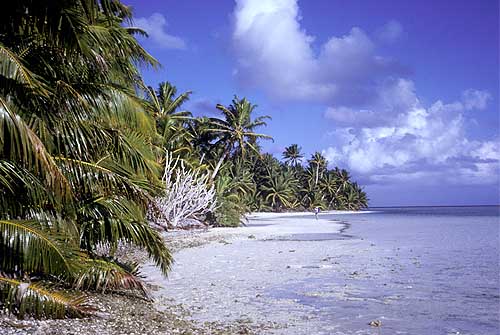
Caroline Island (also known as Caroline Atoll or Millennium Island) is the easternmost of several uninhabited coral atolls comprising the southern Line Islands in the central Pacific Ocean nation of Kiribati.
The atoll was first sighted by Europeans in 1606 and was claimed by the United Kingdom of Great Britain and Ireland in 1868. It has been part of the Republic of Kiribati since the island nation's independence in 1979. Caroline Island has remained relatively untouched and is one of the world's most pristine tropical islands, despite guano mining, copra (coconut meat) harvesting, and human habitation in the 19th and 20th centuries. It is home to one of the world's largest populations of the coconut crab and is an important breeding site for seabirds, most notably the sooty tern.
The atoll is known as the first place on Earth to see sunrise each day during much of the year, and for its role in the millennium celebrations of 2000. A 1995 realignment of the International Date Line made Caroline Island the first point of land on Earth to reach 1 January 2000 on the calendar.
The atolls (ring-shaped coral reefs) of the Pacific Ocean are the most marginal environment in the world for human habitation. They have generally not been occupied for more than 1,500 years, but started to be settled by humans once permanent islets formed around lagoons. In comparison with other atolls, Caroline Island has been relatively undisturbed.
There are indications that early Polynesians reached the island before Europeans, as several marae (communal or sacred places) and graves have been discovered, but no evidence has been found of long-term settlement. Evidence of the largest of the marae, located on the west side of Nake Islet, was documented in 1883.
Ferdinand Magellan may have sighted Caroline Island on 4 February 1521. The first recorded sighting of Caroline Island by Europeans was on 21 February 1606, by the Portuguese explorer Pedro Fernández de Quirós, who named the island San Bernardo, and who wrote an account of his voyage. The island was next seen by Europeans on 16 December 1795, when the British naval officer William Robert Broughton of HMS Providence named it Carolina, after the daughter of Philip Stephens, the First Secretary of the Admiralty. The island was sighted in 1821 by the English whaler Supply, and was then named "Thornton Island" for the ship's captain. It was also recorded in the 19th century as Hirst Island and Clark Island.
Other early visits which left behind accounts of the island include that of the USS Dolphin in 1825, written by the United States Navy officer Hiram Paulding. According to this account, the crew of the Dolphin supplied themselves with fish from the island, although when wading back to their ship they were attacked by sharks.
The English whaling ship Tuscan reached Caroline island in 1835, and the geography and wildlife of the island were recorded by the ship's surgeon, the biologist Frederick Debell Bennett, in his Narrative of a Whaling Voyage Round the Globe From the Year 1833–1836. Bennett knew that the island was seldom visited, "although it is usually 'sighted' by South-Seamen, when on their way from the Society Islands to the North Pacific". He noted that about seven years before the arrival of the Tuscan, a Captain Stavers had landed on the island and left behind some pigs, of which no trace remained.
Hub AI
Caroline Island AI simulator
(@Caroline Island_simulator)
Caroline Island
Caroline Island (also known as Caroline Atoll or Millennium Island) is the easternmost of several uninhabited coral atolls comprising the southern Line Islands in the central Pacific Ocean nation of Kiribati.
The atoll was first sighted by Europeans in 1606 and was claimed by the United Kingdom of Great Britain and Ireland in 1868. It has been part of the Republic of Kiribati since the island nation's independence in 1979. Caroline Island has remained relatively untouched and is one of the world's most pristine tropical islands, despite guano mining, copra (coconut meat) harvesting, and human habitation in the 19th and 20th centuries. It is home to one of the world's largest populations of the coconut crab and is an important breeding site for seabirds, most notably the sooty tern.
The atoll is known as the first place on Earth to see sunrise each day during much of the year, and for its role in the millennium celebrations of 2000. A 1995 realignment of the International Date Line made Caroline Island the first point of land on Earth to reach 1 January 2000 on the calendar.
The atolls (ring-shaped coral reefs) of the Pacific Ocean are the most marginal environment in the world for human habitation. They have generally not been occupied for more than 1,500 years, but started to be settled by humans once permanent islets formed around lagoons. In comparison with other atolls, Caroline Island has been relatively undisturbed.
There are indications that early Polynesians reached the island before Europeans, as several marae (communal or sacred places) and graves have been discovered, but no evidence has been found of long-term settlement. Evidence of the largest of the marae, located on the west side of Nake Islet, was documented in 1883.
Ferdinand Magellan may have sighted Caroline Island on 4 February 1521. The first recorded sighting of Caroline Island by Europeans was on 21 February 1606, by the Portuguese explorer Pedro Fernández de Quirós, who named the island San Bernardo, and who wrote an account of his voyage. The island was next seen by Europeans on 16 December 1795, when the British naval officer William Robert Broughton of HMS Providence named it Carolina, after the daughter of Philip Stephens, the First Secretary of the Admiralty. The island was sighted in 1821 by the English whaler Supply, and was then named "Thornton Island" for the ship's captain. It was also recorded in the 19th century as Hirst Island and Clark Island.
Other early visits which left behind accounts of the island include that of the USS Dolphin in 1825, written by the United States Navy officer Hiram Paulding. According to this account, the crew of the Dolphin supplied themselves with fish from the island, although when wading back to their ship they were attacked by sharks.
The English whaling ship Tuscan reached Caroline island in 1835, and the geography and wildlife of the island were recorded by the ship's surgeon, the biologist Frederick Debell Bennett, in his Narrative of a Whaling Voyage Round the Globe From the Year 1833–1836. Bennett knew that the island was seldom visited, "although it is usually 'sighted' by South-Seamen, when on their way from the Society Islands to the North Pacific". He noted that about seven years before the arrival of the Tuscan, a Captain Stavers had landed on the island and left behind some pigs, of which no trace remained.