



Community hub
Recent from talks
Knowledge base stats:
Talk channels stats:
Members stats:
Carpenter ant
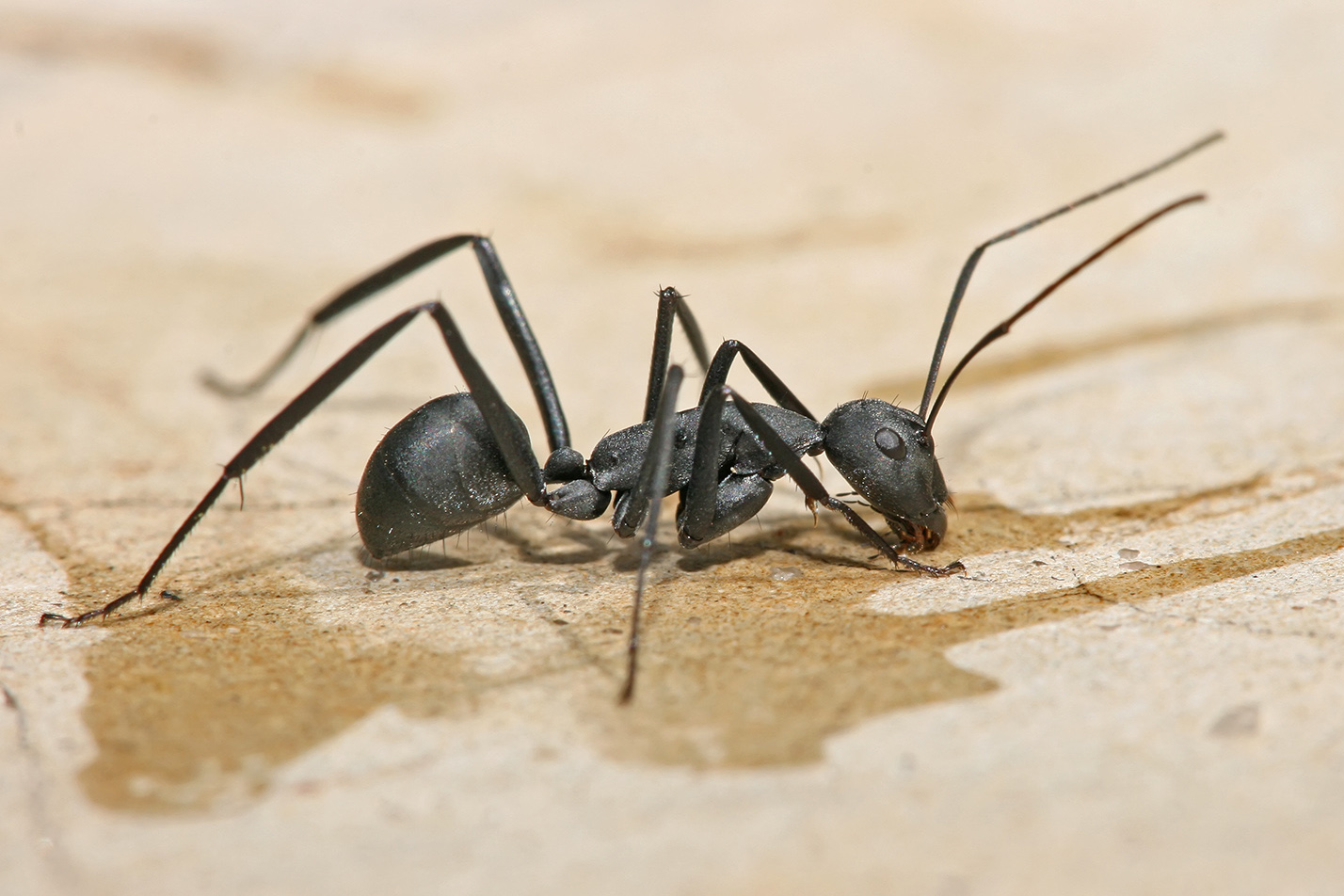
Carpenter ants (Camponotus spp.) are a genus of ants in the subfamily Formicinae found nearly worldwide except in Antarctica and a few islands. The genus is the most species-rich genus of ants in terms of described species, comprising over 1,500 described species as of 2025. Although they are commonly referred to as carpenter ants, only a few members, mostly in the subgenera Camponotus and Myrmentoma, nest in wood.
True carpenter ants build nests inside wood, consisting of galleries chewed out with their mandibles or jaws, preferably in dead, damp wood. However, unlike termites, they do not consume wood, but instead discard a material that resembles sawdust outside their nest. Sometimes, carpenter ants hollow out sections of trees. They also commonly infest wooden buildings and structures, causing a widespread problem: they are a major cause of structural damage. Nevertheless, their ability to excavate wood helps in forest decomposition. The genus includes over 1,000 species. They also farm aphids. In their farming, the ants protect the aphids from predators (usually other insects) while they excrete a sugary fluid called honeydew, which the ants get by stroking the aphids with their antennae.
Carpenter ants are generally large ants: workers are usually 4–7 mm long in small species and 7–13 mm in large species, queens are 9–20 mm long and males are 5–13 mm long. The bases of the antennae are separated from the clypeal border by a distance of at least the antennal scape's maximum diameter. The mesosoma in profile usually forms a continuous curve from the pronotum through to the propodeum.
For a period, Colobopsis (including the "exploding ants" in the Colobopsis cylindrica group) was considered a subgenus of Camponotus. A 2015 phylogenomic study found it to be the sister group to all the remaining Camponotini. Consequently, since 2016, Colobopsis has been treated as a separate genus again.
Carpenter ant species reside both outdoors and indoors in moist, decaying, or hollow wood, most commonly in forest environments. They cut "galleries" into the wood grain to provide passageways to allow for movement between different sections of the nest. Certain parts of a house, such as around and under windows, roof eaves, decks and porches, are more likely to be infested by carpenter ants because these areas are most vulnerable to moisture. Carpenter ants have been known to construct extensive underground tunneling systems. These systems often end at some food source – often aphid colonies, where the ants extract and feed on honeydew. These tunneling systems also often exist in trees. The colonies typically include a central "parent" colony surrounded and supplemented by smaller satellite colonies.
Carpenter ants are considered both predators and scavengers. These ants are foragers that typically eat parts of other dead insects or substances derived from other insects. Common foods for them include insect parts, "honeydew" produced by aphids, and extrafloral nectar from plants. They are also known for eating other sugary liquids such as honey, syrup, or juices and engaging in trophallaxis. Carpenter ants can increase the survivability of aphids when they tend them.
Most species of carpenter ants forage at night. When foraging, they usually collect and consume dead insects. Some species less commonly collect live insects. When they discover a dead insect, workers surround it and extract its body fluids to be carried back to the nest. The remaining chitin-based shell is left behind. Occasionally, the ants bring the chitinous head of the insect back to the nest, where they also extract its inner tissue. The ants can forage individually or in small or large groups, though they often opt to do so individually. Different colonies in close proximity may have overlapping foraging regions, although they typically do not assist each other in foraging. Their main food sources normally include proteins and carbohydrates. Instances of carpenter ants bleeding Chinese elm trees for the sap have been observed in northern Arizona. These instances may be rare, as the colonies vastly exceeded the typical size of carpenter ant colonies elsewhere. When workers find food sources, they communicate this information to the rest of the nest. They use biochemical pheromones to mark the shortest path that can be taken from the nest to the source. When a sizable number of workers follows this trail, the strength of the cue increases and a foraging trail is established. This ends when the food source is depleted. The workers will then feed the queen and the larvae by consuming the food they have found, and regurgitating the food at the nest. Foraging trails can be either under or above ground.
Although carpenter ants do not tend to be extremely aggressive, they have developed mechanisms to maximize what they take from a food source when that same food source is also visited by competing organisms. This is accomplished in different ways. Sometimes they colonize an area near a relatively static food supply. More often, they develop a systemic way to visit the food source, with alternating trips by different individual ants or groups. This allows them to decrease the gains of intruders because the intruders tend to visit in a scattered, random, and unorganized manner. The ants, however, visit the sources systematically so that they reduce the average crop remaining. They tend to visit more resource-dense food areas in an attempt to minimize resource availability for others. That is, the more systematic the foraging behavior of the ants, the more random that of its competitors.
Hub AI
Carpenter ant AI simulator
(@Carpenter ant_simulator)
Carpenter ant
Carpenter ants (Camponotus spp.) are a genus of ants in the subfamily Formicinae found nearly worldwide except in Antarctica and a few islands. The genus is the most species-rich genus of ants in terms of described species, comprising over 1,500 described species as of 2025. Although they are commonly referred to as carpenter ants, only a few members, mostly in the subgenera Camponotus and Myrmentoma, nest in wood.
True carpenter ants build nests inside wood, consisting of galleries chewed out with their mandibles or jaws, preferably in dead, damp wood. However, unlike termites, they do not consume wood, but instead discard a material that resembles sawdust outside their nest. Sometimes, carpenter ants hollow out sections of trees. They also commonly infest wooden buildings and structures, causing a widespread problem: they are a major cause of structural damage. Nevertheless, their ability to excavate wood helps in forest decomposition. The genus includes over 1,000 species. They also farm aphids. In their farming, the ants protect the aphids from predators (usually other insects) while they excrete a sugary fluid called honeydew, which the ants get by stroking the aphids with their antennae.
Carpenter ants are generally large ants: workers are usually 4–7 mm long in small species and 7–13 mm in large species, queens are 9–20 mm long and males are 5–13 mm long. The bases of the antennae are separated from the clypeal border by a distance of at least the antennal scape's maximum diameter. The mesosoma in profile usually forms a continuous curve from the pronotum through to the propodeum.
For a period, Colobopsis (including the "exploding ants" in the Colobopsis cylindrica group) was considered a subgenus of Camponotus. A 2015 phylogenomic study found it to be the sister group to all the remaining Camponotini. Consequently, since 2016, Colobopsis has been treated as a separate genus again.
Carpenter ant species reside both outdoors and indoors in moist, decaying, or hollow wood, most commonly in forest environments. They cut "galleries" into the wood grain to provide passageways to allow for movement between different sections of the nest. Certain parts of a house, such as around and under windows, roof eaves, decks and porches, are more likely to be infested by carpenter ants because these areas are most vulnerable to moisture. Carpenter ants have been known to construct extensive underground tunneling systems. These systems often end at some food source – often aphid colonies, where the ants extract and feed on honeydew. These tunneling systems also often exist in trees. The colonies typically include a central "parent" colony surrounded and supplemented by smaller satellite colonies.
Carpenter ants are considered both predators and scavengers. These ants are foragers that typically eat parts of other dead insects or substances derived from other insects. Common foods for them include insect parts, "honeydew" produced by aphids, and extrafloral nectar from plants. They are also known for eating other sugary liquids such as honey, syrup, or juices and engaging in trophallaxis. Carpenter ants can increase the survivability of aphids when they tend them.
Most species of carpenter ants forage at night. When foraging, they usually collect and consume dead insects. Some species less commonly collect live insects. When they discover a dead insect, workers surround it and extract its body fluids to be carried back to the nest. The remaining chitin-based shell is left behind. Occasionally, the ants bring the chitinous head of the insect back to the nest, where they also extract its inner tissue. The ants can forage individually or in small or large groups, though they often opt to do so individually. Different colonies in close proximity may have overlapping foraging regions, although they typically do not assist each other in foraging. Their main food sources normally include proteins and carbohydrates. Instances of carpenter ants bleeding Chinese elm trees for the sap have been observed in northern Arizona. These instances may be rare, as the colonies vastly exceeded the typical size of carpenter ant colonies elsewhere. When workers find food sources, they communicate this information to the rest of the nest. They use biochemical pheromones to mark the shortest path that can be taken from the nest to the source. When a sizable number of workers follows this trail, the strength of the cue increases and a foraging trail is established. This ends when the food source is depleted. The workers will then feed the queen and the larvae by consuming the food they have found, and regurgitating the food at the nest. Foraging trails can be either under or above ground.
Although carpenter ants do not tend to be extremely aggressive, they have developed mechanisms to maximize what they take from a food source when that same food source is also visited by competing organisms. This is accomplished in different ways. Sometimes they colonize an area near a relatively static food supply. More often, they develop a systemic way to visit the food source, with alternating trips by different individual ants or groups. This allows them to decrease the gains of intruders because the intruders tend to visit in a scattered, random, and unorganized manner. The ants, however, visit the sources systematically so that they reduce the average crop remaining. They tend to visit more resource-dense food areas in an attempt to minimize resource availability for others. That is, the more systematic the foraging behavior of the ants, the more random that of its competitors.