


Community hub
Recent from talks
Contribute something
Nothing was collected or created yet.
Prothorax
View on Wikipedia

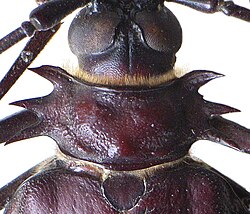
The prothorax is the foremost of the three segments in the thorax of an insect, and bears the first pair of legs. Its principal sclerites (exoskeletal plates) are the pronotum (dorsal), the prosternum (ventral), and the propleuron (lateral) on each side. The prothorax never bears wings in extant insects (except in some cases of atavism), though some fossil groups possessed wing-like projections.[1] All adult insects possess legs on the prothorax, though in a few groups (e.g., the butterfly family Nymphalidae) the forelegs are greatly reduced. In many groups of insects, the pronotum is reduced in size, but in a few it is hypertrophied, such as in all beetles (Coleoptera). In most treehoppers (family Membracidae, order Hemiptera), the pronotum is expanded into often fantastic shapes that enhance their camouflage or mimicry. Similarly, in the Tetrigidae, the pronotum is extended backward to cover the flight wings, supplanting the function of the tegmina.
See also
[edit]References
[edit]- ^ Medved, Victor; Marden, James; Fescemyer, Howard; Der, Joshua; Liu, Jin; Mahfooz, Najmus; Popadic, Aleksander (December 2015). "Origin and diversification of wings: Insights from a neopteran insect". Proceedings of the National Academy of Sciences of the United States of America. 112 (52): 15946–15951. Bibcode:2015PNAS..11215946M. doi:10.1073/pnas.1509517112. JSTOR 26466262. PMC 4702999. PMID 26668365. Retrieved 19 November 2020.
 | This insect anatomy–related article is a stub. You can help Wikipedia by expanding it. |
Prothorax
View on GrokipediaDefinition and Overview
Definition
The prothorax is the foremost of the three thoracic segments in the insect body, forming a key part of the tagma specialized for locomotion. It is positioned anteriorly, articulating with the head through the narrow cervical region and posteriorly with the mesothorax.[5] The term "prothorax" originates from New Latin, combining the Greek prefix "pro-" (meaning "before" or "foremost") with "thorax" (referring to the chest or breastplate). This nomenclature reflects its position as the leading thoracic division. First documented in entomological literature around 1826, it denotes the segment bearing the first pair of legs.[6] Structurally, the prothorax consists of sclerotized plates, or sclerites, that provide rigidity and support. Unlike the mesothorax and metathorax, it does not bear wings in extant insects, though evolutionary evidence suggests ancestral forms may have had prothoracic wing rudiments that regressed over time.[5] The recognition of the prothorax within the broader arthropod tagmosis— the functional grouping of body segments—traces to foundational 18th-century entomology, including Carl Linnaeus's classifications of insect orders based on body divisions like the thorax.[7]Position in the Insect Thorax
The prothorax occupies the anteriormost position within the insect thorax, serving as the first of three thoracic segments that collectively form the tagma responsible for locomotion and appendage attachment. It articulates directly with the head through the membranous cervix, a flexible neck region that permits a wide range of head movements essential for feeding, sensory perception, and orientation. This articulation typically involves cervical sclerites on either side of the membranous area, which connect to the occipital condyle of the head capsule and the prothoracic episternum, enabling limited but crucial mobility without rigid fusion. In many species, such as beetles in the genus Chrysolina, the cervical membrane lacks lateral sclerites, further enhancing flexibility as an adaptation to specific lifestyles.[8][9] The boundary between the prothorax and the succeeding mesothorax is primarily defined by flexible intersegmental membranes, which allow for segmental movement and accommodate the insect's overall body flexibility. These membranes separate the pronotum (dorsal plate of the prothorax) from the mesonotum and connect the prosternum to the mesosternum, often marked by sutures such as the promesonotal suture in ants and other Hymenoptera. In primitive insects like Neuroptera, this boundary features a large, conspicuous membrane, whereas in more derived forms such as Diptera, it is reduced to facilitate compact thoracic structure for flight. The prosternal and mesosternal sutures further delineate this division internally, supporting muscle attachments without impeding basic mobility.[10][11] In the context of thoracic tagmosis—the evolutionary fusion and functional specialization of segments—the prothorax generally retains a more distinct and mobile identity compared to the often-fused meso- and metathorax, which form the pterothorax in flying insects. This distinction allows the prothorax to function independently in supporting the forelegs and contributing to overall thoracic rigidity without compromising head-neck flexibility. For instance, in Odonata, the prothorax remains separate while the posterior segments fuse for enhanced flight stability, preserving prothoracic mobility for behaviors like perching. This relative autonomy underscores the prothorax's role in balancing the thorax's tagmatic integration with segmental versatility across insect lineages.[12] Size variability in the prothorax is pronounced and tied to ecological demands, often making it the smallest thoracic segment but subject to elongation or reduction based on lifestyle. In flying insects like Hymenoptera and Diptera, it is typically reduced to a narrow band to minimize weight and streamline the body for aerodynamics. Conversely, in ground-dwelling or predatory forms such as Mantodea, the prothorax is elongated to enhance head swivel for hunting, as seen in praying mantises where it facilitates approximately 180-degree rotation. In Coleoptera, it can be large and shield-like, protecting vital organs, while in Odonata it remains small yet distinct for agile maneuvers. These variations highlight adaptations where shorter prothoraces predominate in highly mobile, flight-oriented species.[10][12][13][14]Anatomical Structure
External Features
The external features of the prothorax consist primarily of hardened sclerites forming the exoskeleton, which provide structural support and attachment points for the first pair of legs. These sclerites include the dorsal pronotum, lateral propleuron on each side, and ventral prosternum, connected by sutures and flexible membranes that allow limited mobility while maintaining rigidity.[1] The pronotum is the prominent dorsal sclerite, often appearing as a shield-like plate that covers the top of the prothorax and may extend forward to overlap the posterior head margin. In many insects, it is a single undivided plate; its texture varies, being smooth and reduced in flies (Diptera) but sculptured or ornate in beetles (Coleoptera).[1][15] The propleuron forms the lateral sclerite on each side, bridging the pronotum and prosternum while articulating with the procoxae (bases of the forelegs). It is typically subdivided by the pleural suture into an anterior episternum and a posterior epimeron, which serve as attachment sites for muscles and the pleural ridge for reinforcement; in some orders like Coleoptera, this subdivision is more pronounced, enhancing lateral stability.[1][15] The prosternum is the ventral sclerite, positioned beneath the prothorax and directly supporting the procoxae through lateral extensions. It often features furcal pits near the midline for internal bracing and may include a prosternal process—a median projection extending posteriorly between the procoxae—in groups such as Coleoptera and Orthoptera, which aids in stabilizing the segment during movement. A sternacostal suture may divide the prosternum into basisternum and heisternum parts in certain taxa.[1] Sutures delineate the sclerite boundaries and indicate internal apodemes for strength: the pleurosternal suture separates the propleuron from the prosternum, facilitating independent movement, while the intersegmental membrane posteriorly connects the prothorax to the mesothorax, allowing flexibility between thoracic segments.[1][11] The first thoracic spiracle, essential for gas exchange, is located on the propleuron, typically in the episternal region near the pleural suture, opening laterally to connect with the tracheal system.[15][16]Internal Features
The internal anatomy of the prothorax in insects encompasses a network of muscles, neural elements, respiratory structures, endoskeletal supports, and circulatory spaces that provide structural integrity and facilitate physiological processes. The musculature includes longitudinal muscles that run parallel to the body axis and vertical muscles that span dorsoventrally, both primarily attached to the inner surfaces of the prothoracic sclerites to enable movement of the forelegs. These muscles, such as the dorsal longitudinal prothoracic muscles and the vertical tergo-sternal muscles observed in species like the cockroach Periplaneta americana, contract to flex and extend the prothoracic segment, supporting leg articulation without direct involvement in flight. Additionally, dilator muscles associated with the first thoracic spiracle open this respiratory valve to regulate air intake, as seen in primitive moths like Micropterix calthella where extrinsic ventral dilators assist in spiracle expansion.[17][18][19] The nervous and respiratory systems are integral to prothoracic function. The prothoracic ganglion, a key component of the ventral nerve cord, processes sensory input and coordinates motor outputs for the forelegs and anterior body, enveloped by glial cells that insulate neurons in species such as the stick insect Carausius morosus. Tracheal branches originate from the first spiracle and extend into the prothorax, supplying oxygen directly to the leg muscles and adjacent tissues via fine tracheoles that penetrate muscle fibers and connectives. In stick insects, for instance, two distinct tracheae enter the prothoracic leg from separate prothoracic trunks, ensuring efficient gas exchange during locomotion.[20][21][22] The endoskeleton consists of apodemes, which are invaginations of the exoskeleton serving as attachment points for muscles. In the prothorax, prominent apodemes project inward from the prosternum (ventral plate) and propleuron (lateral plate), forming a supportive framework that anchors the longitudinal and vertical muscles, as detailed in comparative studies of insect thoracic architecture. These structures enhance mechanical leverage for leg movement without adding external bulk. The prothoracic hemocoel, an open body cavity filled with hemolymph, allows nutrient and waste circulation, compartmentalized by dorsal and ventral diaphragms that partially separate it from the meso- and metathoracic hemocoels to direct flow via alary muscles. This arrangement maintains hydraulic pressure gradients essential for tissue perfusion.[23][24][25][26] In orthopterans like grasshoppers and crickets, the prothoracic muscles exhibit adaptations for stability during jumping, with robust longitudinal and vertical fibers linking to the robust endoskeleton to counteract recoil from powerful hindleg thrusts in the metathorax, as evidenced in morphological comparisons across 23 species.[27]Functions
Locomotion and Support
The procoxae, the basal segments of the forelegs, articulate directly with the propleuron and prosternum of the prothorax, forming a pivotal joint that enables multi-directional flexion essential for various locomotor activities such as walking, grasping, and digging.[28][29] This articulation often involves a cup-like depression on the propleuron for pivoting and connections to the prosternum via intercoxal processes, providing both stability and flexibility in foreleg positioning.[30] In many insects, the coxa also links to a trochantin anteriorly, enhancing the range of motion while the pleural wall supports the coxa dorsally, anteriorly, and posteriorly.[28] Prothoracic muscles, primarily extrinsic types originating from the tergum, sternum, and pleuron, contract to drive foreleg movements, allowing independent action or synchronization with the meso- and metathoracic legs for coordinated locomotion.[28] Key muscles include tergal and sternal promotors and remotors, which insert on the anterior and posterior margins of the procoxa to protract and retract the leg, respectively, while pleurocoxal muscles facilitate abduction and adduction via the pleural fulcrum.[28] These antagonistic muscle pairs, innervated by thoracic ganglia, ensure precise control and integration with central pattern generators for rhythmic stepping patterns across segments.[28][29] In cursorial insects such as cockroaches, the prothorax serves as a stable biomechanical base for rapid strides, with the trochanter-femur joint connections enabling efficient force transmission during the tripod gait, where forelegs alternate with middle and hind legs for propulsion and stability.[31][29] For instance, in ants, the prothoracic legs are specialized for carrying loads, featuring robust coxae and strong extensor muscles that support weight-bearing during foraging.[29] Similarly, in burrowing beetles, the prothorax provides robust support through reinforced procoxal articulations, allowing powerful digging motions via enlarged femurs and trochanters adapted for soil penetration.[29] The mobility of the prothorax contributes to energy efficiency in forward locomotion by enabling foreleg positioning that minimizes aerodynamic drag and optimizes stride mechanics.[31]Protection and Sensory Roles
The pronotum, as the dorsal sclerite of the prothorax, functions as a hardened shield that protects underlying vital organs and tissues from predators and environmental hazards in many insects. This sclerotized structure provides a physical barrier, enhancing overall exoskeleton defense by resisting penetration and impact.[32] In ground beetles of the family Carabidae, the particularly robust and hardened pronotum contributes to impact resistance, allowing these predatory insects to withstand attacks while foraging on the ground.[33] Beyond structural defense, the prothorax plays a key role in camouflage and mimicry through modifications to the pronotum. In treehoppers (Membracidae), the pronotum is often greatly expanded into elaborate shapes and textures that resemble thorns, bark, or other plant features, deterring herbivores and predators by blending seamlessly with host vegetation.[34] This adaptation not only conceals the insect but also mimics inedible or harmful plant parts, reducing predation risk during feeding on sap.[35] Sensory functions of the prothorax involve mechanoreceptive setae distributed across its surface, which detect substrate vibrations and air currents to alert the insect to nearby threats or environmental changes.[36] These prothoracic sensory inputs are processed by the thoracic nervous system, enabling rapid reflexes that coordinate defensive postures or evasion maneuvers in response to stimuli.[37] Additionally, in certain hemipterans such as triatomine bugs, the prothorax contains specialized glands like Brindley's glands that secrete defensive compounds, including alarm pheromones that signal danger to conspecifics and repel attackers.[38] Although effective, prothoracic mechanoreceptors are generally less specialized than antennal sensilla for fine-scale detection, serving primarily as supplementary inputs that enhance head-centered sensory processing without the antennal array's versatility in chemosensation and precise mechanodetection.[39]Variations and Comparisons
Across Insect Orders
The prothorax exhibits significant morphological diversity across insect orders, reflecting adaptations to locomotion, protection, and sensory functions. In Coleoptera (beetles), the prothorax is prominently developed, with a large pronotum that often serves as the broadest segment of the thorax and articulates closely with the base of the elytra for enhanced armored protection against predators.[40] This robust structure supports the beetle's terrestrial lifestyle, where the pronotum can extend laterally or posteriorly to shield vital areas.[41] In contrast, the prothorax is notably reduced in Lepidoptera (butterflies and moths), featuring a small pronotum often obscured by patagia, paired articulated plates at its anterior edge.[42] This miniaturization accommodates the order's emphasis on flight, with the forelegs occasionally becoming vestigial, as seen in brush-footed butterflies (Nymphalidae), where they form non-functional brushes rather than ambulatory structures.[43] Similarly, in Diptera (flies), the prothorax is compact and minimally pronounced, fused with the meso- and metathorax to form a streamlined pterothorax that facilitates rapid flight maneuvers and coordination with halteres on the metathorax.[44] Orthoptera (grasshoppers and crickets) display an elongated prothorax, characterized by a prominent, shield-like pronotum that enhances neck flexibility for head movement and a reinforced prosternum providing leverage for the powerful jumping mechanism powered by hind legs.[45] In Hymenoptera (bees, wasps, and ants), the prothorax remains short yet muscular, optimized to support specialized forelegs; for instance, in bees (Apoidea), it bolsters the pollen-carrying and grooming functions of the forelegs through attached musculature.[46] Overall, a key trend emerges wherein prothorax reduction predominates in flight-dominant orders like Diptera, Lepidoptera, and Hymenoptera to minimize drag and prioritize posterior thoracic expansion for wings, whereas expansion occurs in more ground-oriented orders such as Coleoptera and Orthoptera for structural reinforcement.[47]Differences from Meso- and Metathorax
The prothorax differs from the mesothorax and metathorax primarily in its lack of wings, with the mesothorax bearing the forewings and the metathorax the hindwings in winged insects, while the prothorax remains wingless to facilitate its role in head mobility and foreleg function.[1][2] In terms of mobility, the prothorax exhibits greater independent movement due to its direct attachment to the flexible cervical region, allowing enhanced head-neck articulation, whereas the mesothorax and metathorax are often fused into a rigid pterothorax to provide stability for flight musculature and wing operation.[48] This fusion in the posterior segments contrasts with the prothorax's relative isolation, which supports adaptive neck postures in species like snakeflies (Raphidioptera).[48] Leg specialization further distinguishes the segments: the prothoracic forelegs frequently adapt for sensory or manipulative roles, such as raptorial grasping in mantids, while mesothoracic legs emphasize propulsion during locomotion and metathoracic legs contribute to stability or power, as in saltatorial jumping with elongated hind femora and tibiae.[2] Biomechanical analyses in stick insects reveal that foreleg propulsion relies on femur-tibia joint torques for forward thrust and height control, differing from the coxa-trochanter torques dominant in middle and hind legs for weight support and overall propulsion.[49] Regarding size and sclerotization, the prothorax is typically smaller and less robustly sclerotized than the enlarged mesothorax, which accommodates expansive flight muscles, or the variably reduced metathorax; the prothorax features a unique pronotum as its prominent dorsal sclerite, without direct equivalents in the mesonotum or metanotum of the posterior segments.[1][48] This lighter sclerotization in the prothorax prioritizes flexibility over the reinforced structure needed for wing-powered locomotion in the meso- and metathorax.[48] Functionally, the prothorax prioritizes linkage between the head and body while enabling precise forelimb actions for exploration or capture, in contrast to the meso- and metathorax, which integrate flight dynamics and hindlimb power generation for sustained propulsion and aerial maneuverability.[48] For instance, in Drosophila, the prothorax supports the prothoracic gland for hormonal regulation, underscoring its non-flight-oriented role compared to the pterothoracic emphasis on aerodynamic efficiency.[48]Development and Evolution
Ontogeny
In insect embryogenesis, the prothorax arises as the first thoracic segment (T1) following the gnathal segments along the ventral germ band, which forms through the migration and proliferation of ectodermal and mesodermal cells during gastrulation.[50] This segment differentiates early in the process of germ band extension, where the ectoderm subdivides into repeating parasegmental units that establish the anterior-posterior patterning of the thorax. The sclerites of the prothorax, including the pronotum and pleurites, emerge from the ectodermal layer via localized thickenings and invaginations that form the foundational cuticle, with subsequent sclerotization occurring prior to the embryo's first ecdysial event, or hatching.[50] In holometabolous insects, the prothoracic segment becomes prominent during early larval instars, where it supports the first pair of true thoracic legs essential for locomotion.[51] These structures develop through successive molts, allowing the segment to expand in size while maintaining its positional identity relative to the meso- and metathorax. The prothoracic glands, located in the prothorax, secrete ecdysone, which orchestrates these molts by inducing apolysis—the separation of the old cuticle—and promoting the synthesis of a new, larger prothoracic cuticle to accommodate growth.[52] During the pupal stage of complete metamorphosis, the larval prothorax undergoes profound restructuring as the adult form emerges from imaginal tissues. Specifically, the leg imaginal discs associated with the prothoracic segment evaginate through a coordinated process involving actomyosin contractility and hormonal signaling, extending outward to form the elongated adult prothoracic legs while the surrounding sclerites remodel to achieve their definitive shape.[53] This transformation integrates the eversion of disc epithelia with histolysis of larval tissues, ensuring the prothorax transitions from a feeding-oriented larval appendage bearer to a supportive structure in the adult.[53] A well-studied example of prothorax ontogeny occurs in Drosophila melanogaster, where segment-polarity genes like engrailed are expressed in the posterior compartment of the prothoracic primordium during late embryogenesis, precisely delineating boundaries between the prothorax and adjacent segments to prevent fusion and ensure proper sclerite patterning.[54] Mutations in engrailed disrupt these boundaries, leading to malformed thoracic segments, underscoring its conserved role in arthropod development.[54]Phylogenetic Aspects
The prothorax in insects is homologous to the anterior thoracic segments observed in other arthropod groups, such as the maxilliped-bearing segments in crustaceans and the anterior trunk segments in myriapods, reflecting a shared evolutionary origin within the Mandibulata clade.[55] This homology underscores the conservation of segmental patterning across arthropods, where the prothorax represents the first of three locomotor-specialized segments derived from a pre-existing embryonic field in the common ancestor.[56] The prothorax itself emerged approximately 400 million years ago during the Devonian period, coinciding with the diversification of early hexapods from arthropod lineages, as evidenced by fossils like Strudiella, which preserve a differentiated thorax with three segments indicative of early insectimorphs.[57] Tagmosis, the evolutionary fusion and specialization of segments into functional units, transformed the ancestral arthropod thorax from a uniformly segmented region into the tripartite insect thorax, with the prothorax becoming distinctly specialized for enhanced head mobility in the winged Pterygota subclade.[58] In this process, the prothorax retained its role as a flexible connector to the head via the membranous cervix, while the meso- and metathorax integrated wing-bearing appendages for flight; the absence of wings on the prothorax became fixed in pterygote insects, stabilizing the tagmosis pattern after the Carboniferous diversification of pterygote lineages.[56] Fossil records further illustrate this, with Devonian insectimorphs showing preserved, undifferentiated thoracic regions in early hexapod-like arthropods, and Carboniferous beetles exhibiting early pronotal expansions that foreshadowed defensive sclerotization.[57] Adaptive radiations highlight the prothorax's role in insect diversification, particularly through hypertrophy in Coleoptera, where an enlarged, shield-like pronotum evolved for physical defense and protection of the head, correlating with the order's explosive Mesozoic radiation amid angiosperm expansion and ecological opportunities.[59] Conversely, in Endopterygota (holometabolous insects), reductions in prothoracic size and sclerotization enhanced flight efficiency by minimizing anterior weight and improving thoracic flexibility, as seen in the streamlined forms of Diptera and Hymenoptera during their Cretaceous-Cenozoic proliferations.[10] Comparative phylogenetic analyses reveal that in apterygotes, such as silverfish (Zygentoma), the prothorax remains more similar to the meso- and metathorax in structure and mobility—featuring a short, membranous-separated segment without pronounced specialization—representing the primitive condition prior to pterygote tagmosis.[47][58]References
- https://www.antwiki.org/wiki/Morphological_Terms