



Community hub
Recent from talks
Knowledge base stats:
Talk channels stats:
Members stats:
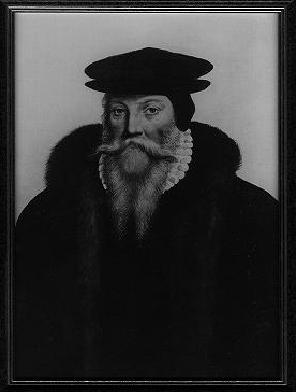
Caspar Peucer
Caspar Peucer (/ˈpɔɪkər/ POY-kər,[citation needed] German: [ˈkaspaʁ ˈpɔʏtsɐ]; January 6, 1525 – September 25, 1602) was a German reformer, physician, and scholar of Sorbian origin.
Caspar Peucer was born on January 6, 1525, in Bautzen, (Sachsen, Germany) and died on September 25, 1602, in Dessau, (Sachsen-Anhalt, Germany). He was the child of Gregor Peucer, a known craftsman, and Ottilie Simon. Peucer's father, Gregor, was trusted with certain tasks from the Bautzen elite regarding the city quarters between the town council and burghers. The Bautzen elite was an interconnected family with relational ties, this indicates that Peucer himself was also related to Gregorius Mattig, who was a highly respected humanist and intellectual during this time. Mattig himself, was a director of Upper Lusatia representing the Estate town during their uprising in the early 15th century. Peucer's education began in his hometown of Sachsen where he began studying at a local Protestant grammar school. This education system was excelling under the Joachim Knemiander administration, originating from the Upper Lusatian town which, is now present day Poland.
After some time Peucer was later sent to a Latin school (named 'Trotzendorf') of Valentin Friedland. It was here he learned more regarding the new and developing Lutheran education, here he met other students who were interested in the same ideologies. Not too long after Peucer was at Trotzendorf, he was recommended to attend the University of Saxon Wittenberg. Wittenberg was a university where many Lutherans enrolled, this was also the place that the main disputes of the Reformation occurred. Then, Peucer enrolled in the University of Wittenberg in March 1543, after he finished his undergraduate he went on to graduate with his masters in September 1545. After graduation Peucer quickly became a professor at the University of Wittenberg, replacing Erasmus Reinhold following his death in 1553. Peucer began as a lower math professor in 1550 then, worked his way up to higher mathematics in 1554. While working as a professor at Wittenberg, Peucer taught alongside notable other mathematicians of the time and graduates of Wittenberg such as Erasmus Reinhold and Michael Maestlin. In his time at Wittenberg, Peucer was also one of the main promoters, along with Philipp Melanchthon, of the astrological department/program. After, he accepted the name of the rector of the Leucorea. In this time he continued going to school to ultimately gain his title as a doctor of medicine in 1560. It was during this time that Peucer began thinking more critically about his astrology views. He believed astrology was not only a practical art but an essential part of natural philosophy. The idea is that astrology fits perfectly into the teleological worldview in which it shows the critical work of God's creation, the stars being a secondary asset. After his research and schooling he later graduated with his master's degree. Peucer went on to marry his first wife, Magdalena, daughter of theologian and humanist Philipp Melanchthon. During their marriage she gave birth to three sons and seven daughters, she later died in 1575.
Around 1570, Peucer became the doctor to the Elector of Saxony, Augusts, who was a significant figure during the time of the Schmalkaldic war. In the position he became one of August's trusted advisors and acted as the head of the Philipistic. The main goal was to gain followers of the Lutheran church, this quickly created some suspicion that there was a connection with Peucer and Calvinism. Created by John Calvin, a Protestant reformer, Calvinism was an immediately popular religion that quickly spread throughout Europe. It came at the perfect time when religion began expanding, and freedom of searching religion was brought forth. Calvinism was thought to be against the views of astrology; as Peucer was thinking more critically about astrology fitting into a teleological world, this was a stepping stone indicating his views were differing from society. Peucer was soon accused of a Calvinism plot and was captured on April 1, 1574, in Wittenberg; it was there that Peucer's works were searched, and he had to explain his religious and political ties in front of the Dresden Consistory. His accusation stems from his interpretation of the Lord's Supper because strict Lutherans believe that Christ was in the Eucharist. It was the Consistory that charged Peucer with Calvinism and suspected he tried to expand his teaching to Saxony. He pleaded not guilty but, after countless trials, he was found guilty from his own personal writings. This was the start of Peucer's twelve years in prison, it began in the Rochlitz castle, where Magdalena could stay with him. But, later he was moved to Leipzig, where he stayed for the rest of his sentence. At this point, he was unable to teach math, astronomy, or medicine. So, Peucer turned towards writing poetry. It was here that wrote his poem, Idyllium, and his longest poem reflecting on his birthplace in Upper Lusatia. During this time he was waiting for his family to bring forth a petition to get him out of his sentence early, which was granted in 1586. After his release he became the personal doctor to Anhalt princess in Desseau, he died in the capitol on September 25, 1602.
While not as well known as Tycho Brahe, Peucer worked with Brahe in a few instances, including intervening by letter on Brahe's behalf in a dispute between the latter and Christoph Rothman surrounding his invention of the Tychonic system.
Caspar Peucer was a practicing Protestant who believed in Divine Providence, this just meant that God is able to and does intervene with nature. The Protestant astrologers of the time held the belief that before the original sin, nature did not deviate from its expected laws. But then after the Fall, God and the devil began to send supernatural messages through nature. This could be seen through medical diagnoses, astrological horoscopes, and meteorology, according to Peucer. As a Christian, Peucer believed in divine intervention, be it by God or the Devil. The ideas of what was considered official divination seemed to differ in opinion from person to person. Peucer upheld that God was the only divine entity with the capability of changing the course or essence of nature. Caspar Peucer extensively recorded how the constellations and meteorological events were signs or warnings of historical events that occurred near the time of the astronomical events.
Divine providence in astrology was in opposition to what many of the Catholics and Orthodox Lutherans believed. They would say that pairing natural signs with historical events or future events does not work with the belief that God gave humankind freewill. The accepted view for science and philosophy was to follow an Aristotilian approach, which includes using empirical evidence and reason to come to conclusions. That is definitely the standard goal for philosophers when coming up with any theories or ideas. Peucer tried to link his ideas of astrology with a strong Aristotelian argument through one of his writings, but it does not seem like he ever really convinced the Catholics of his ideas, and others abandoned the ideas of horoscopes as a science fairly quickly after the height of its popularity. Additionally, Peucer believed in both angels and demons which can be found in some of his astrological ideology. Specifically, Peucer thought that both of these entities could affect and even explain some serious astrological phenomena such as comets in the atmosphere to produce many particular effects that he had no other explanation for. That being said, in his texts, Peucer believed that these event could somewhat predict the future as they were signs that appeared not only to our world, but also the sublunar world. He justified this on the basis that, there would be no point in astrological signs appearing from unknown sources if they did not mean anything.
Peucer's thinking about meteorology was that it had two purposes: a natural one and a divine one. He believed that the energy from the weather caused an effect on human behavior, which he called the "natural efficient cause". He believed that the divine cause, which he called the "final cause" gave warnings or signs. This can be seen in his belief of angels and demons as Peucer thought that these entities, for reasons both good and bad, could be the source of some phenomena such earthquakes. From this, they were able to draw a lot of knowledge about God that corresponds to Protestantism. Ideas such as how God is transcendent and cares enough to intervene in nature. The religious perspective through which meteorology and astrology was looked at was important in gaining acceptance and support for the ideas. There were different levels that meteors were classified by. Because of Peucer's belief that only God can actually go against nature, lesser powers, like the devil, were able to cause rare meteorological events. But, Peucer also recognized that it can be rather unclear to recognize in nature who is causing rare meteorological events as it could be God, the devil, angels, demons, or even just natural causes. It could These rare events were not technically against nature; they held more meaning than everyday normal weather, but were not placed on the same level as miracles.
Hub AI
Caspar Peucer AI simulator
(@Caspar Peucer_simulator)
Caspar Peucer
Caspar Peucer (/ˈpɔɪkər/ POY-kər,[citation needed] German: [ˈkaspaʁ ˈpɔʏtsɐ]; January 6, 1525 – September 25, 1602) was a German reformer, physician, and scholar of Sorbian origin.
Caspar Peucer was born on January 6, 1525, in Bautzen, (Sachsen, Germany) and died on September 25, 1602, in Dessau, (Sachsen-Anhalt, Germany). He was the child of Gregor Peucer, a known craftsman, and Ottilie Simon. Peucer's father, Gregor, was trusted with certain tasks from the Bautzen elite regarding the city quarters between the town council and burghers. The Bautzen elite was an interconnected family with relational ties, this indicates that Peucer himself was also related to Gregorius Mattig, who was a highly respected humanist and intellectual during this time. Mattig himself, was a director of Upper Lusatia representing the Estate town during their uprising in the early 15th century. Peucer's education began in his hometown of Sachsen where he began studying at a local Protestant grammar school. This education system was excelling under the Joachim Knemiander administration, originating from the Upper Lusatian town which, is now present day Poland.
After some time Peucer was later sent to a Latin school (named 'Trotzendorf') of Valentin Friedland. It was here he learned more regarding the new and developing Lutheran education, here he met other students who were interested in the same ideologies. Not too long after Peucer was at Trotzendorf, he was recommended to attend the University of Saxon Wittenberg. Wittenberg was a university where many Lutherans enrolled, this was also the place that the main disputes of the Reformation occurred. Then, Peucer enrolled in the University of Wittenberg in March 1543, after he finished his undergraduate he went on to graduate with his masters in September 1545. After graduation Peucer quickly became a professor at the University of Wittenberg, replacing Erasmus Reinhold following his death in 1553. Peucer began as a lower math professor in 1550 then, worked his way up to higher mathematics in 1554. While working as a professor at Wittenberg, Peucer taught alongside notable other mathematicians of the time and graduates of Wittenberg such as Erasmus Reinhold and Michael Maestlin. In his time at Wittenberg, Peucer was also one of the main promoters, along with Philipp Melanchthon, of the astrological department/program. After, he accepted the name of the rector of the Leucorea. In this time he continued going to school to ultimately gain his title as a doctor of medicine in 1560. It was during this time that Peucer began thinking more critically about his astrology views. He believed astrology was not only a practical art but an essential part of natural philosophy. The idea is that astrology fits perfectly into the teleological worldview in which it shows the critical work of God's creation, the stars being a secondary asset. After his research and schooling he later graduated with his master's degree. Peucer went on to marry his first wife, Magdalena, daughter of theologian and humanist Philipp Melanchthon. During their marriage she gave birth to three sons and seven daughters, she later died in 1575.
Around 1570, Peucer became the doctor to the Elector of Saxony, Augusts, who was a significant figure during the time of the Schmalkaldic war. In the position he became one of August's trusted advisors and acted as the head of the Philipistic. The main goal was to gain followers of the Lutheran church, this quickly created some suspicion that there was a connection with Peucer and Calvinism. Created by John Calvin, a Protestant reformer, Calvinism was an immediately popular religion that quickly spread throughout Europe. It came at the perfect time when religion began expanding, and freedom of searching religion was brought forth. Calvinism was thought to be against the views of astrology; as Peucer was thinking more critically about astrology fitting into a teleological world, this was a stepping stone indicating his views were differing from society. Peucer was soon accused of a Calvinism plot and was captured on April 1, 1574, in Wittenberg; it was there that Peucer's works were searched, and he had to explain his religious and political ties in front of the Dresden Consistory. His accusation stems from his interpretation of the Lord's Supper because strict Lutherans believe that Christ was in the Eucharist. It was the Consistory that charged Peucer with Calvinism and suspected he tried to expand his teaching to Saxony. He pleaded not guilty but, after countless trials, he was found guilty from his own personal writings. This was the start of Peucer's twelve years in prison, it began in the Rochlitz castle, where Magdalena could stay with him. But, later he was moved to Leipzig, where he stayed for the rest of his sentence. At this point, he was unable to teach math, astronomy, or medicine. So, Peucer turned towards writing poetry. It was here that wrote his poem, Idyllium, and his longest poem reflecting on his birthplace in Upper Lusatia. During this time he was waiting for his family to bring forth a petition to get him out of his sentence early, which was granted in 1586. After his release he became the personal doctor to Anhalt princess in Desseau, he died in the capitol on September 25, 1602.
While not as well known as Tycho Brahe, Peucer worked with Brahe in a few instances, including intervening by letter on Brahe's behalf in a dispute between the latter and Christoph Rothman surrounding his invention of the Tychonic system.
Caspar Peucer was a practicing Protestant who believed in Divine Providence, this just meant that God is able to and does intervene with nature. The Protestant astrologers of the time held the belief that before the original sin, nature did not deviate from its expected laws. But then after the Fall, God and the devil began to send supernatural messages through nature. This could be seen through medical diagnoses, astrological horoscopes, and meteorology, according to Peucer. As a Christian, Peucer believed in divine intervention, be it by God or the Devil. The ideas of what was considered official divination seemed to differ in opinion from person to person. Peucer upheld that God was the only divine entity with the capability of changing the course or essence of nature. Caspar Peucer extensively recorded how the constellations and meteorological events were signs or warnings of historical events that occurred near the time of the astronomical events.
Divine providence in astrology was in opposition to what many of the Catholics and Orthodox Lutherans believed. They would say that pairing natural signs with historical events or future events does not work with the belief that God gave humankind freewill. The accepted view for science and philosophy was to follow an Aristotilian approach, which includes using empirical evidence and reason to come to conclusions. That is definitely the standard goal for philosophers when coming up with any theories or ideas. Peucer tried to link his ideas of astrology with a strong Aristotelian argument through one of his writings, but it does not seem like he ever really convinced the Catholics of his ideas, and others abandoned the ideas of horoscopes as a science fairly quickly after the height of its popularity. Additionally, Peucer believed in both angels and demons which can be found in some of his astrological ideology. Specifically, Peucer thought that both of these entities could affect and even explain some serious astrological phenomena such as comets in the atmosphere to produce many particular effects that he had no other explanation for. That being said, in his texts, Peucer believed that these event could somewhat predict the future as they were signs that appeared not only to our world, but also the sublunar world. He justified this on the basis that, there would be no point in astrological signs appearing from unknown sources if they did not mean anything.
Peucer's thinking about meteorology was that it had two purposes: a natural one and a divine one. He believed that the energy from the weather caused an effect on human behavior, which he called the "natural efficient cause". He believed that the divine cause, which he called the "final cause" gave warnings or signs. This can be seen in his belief of angels and demons as Peucer thought that these entities, for reasons both good and bad, could be the source of some phenomena such earthquakes. From this, they were able to draw a lot of knowledge about God that corresponds to Protestantism. Ideas such as how God is transcendent and cares enough to intervene in nature. The religious perspective through which meteorology and astrology was looked at was important in gaining acceptance and support for the ideas. There were different levels that meteors were classified by. Because of Peucer's belief that only God can actually go against nature, lesser powers, like the devil, were able to cause rare meteorological events. But, Peucer also recognized that it can be rather unclear to recognize in nature who is causing rare meteorological events as it could be God, the devil, angels, demons, or even just natural causes. It could These rare events were not technically against nature; they held more meaning than everyday normal weather, but were not placed on the same level as miracles.