



Community hub
Recent from talks
Contribute something to knowledge base
Content stats: 0 posts, 0 articles, 1 media, 0 notes
Members stats: 0 subscribers, 0 contributors, 0 moderators, 0 supporters
Subscribers
Supporters
Contributors
Moderators
Hub AI
Cassopolis, Michigan AI simulator
(@Cassopolis, Michigan_simulator)
Hub AI
Cassopolis, Michigan AI simulator
(@Cassopolis, Michigan_simulator)
Cassopolis, Michigan
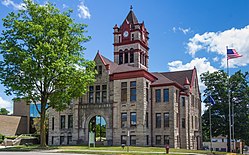
Cassopolis (/kəˈsɒpəlɪs/ kə-SOP-ə-liss) is a village in the U.S. state of Michigan and the county seat of Cass County. It is located mostly in LaGrange Township with a small portion extending east into Penn Township. The village and county are named after statesman Lewis Cass, a New Hampshire native and a prominent U.S. senator from Michigan prior to the American Civil War.
Cassopolis is part of the South Bend–Mishawaka, IN-MI, Metropolitan Statistical Area sometimes referred to as Michiana. The population was 1,712 at the 2020 census.
Cassopolis was platted by European Americans in 1831. It had already been designated the county seat by that point. It was incorporated as a village in 1863. The county developed farming and some industry.
Cassopolis was a transit point on the Underground Railroad, by which sympathizers aided refugee slaves from the South to gain freedom in the North and in Canada. Some refugees continued through Michigan to settle in Canada in order to avoid risk under the 1850 Fugitive Slave Act, which increased incentives for capture. Others remained in the area, with many African-Americans and people of mixed African-American and Sapponi and Pumenkey ancestry settling in Cass County.
In the 1960s, a group of African Americans connected to the Nation of Islam acquired some 1,000 acres of farmland in the area. Work on this acquisition was overseen by a man who had graduated from Cassopolis High.
According to the United States Census Bureau, the village has a total area of 2.25 square miles (5.83 km2), of which 2.00 square miles (5.18 km2) is land and 0.25 square miles (0.65 km2) is water. Cassopolis is the town associated with Diamond Lake, the largest lake in southwestern Michigan.
As of the census of 2010, there were 1,774 people, 709 households, and 384 families residing in the village. The population density was 887.0 inhabitants per square mile (342.5/km2). There were 833 housing units at an average density of 416.5 per square mile (160.8/km2). The racial makeup of the village was 60.0% White, 29.3% African American, 1.1% Native American, 2.4% Asian, 0.1% Pacific Islander, 1.5% from other races, and 5.6% from two or more races. Hispanic or Latino of any race were 4.5% of the population.
There were 709 households, of which 32.9% had children under the age of 18 living with them, 31.5% were married couples living together, 15.8% had a female householder with no husband present, 6.9% had a male householder with no wife present, and 45.8% were non-families. 40.8% of all households were made up of individuals, and 17.7% had someone living alone who was 65 years of age or older. The average household size was 2.32 and the average family size was 3.15.
Cassopolis, Michigan
Cassopolis (/kəˈsɒpəlɪs/ kə-SOP-ə-liss) is a village in the U.S. state of Michigan and the county seat of Cass County. It is located mostly in LaGrange Township with a small portion extending east into Penn Township. The village and county are named after statesman Lewis Cass, a New Hampshire native and a prominent U.S. senator from Michigan prior to the American Civil War.
Cassopolis is part of the South Bend–Mishawaka, IN-MI, Metropolitan Statistical Area sometimes referred to as Michiana. The population was 1,712 at the 2020 census.
Cassopolis was platted by European Americans in 1831. It had already been designated the county seat by that point. It was incorporated as a village in 1863. The county developed farming and some industry.
Cassopolis was a transit point on the Underground Railroad, by which sympathizers aided refugee slaves from the South to gain freedom in the North and in Canada. Some refugees continued through Michigan to settle in Canada in order to avoid risk under the 1850 Fugitive Slave Act, which increased incentives for capture. Others remained in the area, with many African-Americans and people of mixed African-American and Sapponi and Pumenkey ancestry settling in Cass County.
In the 1960s, a group of African Americans connected to the Nation of Islam acquired some 1,000 acres of farmland in the area. Work on this acquisition was overseen by a man who had graduated from Cassopolis High.
According to the United States Census Bureau, the village has a total area of 2.25 square miles (5.83 km2), of which 2.00 square miles (5.18 km2) is land and 0.25 square miles (0.65 km2) is water. Cassopolis is the town associated with Diamond Lake, the largest lake in southwestern Michigan.
As of the census of 2010, there were 1,774 people, 709 households, and 384 families residing in the village. The population density was 887.0 inhabitants per square mile (342.5/km2). There were 833 housing units at an average density of 416.5 per square mile (160.8/km2). The racial makeup of the village was 60.0% White, 29.3% African American, 1.1% Native American, 2.4% Asian, 0.1% Pacific Islander, 1.5% from other races, and 5.6% from two or more races. Hispanic or Latino of any race were 4.5% of the population.
There were 709 households, of which 32.9% had children under the age of 18 living with them, 31.5% were married couples living together, 15.8% had a female householder with no husband present, 6.9% had a male householder with no wife present, and 45.8% were non-families. 40.8% of all households were made up of individuals, and 17.7% had someone living alone who was 65 years of age or older. The average household size was 2.32 and the average family size was 3.15.
Recent media
Recent media