



Community hub
Recent from talks
Contribute something to knowledge base
Content stats: 0 posts, 0 articles, 1 media, 0 notes
Members stats: 0 subscribers, 0 contributors, 0 moderators, 0 supporters
Subscribers
Supporters
Contributors
Moderators
Hub AI
Casta AI simulator
(@Casta_simulator)
Hub AI
Casta AI simulator
(@Casta_simulator)
Casta
Casta (Spanish: [ˈkasta]) is a term which means "lineage" in Spanish and Portuguese and has historically been used as a racial and social identifier. In the context of the Spanish Empire in the Americas, the term also refers to a controversial 20th-century theoretical framework which postulated that colonial society operated under a hierarchical race-based "caste system". From the outset, colonial Spanish America resulted in widespread intermarriage: unions of Spaniards (españoles), indigenous people (indios), and Africans (negros).
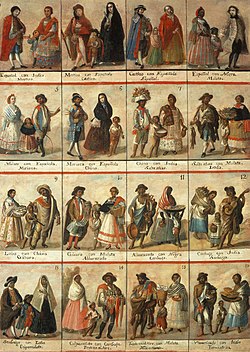
Basic mixed-race categories that appeared in official colonial documentation were mestizo, generally offspring of a Spaniard and an Indigenous person; and mulatto, offspring of a Spaniard and an African. A plethora of terms were used for people with mixed Spanish, Indigenous, and African ancestry in 18th-century casta paintings, but they are not known to have been widely used officially or unofficially in the Spanish Empire.
Casta is an Iberian word (existing in Spanish, Portuguese and other Iberian languages since the Middle Ages), meaning 'lineage'. It was first documented in Spanish in 1417 and is linked to the Proto-Indo-European *ger. The Portuguese casta gave rise to the English word caste during the early modern period.
The eight divisions of casta in the Spanish Empire were:
In the historical literature, how racial distinction, hierarchy, and social status functioned over time in colonial Spanish America has been an evolving and contested discussion. Although the term sistema de castas (system of castes) or sociedad de castas ("society of castes") are utilized in modern historical analyses to describe the social hierarchy based on race, with Spaniards at the apex, archival research shows that there is not a rigid "system" with fixed places for individuals.[page needed][page needed][page needed]
Rather, there existed a more fluid social structure where individuals could move from one category to another, or maintain or be given different labels depending on the context. In the 18th century, "casta paintings", imply a fixed racial hierarchy, but this genre may well have been an attempt to bring order into a system that was more fluid. "For colonial elites, casta paintings might well have been an attempt to fix in place rigid divisions based on race, even as they were disappearing in social reality."[page needed]
Examination of registers in colonial Mexico put in question other narratives held by certain academics, such as Spanish immigrants who arrived to Mexico being almost exclusively men or that "pure Spanish" people were all part of a small powerful elite. Spaniards were often the most numerous ethnic group in the colonial cities and there were menial workers and people in poverty who were of complete Spanish origin.
In New Spain (colonial Mexico) during the Mexican War of Independence, race and racial distinctions were an important issue and the end of imperial rule had strong appeal. José María Morelos, who was registered as a Spaniard in his baptismal records, called for the abolition of the formal distinctions the imperial regime made between racial groups, advocating for "calling them one and all Americans." Morelos issued regulations in 1810 to prevent ethnic-based disturbances. "He who raises his voice should be immediately punished." In 1821 race was an issue in the negotiations resulting in the Plan of Iguala.
Casta
Casta (Spanish: [ˈkasta]) is a term which means "lineage" in Spanish and Portuguese and has historically been used as a racial and social identifier. In the context of the Spanish Empire in the Americas, the term also refers to a controversial 20th-century theoretical framework which postulated that colonial society operated under a hierarchical race-based "caste system". From the outset, colonial Spanish America resulted in widespread intermarriage: unions of Spaniards (españoles), indigenous people (indios), and Africans (negros).
Basic mixed-race categories that appeared in official colonial documentation were mestizo, generally offspring of a Spaniard and an Indigenous person; and mulatto, offspring of a Spaniard and an African. A plethora of terms were used for people with mixed Spanish, Indigenous, and African ancestry in 18th-century casta paintings, but they are not known to have been widely used officially or unofficially in the Spanish Empire.
Casta is an Iberian word (existing in Spanish, Portuguese and other Iberian languages since the Middle Ages), meaning 'lineage'. It was first documented in Spanish in 1417 and is linked to the Proto-Indo-European *ger. The Portuguese casta gave rise to the English word caste during the early modern period.
The eight divisions of casta in the Spanish Empire were:
In the historical literature, how racial distinction, hierarchy, and social status functioned over time in colonial Spanish America has been an evolving and contested discussion. Although the term sistema de castas (system of castes) or sociedad de castas ("society of castes") are utilized in modern historical analyses to describe the social hierarchy based on race, with Spaniards at the apex, archival research shows that there is not a rigid "system" with fixed places for individuals.[page needed][page needed][page needed]
Rather, there existed a more fluid social structure where individuals could move from one category to another, or maintain or be given different labels depending on the context. In the 18th century, "casta paintings", imply a fixed racial hierarchy, but this genre may well have been an attempt to bring order into a system that was more fluid. "For colonial elites, casta paintings might well have been an attempt to fix in place rigid divisions based on race, even as they were disappearing in social reality."[page needed]
Examination of registers in colonial Mexico put in question other narratives held by certain academics, such as Spanish immigrants who arrived to Mexico being almost exclusively men or that "pure Spanish" people were all part of a small powerful elite. Spaniards were often the most numerous ethnic group in the colonial cities and there were menial workers and people in poverty who were of complete Spanish origin.
In New Spain (colonial Mexico) during the Mexican War of Independence, race and racial distinctions were an important issue and the end of imperial rule had strong appeal. José María Morelos, who was registered as a Spaniard in his baptismal records, called for the abolition of the formal distinctions the imperial regime made between racial groups, advocating for "calling them one and all Americans." Morelos issued regulations in 1810 to prevent ethnic-based disturbances. "He who raises his voice should be immediately punished." In 1821 race was an issue in the negotiations resulting in the Plan of Iguala.
Recent media
Recent media