Hubbry Logo
Spanish AmericaSpanish AmericaMain
Open search
Spanish America
Community hub
Spanish America
logo
8 pages, 0 posts
0 subscribers
Be the first to start a discussion here.
Contribute something
Spanish America
Spanish America
from Wikipedia
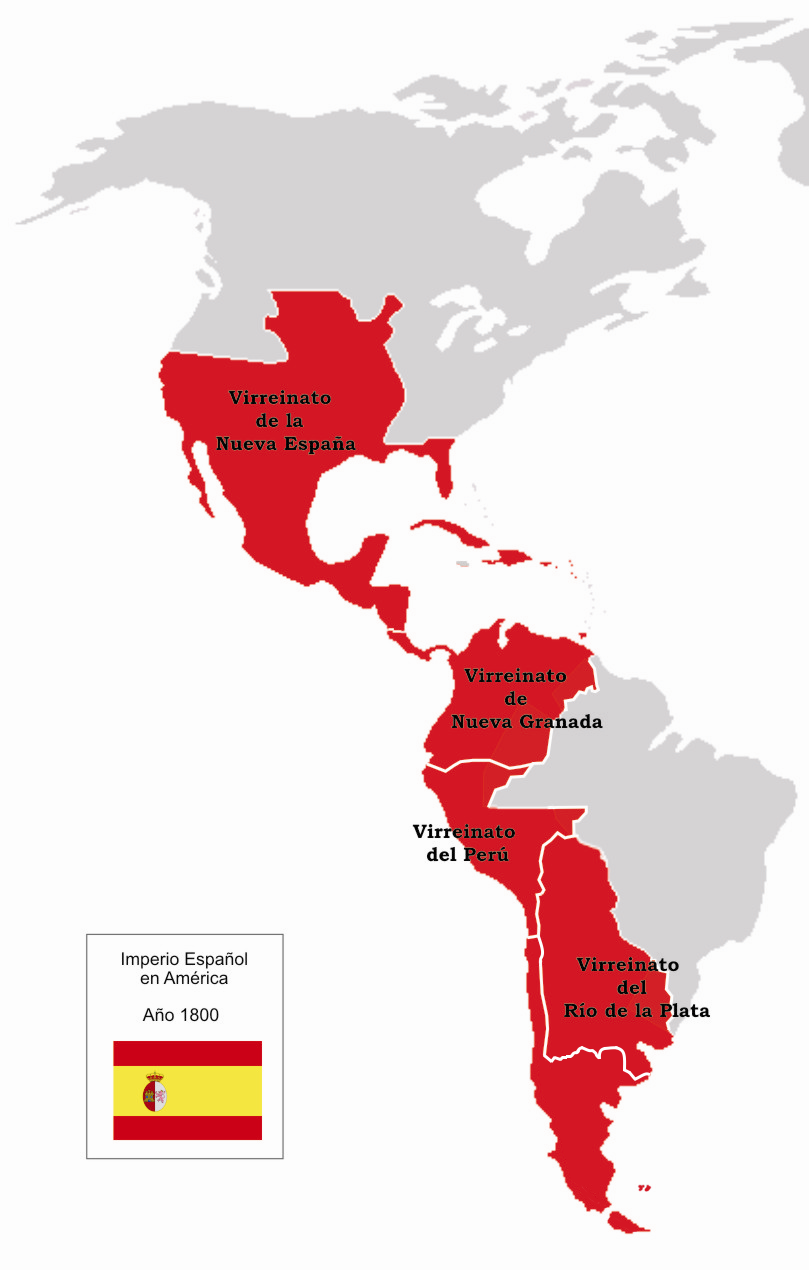
Spanish America in 1800, with four kingdoms: New Spain, New Granada, Peru and La Plata
The Spanish Empire (yellow) in 1800

Spanish America refers to the Spanish territories in the Americas during the Spanish colonization of the Americas. The term "Spanish America" was specifically used during the territories' imperial era between 15th and 19th centuries. To the end of its imperial rule, Spain called its overseas possessions in the Americas and the Philippines "The Indies", an enduring remnant of Columbus's notion that he had reached Asia by sailing west. When these territories reach a high level of importance, the crown established the Council of the Indies in 1524, following the conquest of the Aztec Empire, asserting permanent royal control over its possessions. Regions with dense indigenous populations and sources of mineral wealth attracting Spanish settlers became colonial centers, while those without such resources were peripheral to crown interest. Once regions incorporated into the empire and their importance assessed, overseas possessions came under stronger or weaker crown control.[1]

The crown learned its lesson with the rule of Christopher Columbus and his heirs in the Caribbean, and they never subsequently gave authorization of sweeping powers to explorers and conquerors. The Catholic Monarchs' conquest of Granada in 1492 and their expulsion of the Jews "were militant expressions of religious statehood at the moment of the beginning of the American colonization."[2] The crown's power in the religious sphere was absolute in its overseas possessions through the papacy's grant of the Patronato real, and "Catholicism was indissolubly linked with royal authority."[3] Church-State relations were established in the conquest era and remained stable until the end of the Habsburg era in 1700, when the Bourbon monarchs implemented major reforms and changed the relationship between crown and altar.

The crown's administration of its overseas empire was implemented by royal officials in both the civil and religious spheres, often with overlapping jurisdictions. The crown could administer the empire in the Indies by using native elites as intermediaries with the large indigenous populations. Administrative costs of empire were kept low, with a small number of Spanish officials generally paid low salaries.[4] Crown policy to maintain a closed commercial system limited to one port in Spain and only a few in the Indies was in practice not closed, with European merchant houses supplying Spanish merchants in the Spanish port of Seville with high quality textiles and other manufactured goods that Spain itself could not supply. Much of the silver of the Indies was diverted into those European merchant houses. Crown officials in the Indies enabled the creation of a whole commercial system in which they could coerce native populations to participate while reaping profits themselves in cooperation with merchants.[4]

History

[edit]

15th century

[edit]

16th century

[edit]
Inca emperor Atahualpa is shown surrounded on his palanquin at the Battle of Cajamarca.

The Spanish conquest was facilitated by the spread of diseases such as smallpox, common in Europe but never present in the New World, which reduced the indigenous populations in the Americas. This sometimes caused a labor shortage for plantations and public works and so the colonists informally and gradually, at first, initiated the Atlantic slave trade.

One of the most accomplished conquistadors was Hernán Cortés, who, leading a relatively small Spanish force but with local translators and the crucial support of thousands of native allies, achieved the Spanish conquest of the Aztec Empire in the campaigns of 1519–1521. This territory later became the Viceroyalty of New Spain, present day Mexico. Of equal importance was the Spanish conquest of the Inca Empire by Francisco Pizarro, which would become the Viceroyalty of Peru.[5] The Spanish conquest of the Maya began in 1524, but the Maya kingdoms resisted integration into the Spanish Empire with such tenacity that their defeat took almost two centuries.

Cristóbal de Olid leads Spanish soldiers with Tlaxcalan allies in the conquests of Jalisco, 1522. From Lienzo de Tlaxcala.

After the conquest of Mexico, rumors of golden cities (Quivira and Cíbola in North America and El Dorado in South America) motivated several other expeditions. Many of those returned without having found their goal, or finding it much less valuable than was hoped. Indeed, the New World colonies only began to yield a substantial part of the Crown's revenues with the establishment of mines such as that of Potosí (Bolivia) and Zacatecas (Mexico) both started in 1546. By the late 16th century, silver from the Americas accounted for one-fifth of Spain's total budget.[5]

Spanish empire in North America. Includes historical presence, claimed territories, points of interest and expeditions

Eventually the world's stock of precious metal was doubled or even tripled by silver from the Americas.[6] Official records indicate that at least 75% of the silver was taken across the Atlantic to Spain and no more than 25% across the Pacific to China. Some modern researchers argue that due to rampant smuggling about 50% went to China.[6] In the 16th century "perhaps 240,000 Europeans" entered American ports.[7]

Further Spanish settlements were progressively established in the New World: New Granada in the 1530s (later in the Viceroyalty of New Granada in 1717 and present day Colombia), Lima in 1535 as the capital of the Viceroyalty of Peru, Buenos Aires in 1536 (later in the Viceroyalty of the Río de la Plata in 1776), and Santiago in 1541.

Florida was colonized in 1565 by Pedro Menéndez de Avilés when he founded St. Augustine and then promptly destroyed Fort Caroline in French Florida and massacred its several hundred Huguenot inhabitants after they surrendered. Saint Augustine quickly became a strategic defensive base for the Spanish ships full of gold and silver being sent to Spain from its New World dominions.

Spanish explorations and routes across the Pacific Ocean.

The Portuguese mariner sailing for Castile, Ferdinand Magellan, died while in the Philippines commanding a Castilian expedition in 1522, which was the first to circumnavigate the globe. The Basque commander Juan Sebastián Elcano led the expedition to success. Spain sought to enforce their rights in the Moluccan islands, which led a conflict with the Portuguese, but the issue was resolved with the Treaty of Zaragoza (1525), settling the location of the antimeridian of Tordesillas, which would divide the world into two equal hemispheres. From then on, maritime expeditions led to the discovery of several archipelagos in the South Pacific as the Pitcairn Islands, the Marquesas, Tuvalu, Vanuatu, the Solomon Islands or New Guinea, to which Spain laid claim.

Most important in Pacific exploration was the claim on the Philippines, which was populous and strategically located for the Spanish settlement of Manila and entrepôt for trade with China. On 27 April 1565, the first permanent Spanish settlement in the Philippines was founded by Miguel López de Legazpi and the service of Manila Galleons was inaugurated. The Manila Galleons shipped goods from all over Asia across the Pacific to Acapulco on the coast of Mexico. From there, the goods were transshipped across Mexico to the Spanish treasure fleets, for shipment to Spain. The Spanish trading port of Manila facilitated this trade in 1572. Although Spain claimed islands in the Pacific, it did not encounter or claim the Hawaiian Islands. The control of Guam, Mariana Islands, Caroline Islands, and Palau came later, from the end of the 17th century, and remained under Spanish control until 1898.

17th century

[edit]

18th century

[edit]

In the 18th century, Spain was concerned with increasing Russian and British influence in the Pacific Northwest of North America and sent several expeditions to explore and further shore up Spanish claims to the region.[8]

19th century

[edit]

Most of Spanish America was lost in the Spanish American wars of independence (1808–1833)

The second half of the 1890s saw the final unravelling of Spanish America, which began with insurrections in Cuba (1895) and the Philippines (1896) and ended with the Spaniards' defeat at the hands of the United States in 1898.

Organization and administration of empire

[edit]

The empire in the Indies was a newly established dependency of the kingdom of Castile alone, so crown power was not impeded by any existing cortes (i.e. parliament), administrative or ecclesiastical institution, or seigneurial group.[9] The crown sought to establish and maintain control over its overseas possessions through a complex, hierarchical bureaucracy, which in many ways was decentralized. The crown asserted is authority and sovereignty of the territory and vassals it claimed, collected taxes, maintained public order, meted out justice, and established policies for governance of large indigenous populations. Many institutions established in Castile found expression in The Indies from the early colonial period. Spanish universities expanded to train lawyer-bureaucrats (letrados) for administrative positions in Spain and its overseas empire.

The end of the Habsburg dynasty in 1700 saw major administrative reforms in the eighteenth century under the Bourbon monarchy, starting with the first Spanish Bourbon monarch, Philip V (r. 1700–1746) and reaching its apogee under Charles III (r. 1759–1788). The reorganization of administration has been called "a revolution in government."[10] Reforms sought to centralize government control through reorganization of administration, reinvigorate the economies of Spain and the Spanish empire through changes in mercantile and fiscal policies, defend Spanish colonies and territorial claims through the establishment of a standing military, undermine the power of the Catholic church, and rein in the power of the American-born elites.[11]

Early institutions of governance

[edit]

The crown relied on ecclesiastics as important councilors and royal officials in the governance of their overseas territories. Archbishop Juan Rodríguez de Fonseca, Isabella's confessor, was tasked with reining in Columbus's independence. He strongly influenced the formulation of colonial policy under the Catholic Monarchs, and was instrumental in establishing the Casa de Contratación (1503), which enabled crown control over trade and immigration. Ovando fitted out Magellan's voyage of circumnavigation, and became the first President of the Council of the Indies in 1524.[12] Ecclesiastics also functioned as administrators overseas in the early Caribbean period, particularly Frey Nicolás de Ovando, who was sent to investigate the administration of Francisco de Bobadilla, the governor appointed to succeed Christopher Columbus.[13] Later ecclesiastics served as interim viceroys, general inspectors (visitadores), and other high posts.

The crown established control over trade and emigration to the Indies with the 1503 establishment the Casa de Contratación (House of Trade) in Seville. Ships and cargoes were registered, and emigrants vetted to prevent migration of anyone not of old Christian heritage and facilitated the migration of families and women.[14] In addition, the Casa de Contratación took charge of the fiscal organization, and of the organization and judicial control of the trade with the Indies.[15]

The politics of asserting royal authority opposite to Columbus caused the suppression of his privileges in The Indies and the creation of territorial governance under royal authority. These governorates, also called as provinces, were the basic of the territorial government of the Indies,[16] and arose as the territories were conquered and colonized.[17] To carry out the expedition (entrada), which entailed exploration, conquest, and initial settlement of the territory, the king, as owner of the Indies, agreed capitulación (an itemized contract) with the specifics of the conditions of the expedition in a particular territory. The individual leaders of expeditions (adelantados) assumed the expenses of the venture and in return received as reward the grant from the government of the conquered territories;[18] and in addition, they received instructions about treating the aborigens.[19]

Fray Bartolomé de las Casas, Protector of the Indians

After the end of the period of conquests, it was necessary to manage extensive and different territories with a strong bureaucracy. In the face of the impossibility of the Castilian institutions to take care of the New World affairs, other new institutions were created.[20]

As the basic political entity it was the governorate, or province. The governors exercised judicial ordinary functions of first instance, and prerogatives of government legislating by ordinances.[21] To these political functions of the governor, it could be joined the military ones, according to military requirements, with the rank of Captain general.[22] The office of captain general involved to be the supreme military chief of the whole territory and he was responsible for recruiting and providing troops, the fortification of the territory, the supply and the shipbuilding.[23]

Provinces in the Spanish Empire had a royal treasury controlled by a set of officiales reales (royal officials). The officials of the royal treasury included up to four positions: a tesorero (treasurer), who guarded money on hand and made payments; a contador (accountant or comptroller), who recorded income and payments, maintained records, and interpreted royal instructions; a factor, who guarded weapons and supplies belonging to the king, and disposed of tribute collected in the province; and a veedor (overseer), who was responsible for contacts with native inhabitants of the province, and collected the king's share of any war booty. The treasury officials were appointed by the king, and were largely independent of the authority of the governor. Treasury officials were generally paid out of the income from the province and were normally prohibited from engaging in personal income-producing activities.[24]

The indigenous populations in the Caribbean became the focus of the crown in its roles as sovereigns of the empire and patron of the Catholic Church. Spanish conquerors holding grants of indigenous labor in encomienda ruthlessly exploited them Spanish. A number of friars in the early period came to the vigorous defense of the indigenous populations, who were new converts to Christianity. Prominent Dominican friars in Santo Domingo, especially Antonio de Montesinos and Bartolomé de las Casas denounced the maltreatment and pressed the crown to act to protect the indigenous populations. The crown enacted Laws of Burgos (1513) and the Requerimiento to curb the power of the Spanish conquerors and give indigenous populations the opportunity to peacefully embrace Spanish authority and Christianity. Neither was effective in its purpose. Las Casas was officially appointed Protector of the Indians and spent his life arguing forcefully on their behalf. The New Laws of 1542, limiting the power of encomenderos, were a result.

Beginning in 1522 in the newly conquered Mexico, government units in the Spanish Empire had a royal treasury controlled by a set of officiales reales (royal officials). There were also sub-treasuries at important ports and mining districts. The officials of the royal treasury at each level of government typically included two to four positions: a tesorero (treasurer), the senior official who guarded money on hand and made payments; a contador (accountant or comptroller), who recorded income and payments, maintained records, and interpreted royal instructions; a factor, who guarded weapons and supplies belonging to the king, and disposed of tribute collected in the province; and a veedor (overseer), who was responsible for contacts with native inhabitants of the province, and collected the king's share of any war booty. The veedor, or overseer, position quickly disappeared in most jurisdictions, subsumed into the position of factor. Depending on the conditions in a jurisdiction, the position of factor/veedor was often eliminated, as well.[25]

The treasury officials were appointed by the king, and were largely independent of the authority of the viceroy, audiencia president or governor. On the death, unauthorized absence, retirement or removal of a governor, the treasury officials would jointly govern the province until a new governor appointed by the king could take up his duties. Treasury officials were supposed to be paid out of the income from the province, and were normally prohibited from engaging in income-producing activities.[26]

Spanish Law and indigenous peoples

[edit]
Colegio de San Gregorio, Valladolid, where the Laws of the Indies were promulgated

The protection of the indigenous populations from enslavement and exploitation by Spanish settlers was established in the Laws of Burgos, 1512–1513. The laws were the first codified set of laws governing the behavior of Spanish settlers in the Americas, particularly with regards to treatment of native Indians in the institution of the encomienda. They forbade the maltreatment of natives, and endorsed the Indian Reductions with attempts of conversion to Catholicism.[27] Upon their failure to effectively protect the indigenous and following the Spanish conquest of the Aztec Empire and the Spanish conquest of Peru, more stringent laws to control conquerors' and settlers' exercise of power, especially their maltreatment of the indigenous populations, were promulgated, known as the New Laws (1542). The crown aimed to prevent the formation of an aristocracy in the Indies not under crown control.

Despite the fact that The Queen Isabel was the first monarch that laid the first stone for the protection of the indigenous peoples in her testament in which the Catholic monarch prohibited the enslavement of the indigenous peoples of the Americas.[28] Then the first such in 1542; the legal thought behind them was the basis of modern International law.[29] Taking advantage of their extreme remoteness from royal power, some colonists were disagree with the laws when they saw their power being reduced, forcing a partial suppression of these New Laws.

The Valladolid debate (1550–1551) was the first moral debate in European history to discuss the rights and treatment of a colonized people by colonizers. Held in the Colegio de San Gregorio, in the Spanish city of Valladolid, it was a moral and theological debate about the colonization of the Americas, its justification for the conversion to Catholicism and more specifically about the relations between the European settlers and the natives of the New World. It consisted of a number of opposing views about the way natives were to be integrated into colonial life, their conversion to Christianity and their rights and obligations. According to the French historian Jean Dumont The Valladolid debate was a major turning point in world history "In that moment in Spain appeared the dawn of the human rights".[30]

Council of the Indies

[edit]

In 1524 the Council of the Indies was established, following the system of Councils that advised the monarch and made decisions on his behalf about specific matters of government.[31] Based in Castile, with the assignment of the governance of the Indies, it was thus responsible for drafting legislation, proposing the appointments to the King for civil government as well as ecclesiastical appointments, and pronouncing judicial sentences; as maximum authority in the overseas territories, the Council of the Indies took over both the institutions in the Indies as the defense of the interests of the Crown, the Catholic Church, and of indigenous peoples.[32] With the 1508 papal grant to the crown of the Patronato real, the crown, rather than the pope, exercised absolute power over the Catholic Church in the Americas and the Philippines, a privilege the crown zealously guarded against erosion or incursion. Crown approval through the Council of the Indies was needed for the establishment of bishoprics, building of churches, appointment of all clerics.[33]

In 1721, at the beginning of the Bourbon monarchy, the crown transferred the main responsibility for governing the overseas empire from the Council of the Indies to the Ministry of the Navy and the Indies, which were subsequently divided into two separate ministries in 1754.[11]

Viceroyalties

[edit]
View of the Plaza Mayor of Mexico City and the viceroy's palace, by Cristóbal de Villalpando, 1695

The impossibility of the physical presence of the monarch and the necessity of strong royal governance in the Indies resulted in the appointment of viceroys ("vice-kings"), the direct representation of the monarch, in both civil and ecclesiastical spheres. Viceroyalties were the largest territory unit of administration in the civil and religious spheres and the boundaries of civil and ecclesiastical governance coincided by design, to ensure crown control over both bureaucracies.[34] Until the eighteenth century, there were just two viceroyalties, with the Viceroyalty of New Spain (founded 1535) administering North America, a portion of the Caribbean, and the Philippines, and the viceroyalty of Peru (founded 1542) having jurisdiction over Spanish South America. Viceroys served as the vice-patron of the Catholic Church, including the Inquisition, established in the seats of the viceroyalties (Mexico City and Peru). Viceroys were responsible for good governance of their territories, economic development, and humane treatment of the indigenous populations.[35]

In the eighteenth-century reforms, the Viceroyalty of Peru was reorganized, splitting off portions to form the Viceroyalty of New Granada (Colombia) (1739) and the Viceroyalty of Rio de la Plata (Argentina) (1776), leaving Peru with jurisdiction over Peru, Charcas, and Chile. Viceroys were of high social standing, almost without exception born in Spain, and served fixed terms.

Audiencias, the High Courts

[edit]
Members of the Real Audiencia (Royal Audience) of Lima, the presidente, alcaldes de corte, fiscal and alguacil mayor. (Nueva Crónica y Buen Gobierno, p. 488)

The Audiencias were initially constituted by the crown as a key administrative institution with royal authority and loyalty to the crown as opposed to conquerors and first settlers.[36] Although constituted as the highest judicial authority in their territorial jurisdiction, they also had executive and legislative authority, and served as the executive on an interim basis. Judges (oidores) held "formidable power. Their role in judicial affairs and in overseeing the implementation of royal legislation made their decisions important for the communities they served." Since their appointments were for life or the pleasure of the monarch, they had a continuity of power and authority that viceroys and captains-general lacked because of their shorter-term appointments.[37] They were the "center of the administrative system [and] gave the government of the Indies a strong basis of permanence and continuity."[38]

Their main function was judicial, as a court of justice of second instance —court of appeal— in penal and civil matters, but also the Audiencias were courts the first instance in the city where it had its headquarters, and also in the cases involving the Royal Treasury.[39] Besides court of justice, the Audiencias had functions of government as counterweight the authority of the viceroys, since they could communicate with both the Council of the Indies and the king without the requirement of requesting authorization from the viceroy.[39] This direct correspondence of the Audiencia with the Council of the Indies made it possible for the council to give the Audiencia direction on general aspects of government.[36]

Audiencias were a significant base of power and influence for American-born elites, starting in the late sixteenth century, with nearly a quarter of appointees being born in the Indies by 1687. During a financial crisis in the late seventeenth century, the crown began selling Audiencia appointments, and American-born Spaniards held 45% of Audiencia appointments. Although there were restrictions of appointees' ties to local elite society and participation in the local economy, they acquired dispensations from the cash-strapped crown. Audiencia judgments and other functions became more tied to the locality and less to the crown and impartial justice.

During the Bourbon Reforms in the mid-eighteenth century, the crown systematically sought to centralize power in its own hands and diminish that of its overseas possessions, appointing peninsular-born Spaniards to Audiencias. American-born elite men complained bitterly about the change, since they lost access to power that they had enjoyed for nearly a century.[37]

Civil administrative districts

[edit]

During the early colonial era and under the Habsburgs, the crown established a regional layer of colonial jurisdiction in the institution of Corregimiento, which was between the Audiencia and town councils. Corregimiento expanded "royal authority from the urban centers into the countryside and over the indigenous population."[40] As with many colonial institutions, corregimiento had its roots in Castile when the Catholic Monarchs centralize power over municipalities. In the Indies, corregimiento initially functioned to bring control over Spanish settlers who exploited the indigenous populations held in encomienda, to protect the shrinking indigenous populations and prevent the formation of an aristocracy of conquerors and powerful settlers. The royal official in charge of a district was the Corregidor, who was appointed by the viceroy, usually for a five-year term. Corregidores collected the tribute from indigenous communities and regulated forced indigenous labor. Alcaldías mayores were larger districts with a royal appointee, the Alcalde mayor.

As the indigenous populations declined, the need for corregimiento decreased and then suppressed, with the alcaldía mayor remaining an institution until it was replaced in the eighteenth-century Bourbon Reforms by royal officials, Intendants. The salary of officials during the Habsburg era were paltry, but the corregidor or alcalde mayor in densely populated areas of indigenous settlement with a valuable product could use his office for personal enrichment. As with many other royal posts, these positions were sold, starting in 1677.[40] The Bourbon-era intendants were appointed and relatively well paid.[41]

Ecclesiastical organization

[edit]
Puebla Cathedral

During the early colonial period, the crown authorized friars of Catholic religious orders (Franciscans, Dominicans, and Augustinians) to function as priests during the conversion of indigenous populations. During the early Age of Discovery, the diocesan clergy in Spain was poorly educated and considered of a low moral standing, and the Catholic Monarchs were reluctant to allow them to spearhead evangelization. Each order set up networks of parishes in the various regions (provinces), sited in existing Indian settlements, where Christian churches were built and where evangelization of the indigenous was based.[42] However, after the 1550s, the crown increasingly favored the diocesan clergy over the religious orders since the diocesan clergy was under the direct authority of the crown, while religious orders were with their own internal regulations and leadership. The crown had authority to draw the boundaries for dioceses and parishes. The creation of the ecclesiastical hierarchy with priests who not members of religious orders, those known as the diocesan or secular clergy, marked a turning point in the crown's control over the religious sphere. In 1574, Philip II promulgated the Order of Patronage (Ordenaza del Patronato) ordering the religious orders to turn over their parishes to the secular clergy, a policy that secular clerics had long sought for the central areas of empire, with their large indigenous populations. Although implementation was slow and incomplete, it was an assertion of royal power over the clergy and the quality of parish priests improved, since the Ordenanza mandated competitive examination to fill vacant positions.[43] Religious orders along with the Jesuits embarked on further evangelization in frontier regions of the empire. The Jesuits resisted crown control, refusing to pay the tithe on their estates that supported the ecclesiastical hierarchy and came into conflict with bishops. The most prominent example is in Puebla, Mexico, when Bishop Juan de Palafox y Mendoza was driven from his bishopric by the Jesuits. The bishop challenged the Jesuits' continuing to hold Indian parishes and function as priests without the required royal licenses. His fall from power is viewed as an example of the weakening of the crown in the mid-seventeenth century since it failed to protect their duly appointed bishop.[44] The crown expelled the Jesuits from Spain and The Indies in 1767 during the Bourbon Reforms.

Cabildos or town councils

[edit]
Cabildo in the city of Salta (Argentina)

Spanish settlers sought to live in towns and cities, with governance being accomplished through the town council or Cabildo. The cabildo was composed of the prominent residents (vecinos) of the municipality, so that governance was restricted to a male elite, with majority of the population exercising power. Cities were governed on the same pattern as in Spain and in the Indies the city was the framework of Spanish life. The cities were Spanish and the countryside indigenous.[45] In areas of previous indigenous empires with settled populations, the crown also melded existing indigenous rule into a Spanish pattern, with the establishment of cabildos and the participation of indigenous elites as officials holding Spanish titles. There were a variable number of councilors (regidores), depending on the size of the town, also two municipal judges (alcaldes menores), who were judges of first instance, and also other officials as police chief, inspector of supplies, court clerk, and a public herald.[46] They were in charge of distributing land to the neighbors, establishing local taxes, dealing with the public order, inspecting jails and hospitals, preserving the roads and public works such as irrigation ditches and bridges, supervising the public health, regulating the festive activities, monitoring market prices, or the protection of Indians.[47]

After the reign of Philip II, the municipal offices, including the councilors, were auctioned to alleviate the need for money of the Crown, even the offices could also be sold, which became hereditary,[48] so that the government of the cities went on to hands of urban oligarchies.[49] In order to control the municipal life, the Crown ordered the appointment of corregidores and alcaldes mayores to exert greater political control and judicial functions in minor districts.[50] Their functions were governing the respective municipalities, administering of justice and being appellate judges in the alcaldes menores' judgments,[51] but only the corregidor could preside over the cabildo.[52] However, both charges were also put up for sale freely since the late 16th century.[53]

Most Spanish settlers came to the Indies as permanent residents, established families and businesses, and sought advancement in the colonial system, such as membership of cabildos, so that they were in the hands of local, American-born (crillo) elites. During the Bourbon era, even when the crown systematically appointed peninsular-born Spaniards to royal posts rather than American-born, the cabildos remained in the hands of local elites.[54]

Frontier institutions – presidio and mission

[edit]
The San Diego presidio in California

As the empire expanded into areas of less dense indigenous populations, the crown created a chain of presidios, military forts or garrisons, that provided Spanish settlers protection from Indian attacks. In Mexico during the sixteenth-century Chichimeca War, presidios guarded the transit of silver from the mines of Zacatecas to Mexico City. As many as 60 salaried soldiers were garrisoned in presidios.[55] Presidios had resident commanders, who set up commercial enterprises of imported merchandise, selling it to soldiers as well as Indian allies.[56]

The other frontier institution was the religious mission to convert the indigenous populations. Missions were established with royal authority through the Patronato real. The Jesuits were effective missionaries in frontier areas until their expulsion from Spain and its empire in 1767. The Franciscans took over some former Jesuit missions and continued the expansion of areas incorporated into the empire. Although their primary focus was on religious conversion, missionaries served as "diplomatic agents, peace emissaries to hostile tribes ... and they were also expected to hold the line against nomadic nonmissionary Indians as well as other European powers."[57] On the frontier of empire, Indians were seen as sin razón, ("without reason"); non-Indian populations were described as gente de razón ("people of reason"), who could be mixed-race castas or black and had greater social mobility in frontier regions.[58]

[edit]
Castas painting of a Mestizo Child, Spanish man, and Indian Woman by José Joaquín Magón, Mexico Late Eighteenth Century
Depiction of castas in Mexico. Ignacio Maria Barreda, 1777

Codes regulated the status of individuals and groups in the empire in both the civil and religious spheres, with Spaniards (peninsular- and American-born) monopolizing positions of economic privilege and political power. Royal law and Catholicism codified and maintained hierarchies of class and race, while all were subjects of the crown and mandated to be Catholic.[59] The crown took active steps to establish and maintain Catholicism by evangelizing the pagan indigenous populations, as well as African slaves not previously Christian, and incorporating them into Christendom. Catholicism remains the dominant religion in Spanish America. The crown also imposed restrictions on emigration to the Americas, excluding Jews and crypto-Jews, Protestants, and foreigners, using the Casa de Contratación to vet potential emigres and issue licenses to travel.

The portrait to the right was most likely used as a souvenir. For those who traveled to the New World and back it was common to bring back souvenirs as there were a great interest in what the New World meant. The land would be significantly different but there was a special emphasis put on the emerging mixed races. Not only was there whites mixing with blacks but there were natives mixing with both whites and blacks as well. From a Spanish viewpoint, the castas paintings would most-likely have provided a sort of sense to the madness that was mixed races. There were political implications of this portrait as well. The mestizo child appears to be literate with a satisfied grin facing his father alluding to the opportunity the child has due to his father being European.[60]

A central question from the time of first Contact with indigenous populations was their relationship to the crown and to Christianity. Once those issues were resolved theologically, in practice the crown sought to protect its new vassals. It did so by dividing peoples of the Americas into the República de Indios, the native populations, and the República de Españoles. The República de Españoles was the entire Hispanic sector, composed of Spaniards, but also Africans (enslaved and free), as well as mixed-race castas.

Within the República de Indios, men were explicitly excluded from ordination to the Catholic priesthood and obligation for military service as well as the jurisdiction of the Inquisition. Indians under colonial rule who lived in pueblos de indios had crown protections due to their statuses as legal minors. Due to the lack of prior exposure to the Catholic faith, Queen Isabella had declared all indigenous peoples her subjects. This differed from people of the African continent because these populations had theoretically been exposed to Catholicism and chose not to follow it. This religious differentiation is important because it gave indigenous communities legal protections from members of the Républica de Españoles. In fact, an often overlooked aspect of the colonial legal system was that members of the pueblos de indios could appeal to the crown and circumvent the legal system in the Républica de Españoles. The statuses of the indigenous populations as legal minors barred them from becoming priests, but the républica de indios operated with a fair amount of autonomy. Missionaries also acted as guardians against encomendero exploitation. Indian communities had protections of traditional lands by the creation of community lands that could not be alienated, the fondo legal. They managed their own affairs internally through Indian town government under the supervision of royal officials, the corregidores and alcaldes mayores. Although indigenous men were barred from becoming priests, indigenous communities created religious confraternities under priestly supervision, which functioned as burial societies for their individual members, but also organized community celebrations for their patron saint. Blacks also had separate confraternities, which likewise contributed to community formation and cohesion, reinforcing identity within a Christian institution.[61]

Conquest and evangelization were inseparable in Spanish America. The first order to make the trip to the Americas were the Franciscans, led by Pedro de Gante. Franciscans believed that living a spiritual life of poverty and holiness was the best way to be an example that inspired others to convert. The friars would walk into the towns barefoot as a display of their surrender to God in a sort of theater of conversion. With this began the practice of evangelization of the peoples of the new world as supported by the Spanish government. Religious orders in Spanish America had their own internal structures and were organizationally autonomous, but nonetheless were very important to the structure of colonial society. They had their own resources and hierarchies. Though some orders took vows of poverty, by the time the second wave of friars came to the Americas and as their numbers grew, the orders began amassing wealth and thus became key economic players. The church, as this wealthy power, had huge estates and built large constructions such as gilded monasteries and cathedrals. Priests themselves also became wealthy landowners. Orders like the Franciscans also established schools for the indigenous elites as well as hired indigenous laborers, thereby shifting the dynamics in the indigenous communities and their relationship to the Spanish.

After the fall of the Aztec and Inca empires, the rulers of the empires were replaced by the Spanish monarchy, while retaining much of the hierarchical indigenous structures. The crown recognized noble status of elite Indians, giving them exemption from the head-tax and the right to use the nobles title don and doña. Indigenous noblemen were a key group for the administration of the Spanish Empire, since they served as intermediaries between crown officials and indigenous communities.[62][63] Indigenous noblemen could serve on cabildos, ride horses, and carry firearms. The crown's recognition of indigenous elites as nobles meant that these men were incorporated into colonial system with privileges separating them from Indian commoners. Indian noblemen were thus crucial to the governance of the huge indigenous population. Through their continued loyalty to the crown, they maintained their positions of power within their communities but also served as agents of colonial governance. The Spanish Empire's use of local elites to rule large populations that are ethnically distinct from the rulers has long been practiced by earlier empires.[64] Indian caciques were crucial in the early Spanish period, especially when the economy was still based on extracting tribute and labor from commoner Indians who had rendered goods and service to their overlords in the prehispanic period. Caciques mobilized their populations for encomenderos and, later, repartimiento recipients chosen by the crown. The noblemen became the officers of the cabildo in indigenous communities, regulating internal affairs, as well as defending the communities' rights in court. In Mexico, this was facilitated by the 1599 establishment of the General Indian Court (Juzgado General de Indios), which heard legal disputes in which indigenous communities and individuals were engaged. With legal mechanisms for dispute-resolution, there were relatively few outbreaks of violence and rebellion against crown rule. Eighteenth-century rebellions in long-peaceful areas of Mexico, the Tzeltal Rebellion of 1712 and most spectacularly in Peru with the Tupac Amaru Rebellion (1780–81) saw indigenous noblemen leading uprisings against the Spanish state.

In the República de Españoles, class and race hierarchies were codified in institutional structures. Spaniards emigrating to The Indies were to be Old Christians of pure Christian heritage, with the crown excluding New Christians, converts from Judaism and their descendants, because of their suspect religious status. The crown established the Inquisition in Mexico and Peru in 1571, and later Cartagena de Indias (Colombia), to guard Catholics from the influence of crypto-Jews, Protestants, and foreigners. Church practices established and maintained racial hierarchies by recording baptism, marriage, and burial were kept separate registers for different racial groups. Churches were also physically divided by race.[65]

Auto de Fe in Toledo, Spain 1651. Civil officials oversaw the corporal punishment of those convicted by the Inquisition in public ceremonies.

Race mixture (mestizaje) was a fact of colonial society, with the three racial groups, European whites (españoles), Africans (negros), and Indians (indios) producing mixed-race offspring, or castas. There was a pyramid of racial status with the apex being the small number of European white (españoles), a slightly larger number of mixed-race castas, who, like the whites were mainly urban dwelling, and the largest populations were Indians living in communities in the countryside. Although Indians were classified as part of the República de Indios, their offspring of unions with Españoles and Africans were castas. White-Indian mixtures were more socially acceptable in the Hispanic sphere, with the possibility over generations of mixed-race offspring being classified as Español. Any offspring with African ancestry could never remove the "stain" of their racial heritage, since Africans were seen as "natural slaves". Eighteenth-century paintings depicted elites' ideas of the sistema de castas in hierarchical order,[66] but there was some fluidity in the system rather than absolute rigidity.[67] Men of color began to apply to the Royal and Pontifical University of Mexico, but in 1688 Bishop Juan de Palafox y Mendoza attempted to prevent their entrance by drafting new regulations barring blacks and mulattoes. In small Mexican parishes, dark complected priests served while their mixed-race heritage was left unacknowledged.[68] In 1776, the crown attempted to prevent marriages between racially unequal partners by issuing the Royal Pragmatic on Marriage, taking approval of marriages away from the couple and placing it in their parents' hands. The marriage between Luisa de Abrego, a free black domestic servant from Seville and Miguel Rodríguez, a white Segovian conquistador in 1565 in St. Augustine (Spanish Florida), is the first known and recorded Christian marriage anywhere in the continental United States.[69]

The criminal justice system in Spanish cities and towns meted out justice depending on the severity of the crime and the class, race, age, health, and gender of the accused. Non-whites (blacks and mixed-race castas) were far more often and more severely punished, while Indians, considered legal minors, were not expected to behave better and were more leniently punished. Royal and municipal legislation attempted to control the behavior of black slaves, who were subject to a curfew, could not carry arms, and were prohibited from running away from their masters. As the urban, white, lower-class (plebeian) population increased, they too were increasingly subject to criminal arrest and punishment. Capital punishment was seldom employed, with the exception of sodomy and recalcitrant prisoners of the Inquisition, whose deviation from Christian orthodoxy was considered extreme. However, only the civil sphere could exercise capital punishment and prisoners were "relaxed", that is, released to civil authorities. Often criminals served sentences of hard labor in textile workshops (obrajes), presidio service on the frontier, and as sailors on royal ships. Royal pardons to ordinary criminals were often accorded on the celebration of a royal marriage, coronation, or birth.[70]

Elite Spanish men had access to special corporate protections (fueros) and had exemptions by virtue of their membership in a particular group. One important privilege was their being judged by the court of their corporation. Members of the clergy held the fuero eclesiástico were judged by ecclesiastical courts, whether the offense was civil or criminal. In the eighteenth century the crown established a standing military and with it, special privileges (fuero militar). The privilege extended to the military was the first fuero extended to the non-whites who served the crown. Indians had a form of corporate privilege through their membership in indigenous communities. In central Mexico, the crown established a special Indian court (Juzgado General de Indios), and legal fees, including access to lawyers, were funded by a special tax.[71] The crown extended the peninsular institution of the merchant guild (consulado) first established in Spain, including Seville (1543), and later established in Mexico City and Peru. Consulado membership was dominated by peninsular-born Spaniards, usually members of transatlantic commercial houses. The consulados' tribunals heard disputes over contracts, bankruptcy, shipping, insurance and the like and became a wealthy and powerful economic institution and source of loans to the viceroyalties.[72] Transatlantic trade remained in the hands of mercantile families based in Spain and the Indies. The men in the Indies were often younger relatives of the merchants in Spain, who often married wealthy American-born women. American-born Spanish men (criollos) in general did not pursue commerce but instead owned landed estates, entered the priesthood, or became a professional. Within elite families then peninsular-born Spaniards and criollos were often kin.[73]

The regulation of the social system perpetuated the privileged status of wealthy elite spanish men against the vast indigenous populations, and the smaller but still significant number of mixed-race castas. In the Bourbon era, for the first time there was a distinction made between Iberian-born and American-born Spaniards, In the Habsburg era, in law and ordinary speech they were grouped together without distinction. Increasingly American-born Spaniards developed a distinctly local focus, with peninsular-born (peninsulares) Spaniards increasingly seen as outsiders and resented, but this was a development in the late colonial period. Resentment against peninsulares was due to a deliberate change in crown policy, which systematically favored them over American-born criollos for high positions in the civil and religious hierarchies.[74] This left criollos only the membership in a city or town's cabildo. When the secularizing Bourbon monarchy pursued policies strengthening secular royal power over religious power, it attacked the fuero eclesiástico, which for many members of the lower clergy was a significant privilege. Parish priests who had functioned as royal officials as well as clerics in Indian towns lost their privileged position. At the same time the crown established a standing army and promoted militias for the defense of empire, creating a new avenue of privilege for creole men and for castas, but excluding indigenous men from conscription or voluntary service.

See also

[edit]

References

[edit]

Sources

[edit]
Revisions and contributorsEdit on WikipediaRead on Wikipedia
from Grokipedia
Spanish America refers to the extensive territories in the Americas colonized and administered by the Spanish Crown from the late until the early 19th-century movements, spanning the , , , most of except and , and portions of present-day including and . The colonization commenced with Christopher Columbus's 1492 voyage, establishing initial settlements on in 1493, followed by rapid conquests of advanced indigenous civilizations such as the in 1521 and Incas in 1533, driven by motives of territorial expansion, resource extraction, and Catholic evangelization. These expeditions, led by figures like and , integrated vast populations and mineral wealth into the , with silver mining in regions like and fueling Europe's economy through the trade and transatlantic fleets. Governance was centralized under viceroyalties—primarily and , later subdivided into New Granada and —overseen by viceroys appointed by the king, supported by audiencias (high courts) and the , enforcing a mercantilist system that monopolized trade via designated ports like and while imposing tribute and labor systems such as and . This structure facilitated infrastructure development, including roads, aqueducts, and early universities like those in (1551) and (1551), alongside the establishment of missions extending Spanish influence northward. Society in Spanish America evolved into a stratified caste system distinguishing peninsulares (Spain-born elites), criollos (American-born whites), mestizos, , and African slaves, fostering a syncretic culture blending European, indigenous, and African elements in , , and , though marked by demographic collapse from introduced diseases—claiming up to 90% of native populations—and debates over , as articulated by figures like , leading to protective legislation like the of 1542. The era's legacy includes the of the Americas, global dissemination of like potatoes and , and the foundation for modern Latin American nations, tempered by economic dependencies and inequalities that persisted post-independence.

History

Discovery and Conquest (1492–1530s)

, sailing under the auspices of Spain's Catholic Monarchs Ferdinand II and Isabella I, initiated European contact with the on his first voyage. Departing on August 3, 1492, with three ships—the Niña, Pinta, and Santa María—and roughly 90 crew members, Columbus made landfall in on October 12, 1492, erroneously concluding he had reached islands near . His subsequent three voyages between 1493 and 1504 established tentative settlements on , though these faced high mortality from disease, starvation, and conflicts with indigenous populations. To avert rivalry with over newly encountered lands, and signed the on June 7, 1494, demarcating a north-south line 370 leagues west of the Cape Verde Islands, allocating most western discoveries to . Spanish exploration expanded rapidly in the early 1500s, driven by prospects of gold and . In 1513, traversed the , becoming the first European to sight the from its eastern shore, which he named the "South Sea." These ventures laid groundwork for conquests of major indigenous empires. launched the assault on the in 1519, landing near present-day in April with about 500 men, 13 horses, and several cannons. Rejecting retreat by scuttling his ships, Cortés forged alliances with Aztec adversaries, including the Tlaxcalans, leveraging their enmity toward the Triple Alliance's tribute demands. He entered in November 1519, seizing Emperor as a hostage; following Moctezuma's death amid unrest and the Spanish rout during in June 1520, Cortés regrouped and, with indigenous auxiliaries outnumbering his forces, besieged the island city, causing its fall on August 13, 1521, after months of attrition from siege warfare, starvation, and epidemics that had spread ahead of the invaders. Parallel efforts targeted . , after coastal reconnaissance voyages in 1524–1528 revealing Inca wealth, secured royal backing for a 1531 expedition with 180 men, 37 horses, and limited artillery. Exploiting a between and , Pizarro's force ambushed 's entourage at on November 16, 1532, capturing the emperor despite Inca numerical superiority exceeding 80,000, through coordinated charges, gunfire, and steel weapons that induced panic among troops unfamiliar with horses or . 's execution in 1533 after a ransom payment facilitated Spanish advances, culminating in the occupation of , though resistance persisted into the 1570s; conquest success hinged on Inca political fragmentation, technological disparities, and Old World pathogens like , which killed 's brother and decimated highland populations prior to sustained contact. These campaigns, blending military audacity, native alliances, and epidemiological catastrophe, dismantled centralized empires, enabling Spanish dominion over vast territories by the late 1530s.

Territorial Expansion and Consolidation (1540s–1600s)

Following the initial conquests of the Aztec and Inca empires, Spain sought to consolidate its holdings in South America by establishing the Viceroyalty of Peru in 1542, initially encompassing most Spanish territories south of Panama except Venezuela's coast. This administrative reform, prompted by civil wars among conquistadors like those after Francisco Pizarro's death, centralized governance under a viceroy responsible to the Council of the Indies, aiming to curb encomendero abuses through the New Laws of 1542. Concurrently, the Audiencia of Lima was founded in 1543 to provide judicial oversight and check viceregal power, marking a shift from personal conquest to institutionalized rule. Expansion into Chile began in 1540 under Pedro de Valdivia, who led approximately 150 Spaniards and 1,000 indigenous allies southward from Peru, founding Santiago in 1541 amid battles with local Mapuche warriors. Despite Valdivia's capture and death in 1553 during the Arauco War, Spanish forces established Concepción in 1550 and other settlements like Valdivia and Villarrica by 1551, relying on presidios and encomiendas to secure the fertile central valley against persistent indigenous resistance that prevented full pacification into the 17th century. In the north, the conquest of New Granada advanced with Gonzalo Jiménez de Quesada's 1536–1538 expedition, subjugating the Muisca confederation and founding Bogotá in 1538, which by the 1540s integrated into the viceregal structure as a captaincy general under Peru before gaining autonomy. Exploratory ventures pushed boundaries further: Francisco de Orellana, detached from Gonzalo Pizarro's 1541 expedition from Quito seeking cinnamon lands, navigated the entire Amazon River downstream to its mouth by August 1542, encountering hostile tribes but establishing no permanent outposts due to the region's density and resistance. Similarly, in northern New Spain, Francisco Vázquez de Coronado's 1540–1542 expedition from Mexico City traversed modern Arizona, New Mexico, Texas, Oklahoma, and Kansas in pursuit of Quivira's fabled riches, documenting Pueblo cultures and the Grand Canyon but yielding no gold or settlements, with the force returning depleted by famine and conflict. These forays highlighted the limits of overland expansion, favoring coastal and riverine routes for consolidation. Administrative consolidation extended through additional audiencias, such as those in (reorganized 1560s) and Charcas (1559), which enforced royal decrees, resolved disputes, and promoted mining and agriculture in core areas like , where silver production surged after 1545 discoveries, funding imperial defenses. Efforts in the estuary, first probed in 1516, saw de Mendoza's 1536 founding of fail by 1541 due to indigenous attacks and supply shortages, though endured from 1537, serving as a base for Paraguayan missions and gradual inland penetration by the late . By the 1600s, Spanish America featured stabilized viceroyalties with fortified cities, mission frontiers, and extractive economies, though peripheral regions like Amazonia and Araucanía remained contested, reflecting the interplay of military force, legal frameworks, and economic incentives in territorial control.

Imperial Challenges and Reforms (1700s)

The in the Americas encountered significant administrative, economic, and military challenges in the early 1700s, exacerbated by the (1701–1714), which depleted royal finances and highlighted the inefficiencies of the Habsburg-era decentralized governance. among local officials, widespread smuggling that undermined the trade monopoly, and fiscal pressures from European conflicts necessitated reforms to enhance central control and revenue extraction. The transition to Bourbon rule under Philip V (r. 1700–1746) initiated centralizing measures, drawing from French absolutist models to address these vulnerabilities. Under (r. 1759–1788), the intensified, aiming to modernize the imperial structure through administrative restructuring. New viceroyalties were established to manage expansive territories more effectively: the was created in 1717 (temporarily suppressed in 1723 and reestablished in 1739), carving out northern from , while the Viceroyalty of the followed in 1776, separating the regions including modern , , , and . The system, introduced progressively from the and formalized in the , replaced corrupt corregidores with crown-appointed superintendents responsible for fiscal oversight, judicial functions, and development, thereby increasing revenues by streamlining collection and reducing local exploitation. Economic reforms sought to revitalize trade and boost metropolitan income amid stagnant silver production and . The decree opened additional American ports to Spanish shipping, followed by the 1778 Reglamento para el Comercio Libre, which permitted direct trade between designated Spanish and American ports, eliminating the monopoly's rigidities and reportedly doubling legal trade volumes within a decade. State monopolies on commodities like and were enforced more rigorously, funding military enhancements. Military vulnerabilities, exposed by British captures of in 1762 and in the Seven Years' War (1756–1763), prompted the creation of permanent colonial armies and coastal fortifications. Reforms included recruiting up to 10,000 troops in key viceroyalties by the 1780s and establishing regiments for internal security against indigenous uprisings, such as the 1780–1781 Tupac Amaru II rebellion in . Ecclesiastical changes, including the 1767 expulsion of the —who operated missions and educational institutions—aimed to curb their influence and redirect assets to control, affecting over 2,000 priests and educators across the Americas. These reforms strengthened fiscal capacity, with colonial remittances to rising from 1.5 million pesos annually in the 1740s to over 4 million by the 1780s, but they also marginalized American-born creoles by prioritizing peninsular officials, fostering resentments that later fueled independence movements. While effective in curbing some corruption and enhancing state presence, the top-down impositions disrupted entrenched interests without fully resolving underlying economic dependencies on exports.

Independence Movements (1800s)

The independence movements in Spanish America comprised a series of conflicts from 1808 to 1826 that dismantled Spanish imperial control over its mainland viceroyalties. The immediate catalyst was Napoleon's invasion of Spain in 1808, which deposed King Ferdinand VII and installed his brother Joseph Bonaparte as ruler, fracturing monarchical authority and prompting the creation of local juntas in American capitals to govern in Ferdinand's name. These assemblies, initially loyalist, gradually shifted toward autonomy as creole elites—American-born descendants of Europeans—exploited the power vacuum to challenge metropolitan dominance. Underlying grievances stemmed from implemented in the , which centralized administration, imposed stricter trade monopolies, and elevated (Spain-born officials) over creoles in key positions, thereby curtailing local influence and economic opportunities despite creoles' substantial landholdings and administrative experience. Increased taxation and regulatory controls further alienated provincial elites, fostering resentment without proportionally benefiting American interests. Enlightenment ideals circulating among educated creoles, alongside precedents from the American and French Revolutions, provided ideological justification, though practical motivations centered on securing political and economic . In the Viceroyalty of the Río de la Plata, the in Buenos Aires on May 25, 1810, established a junta that repudiated Spanish viceregal authority, initiating wars that secured Argentine by 1816 under José de San Martín's leadership. San Martín's crossed the cordillera in 1817 to liberate , culminating in the on April 5, 1818, and proceeded to , proclaiming its on July 28, 1821. In northern , Simón proclaimed Venezuelan in 1811, endured royalist reconquests, and reconvened the liberation campaign from New Granada in 1819, defeating Spanish forces at the on August 7, 1819, followed by Carabobo on June 24, 1821, and the decisive on December 9, 1824, which ended major resistance in and Upper Peru (Bolivia). Mexico's movement began with Father Miguel Hidalgo's Grito de Dolores on September 16, 1810, mobilizing indigenous and mestizo masses against Spanish rule, but his execution in 1811 shifted efforts to José María Morelos, who convened a constitutional congress in 1813 before his capture and death in 1815. Persistent guerrilla warfare eroded royalist control, enabling Agustín de Iturbide to negotiate the Plan of Iguala in 1821, which unified conservative and insurgent factions to declare Mexican independence on September 27, 1821. Central America followed suit, achieving autonomy from Spain and briefly joining Mexico before forming the Federal Republic in 1823. Led predominantly by creole military and intellectual figures, the movements garnered uneven support from lower social strata, with popular uprisings often suppressed by creole leaders wary of social upheaval; royalist forces, including loyal creoles and , mounted fierce resistance until Ferdinand VII's restoration in 1814 enabled renewed offensives, prolonging the conflicts. By 1825, retained only and , as continental territories fragmented into republics amid internal divisions that hindered stable governance.

Governance and Administration

Central Oversight: Council of the Indies

The (Consejo de Indias), formally the Royal and Supreme Council of the Indies, was established on August 3, 1524, by decree of Charles I of (also Holy Roman Emperor Charles V) to centralize oversight of the rapidly expanding American territories following the conquests of and . Initially based in to coordinate with the transatlantic (House of Trade), the council served as the primary advisory and executive body to the Spanish monarch, asserting royal absolutism over colonial governance by handling all matters of legislation, administration, and adjudication without delegating core authority to local bodies. Its creation addressed the administrative vacuum left by early ad hoc committees under figures like Bishop Juan Rodríguez de Fonseca, formalizing a bureaucratic structure to prevent encomenderos and conquistadors from consolidating unchecked power, as evidenced by the council's rapid issuance of ordinances regulating conquest and settlement by 1526. Composed of 6 to 10 consejeros (councillors) appointed by the king, primarily letrados (trained jurists) selected for their expertise in canon and civil law rather than colonial experience, the council included a president (often a grandee or high cleric), a fiscal (royal prosecutor) to scrutinize proposals, and secretaries for specialized desks like war, finance, and litigation. This merit-based yet crown-controlled membership ensured fidelity to Madrid's interests, with councillors reviewing thousands of documents annually, including viceregal reports (relaciones) and audiencia appeals, thereby maintaining a paper-based chain of command that spanned the Atlantic. By the mid-16th century, under presidents like García de Loaysa (1524–1546), the council had relocated to Madrid in 1561, enhancing proximity to the court while insulating decisions from Andalusian merchant influences. In practice, the council exercised supreme legislative powers by drafting royal cédulas (decrees) on topics from indigenous tribute quotas—such as the 1542 limiting encomiendas—to trade monopolies enforced via the flota system, directly shaping economic extraction with annual silver remittances peaking at 300 tons from by the 1590s. Judicially, it functioned as the ultimate appeals court for audiencias, overturning verdicts in high-profile cases like those involving viceregal , while administratively vetting appointments to colonial offices, including the 10 viceroys and over 50 audiencias by 1700, to curb and fiscal leakage. Military oversight included approving campaigns, such as defenses against English privateers, though delays in transatlantic communication—averaging 3–6 months—often necessitated pragmatic delegations to viceroys, revealing the council's limits in real-time crisis management. Despite its dominance through the Habsburg era, the council's efficacy waned under from the 1710s, as secretaries of state like the centralized power, reducing it to a consultative role by amid Napoleonic disruptions; it was formally abolished in following wars that severed American ties. Archival records, preserved in Seville's Archivo General de Indias (founded 1785 from council documents), underscore its archival rigor, with over legajos detailing 300 years of decrees that prioritized revenue maximization—yielding 20–25% of Spain's GDP from colonies by 1600—over local , fostering a paternalistic absolutism that prioritized extraction amid demographic collapses from and labor drafts.

Viceroyalties and Provincial Structures

The Spanish Crown established viceroyalties as the primary administrative divisions in its American colonies to centralize governance under royal authority, beginning with the Viceroyalty of New Spain in 1535 and the Viceroyalty of Peru in 1542. The viceroy served as the king's direct representative, wielding executive, legislative, military, and ecclesiastical oversight, though checked by audiencias and reporting to the Council of the Indies in Spain. New Spain encompassed Mexico, Central America, the Philippines, and northern frontiers up to modern-day southwestern United States, with Mexico City as its capital under the first viceroy, Antonio de Mendoza. Peru initially covered most of South America, centered in Lima, managing vast territories including the Andean highlands rich in silver mines. Subsequent viceroyalties emerged to address administrative strains: the in 1717 (made permanent in 1739), overseeing northern including modern , , and ; and the in 1776, which included , , , and to secure trade routes and counter smuggling. Each was subdivided into provinces known as gobernaciones or kingdoms, governed by captains-general or governors appointed by the or , who handled local defense, tribute collection, and enforcement of royal policies. These governors often combined civil and roles, particularly in areas vulnerable to indigenous resistance or foreign incursions. Provincial structures further fragmented into corregimientos or alcaldías mayores, the basic rural administrative units managed by corregidores in and Spanish South America or alcaldes mayores in . Corregidores, appointed for fixed terms, supervised indigenous communities through the system remnants, collected taxes, maintained order, and dispensed minor justice, though corruption and abuse were recurrent issues prompting periodic royal inspections known as visitas. In , alcaldías mayores numbered around 200 by the late , each covering districts with populations from 10,000 to 50,000, emphasizing fiscal oversight and labor recruitment for mines and haciendas. Bourbon Reforms in the 1780s introduced intendancies to streamline provincial governance, replacing many corregimientos with intendants who held broader fiscal and administrative powers, salaried to reduce venality and enhance Crown revenue extraction. By 1786, had 12 intendancies, while and other viceroyalties adopted similar systems, dividing provinces into partidos under subdelegates for granular control over tribute and militia mobilization. At the local level, cabildos or town councils provided limited for Spanish settlers, electing regidores to manage municipal affairs, though dominated by creole elites. This hierarchical structure ensured royal dominance while adapting to geographic vastness, sustaining imperial cohesion until independence upheavals.

Judicial System: Audiencias

The audiencias served as the primary appellate courts and administrative councils in Spanish colonial America, established by to administer , advise viceroys and governors, and curb official abuses. Modeled on metropolitan Spanish tribunals, they combined judicial with consultative and supervisory roles, ensuring fidelity to royal law amid decentralized governance. The first audiencia in the was founded in on September 14, 1511, with over islands and Tierra Firme, comprising initial oidores appointed directly by Ferdinand II. Subsequent establishments followed conquests: in 1527 with four oidores, one president, and a fiscal; in 1538; in 1543 as the superior court for ; in 1543; Guadalajara in 1548; Charcas () in 1559 with five oidores; and in 1563. By 1606, eleven audiencias operated across the viceroyalties, expanding to fifteen by the late 18th century under that added seats like (1788) and (1783, reestablished 1810). These tribunals were strategically placed in administrative capitals to handle appeals from lower courts and oversee vast territories, with jurisdictions often overlapping viceregal boundaries. Judicially, audiencias exercised appellate review over civil and criminal cases from alcaldes mayores and gobernadores, conducted residencias (mandatory audits of outgoing officials for corruption or malfeasance), and held in high-value disputes or crimes within their districts, such as those exceeding 100 pesos or involving royal officials. Administratively, they issued acuerdos (collective decrees) advising on policy, supervised allocations, treasury audits, and native labor protections under the of 1542, while invoking recurso de fuerza to halt ecclesiastical overreach. Oidores, appointed for life by the from peninsular lawyers, formed the core bench—typically four to eight per audiencia for civil matters—alongside two alcaldes de crimen for felonies and one or two fiscales as prosecutors; presidents, often the viceroy or governor, presided but lacked vote in judicial deliberations to preserve . This structure aimed to balance executive power, though oidores frequently clashed with viceroys over , as in Lima's resistance to Pizarro's heirs in the 1540s. In practice, audiencias reinforced monarchical absolutism by representing the king's persona, investigating governorial excesses—such as in 's 1529 residencia of —and mediating caste-based legal inequalities, though enforcement varied due to local and distance from . Reforms in 1776 under standardized compositions (e.g., eight oidores in major seats like and ) and curtailed viceregal presidencies to enhance judicial autonomy, reflecting Bourbon centralization amid imperial strains. Despite biases toward peninsular elites, audiencias provided a modicum of , processing thousands of cases annually by the , and their records reveal systemic tensions between extractive policies and pragmatic administration.
Major AudienciasEstablishment YearJurisdiction
1511Caribbean and initial mainland
1527 (, Central America peripherally)
1543 viceroyalty core
Charcas1559Alto Peru ( region)
1543

Local Administration: Cabildos and Frontier Institutions

The formed the core of municipal administration across Spanish American settlements, granting limited autonomy to urban centers while subordinating them to viceregal oversight. Composed principally of two alcaldes ordinarios who acted as judges and executives, a body of regidores numbering from four in smaller towns to twelve or more in major cities, a síndico procurador responsible for financial accountability, and auxiliary roles like the escribano público for record-keeping and alguaciles for enforcement, these councils managed essential civic operations. Officials were selected annually through elections restricted to vecinos—adult males of Spanish descent possessing property and residency—though positions frequently became hereditary or were purchased, concentrating influence among elite families. Functions included regulating commerce and markets to prevent and , overseeing such as and road maintenance, collecting municipal taxes for , organizing militias for internal security, and resolving petty criminal and civil cases, with appeals escalating to audiencias. In extraordinary circumstances, cabildos convened as cabildo abierto, admitting broader participation from residents to deliberate on threats like invasions or epidemics, as occurred in Buenos Aires during British assaults in 1806–1807. Over time, these bodies increasingly voiced creole grievances against peninsular dominance, petitioning for reforms on taxation and trade, yet their efficacy waned under Bourbon centralization after 1700, which imposed intendants to curb local fiscal autonomy. Indigenous communities maintained parallel cabildos, led by native caciques and elected officials, to adjudicate internal disputes, allocate communal lands, and interface with Spanish authorities, preserving some pre-conquest governance amid coerced integration. These native councils operated with independence in routine matters but faced intervention in conflicts over or labor drafts, with records often skewed toward Spanish perspectives due to archival biases. On sparsely populated frontiers, such as northern or southern , cabildos proved impractical, yielding to hybrid military-civil institutions: for defense, missions for pacification, and pueblos for settlement. , fortified garrisons manned by 50 to 100 soldiers under a captain appointed by the , secured borders against nomadic incursions, doubling as administrative hubs where commanders wielded provisional justice and supply oversight, as in the Presidio of San Antonio de Béxar founded in 1718. Missions, directed by Franciscan or Jesuit orders with royal subsidies, combined evangelization, agricultural training, and herding to sedentaryize indigenous groups, functioning as proto-economies until secularization in the late 18th century; for example, the 21 missions initiated by from 1769 integrated neophyte labor under friar governance, supported by nearby presidios for protection. Pueblos, intended as self-reliant civilian enclaves with irrigated farmlands, eventually adopted structures upon reaching viability, handling local elections and resources, though many struggled with depopulation and native raids, as evidenced by the 1598 founding of . This tripartite system—, mission, —enabled phased territorial incorporation, with fluid authority among military, ecclesiastical, and emerging municipal elements adapting to geographic isolation and hostility.

Social Structure

The caste system, or sistema de castas, in Spanish America formalized a racial hierarchy rooted in ancestry, extending the Iberian limpieza de sangre doctrine—which emphasized purity of Christian blood free from Jewish, Muslim, or heretical taint—to classify colonial subjects and regulate access to power, education, and privileges. Originating in 15th-century Spain to exclude conversos from institutions like universities and military orders, limpieza de sangre certificates became mandatory in the Americas by the 16th century for positions in the Inquisition, cabildos, and guilds, effectively barring those with indigenous or African ancestry regardless of conversion. This system was codified in royal decrees and the Recopilación de Leyes de los Reinos de las Indias (1681), which compiled earlier ordinances distinguishing Spaniards from other groups in matters of governance and tribute. At the pinnacle stood peninsulares, Spaniards born in Iberia, who monopolized viceregal and audiencias posts due to laws reserving them for European-born subjects to ensure loyalty to the Crown; by 1800, they numbered fewer than 10,000 across a population exceeding 15 million, yet dominated administration. Criollos, American-born whites of pure Spanish descent, shared legal equality in limpieza but faced de facto exclusion from top offices, fostering resentment that fueled later independence movements; they comprised about 10-20% of whites but held most local elite roles. Below them, castas—mestizos (Spanish-indigenous offspring), mulatos (Spanish-African), zambos (indigenous-African), and further mixtures—faced escalating restrictions: mestizos could own property and join militias but were ineligible for universities or priesthood without papal dispensations, while mulatos often endured heavier taxation and military drafts. Indigenous peoples, classified as free vassals under laws like those of Burgos (1512) and New Laws (1542), retained communal lands (ejidos) and exemptions from personal alcabala taxes but paid annual tribute—fixed at 8 reales per adult male by the 1570s—and were subject to repartimiento labor drafts, with exemptions for nobles (caciques). Africans and their descendants occupied the base: enslaved blacks, imported at over 1.5 million by 1800 primarily for mining and plantations, lacked legal personhood until manumission, after which free pardos (mulatos) faced stigmatizing sumptuary laws and segregated barrios. Enforcement varied regionally—stricter in Mexico and Peru than in less populated frontiers like Chile—but the hierarchy sustained Spanish dominance by tying rights to blood quantum, though wealth and gracias al sacar (royal purchase of status upgrades) enabled limited upward mobility for some castas.
CategoryAncestryKey Legal Restrictions/Privileges
Born in , pure SpanishExclusive high offices; full rights
CriollosAmerican-born, pure SpanishLocal access; barred from viceroyalties
MestizosSpanish × IndigenousProperty ownership; no universities/priesthood
MulatosSpanish × AfricanHeavier taxes; militia service
IndigenousNative AmericanTribute (8 reales); repartimiento labor; communal protections
NegrosAfrican descent or free with segregation

Policies Toward Indigenous Populations

Spanish policies toward indigenous populations in America originated with the conquest's legal framework, emphasizing religious submission as justification for expansion. The Requerimiento of 1513 required conquistadors to inform native groups of papal and monarchical authority over the lands, demanding acceptance of ; refusal authorized military action and potential enslavement of combatants. This document, drafted by jurist Juan López de Palacios Rubios, aimed to legitimize conquest under while nominally offering peaceful incorporation. Early regulatory efforts addressed reported mistreatment in . The , enacted December 27, 1512, by the Regency Council under Ferdinand II, prohibited indigenous enslavement, mandated Catholic conversion, and regulated labor by requiring rest days, food provisions, and punishment limits for overseers. These 35 articles sought to integrate natives into Spanish society through supervised villages and evangelization, reflecting initial concerns over depopulation from abuse and disease. The encomienda system, granting Spaniards rights to indigenous tribute and labor for "protection" and Christian instruction, dominated labor extraction but devolved into exploitation, prompting Dominican interventions. Friar , initially an encomendero who relinquished his grants in 1515, documented atrocities in works like A Short Account of the Destruction of the Indies (1552), advocating native rights based on their rational humanity. His lobbying contributed to the of November 1542, issued by Charles V, which banned new encomiendas, abolished perpetual indigenous servitude, prohibited enslavement except for specified war captives, and prioritized over private labor control. Reform enforcement provoked backlash, including the 1544 Peruvian revolt led by encomenderos against viceroy Blasco Núñez Vela. The Valladolid Controversy of 1550–1551 pitted Las Casas against theologian Juan Ginés de Sepúlveda, who invoked Aristotelian to justify subjugation of "barbarians" for evangelization; Las Casas countered with evidence of indigenous civility and biblical equality, resulting in no formal verdict but a affirming native freedom and a moratorium on further conquests. Subsequent systems like imposed temporary drafts for public works, while frontier missions by and congregated natives in for conversion and self-sustaining communities, blending with coerced labor. Despite legislative intent to curb abuses—unique among European empires in codifying indigenous protections—distant administration enabled violations, compounding demographic catastrophe; Spanish America's native population plummeted from approximately 25 million in 1500 to 1 million by 1600, driven chiefly by Eurasian diseases (to which natives lacked immunity) but worsened by , relocation, and under labor regimes. Bourbon-era reforms (1700s) phased out encomiendas, substituting direct tribute and promoting indigenous republics, yet exploitation persisted amid economic pressures.

Role of Africans and Mestiizos

Africans arrived in Spanish America both as enslaved laborers and, in smaller numbers, as free or armed participants in early expeditions, with the first recorded slave shipment landing in in 1520. Enslaved Africans primarily supplied labor for , mining operations in regions like and , and urban roles as domestic servants or artisans' assistants across viceregal capitals. From the 16th to 19th centuries, European powers including Spain facilitated the forced transport of approximately 12 million Africans to the Americas, though Spanish colonies received a smaller share relative to Portuguese Brazil or British Caribbean holdings, concentrated in areas like where around 800,000 arrived by the 19th century. Free Africans and mulattos (mixed African-European descent) formed communities in Spanish colonies, such as the fort at St. Augustine in established in 1738 as a refuge for escaped slaves from British territories, highlighting Spanish policies granting to defectors in exchange for . Africans contributed to cultural practices, including and festivals in the , where elements of West and Central African traditions persisted in colonial-era celebrations. Rebellions occurred sporadically, with enslaved Africans facing harsh punishments like public hangings for suspected conspiracies, underscoring the coercive nature of their integration into colonial labor systems. Mestizos, born of Spanish-indigenous unions, emerged as a growing demographic group in colonial Spanish America, often navigating social hierarchies through economic adaptation rather than elite acceptance. They filled roles in artisan trades, agricultural labor, and service positions, leveraging skills to integrate into colonial economies while facing discriminatory views from peninsular and creoles who associated them with illegitimacy or lower status. Legally, mestizos bore obligations akin to , including exemptions in some cases, , and access to certain trades, which enabled participation in defense and local militias. By the late colonial period, their numbers swelled, contributing to urban crafts, small-scale farming, and trade networks that bridged indigenous and European spheres, though persistent barriers limited upward mobility.

Economy and Trade

Mining and Resource Exploitation

, particularly of silver, formed the economic backbone of Spanish America from the mid- onward, generating vast revenues for the Spanish Crown through exports that sustained mercantilist policies and global trade networks. The discovery of rich deposits in and transformed sparsely populated frontiers into booming districts, with silver output from these regions accounting for the majority of production; for instance, between 1545 and 1810, alone contributed nearly 20% of all known global silver mined over those 265 years. In , , founded after silver strikes in 1546, supplied about one-third of the viceroyalty's total silver in the early colonial phase, peaking in output during the 1620s before fluctuations due to ore depletion and labor shortages. Overall colonial silver production exhibited long-term growth, with registered outputs rising steadily from the late despite periodic declines tied to technological shifts and market dynamics. Extraction techniques evolved to maximize yields from low-grade ores, initially relying on but shifting to the more efficient mercury amalgamation process, known as the patio method, introduced in , , in 1554 by Bartolomé de Medina. This innovation spread to by around 1580, enabling full production capacity by combining crushed ore with mercury, salt, and copper sulfate in open-air patios to separate silver, a process that dramatically increased output but required mercury sourced from Huancavelica mines in . Labor was coerced through the mita system, adapted from Inca precedents and formalized under in 1573, which drafted one-seventh of adult indigenous males from designated Andean communities for rotational shifts in mines like , often under grueling conditions that led to high mortality and demographic strain. The Crown extracted direct fiscal benefits via the quinto real, a 20% tax on refined metals levied at royal treasuries, which became a primary source and incentivized to evade collection. This system funneled billions of pesos to —Mexico's mines alone yielded over 2.5 billion ounces of silver across the colonial era—fueling imperial expenditures while distorting local economies through dependency on export-oriented booms and busts. , though secondary, contributed in regions like Colombia's Chocó, but silver's dominance underscored resource exploitation's role in underwriting colonial administration and transatlantic commerce, albeit at the cost of and indigenous population collapse.

Agriculture, Haciendas, and Labor Systems

in Spanish America sustained the colonial population and complemented as an economic pillar, with indigenous communities continuing cultivation on communal lands while Spaniards introduced , , and in highland regions suitable for European grains, alongside extensive ranching that converted arable lands into pastures for , sheep, and horses. rarely specialized in single commodities, diversifying across grains, grazing, and cash crops like in coastal areas, producing for local consumption and urban markets rather than large-scale exports. In , output focused on and to feed , while Andean estates emphasized and highland cereals amid post-conquest depopulation that reduced pressure on traditional plots. Haciendas, originating as private estates from late sixteenth-century land acquisitions often rooted in territories, became the predominant rural institution by the seventeenth century, featuring central residences, chapels, and integrated operations in agriculture, ranching, and proto-industry like obrajes for textiles. These estates tied rural production to urban elites, who dominated cabildos and exported surplus to cities, fostering self-sufficiency but concentrating land in creole and peninsular hands at the expense of indigenous communal holdings. In core areas like the highlands and Peruvian sierra, haciendas expanded through purchases from or church lands, with the Valley of Mexico seeing roughly 30 post-1521 evolve into about 160 haciendas by the late eighteenth century. Early labor relied on the system, formalized in the around 1503 and extended to mainland colonies, whereby conquistadors received grants of indigenous tributaries for labor and in exchange for tutelage and evangelization, though it devolved into exploitation prompting the 1542 that banned perpetual inheritance and hereditary grants to mitigate demographic collapse. By the mid-sixteenth century, supplemented this with crown-authorized temporary drafts of indigenous workers for or private projects, allocating labor in shifts to avoid permanent bondage. In the , Viceroy reformed the Inca in 1573 into a rotational draft compelling one-seventh of males from designated provinces to serve in mines or haciendas for fixed periods, sustaining silver output but extending to agricultural labor amid labor shortages. Hacienda labor shifted toward resident workers—gananes in or yanaconas in —who received advances on wages or plots in exchange for perpetual service, often trapping them in debt peonage through high-interest loans for tools, seeds, or fiestas, though enforcement varied and fewer than half of late colonial hacienda workers in central were fully or immobile. Seasonal migrants filled gaps via or free wage arrangements, while African chattel concentrated in plantations rather than inland s, where indigenous and peons predominated due to lower costs and restrictions on enslaving natives post-1542. This mix preserved pre-colonial periodic labor norms but entrenched hierarchies, with hacendados exerting paternalistic control amid sporadic royal interventions against abuses.

Mercantilist Trade Networks

The mercantilist trade networks linking Spanish America to the were centralized under the , founded in 1503 in to monopolize all transatlantic commerce, navigation, and emigration to the colonies. This institution enforced strict regulations requiring that colonial exports—primarily silver, , cochineal dye, hides, sugar, and —be funneled exclusively through Spanish ports, while imports of manufactured goods, textiles, wine, , and tools originated solely from , aiming to accumulate reserves and bolster the metropole's economy at the expense of colonial self-sufficiency. By controlling licenses, tariffs (including the quinto real tax on precious metals), and schedules, the Casa sought to prevent direct colonial trade with foreign powers, though enforcement proved uneven due to geographic vastness and official corruption. The core mechanism was the Flota de Indias convoy system, formalized in the 1560s and operational until 1790, involving armed galleons departing annually in spring, convoyed to the for favorable winds before splitting toward on Mexico's Gulf coast or the ports of Cartagena and Portobélo in present-day and . From Portobélo, Peruvian silver from and other Andean mines—estimated at 40,000 tons produced between 1545 and the early 19th century—was transported overland across the to Nombre de Dios or later ports for loading onto the return fleet, while Mexican silver from and mines followed the route directly to . By 1600, these shipments had delivered approximately 25,000 tons of silver to , fueling the empire's wars and global influence but also contributing to inflationary pressures in known as the . The system's inefficiencies, including seasonal scheduling and vulnerability to hurricanes and privateers, limited trade volumes to around 10-20 ships per fleet, averaging 200,000-300,000 pesos in registered silver annually in the peak 16th-17th centuries, far below total production due to unregistered flows and local retention for administrative costs. Trade restrictions bred extensive , with Dutch, English, French, and interlopers supplying prohibited goods via coastal raids or clandestine ports, often with from colonial s and merchants frustrated by high duties (up to 20-30% on imports) and inferior Spanish products. In regions like the Venezuelan coast and (outside the routes until the late ), accounted for an estimated 30-50% of colonial by the 1700s, eroding the monopoly's registers captured only about half of Potosí's output—and fostering markets that integrated Spanish America into broader Atlantic networks despite mercantilist prohibitions. Reforms in 1765 and full decree in 1778 partially liberalized intra-colonial exchanges but failed to stem illicit flows, hastening the system's obsolescence amid Spain's declining naval power and rising movements. This rigid framework, while amassing short-term gains, ultimately stifled diversification, encouraged dependency on mining rents, and incentivized evasion that weakened imperial cohesion.

Religion and Culture

Evangelization and Missionary Efforts

Evangelization formed a core justification for Spanish conquest in the Americas, as articulated in papal bulls such as Inter caetera of 1493, which granted Spain rights to territories conditional on converting indigenous populations to Catholicism. Missionary orders, primarily mendicants, spearheaded these efforts, with Franciscans arriving in Santo Domingo by 1500 and establishing the first province in 1505, achieving early baptisms among the Taíno. In New Spain, twelve Franciscan friars, known as the "Twelve Apostles of Mexico," landed in 1524 at Cortés's invitation, initiating mass conversions through preaching, destruction of pagan idols, and construction of monasteries that served as conversion centers. Dominicans followed, with Bartolomé de las Casas, who entered the order in 1522 after renouncing his encomienda, emphasizing non-violent evangelization via doctrinal instruction in native languages and legal protections for converts. His advocacy contributed to the New Laws of 1542, promulgated by Charles V, which prohibited indigenous enslavement and limited encomiendas to facilitate genuine conversion rather than exploitation, though enforcement varied and sparked backlash from colonists. Jesuits entered later, establishing reducciones in Paraguay from 1609, where over 100,000 Guaraní were congregated by the mid-18th century into self-sustaining mission communities focused on education, agriculture, and defense against slavers, blending catechesis with temporal welfare. Conversion methods combined —such as bilingual catechisms, schools teaching , and theatrical displays in mission churches—with , including bans on native rituals and relocation to doctrinas under clerical oversight. While millions were baptized, often en masse following , superficial adherence and persisted, as indigenous beliefs adapted Catholic forms; missionaries documented resistance, like hidden idol worship, but also genuine appropriations, such as Andean Virgins paralleling . Efforts preserved some native languages through grammars and preserved cultural elements via art and music in churches, though critics like Las Casas warned that abuses by encomenderos undermined evangelistic credibility, a view echoed in debates of 1550-1551. Modern historiography, influenced by institutional biases, sometimes amplifies atrocity narratives from Las Casas's disputed accounts, yet primary records affirm missionaries' frequent role in shielding natives from settler violence to prioritize spiritual ends.

Ecclesiastical Organization

The ecclesiastical organization in Spanish America was fundamentally shaped by the , a series of papal concessions granting the Spanish crown extensive control over church appointments, tithes, and missionary activities in the colonies, formalized through bulls such as (1493) and subsequent agreements under Popes Alexander VI and Julius II. This system positioned the monarchy as the ultimate patron, allowing it to nominate bishops and archbishops for papal confirmation, erect dioceses, and direct ecclesiastical revenues toward colonial governance and evangelization, thereby integrating the church into the administrative framework of the viceroyalties. By subordinating papal authority to royal oversight, the Patronato minimized direct Roman interference, though tensions arose over issues like clerical immunity and revenue allocation. The hierarchy began with the establishment of the first American diocese in () in 1511, elevated to metropolitan status shortly thereafter, overseeing suffragan sees in the . In mainland territories, diocesan foundations accelerated post-conquest: the Diocese of was created in 1530 and raised to an archdiocese in 1546, serving as primate see for with suffragans including (1535), (1536), and (1538). Similarly, the Archdiocese of , founded in 1541 and metropolitan by 1546, anchored the church in , extending jurisdiction over sees in Cuzco (1538) and (1545). By the late 16th century, additional provinces emerged, such as (1564) for New Granada and La (, 1552) for Charcas, reflecting the stabilization of urban centers and conquest frontiers. Secular clergy dominated the upper echelons, with bishops appointed from Spanish universities or cathedral chapters, often prioritizing administrative loyalty to the crown over pastoral innovation. Cathedral chapters, composed of canons and prebends, managed diocesan governance, while regulars (Dominicans, Franciscans, Augustinians, and later Jesuits) handled frontier missions but yielded to secular authority in established areas via papal briefs like Exponi nobis (1568). By 1800, the structure encompassed approximately 30 dioceses and 10 archdioceses across Spanish America, supported by seminaries founded from the 1560s onward for clerical training, though shortages persisted due to crown restrictions on ordaining creoles and indigenous clergy. This organization reinforced social hierarchies, as higher posts favored peninsular Spaniards, contributing to creole resentments that later fueled independence movements.

Inquisition and Intellectual Life

The extension of the Spanish Inquisition to the Americas began with the establishment of permanent tribunals in in 1570 and in 1571, following royal decrees from Philip II to enforce Catholic orthodoxy in territories populated by indigenous converts, European settlers, conversos (Jewish descendants), and enslaved Africans. These bodies operated under the Holy Office, conducting investigations into , , , solicitation by , and indigenous "idolatry," while prioritizing the suppression of Judaizing practices among New Christians who had migrated to evade persecution in . Over their duration until abolition in the 1820s, the tribunals processed thousands of cases—approximately 1,500 denunciations in from 1570 to 1660 alone—but executions remained rare, with fewer than 50 recorded across and combined, reflecting a focus on through rather than . Censorship constituted a core mechanism for regulating intellectual life, as the controlled printing presses, book imports, and libraries to align with the Roman Index of Prohibited Books, first systematically enforced in the colonies after 1571. In , censors expurgated or banned texts on , , and vernacular translations of Scripture that could foster unorthodox interpretations, with over 200 books prohibited or modified by 1600; similar measures in targeted works by , Luther, and later Copernicus, though practical enforcement lagged due to smuggling and limited resources. Inquisitorial officials, often local clergy, debated censorship criteria internally, revealing ideological tensions—such as between strict Thomists and more lenient humanists—but ultimately prioritized doctrinal uniformity, which curtailed dissemination of empirical sciences conflicting with Aristotelian cosmology endorsed by the Church. This system deterred open inquiry into topics like or , fostering a climate where scholars self-censored to avoid trials, as seen in the 1640s prosecution of Mexican physician Diego López de Cortegana for naturalistic views on disease. Despite these constraints, intellectual activity endured through institutions predating the tribunals, including the University of San Marcos in (1551) and the Royal and Pontifical University of Mexico (1551), where curricula emphasized scholastic theology, canon law, and medicine under Jesuit and Franciscan influence. Creole scholars produced works on colonial , , and indigenous languages—such as Bernardino de Sahagún's (completed circa 1577), which documented Nahua culture while navigating inquisitorial oversight by framing it as evangelistic aid. By the , as relaxed some controls, Enlightenment texts filtered in covertly, enabling figures like Peruvian polymath Hipólito Unanue to advance medical and economic studies, though the 's persistence targeted Masonic and liberal imports, delaying broader until . Historians note that while the imposed orthodoxy, its peripheral colonial application allowed pragmatic adaptations, such as tolerance for practical sciences aiding extraction economies, contrasting with exaggerated narratives of total intellectual stagnation that overlook endogenous scholastic advancements.

Legacy and Historiography

Demographic, Genetic, and Institutional Impacts

The Spanish conquest precipitated a profound demographic collapse among indigenous populations in Spanish America, with mortality rates reaching 80-95% in many regions during the . This decline stemmed primarily from diseases such as , , and , to which native peoples had no prior exposure or immunity, rather than solely from or exploitation. In central , pre-Columbian estimates range from 10 to 25 million, plummeting to approximately 1 million by the 1620s; experienced a similar trajectory, falling from about 9 million to 600,000 by 1620. Epidemics like the 1545-1548 cocoliztli outbreak in alone claimed 5-15 million lives, up to 80% of the affected population, exacerbating labor shortages and social upheaval. Warfare, forced labor, and nutritional disruptions contributed secondarily, but epidemiological factors dominated the causal chain. Population recovery from these lows, reaching several million by the late , involved limited Spanish immigration—predominantly male—and the importation of African slaves, totaling fewer than 100,000 in Spanish territories compared to millions in Brazil. This imbalance fostered widespread miscegenation, producing majorities and formalized systems classifying mixed ancestries. Indigenous birth rates eventually stabilized under labor reforms and missionary protections, though urban-rural disparities persisted. Genetic studies confirm extensive admixture in contemporary Latin American populations, reflecting colonial-era intermixing. In Mexico, mestizos exhibit 36-95% Native American ancestry on average, 21-62% European, and 1-17% African, with higher Native components in southern regions like Guerrero (up to 95%) and more European in northern states like Sonora (up to 62%). Peruvian mestizos show 67-98% Native ancestry, 1-31% European, and minimal African (1-3%), concentrated in Andean interiors. In Colombia, proportions vary regionally but average around 11-75% Native, 23-79% European, and significant African (up to 89% in coastal areas). These patterns, derived from autosomal DNA analyses, underscore asymmetric gene flow from European males and Native females, with African input elevated in Caribbean vicinities due to slavery. Institutionally, Spanish colonialism imprinted enduring structures on , . The civil law , rooted in Castilian codes like the , supplanted indigenous systems and persists in modern legal frameworks across Spanish America, facilitating bureaucratic continuity post-independence. Viceregal hierarchies and audiencias established centralized administration that influenced federal constitutions, though extractive fiscal policies—prioritizing bullion remittances—fostered path-dependent inequality, with resource-rich areas like mines entrenching . The model perpetuated latifundia landholdings, sustaining rural oligarchies into the and correlating with contemporary Gini coefficients exceeding 0.50 in many nations. The Catholic Church's monopolistic role in , charity, and embedded confessional influences, yielding near-universal adherence (e.g., 80-90% in and today) and institutions like early universities in (1551) and (1551). These legacies, while enabling cultural cohesion via dominance (spoken by 400+ million), amplified regional disparities tied to pre-colonial density and colonial investment.

Cultural and Linguistic Contributions

The linguistic legacy of Spanish colonization in the Americas centers on the widespread adoption of Spanish as the dominant language, which supplanted many indigenous tongues through administrative, educational, and religious imposition starting in the 16th century. By 2023, Spanish boasted approximately 486 million native speakers globally, with the vast majority—over 460 million—residing in Latin America, where it serves as the official language in 18 countries and facilitates cross-regional communication. This dominance arose from policies mandating Spanish in governance and missions, though regional dialects incorporated indigenous loanwords, such as Quechua terms for Andean flora in Peruvian Spanish, preserving elements of pre-colonial lexicons amid overall linguistic homogenization. Culturally, Spanish America produced syncretic traditions blending Iberian, indigenous, and African influences, evident in religious practices like the cult of the Virgin of Guadalupe, established in 1531 near , which fused Aztec reverence for the goddess with Catholic iconography to foster mass conversions and social cohesion. Artistic expressions, including casta paintings from the 18th century, documented the social order by categorizing racial mixtures, influencing visual representations of colonial hierarchies and identity formation. Early institutions, such as the University of Santo Domingo founded in 1538 and the established in 1551, represented pioneering centers of higher learning in the Americas, promoting , , and that laid groundwork for regional intellectual output. These contributions extended to material culture, with colonial fusions yielding enduring global exports like adapted culinary staples—combining New World crops such as and potatoes with Spanish techniques—and musical forms precursors to genres like , which integrated European string instruments with indigenous rhythms by the 19th century. In literature, colonial chroniclers like (1539–1616) bridged Old and narratives, articulating perspectives that informed later Latin American literary traditions. Such legacies underscore the adaptive resilience of colonized populations, channeling imposed elements into distinct cultural assemblages that persist in modern societies.

Debates on Atrocities and the Black Legend

The Black Legend refers to a tradition of propaganda originating in the 16th century that portrayed Spanish actions in the Americas as uniquely barbaric and cruel, emphasizing alleged systematic extermination and torture of indigenous peoples. This narrative emerged primarily from Protestant rivals of Spain, including Dutch, English, and French propagandists, who amplified accounts of conquest-era violence to justify their own imperial ambitions and religious conflicts. While rooted in documented abuses under the early encomienda system—where Spanish settlers were granted labor rights over natives—the Legend exaggerated the scale and intent, often ignoring Spanish legal reforms and the role of epidemic diseases in population declines. Central to these debates is , a Spanish Dominican whose 1552 Brevísima relación de la destrucción de las Indias detailed eyewitness reports of massacres, enslavement, and forced labor by conquistadors in the and , estimating millions of native deaths. Las Casas advocated for , influencing the 1542 that prohibited Indian and aimed to regulate encomiendas, though enforcement varied. His work, intended as internal critique to the Spanish crown, was repurposed by foreign enemies to fuel anti-Spanish sentiment, omitting context such as native alliances with Spaniards against empires like the and the friar's own initial participation in colonization. The 1550–1551 exemplified early Spanish introspection on these issues, pitting Las Casas against , who argued were "natural slaves" per Aristotelian theory, justifying conquest as civilizing. Las Casas countered that natives possessed full rationality and souls equal to Europeans, demanding peaceful evangelization. No formal resolution emerged, but the debate prompted Emperor Charles V to suspend violent expansions, reflecting Crown efforts to mitigate abuses amid reports of atrocities like those during Cortés's 1519–1521 siege of Tenochtitlán, where systematic destruction and allied native forces contributed to tens of thousands of deaths. Historiographical contention persists over whether Spanish violence was exceptional or comparable to other European colonizers. Empirical data indicate indigenous populations plummeted 80–95% post-contact across the Americas, primarily from Old World diseases like smallpox, with violence secondary; Spanish domains saw earlier demographic recovery through mestizaje and protective institutions, yielding higher modern indigenous and mixed-ancestry proportions (e.g., 50–60% in Mexico) versus near-total displacement in British North America. Revisionist scholars argue the Black Legend, perpetuated in Anglo-centric narratives, downplays equivalent atrocities elsewhere—such as English Pequot War massacres (1637) or French Huron decimations—while Spanish records show over 300 laws by 1600 regulating native treatment, contrasting settler-colonial extermination models. Critics, however, cite archaeological evidence of conquest-era mass graves and chronicler accounts as validating core claims of brutality, though causal realism attributes much decline to unintended epidemics rather than deliberate genocide.

References

Add your contribution
Related Hubs
Contribute something
User Avatar
No comments yet.