


Community hub
Recent from talks
Contribute something to knowledge base
Content stats: 0 posts, 0 articles, 1 media, 0 notes
Members stats: 0 subscribers, 0 contributors, 0 moderators, 0 supporters
Subscribers
Supporters
Contributors
Moderators
Hub AI
Caste AI simulator
(@Caste_simulator)
Hub AI
Caste AI simulator
(@Caste_simulator)
Caste
A caste is a fixed social group into which an individual is born within a particular system of social stratification: a caste system. Within such a system, individuals are expected to marry exclusively within the same caste (endogamy), follow lifestyles often linked to a particular occupation, hold a ritual status observed within a hierarchy, and interact with others based on cultural notions of exclusion, with certain castes considered as either more pure or more polluted than others. The term "caste" is also applied to morphological groupings in eusocial insects such as ants, bees, and termites.
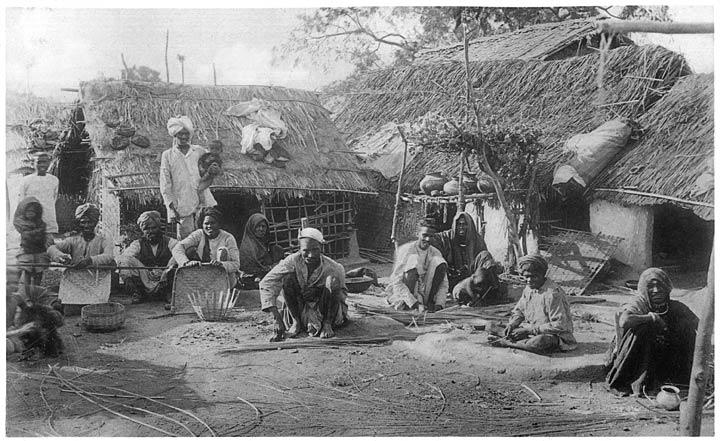
The paradigmatic ethnographic example of caste is the division of India's Hindu society into rigid social groups. Its roots lie in South Asia's ancient history and it still exists; however, the economic significance of the caste system in India seems to be declining as a result of urbanisation and affirmative action programs. A subject of much scholarship by sociologists and anthropologists, the Hindu caste system is sometimes used as an analogical basis for the study of caste-like social divisions existing outside Hinduism and India. In colonial Spanish America, mixed-race castas were a category within the Hispanic sector but the social order was otherwise fluid.
The English word caste (/kæst/, also UK: /kɑːst/) derives from the Spanish and Portuguese casta, which, according to the John Minsheu's Spanish dictionary (1569), means "race, lineage, tribe or breed". The Portuguese and Spanish word "casta" originated in Gothic "kasts" - "group of animals". The word entered the languages of the Iberian Peninsula with the sense "type of animal," and soon developed into "race of men" and later "class, condition of men". When the Spanish colonised the New World, they used the word to mean a 'clan or lineage'. It was, however, the Portuguese, the first Europeans to reach India by sea in 1498, to first employ casta in the primary modern sense of the English word 'caste' when they applied it to the thousands of endogamous, hereditary Indian social groups they encountered. The use of the spelling caste, with this latter meaning, is first attested in English in 1613. In the Latin American context, the term caste is sometimes used to describe the casta system of racial classification, based on whether a person was of pure European, Indigenous or African descent, or some mix thereof, with the different groups being placed in a racial hierarchy; however, despite the etymological connection between the Latin American casta system and South Asian caste systems (the former giving its name to the latter), it is controversial to what extent the two phenomena are really comparable.[page needed]
Modern India's caste system is based on the superimposition of an old four-fold theoretical classification called varna on the social ethnic grouping called jāti. The Vedic period conceptualised a society as consisting of four types of varnas, or categories: Brahmin, Kshatriya, Vaishya and Shudra, according to the nature of the work of its members. Varna was not an inherited category and the occupation determined the varna. However, a person's Jati is determined at birth and makes them take up that Jati's occupation; members could and did change their occupation based on personal strengths as well as economic, social and political factors.[citation needed] A 2016 study based on the DNA analysis of unrelated Indians determined that endogamous jatis originated during the Gupta Empire. Today, there are around 3,000 castes and 25,000 sub-castes in India.
From 1901 onwards, for the purposes of the Decennial Census, British authorities in India categorized all Jātis into the four Varna categories as described in ancient Indian texts. Herbert Hope Risley, the Census Commissioner, noted that "The principle suggested as a basis was that of classification by social precedence as recognized by native public opinion at the present day, and manifesting itself in the facts that particular castes are supposed to be the modern representatives of one or other of the castes of the theoretical Indian system."
Varna, as mentioned in ancient Hindu texts, describes society as divided into four categories: Brahmins (scholars and yajna priests), Kshatriyas (rulers and warriors), Vaishyas (farmers, merchants and artisans) and Shudras (workmen/service providers). Scholars believe that the Varnas system was never truly operational in society and there is no evidence of it ever being a reality in Indian history. The practical division of the society has been in terms of Jatis (birth groups), which are not based on any specific religious principle but could vary from ethnic origins to occupations to geographic areas. The Jātis have been endogamous social groups without any fixed hierarchy but subject to vague notions of rank articulated over time based on lifestyle and social, political, or economic status. Many of India's major empires and dynasties like the Mauryas,[page needed] Shalivahanas, Chalukyas,[full citation needed] Kakatiyas among many others, were founded by people who would have been classified as Shudras, under the Varnas system, as interpreted by the British. It is well established that by the 9th century, kings from all the four Varnas, including Brahmins and Vaishyas, had occupied the highest seat in the monarchical system in Hindu India, contrary to the Varna theory. Historically the kings and rulers had been called upon to mediate on the ranks of Jātis, which might number in thousands all over the subcontinent and vary by region. In practice, the jātis are seen to fit into the varna classes, but the varna status of jātis itself was subject to articulation over time.
Starting with the 1901 Census of India led by colonial administrator Herbert Hope Risley, all the jātis were grouped under the theoretical varnas categories. According to political scientist Lloyd Rudolph, Risley believed that varna, however ancient, could be applied to all the modern castes found in India, and "[he] meant to identify and place several hundred million Indians within it." The terms varna (conceptual classification based on occupation) and jāti (groups) are two distinct concepts: while varna is a theoretical four-part division, jāti (community) refers to the thousands of actual endogamous social groups prevalent across the subcontinent. The classical authors scarcely speak of anything other than the varnas, as it provided a convenient shorthand; but a problem arises when colonial Indologists sometimes confuse the two. Sujata Patel argues that colonial ethnographic practices, frequently in association with Brahmin elites, constructed Indian society as traditional and caste-based. These practices, according to Patel, emphasise the cultural and religious dimensions and downplay economic and political factors.
Upon independence from Britain, the Indian Constitution listed 1,108 Jatis across the country as Scheduled Castes in 1950, for positive discrimination. This constitution would also ban discrimination of the basis of the caste, though its practice in India remained intact. The Untouchable communities are sometimes called Dalit or Harijan in contemporary literature. In 2001, Dalits were 16.2% of India's population. Most of the 15 million bonded child workers are from the lowest castes. Independent India has witnessed caste-related violence. In 2005, government recorded approximately 110,000 cases of reported violent acts, including rape and murder, against Dalits.
Caste
A caste is a fixed social group into which an individual is born within a particular system of social stratification: a caste system. Within such a system, individuals are expected to marry exclusively within the same caste (endogamy), follow lifestyles often linked to a particular occupation, hold a ritual status observed within a hierarchy, and interact with others based on cultural notions of exclusion, with certain castes considered as either more pure or more polluted than others. The term "caste" is also applied to morphological groupings in eusocial insects such as ants, bees, and termites.
The paradigmatic ethnographic example of caste is the division of India's Hindu society into rigid social groups. Its roots lie in South Asia's ancient history and it still exists; however, the economic significance of the caste system in India seems to be declining as a result of urbanisation and affirmative action programs. A subject of much scholarship by sociologists and anthropologists, the Hindu caste system is sometimes used as an analogical basis for the study of caste-like social divisions existing outside Hinduism and India. In colonial Spanish America, mixed-race castas were a category within the Hispanic sector but the social order was otherwise fluid.
The English word caste (/kæst/, also UK: /kɑːst/) derives from the Spanish and Portuguese casta, which, according to the John Minsheu's Spanish dictionary (1569), means "race, lineage, tribe or breed". The Portuguese and Spanish word "casta" originated in Gothic "kasts" - "group of animals". The word entered the languages of the Iberian Peninsula with the sense "type of animal," and soon developed into "race of men" and later "class, condition of men". When the Spanish colonised the New World, they used the word to mean a 'clan or lineage'. It was, however, the Portuguese, the first Europeans to reach India by sea in 1498, to first employ casta in the primary modern sense of the English word 'caste' when they applied it to the thousands of endogamous, hereditary Indian social groups they encountered. The use of the spelling caste, with this latter meaning, is first attested in English in 1613. In the Latin American context, the term caste is sometimes used to describe the casta system of racial classification, based on whether a person was of pure European, Indigenous or African descent, or some mix thereof, with the different groups being placed in a racial hierarchy; however, despite the etymological connection between the Latin American casta system and South Asian caste systems (the former giving its name to the latter), it is controversial to what extent the two phenomena are really comparable.[page needed]
Modern India's caste system is based on the superimposition of an old four-fold theoretical classification called varna on the social ethnic grouping called jāti. The Vedic period conceptualised a society as consisting of four types of varnas, or categories: Brahmin, Kshatriya, Vaishya and Shudra, according to the nature of the work of its members. Varna was not an inherited category and the occupation determined the varna. However, a person's Jati is determined at birth and makes them take up that Jati's occupation; members could and did change their occupation based on personal strengths as well as economic, social and political factors.[citation needed] A 2016 study based on the DNA analysis of unrelated Indians determined that endogamous jatis originated during the Gupta Empire. Today, there are around 3,000 castes and 25,000 sub-castes in India.
From 1901 onwards, for the purposes of the Decennial Census, British authorities in India categorized all Jātis into the four Varna categories as described in ancient Indian texts. Herbert Hope Risley, the Census Commissioner, noted that "The principle suggested as a basis was that of classification by social precedence as recognized by native public opinion at the present day, and manifesting itself in the facts that particular castes are supposed to be the modern representatives of one or other of the castes of the theoretical Indian system."
Varna, as mentioned in ancient Hindu texts, describes society as divided into four categories: Brahmins (scholars and yajna priests), Kshatriyas (rulers and warriors), Vaishyas (farmers, merchants and artisans) and Shudras (workmen/service providers). Scholars believe that the Varnas system was never truly operational in society and there is no evidence of it ever being a reality in Indian history. The practical division of the society has been in terms of Jatis (birth groups), which are not based on any specific religious principle but could vary from ethnic origins to occupations to geographic areas. The Jātis have been endogamous social groups without any fixed hierarchy but subject to vague notions of rank articulated over time based on lifestyle and social, political, or economic status. Many of India's major empires and dynasties like the Mauryas,[page needed] Shalivahanas, Chalukyas,[full citation needed] Kakatiyas among many others, were founded by people who would have been classified as Shudras, under the Varnas system, as interpreted by the British. It is well established that by the 9th century, kings from all the four Varnas, including Brahmins and Vaishyas, had occupied the highest seat in the monarchical system in Hindu India, contrary to the Varna theory. Historically the kings and rulers had been called upon to mediate on the ranks of Jātis, which might number in thousands all over the subcontinent and vary by region. In practice, the jātis are seen to fit into the varna classes, but the varna status of jātis itself was subject to articulation over time.
Starting with the 1901 Census of India led by colonial administrator Herbert Hope Risley, all the jātis were grouped under the theoretical varnas categories. According to political scientist Lloyd Rudolph, Risley believed that varna, however ancient, could be applied to all the modern castes found in India, and "[he] meant to identify and place several hundred million Indians within it." The terms varna (conceptual classification based on occupation) and jāti (groups) are two distinct concepts: while varna is a theoretical four-part division, jāti (community) refers to the thousands of actual endogamous social groups prevalent across the subcontinent. The classical authors scarcely speak of anything other than the varnas, as it provided a convenient shorthand; but a problem arises when colonial Indologists sometimes confuse the two. Sujata Patel argues that colonial ethnographic practices, frequently in association with Brahmin elites, constructed Indian society as traditional and caste-based. These practices, according to Patel, emphasise the cultural and religious dimensions and downplay economic and political factors.
Upon independence from Britain, the Indian Constitution listed 1,108 Jatis across the country as Scheduled Castes in 1950, for positive discrimination. This constitution would also ban discrimination of the basis of the caste, though its practice in India remained intact. The Untouchable communities are sometimes called Dalit or Harijan in contemporary literature. In 2001, Dalits were 16.2% of India's population. Most of the 15 million bonded child workers are from the lowest castes. Independent India has witnessed caste-related violence. In 2005, government recorded approximately 110,000 cases of reported violent acts, including rape and murder, against Dalits.
Recent media
Recent media