
Recent from talks
Castel Nuovo
Knowledge base stats:
Talk channels stats:
Members stats:
Castel Nuovo
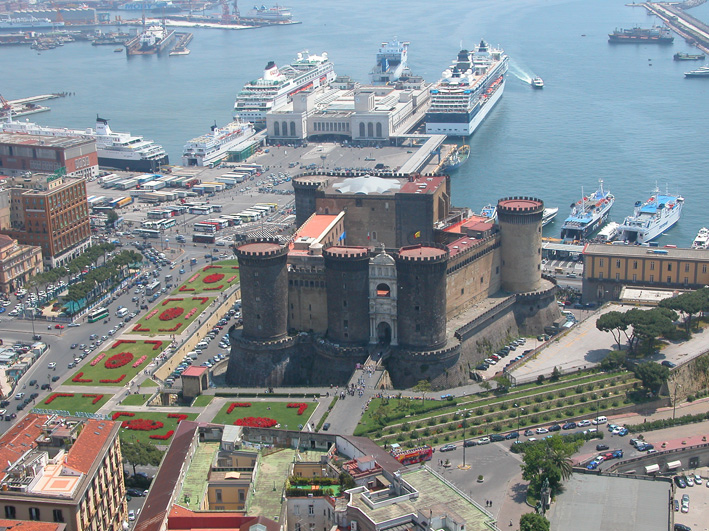
Castel Nuovo (Italian: [kaˌstɛl ˈnwɔːvo]; Neapolitan: Castiello Nuovo; 'New Castle'), often called Maschio Angioino (Italian: [ˈmaskjo andʒoˈiːno]; Neapolitan: Maschio Angiuino; 'Angevin Keep'), is a medieval castle located in front of Piazza Municipio and the city hall (Palazzo San Giacomo) in central Naples, Campania, Italy. Its scenic location and imposing size makes the castle, first erected in 1279, one of the main architectural landmarks of the city. It was a royal seat for kings of Naples, Aragon and Spain until 1815.
It is the headquarters of Società Napoletana di Storia Patria ("Neapolitan Society of Homeland History") and of the Naples Committee of the Istituto per la storia del Risorgimento italiano (Institute for the History of the Italian Risorgimento). In the complex there is also the civic museum, which includes the Palatine Chapel and the museum paths on the first and second floors.
The original nucleus of the estate—partially uncovered through restoration and archaeological excavations—was built on the initiative of Charles I of Anjou. In 1266, after defeating the Hohenstaufens, Charles ascended to the throne of Sicily and moved the capital from Palermo to Naples.
The presence of an external monarchy had set the town planning of Naples around the center of the royal power, constituting an alternative urban core, formed by the port and by the two main castles adjacent to it, Castel Capuano and Castel dell'Ovo. This relationship between the royal court and town planning had already manifested itself with Frederick II, Holy Roman Emperor, who in the 13th century, in the Swabian statute had concentrated greater attention on castles neglecting the city walls. To the two existing castles the Anjevins added the main, Castel Nuovo (Chastiau neuf), which was not just a fortification but above all his magnificent palace.
The royal residence of Naples had been until then the Castel Capuano, but the Norman ancient fortress was judged as inadequate to the function and the king wanted to build a new castle near the sea.
The project was designed by the French architect Pierre de Chaulnes, the construction of the Castrum Novum started in 1279 to finish just three years later, a very short time considering the techniques of construction of the period and the overall size of the work. However, the king never lived there: following the War of the Sicilian Vespers, which cost to the House of Anjou the crown of Sicily, conquered by Peter III of Aragon and other events, the new palace remained unused until 1285, the year of the death of Charles I.
The new king Charles II of Naples moved with his family and the court to the new residence, which he enlarged and embellished. During his reign the Holy See was particularly linked to the House of Anjou, in a turbulent relationship, which also in the following years will be marked by pressure, alliances and continuous ruptures. On December 13 of 1294 the Main Hall of the Castel Nuovo was the scene of the famous abdication of Pope Celestine V (the hermit Pietro da Morrone), from the papal throne, called by Dante Alighieri the great refusal and the following December 24, in the same hall the board of cardinals elected Benedetto Caetani, who assumed the name of Pope Boniface VIII and immediately moved its headquarters to Rome to avoid the interference of the Anjevin family.
With the ascent to the throne of Robert, King of Naples, in 1309, the castle, which he renovated and expanded, became a remarkable center of culture, because to his patronage and his passion for the arts and literature: the Castel Nuovo hosted important personalities of the culture of the time, such as the writers Petrarch and Giovanni Boccaccio in their Neapolitan stays, while the most famous painters of the time that they were called to paint its walls: Pietro Cavallini, Montano d'Arezzo, and above all Giotto, who in 1332 painted the Palatine Chapel.
Hub AI
Castel Nuovo AI simulator
(@Castel Nuovo_simulator)
Castel Nuovo
Castel Nuovo (Italian: [kaˌstɛl ˈnwɔːvo]; Neapolitan: Castiello Nuovo; 'New Castle'), often called Maschio Angioino (Italian: [ˈmaskjo andʒoˈiːno]; Neapolitan: Maschio Angiuino; 'Angevin Keep'), is a medieval castle located in front of Piazza Municipio and the city hall (Palazzo San Giacomo) in central Naples, Campania, Italy. Its scenic location and imposing size makes the castle, first erected in 1279, one of the main architectural landmarks of the city. It was a royal seat for kings of Naples, Aragon and Spain until 1815.
It is the headquarters of Società Napoletana di Storia Patria ("Neapolitan Society of Homeland History") and of the Naples Committee of the Istituto per la storia del Risorgimento italiano (Institute for the History of the Italian Risorgimento). In the complex there is also the civic museum, which includes the Palatine Chapel and the museum paths on the first and second floors.
The original nucleus of the estate—partially uncovered through restoration and archaeological excavations—was built on the initiative of Charles I of Anjou. In 1266, after defeating the Hohenstaufens, Charles ascended to the throne of Sicily and moved the capital from Palermo to Naples.
The presence of an external monarchy had set the town planning of Naples around the center of the royal power, constituting an alternative urban core, formed by the port and by the two main castles adjacent to it, Castel Capuano and Castel dell'Ovo. This relationship between the royal court and town planning had already manifested itself with Frederick II, Holy Roman Emperor, who in the 13th century, in the Swabian statute had concentrated greater attention on castles neglecting the city walls. To the two existing castles the Anjevins added the main, Castel Nuovo (Chastiau neuf), which was not just a fortification but above all his magnificent palace.
The royal residence of Naples had been until then the Castel Capuano, but the Norman ancient fortress was judged as inadequate to the function and the king wanted to build a new castle near the sea.
The project was designed by the French architect Pierre de Chaulnes, the construction of the Castrum Novum started in 1279 to finish just three years later, a very short time considering the techniques of construction of the period and the overall size of the work. However, the king never lived there: following the War of the Sicilian Vespers, which cost to the House of Anjou the crown of Sicily, conquered by Peter III of Aragon and other events, the new palace remained unused until 1285, the year of the death of Charles I.
The new king Charles II of Naples moved with his family and the court to the new residence, which he enlarged and embellished. During his reign the Holy See was particularly linked to the House of Anjou, in a turbulent relationship, which also in the following years will be marked by pressure, alliances and continuous ruptures. On December 13 of 1294 the Main Hall of the Castel Nuovo was the scene of the famous abdication of Pope Celestine V (the hermit Pietro da Morrone), from the papal throne, called by Dante Alighieri the great refusal and the following December 24, in the same hall the board of cardinals elected Benedetto Caetani, who assumed the name of Pope Boniface VIII and immediately moved its headquarters to Rome to avoid the interference of the Anjevin family.
With the ascent to the throne of Robert, King of Naples, in 1309, the castle, which he renovated and expanded, became a remarkable center of culture, because to his patronage and his passion for the arts and literature: the Castel Nuovo hosted important personalities of the culture of the time, such as the writers Petrarch and Giovanni Boccaccio in their Neapolitan stays, while the most famous painters of the time that they were called to paint its walls: Pietro Cavallini, Montano d'Arezzo, and above all Giotto, who in 1332 painted the Palatine Chapel.
Recent media