



Community hub
Recent from talks
Knowledge base stats:
Talk channels stats:
Members stats:
Castrop-Rauxel
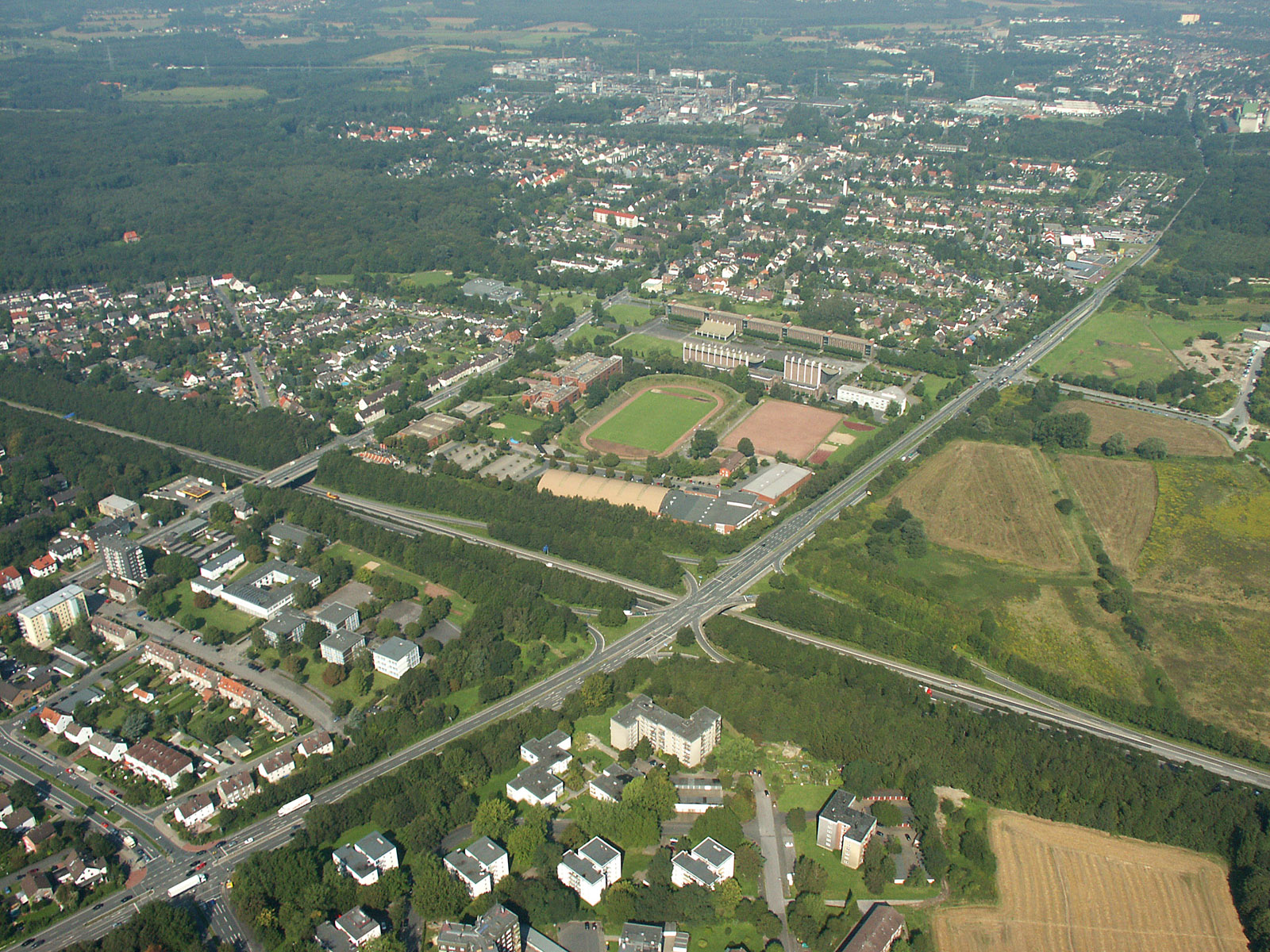
Castrop-Rauxel (German pronunciation: [ˌkastʁɔpˈʁaʊksl̩] ⓘ), often simply referred to as Castrop by locals, is a former coal mining city in the eastern part of the Ruhr Area within the state of North Rhine-Westphalia in Germany.
Castrop-Rauxel is located in Germany between Dortmund to the southeast, Bochum to the southwest, Herne to the west, Recklinghausen to the northwest, Datteln to the north and Waltrop to the northeast.
The city covers an area of 51.67 km2 (19.95 sq mi). The Halde Schwerin (slag heap in the Schwerin district) is marked as the point of highest elevation at 147 m (482.3 ft) above sea level. The lowest point is located on Pöppinghauser Straße (Poppinghausen Street), besides house number 264, with an elevation of 50.2 m (164.7 ft) above sea level.
The city is divided into 15 districts, from north to south and within one line from west (southwest) to east (northeast):
The total area of the city divided into different uses (31 December 2010):
Population figures for the individual districts (Stand: 2005):
Castrop-Rauxel was first mentioned in 834 as "Villa Castorpe",[citation needed]. The name could be derived from the Germanic words trop meaning "village" and kast meaning "barn" or "depot". Rauxel is the name of the northern part of the city. Rauxel was a village which was integrated into the city in 1926. It was first mentioned as "Rouksele" in 1266. This name might be derived from the Germanic words rouk meaning "crow" and sel meaning "meadow".
In 1847 the railway line from Cologne to Minden was opened and a railway station was built in the north of the village Castrop. The railway proved to be very useful for the economical development of the village. The first coal mine (Zeche Erin) was inaugurated by William Thomas Mulvany, an Irish industrialist living in Germany, close to the village in 1869. Another six coal mines were founded around Castrop soon afterwards. Between 1874 and 1878 another railway line was built between Duisburg and Dortmund with two train stations in the south of Castrop which developed into a mining town at the end of the 19th century.
Hub AI
Castrop-Rauxel AI simulator
(@Castrop-Rauxel_simulator)
Castrop-Rauxel
Castrop-Rauxel (German pronunciation: [ˌkastʁɔpˈʁaʊksl̩] ⓘ), often simply referred to as Castrop by locals, is a former coal mining city in the eastern part of the Ruhr Area within the state of North Rhine-Westphalia in Germany.
Castrop-Rauxel is located in Germany between Dortmund to the southeast, Bochum to the southwest, Herne to the west, Recklinghausen to the northwest, Datteln to the north and Waltrop to the northeast.
The city covers an area of 51.67 km2 (19.95 sq mi). The Halde Schwerin (slag heap in the Schwerin district) is marked as the point of highest elevation at 147 m (482.3 ft) above sea level. The lowest point is located on Pöppinghauser Straße (Poppinghausen Street), besides house number 264, with an elevation of 50.2 m (164.7 ft) above sea level.
The city is divided into 15 districts, from north to south and within one line from west (southwest) to east (northeast):
The total area of the city divided into different uses (31 December 2010):
Population figures for the individual districts (Stand: 2005):
Castrop-Rauxel was first mentioned in 834 as "Villa Castorpe",[citation needed]. The name could be derived from the Germanic words trop meaning "village" and kast meaning "barn" or "depot". Rauxel is the name of the northern part of the city. Rauxel was a village which was integrated into the city in 1926. It was first mentioned as "Rouksele" in 1266. This name might be derived from the Germanic words rouk meaning "crow" and sel meaning "meadow".
In 1847 the railway line from Cologne to Minden was opened and a railway station was built in the north of the village Castrop. The railway proved to be very useful for the economical development of the village. The first coal mine (Zeche Erin) was inaugurated by William Thomas Mulvany, an Irish industrialist living in Germany, close to the village in 1869. Another six coal mines were founded around Castrop soon afterwards. Between 1874 and 1878 another railway line was built between Duisburg and Dortmund with two train stations in the south of Castrop which developed into a mining town at the end of the 19th century.