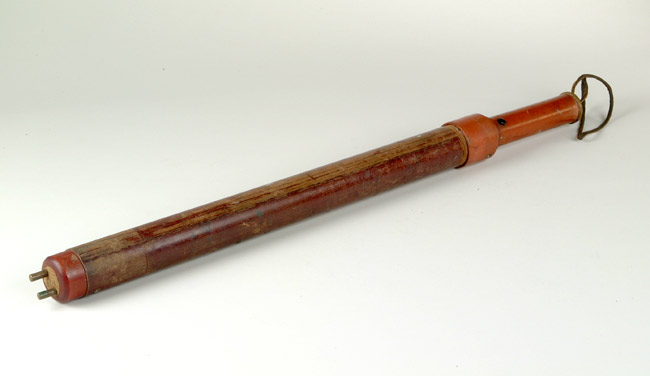

Cattle prod
View on Wikipedia
A cattle prod, also called a stock prod, is a handheld device commonly used to make cattle or other livestock move by striking or poking them. An electric cattle prod, also called a hot stick, is a stick with electrodes on the end which is used to make cattle move via a relatively high-voltage, low-current electric shock. The electric cattle prod is errantly claimed to have been invented by Texas cattle baron Robert J. Kleberg III,[1][2] of the King Ranch around 1930, although visual evidence such as an advertisement in a 1917 magazine confirms that versions were sold nearly 15 years prior:

Electric prods
[edit]
An electric cattle prod is typically cylindrical, and can carry an open electric current through two metal electrodes at the "shock end" when activated. Anything that touches the electrodes receives a high-voltage, non-fatal low-current shock, strong enough to cause significant pain.
The electric cattle prod is designed to inflict a painful shock to cattle, and thus "prod" them along; the pain stimulates movement.
There are various designs of electric cattle prods. Their shape is designed to make them easy to use and handle. They range in length from six inches (usually of a more encased rectangular prism design like a stun gun), to up to six feet. Most are simple designs powered by 9-volt battery or similarly small batteries, to make them small and light enough to wield. One typical design is a box containing a large battery (or battery pack) at the handle end and wires embedded in a fibreglass rod, ending with two electrodes in a rubber tip.
As the precursor of the stun gun, cattle prods have a wide range of voltage with enough current to operate in the same manner as a stun gun does against humans.
The use of electric cattle prods has been debated by many people.[3][4] Organizations such as PETA contend that the use of cattle prods is as much mentally harmful as it is physically.[5] Most farmers contend that the short shock is minutely felt, and soon forgotten.[citation needed]
Some higher-voltage prods can interfere with radio reception when activated.[citation needed]
Usage on people in policing and torture
[edit]
Cattle prods today are designed with a high range of voltages and currents. If more powerful prods are applied continuously to the skin, the current eventually causes heating, searing, burning, and scarring of skin at the contact point. Electric prods have found favour with torturers.[7]
Prior to the development of stun batons and the taser, electric cattle prods were also used on people in varying degrees. Their first common usage on people occurred during the Civil Rights Movement of the 1960s; prods were first adopted by police officers in Alabama to use on protesters and agencies elsewhere followed; Hotshot later developed an electric police baton.[8]
The picana is an electric prod based originally on the cattle prod but designed specifically for human torture. It works at very high voltage and low current so as to maximize pain and minimize the physical marks left on the victim. Among its advantages over other torture devices is that it is portable, easy to use, and allows the torturer to localize the electric shocks to the most sensitive places on the body, where they cause intense pain that can be repeated many times.
Electric shock devices, including cattle prods, have been used as a means of coercive control on autistic and mentally handicapped people.[9][10] Famous proponents of this practice include Matthew Israel and Ivar Lovaas.[11] The use of electric shocks in this way has been condemned as torture by the United Nations special rapporteur, and the United States Food and Drug Administration issued a ban on all such electric shock devices in 2020.[12]
On August 14, 2013 in Lakewood Township, New Jersey, gang leader Mendel Epstein told two undercover Federal Bureau of Investigation agents that he used a cattle prod to coerce Jewish husbands to grant religious divorces to their wives, leading the press to nickname him "The Prodfather".[13] The cattle prod had been favored as a torture device by Epstein due to its effectiveness when used on cattle.[14] He was convicted of conspiring to commit kidnapping, and sentenced to 10 years in prison.[15][16]
Alternatives
[edit]Cattle can be difficult to move and direct for a variety of reasons. Prods can be useful for moving stubborn or aggressive animals,[17] but often cattle will not move forward when they are fearful of something they see, hear, or smell. Removal of these distractions or hiding them, such as with solid wall partitions, can greatly reduce animal-handling problems;[18] however, cattle handlers cannot completely overcome the animal's decision not to move forward.
By studying the psychology of the animals and redesigning the working environment it is possible to handle the animals without the need for brute force and causing pain and suffering to the animal in many, but not all, cases. Significant work in this regard has been done by Colorado State University professor Temple Grandin to study how cattle perceive the environment around them and to design better livestock slaughterhouse handling systems that do not induce fear into the animal.[19]
See also
[edit]References
[edit]- ^ Broyles, William (October 1980). "The Last Empire". Texas Monthly. Emmis Publishing, L.P. Retrieved December 19, 2014.
- ^ Hutton, Paul Andrew (2013). Western Heritage: A Selection of Wrangler Award-Winning Articles. University of Oklahoma Press. p. 117. ISBN 978-0806189734.
- ^ Book: The Welfare of Cattle, By Jeffrey Rushen, Anne Maria De Passille, Marina A. G. von Keyserlingk, Daniel M. Weary, Contributor Jeffrey Rushen, Anne Maria De Passille, Marina A. G. von Keyserlingk, Published by Springer, 2007, ISBN 1-4020-6557-4 / ISBN 978-1-4020-6557-6, 310 pages
- ^ Editorial: A cattle prod for USDA, Saturday, February 23, 2008 – Slaughter plant workers videotaped shocking sick cattle with prods to keep them on their feet before slaughter Sacbee.com Archived 2008-07-24 at the Wayback Machine
- ^ Link to PETA website GoVeg.com, Cruelty to Animals: Cows
- ^ "Amnesty International Annual Report 2006". Amnesty International (in German). March 2006. Archived from the original on 2014-07-25. Retrieved 29 November 2017.
- ^ Crowley, Michael (5 September 2000). "Trading In Shock". New Internationalist. No. 327. Archived from the original on 2016-10-22. Retrieved 29 November 2017.
Electroshock weapons have become a favoured tool of many of the world's torturers. The 'torture trail' has often begun with companies in Europe and the US.
- ^ Rejali, Darius (2007). Torture and democracy. Princeton, New Jersey: Princeton University Press. p. 228. ISBN 978-0-691-11422-4.
- ^ "15 Mar 2007, 21 - The Berkshire Eagle at Newspapers.com". Newspapers.com. Retrieved 2020-08-12.
- ^ "15 Mar 2007, A10 - Daily Press at Newspapers.com". Newspapers.com. Retrieved 2020-08-12.
- ^ Willingham, Emily. "FDA Proposes Ban On Electric Shock Devices Used On Autistic Children". Forbes. Retrieved 2020-08-13.
- ^ Fortin, Jacey (2020-03-06). "F.D.A. Bans School Electric Shock Devices". The New York Times. ISSN 0362-4331. Retrieved 2020-08-08.
- ^ Mullen, Shannon (December 15, 2015). "10-year sentence for Lakewood 'Prodfather' rabbi". USA Today.
- ^ Marsh, Julia and Fears, Danika (April 6, 2016) "Rabbi Used Electric Cattle Prod to Force Husbands into Religious Divorces", New York Post
- ^ Blau, Reuven (April 22, 2015). "N.J. jury finds Orthodox rabbi guilty of kidnap-divorce plot". Archived from the original on 2017-08-25.
- ^ Albert, Samaha (December 4, 2013). "Bad Rabbi: Tales of Extortion and Torture Depict a Divorce Broker's Brutal Grip on the Orthodox Community". Village Voice. Archived from the original on 2017-10-11.
- ^ Grandin, Temple; Johnson, Catherine (2005). Animals in Translation. New York, New York: Scribner. p. 20. ISBN 0-7432-4769-8.
- ^ Link to Temple Grandin's website page, discussing common distractions that prevent animal movement through chutes and gates, with pictures of the distractions from the animal's viewpoint, grandin.com
- ^ Grandin, T. "Best Practices for Animal Handling and Stunning", Meat & Poultry, April 2000, pg. 76, grandin.com
Cattle prod
View on GrokipediaDefinition and Purpose
Core Function and Design Principles
The core function of an electric cattle prod is to administer a targeted, non-penetrating electric shock to livestock, eliciting an immediate behavioral response such as forward movement or aversion without inflicting lasting physical harm. This is achieved through contact between two electrodes and the animal's skin, completing an electrical circuit that delivers high-voltage pulses—typically in the range of 2,000 to 5,000 volts—at low current levels, often under 10 milliamperes, to stimulate superficial nerves and muscles via neuromuscular incapacitation rather than deep tissue damage.[10][11] The shock's primary effect is psychological and reflexive, leveraging the animal's instinctual reaction to pain or surprise to facilitate herding, loading, or sorting in agricultural settings.[6][5] Design principles emphasize ergonomic handling, electrical efficiency, and minimal risk to operators and animals. The device consists of a lightweight, insulated shaft—usually 24 to 48 inches long, made of durable plastic or composite materials—housing batteries and circuitry, with prong-like electrodes at the distal end spaced approximately 1-2 inches apart to ensure reliable arc or contact discharge. Power sources include replaceable alkaline batteries (e.g., four C-cells) or rechargeable lithium-ion packs, stepped up via an internal oscillator and transformer to generate the requisite voltage while limiting amperage through impedance control, thereby prioritizing operator safety during wet or close-quarters use.[12][13] Variants may incorporate flexible shafts for extended reach or LED indicators for battery status, but the fundamental architecture avoids continuous current flow, relying on momentary activation via a trigger or button to conserve energy and prevent accidental prolonged exposure.[14] This configuration balances efficacy in penetrating thick hides with adherence to animal welfare standards that discourage excessive force.[6]Historical Development
Invention and Early Adoption
An early design for an electric cattle prod appeared in the April 1917 issue of The Electrical Experimenter magazine, demonstrating the device's existence by the early 20th century through a handheld apparatus delivering electric shock to livestock.[15] This predates claims attributing invention to Texas rancher Robert J. Kleberg around 1930, though such accounts suggest refinements for practical ranch use.[16] The Hot-Shot brand prod, introduced in 1939 by a company founded in Savage, Minnesota, represented the first commercially available electric livestock prod in the United States, revolutionizing handling practices by providing a targeted, low-amperage shock to encourage animal movement without significant tissue damage.[7] Prior to widespread commercialization, rudimentary electric versions were likely prototyped or used experimentally in stockyards and ranches, building on emerging battery and induction coil technologies.[15] Early adoption centered on American cattle operations, where prods facilitated efficient herding, loading for transport, and restraint in processing facilities, reducing labor intensity and injury risks compared to mechanical prods or physical striking.[7] By the mid-20th century, these tools gained traction in the livestock industry for their ability to exploit animals' aversion to electric stimuli, promoting directional compliance through neuromuscular disruption rather than blunt force.[7]Technological Advancements
The electric cattle prod originated with John Burton's 1890 patent (US 427,549) for an "Electric Prod-Pole," which utilized a battery-powered induction coil and dual prongs to generate electrical shocks for directing livestock, representing the shift from mechanical poking tools to electrified alternatives.[17] This design relied on dry-cell batteries and basic wiring, prioritizing simplicity over portability, and laid the foundation for non-lethal aversive stimulation based on neuromuscular disruption rather than physical force.[18] Commercial viability emerged in 1939 with the introduction of the Hot-Shot prod by the Bar-Bar Corporation (later acquired by Miller Manufacturing), the first mass-produced electric livestock prod in the United States, which standardized battery operation and insulated shafts for safer handling amid wet or crowded conditions.[7] Post-World War II refinements emphasized durability, incorporating sealed components to resist moisture and debris—common failure points in early models—while maintaining low-amperage, high-voltage pulses (typically 2,000–4,000 volts in brief bursts) to minimize tissue damage and ensure repeated usability without recharging infrastructure.[19] Contemporary advancements, evident by the 2010s, include lithium-ion rechargeable batteries (e.g., 2,600 mAh USB-compatible units) over disposable alkaline cells, extending operational life to hundreds of shocks per charge and reducing environmental waste from battery disposal.[13] Ergonomic enhancements, such as rubber-overmolded grips and lightweight composite shafts, improve handler fatigue resistance during extended use, while integrated circuitry allows voltage modulation for species-specific applications—lower settings for smaller animals to avoid over-stimulation.[20] These iterations prioritize empirical reliability, with field-tested models demonstrating up to 90% reduced failure rates in adverse weather compared to 20th-century predecessors, driven by material science progress in insulation and corrosion resistance.[21]Technical Features
Electrical Mechanism
A cattle prod's electrical mechanism relies on a compact, battery-powered circuit that converts low-voltage direct current from rechargeable lithium-ion or alkaline batteries—typically 6–9 volts—into high-voltage pulses via an electronic oscillator and step-up transformer.[22] The oscillator, often a multivibrator or relaxation circuit using transistors, generates an alternating signal at frequencies around 500–2000 Hz, which drives the primary winding of the transformer to induce thousands of volts in the secondary winding.[23] This high-voltage output, usually pulsed DC or quasi-square waveform, is delivered through two closely spaced electrodes at the prod's tip upon trigger activation, creating an arc or direct contact shock across a small gap. Output specifications vary by model but generally feature peak voltages of 4,000–13,000 volts with extremely low current, often under 1 milliampere, ensuring the shock stimulates peripheral nerves and muscles via localized tetanic contraction without penetrating deep tissues or causing cardiac disruption.[24][25] Pulse duration is brief, typically milliseconds, limiting total energy delivery to 1–5 joules per discharge to prioritize aversive discomfort over incapacitation.[26] The low amperage, combined with the device's contact-only design, minimizes risks like burns or sustained injury, as the current density remains insufficient for ventricular fibrillation in livestock.[7] Modern variants incorporate sealed, shock-resistant circuitry with feedback prevention to avoid operator exposure, powered by circuits drawing 0.35–0.82 amperes from the battery during operation.[27] Early designs, such as those patented in the mid-20th century, used similar transformer-based boosting but with less efficient dry-cell batteries, yielding comparable voltage outputs.[23]Physical Construction and Variants
A cattle prod consists of an insulating shaft attached to a handle, with electrodes at the shaft's distal end for delivering electric shocks. The shaft is constructed from non-conductive materials such as fiberglass or synthetic plastic, often hollow to route insulated electrical leads, and measures 15 to 60 inches in length to suit varied handling distances.[28][29][22] The handle, molded from insulating plastic with a rubber grip to minimize user fatigue, encases the power source—typically dry cell C-batteries or rechargeable lithium-ion cells—and circuitry featuring a high-voltage pulse generator derived from low-voltage battery input. Activation occurs via a trigger or push-button switch, frequently equipped with a safety clip and finger guard; sealed components ensure durability in wet conditions.[30][12][29] Electrodes comprise paired metal tips, such as copper or bare conductive material, spaced approximately 1.5 inches apart at the shaft's end, sometimes mounted on an adjustable bifurcated head to optimize contact.[29][22] Variants distinguish between rigid fiberglass shafts for direct poking and flexible shafts bendable up to 180 degrees for maneuverability around obstacles; interchangeable shafts allow length customization. Battery-powered models emphasize reliability in remote settings, while rechargeable types extend operational time; select designs incorporate waterproofing, LED status indicators, and mechanisms to reduce operator feedback shock.[31][32][33]Primary Applications
Livestock Herding and Management
Cattle prods are primarily utilized in livestock herding and management to direct and motivate animals during loading, unloading, sorting, and movement through facilities such as chutes and pens. By delivering a brief, low-voltage electric shock—typically under 50 volts from battery-operated devices—the prod stimulates a reflexive response in the animal, encouraging forward movement without physical contact or injury when applied correctly to sensitive areas like the hindquarters.[6] This tool enhances handler safety by allowing control from a distance, particularly with aggressive or balking cattle, and is effective for refocusing attention in close-quarters tasks like feeding or veterinary procedures.[5] Empirical guidelines emphasize minimal prod usage to optimize efficacy and animal welfare; for instance, Temple Grandin advocates limiting application to 1-5% of cattle at squeeze chute entrances and 0% during group herding to prevent stress-induced behaviors such as bellowing or piling.[6] Studies indicate that excessive prodding elevates cortisol levels and contributes to meat quality defects like pale, soft, exudative (PSE) pork or dark-cutting beef, whereas low-stress techniques integrating prods as a last resort—after flags or paddles—reduce handling incidents and improve throughput.[34] [35] Battery-powered models provide precise, directional stimuli superior to older hot-iron types, minimizing unintended agitation.[6] In practice, effective management integrates prods within low-stress stockmanship principles, where handlers exploit cattle's flight zones and points of balance to guide movement naturally, resorting to the device only for immobile animals after addressing environmental distractions like shadows or air blasts.[36] University extension services recommend training to ensure prods serve as secondary aids, noting that skilled operators achieve near-zero usage in well-designed facilities, thereby lowering injury risks to both livestock and personnel.[37] [38]Adaptations for Other Uses
Cattle prods have been modified for handling other species of livestock beyond cattle, such as pigs and horses, with adjustments to voltage and design to account for differences in size, skin thickness, and sensitivity. For pigs, which require lower electrical output to prevent distress, prods delivering reduced amperage—typically under 0.01 amps—are recommended to encourage movement without causing undue pain or injury.[6] Horses, being more sensitive, often necessitate even milder stimuli, leading to adaptations like vibrating or non-electric prods in some handling protocols, though electric variants persist in certain large-animal operations.[6] These modifications prioritize minimal use to avoid welfare issues, as excessive application can elevate stress hormones in non-bovine species.[39] In veterinary and research settings, electric prods serve as tools for aversion training or facilitating movement of large animals during examinations, though guidelines emphasize restraint and low-stress alternatives to limit reliance on shocks.[7] For instance, in cattle research on behavioral modification, prods standardize aversive stimuli, but their extension to other ruminants like sheep is discouraged due to risks of panic in smaller animals.[7] The OIE (World Organisation for Animal Health) advises against prod use on sheep, calves under 100 pounds, or piglets, favoring flags or plastic boards instead.[6] Beyond agricultural and veterinary contexts, some commercial products resembling cattle prods—often rechargeable batons with extendable shafts—have been marketed for personal defense against aggressive dogs or as non-lethal deterrents, leveraging the device's reach and shock capability without the neuromuscular incapacitation of tasers.[14] These adaptations differ from traditional prods by incorporating features like waterproofing and LED lights, but they deliver contact-based shocks similar to livestock models, effective for pain compliance rather than remote deployment.[40] However, such uses on humans or wildlife remain unadapted in design intent, with efficacy limited compared to purpose-built stun devices, and legal restrictions often classify them alongside prohibited weapons in certain jurisdictions.[41] Empirical data on their defensive performance is sparse, primarily anecdotal, underscoring that cattle prods prioritize animal herding over human or multipurpose applications.[3]Efficacy and Safety in Animal Handling
Empirical Evidence on Effectiveness
Empirical studies indicate that electric cattle prods reliably elicit immediate avoidance and movement responses in livestock, facilitating herding and restraint compliance. In a controlled experiment involving 24 beef cattle restrained in a squeeze chute, animals exposed to five consecutive 1-second applications of an energized prod (delivering approximately 4,000 volts) displayed significantly higher frequencies of withdrawal behaviors, such as stepping backward (P < 0.01) and head tossing (P < 0.05), compared to those touched with a non-energized prod; these responses persisted across repetitions without habituation, demonstrating the prod's capacity to motivate rapid compliance even in restrained settings.[39] Similarly, infrared thermography assessments of cattle during handling procedures revealed that prod application correlated with accelerated exit speeds from races (P = 0.07), alongside elevated eye temperatures indicative of acute stress responses, underscoring the device's efficacy in prompting forward movement under aversive stimulation.[42] Physiological data further supports this effectiveness, as electric shock intensities from prods (typically 2,000–5,000 volts at low amperage) trigger measurable catecholamine surges in restrained cattle, comparable to acute stressors, which drive escape-oriented behaviors essential for management tasks like loading or sorting.80473-8/pdf) Livestock handling researcher Temple Grandin, drawing from observational audits across North American facilities, reports that targeted prod use on sensitive areas (e.g., hindquarters) achieves movement in over 95% of cases when facilities are well-designed, with optimal application rates below 5% of animals at chutes to avoid escalation.[6] Comparative aversion tests in Y-mazes confirm cattle actively avoid routes associated with prod exposure, selecting handler paths without shocks in 70–90% of trials, affirming the prod's role in reinforcing directional compliance through learned aversion.[43] While effective, efficacy diminishes with improper use or poor facility layout, as evidenced by increased vocalization rates (up to 20% higher) and balking in high-prod scenarios, per slaughter plant audits; nonetheless, when integrated with low-stress techniques, prods reduce overall handling time by prompting unresponsive animals without requiring physical force.[44] These findings, primarily from peer-reviewed behavioral and physiological assays, establish cattle prods as a potent tool for immediate behavioral control in agricultural settings, though their success hinges on minimal, judicious application to sustain responsiveness.Comparative Risks Versus Traditional Methods
Traditional methods of livestock herding, such as striking with sticks, canes, or whips, frequently result in physical injuries including carcass bruising, lacerations, and soft tissue damage, with rough handling accounting for up to 50% of observed bruises in beef cattle.[45] [46] These impacts arise from direct mechanical force, leading to economic losses estimated at $20–$50 per bruised carcass in U.S. beef processing as of 2018 data.[46] In contrast, electric cattle prods apply a high-voltage, low-amperage shock without sustained physical contact, substantially reducing the incidence of such visible trauma when used judiciously alongside low-stress techniques.[47] Empirical assessments in slaughter facilities show that protocols minimizing electric prod application—targeting 1–5% usage at restraint points—correlate with halved bruising rates compared to aggressive physical prodding, as quieter movement at a walk speed avoids balking and collisions.[48] [46] Vocalization rates, a proxy for acute stress, decline by up to 50% when prod use drops below 10% of animals handled, outperforming traditional yelling or whipping, which elevate cortisol and aggression independently of injury.[49] However, overuse of prods (>20% of cattle) induces comparable or higher fear responses, including handler avoidance and elevated heart rates, mirroring stress from physical beatings but without residual wounds.[48] [50]| Risk Factor | Traditional Methods (e.g., Sticks/Whips) | Electric Prods (Minimal Use) |
|---|---|---|
| Physical Injury (Bruising/Lacerations) | High (50% of carcasses affected by rough handling) | Low (non-contact shock; reduces bruises by 50% in low-stress protocols)[46] |
| Acute Stress (Vocalization/Cortisol) | High (from pain and noise) | Moderate (shock-induced but lower with flags as primary aid)[49] |
| Long-Term Welfare (e.g., Reproductive Impact) | Moderate (cumulative trauma impairs function) | Low if <5% use; higher if over-relied upon[50] |