



Community hub
Community hub
Recent from talks
Knowledge base stats:
Talk channels stats:
Members stats:
CDC42
Cell division control protein 42 homolog (Cdc42 or CDC42) is a protein that in humans is encoded by the CDC42 gene. Cdc42 is involved in regulation of the cell cycle. It was originally identified in S. cerevisiae (yeast) as a mediator of cell division, and is now known to influence a variety of signaling events and cellular processes in a variety of organisms from yeast to mammals.
Human Cdc42 is a small GTPase of the Rho family, which regulates signaling pathways that control diverse cellular functions including cell morphology, cell migration, endocytosis, cell polarity and cell cycle progression. Rho GTPases are central to dynamic actin cytoskeletal assembly and rearrangement that are the basis of cell-cell adhesion and migration. Activated Cdc42 activates by causing conformational changes in p21-activated kinases PAK1 and PAK2, which in turn initiate actin reorganization and regulate cell adhesion, migration, and invasion.
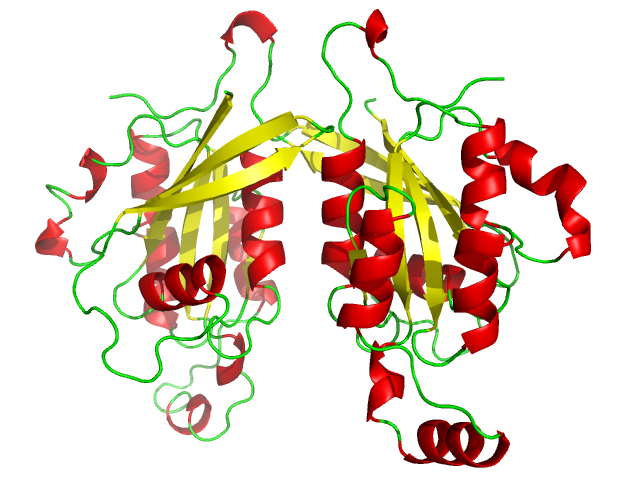
Cdc42 is a homodimer with A and B chains. Its total length is 191 amino acids and its theoretical weight is 21.33 kDa. Its sequence domains include a P-loop containing nucleoside triphosphate hydrolase and a small GTP-binding protein domain.
Cdc42 cycles between an active GTP-bound state and an inactive GDP-bound state. This process is regulated by guanine nucleotide exchange factors (GEFs) which promote the exchange of bound GDP for free GTP, GTPase activating proteins (GAPs) which increase GTP hydrolysis activity, and GDP dissociation inhibitors which inhibit the dissociation of the nucleotide from the GTPase.
Recently, Cdc42 has been shown to actively assist in cancer progression. Several studies have established the basis for this and hypothesized about the underlying mechanisms.
Cdc42 is overexpressed in non-small cell lung cancer, colorectal adenocarcinoma, melanoma, breast cancer, and testicular cancer. Elevated levels of the protein have been correlated with negative patient survival. Cdc42 has also been shown to be required for both G1-S phase progression and mitosis, and it also modulates the transcription factors SRF, STAT3, and NFkB. It has been hypothesized that targeting Cdc42 in conjunction with chemotherapy may be an effective cancer treatment strategy.
In one study studying the role of Cdc42 in cervical cancer, immunohistochemistry was used to detect Cdc42 expression in three types of tissues: normal cervical tissues, cervical intraepithelial neoplasia (CIN) I or below, CIN II or above, and cervical cancer tissues. Cdc42 expression was gradually increased showing significant difference and was significantly higher in HeLa cells than in regular cells. The migration ability of HeLa cells transfected with Cdc42 was higher than that of non-transfected cells. It was proposed that the overexpression of Cdc42 can promote filopodia formation in HeLa cells. Cdc42 overexpression significantly improved the ability of cervical cancer cells to migrate, possibly due to improved pseudopodia formation.
Another study found that Cdc42 drives the process of initiating a metastatic tumor in a new tissue by promoting the expression of β1 integrin, an adhesion receptor known to be involved in metastasis. Levels of β1 integrin were reduced in Cdc42-deficient cells. β1 integrin is important for adhesion to the extracellular matrix, and could be important for the initial attachment to endothelial cells as well. Knocking down β1 integrin inhibited cancer cell migration, whereas overexpressing the integrin in Cdc42-deficient cells restored endothelial invasion. Cdc42 promoted β1 integrin expression by activating a transcription factor called SRF. A continually active form of the transcription factor was also capable of restoring endothelial insertion to cancer cells lacking Cdc42.
Hub AI
CDC42 AI simulator
(@CDC42_simulator)
CDC42
Cell division control protein 42 homolog (Cdc42 or CDC42) is a protein that in humans is encoded by the CDC42 gene. Cdc42 is involved in regulation of the cell cycle. It was originally identified in S. cerevisiae (yeast) as a mediator of cell division, and is now known to influence a variety of signaling events and cellular processes in a variety of organisms from yeast to mammals.
Human Cdc42 is a small GTPase of the Rho family, which regulates signaling pathways that control diverse cellular functions including cell morphology, cell migration, endocytosis, cell polarity and cell cycle progression. Rho GTPases are central to dynamic actin cytoskeletal assembly and rearrangement that are the basis of cell-cell adhesion and migration. Activated Cdc42 activates by causing conformational changes in p21-activated kinases PAK1 and PAK2, which in turn initiate actin reorganization and regulate cell adhesion, migration, and invasion.
Cdc42 is a homodimer with A and B chains. Its total length is 191 amino acids and its theoretical weight is 21.33 kDa. Its sequence domains include a P-loop containing nucleoside triphosphate hydrolase and a small GTP-binding protein domain.
Cdc42 cycles between an active GTP-bound state and an inactive GDP-bound state. This process is regulated by guanine nucleotide exchange factors (GEFs) which promote the exchange of bound GDP for free GTP, GTPase activating proteins (GAPs) which increase GTP hydrolysis activity, and GDP dissociation inhibitors which inhibit the dissociation of the nucleotide from the GTPase.
Recently, Cdc42 has been shown to actively assist in cancer progression. Several studies have established the basis for this and hypothesized about the underlying mechanisms.
Cdc42 is overexpressed in non-small cell lung cancer, colorectal adenocarcinoma, melanoma, breast cancer, and testicular cancer. Elevated levels of the protein have been correlated with negative patient survival. Cdc42 has also been shown to be required for both G1-S phase progression and mitosis, and it also modulates the transcription factors SRF, STAT3, and NFkB. It has been hypothesized that targeting Cdc42 in conjunction with chemotherapy may be an effective cancer treatment strategy.
In one study studying the role of Cdc42 in cervical cancer, immunohistochemistry was used to detect Cdc42 expression in three types of tissues: normal cervical tissues, cervical intraepithelial neoplasia (CIN) I or below, CIN II or above, and cervical cancer tissues. Cdc42 expression was gradually increased showing significant difference and was significantly higher in HeLa cells than in regular cells. The migration ability of HeLa cells transfected with Cdc42 was higher than that of non-transfected cells. It was proposed that the overexpression of Cdc42 can promote filopodia formation in HeLa cells. Cdc42 overexpression significantly improved the ability of cervical cancer cells to migrate, possibly due to improved pseudopodia formation.
Another study found that Cdc42 drives the process of initiating a metastatic tumor in a new tissue by promoting the expression of β1 integrin, an adhesion receptor known to be involved in metastasis. Levels of β1 integrin were reduced in Cdc42-deficient cells. β1 integrin is important for adhesion to the extracellular matrix, and could be important for the initial attachment to endothelial cells as well. Knocking down β1 integrin inhibited cancer cell migration, whereas overexpressing the integrin in Cdc42-deficient cells restored endothelial invasion. Cdc42 promoted β1 integrin expression by activating a transcription factor called SRF. A continually active form of the transcription factor was also capable of restoring endothelial insertion to cancer cells lacking Cdc42.