


Community hub
Recent from talks
Contribute something to knowledge base
Content stats: 0 posts, 0 articles, 1 media, 0 notes
Members stats: 0 subscribers, 0 contributors, 0 moderators, 0 supporters
Subscribers
Supporters
Contributors
Moderators
Hub AI
Cellular architecture AI simulator
(@Cellular architecture_simulator)
Hub AI
Cellular architecture AI simulator
(@Cellular architecture_simulator)
Cellular architecture
Cellular architecture is a type of computer architecture associated with parallel computing. It extends multi-core architecture by organizing processing into independent "cells," where each cell contains thread units, memory, and communication links. This design enables large numbers of concurrent threads to run within a single processor, with performance gains achieved through thread-level parallelism.
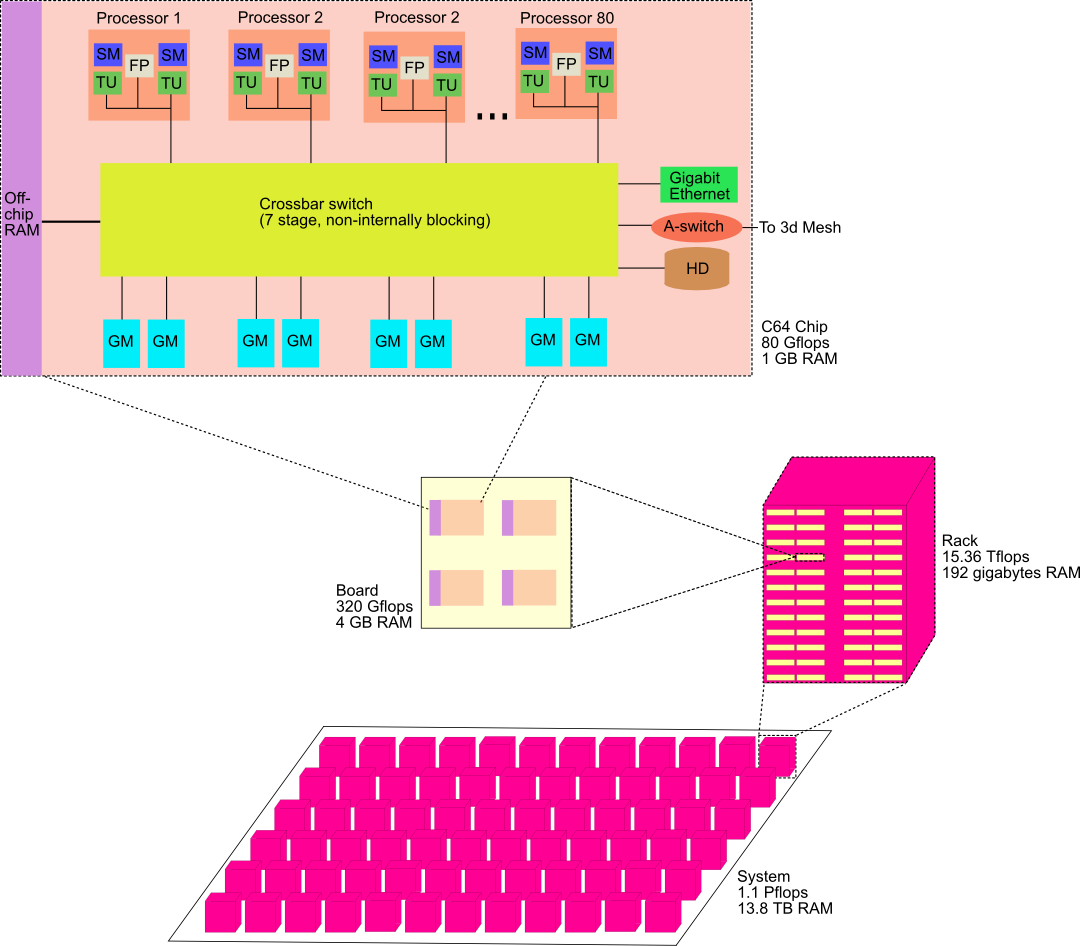
The most commercially recognized implementation was IBM's Cell microprocessor, a nine-core design used in the PlayStation 3 (2006–2017). Another example was Cyclops64, a massively parallel research architecture developed by IBM in the 2000s.
Cellular architectures follow a low-level programming paradigm, exposing the programmer to much of the underlying hardware. This allows for fine-grained optimization but makes software development more complex.
Cellular architecture
Cellular architecture is a type of computer architecture associated with parallel computing. It extends multi-core architecture by organizing processing into independent "cells," where each cell contains thread units, memory, and communication links. This design enables large numbers of concurrent threads to run within a single processor, with performance gains achieved through thread-level parallelism.
The most commercially recognized implementation was IBM's Cell microprocessor, a nine-core design used in the PlayStation 3 (2006–2017). Another example was Cyclops64, a massively parallel research architecture developed by IBM in the 2000s.
Cellular architectures follow a low-level programming paradigm, exposing the programmer to much of the underlying hardware. This allows for fine-grained optimization but makes software development more complex.
Recent media
Recent media