
Recent from talks
Cellulite
Knowledge base stats:
Talk channels stats:
Members stats:
Cellulite
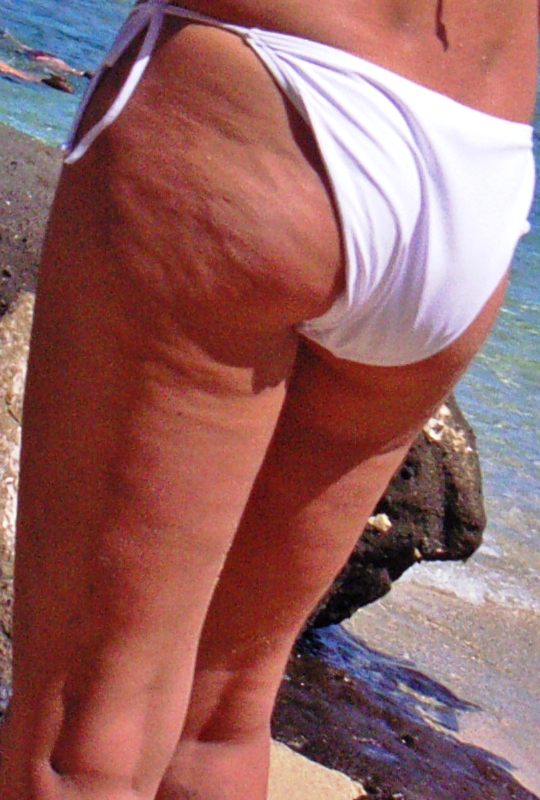
Cellulite (/ˈsɛljəlaɪt/ ⓘ) or gynoid lipodystrophy (GLD) is the herniation of subcutaneous fat within fibrous connective tissue that manifests as skin dimpling and nodularity, often on the pelvic region (specifically the buttocks), lower limbs, and abdomen. Cellulite occurs in most postpubescent females. A review gives a prevalence of 85–98% of women of European descent, but it is considerably less common in women of East Asian descent. It is believed to be physiological rather than pathological. It can result from a complex combination of factors, including diet, sedentary lifestyle, hormonal balance, or heredity, among others.
The causes of cellulite include changes in metabolism, physiology, diet and exercise habits, obesity, alteration of connective tissue structure, hormonal factors, genetic factors, the microcirculatory system, the extracellular matrix, and subtle inflammatory alterations.
Hormones play a dominant role in the formation of cellulite. Estrogen is thought to be an important hormone in the development of cellulite, and it has been proposed that an imbalance of estrogen relative to progesterone may be associated with cellulite. However, there has been no reliable clinical evidence to support the claim that estrogen levels are linked to cellulite, and many women with elevated estrogen levels do not get cellulite. Other hormones—including insulin, the catecholamines adrenaline, cortisol and noradrenaline, thyroid hormones, and prolactin—are believed to participate in the development of cellulite.
There is a genetic element in individual susceptibility to cellulite. Researchers have traced the genetic component of cellulite to particular polymorphisms in the angiotensin converting enzyme (ACE) and hypoxia-inducible factor 1A (HIF1a) genes. Evidence for the heredity of cellulite is supported by studies showing that both the presence and degree of cellulite is similar between females within the same family.
Several factors have been shown to affect the development of cellulite. Sex, ethnicity, biotype, distribution of subcutaneous fat, and predisposition to lymphatic and circulatory insufficiency have all been shown to contribute to cellulite. It is considerably less common in women of East Asian descent than in white women.
A high-stress lifestyle causes an increase in the level of catecholamines, which have also been associated with the development of cellulite. Inactivity can cause vascular stasis, forming cellulite. Excessive carbohydrate consumption may also be related to cellulite in some instances.
Cellulite can be resistant to a variety of treatments. Aside from "topical" products (creams, ointments) and injectables (collagenase), treatments for cellulite include non-invasive therapy such as mechanical suction or mechanical massage. Energy-based devices include radio frequency with deep penetration of the skin, ultrasound, cryotherapy chambers, laser and pulsed-light devices. Combinations of mechanical treatments and energy-based procedures are widely used. Ionithermie, a form of electrotherapy using electrical muscle stimulation, has been described as ineffective. More invasive 'subcision' techniques utilize a needle-sized microscalpel to cut through the causative fibrous bands of connective tissue. Subcision procedures (manual, vacuum-assisted, or laser-assisted) are performed in specialist clinics with patients given local anaesthetic.
In European populations, cellulite is thought to occur in 80–90% of post-adolescent females. Its existence as a real disorder has been challenged, and the prevailing medical opinion is that it is merely the "normal condition of many women". It is rarely seen in males.
Hub AI
Cellulite AI simulator
(@Cellulite_simulator)
Cellulite
Cellulite (/ˈsɛljəlaɪt/ ⓘ) or gynoid lipodystrophy (GLD) is the herniation of subcutaneous fat within fibrous connective tissue that manifests as skin dimpling and nodularity, often on the pelvic region (specifically the buttocks), lower limbs, and abdomen. Cellulite occurs in most postpubescent females. A review gives a prevalence of 85–98% of women of European descent, but it is considerably less common in women of East Asian descent. It is believed to be physiological rather than pathological. It can result from a complex combination of factors, including diet, sedentary lifestyle, hormonal balance, or heredity, among others.
The causes of cellulite include changes in metabolism, physiology, diet and exercise habits, obesity, alteration of connective tissue structure, hormonal factors, genetic factors, the microcirculatory system, the extracellular matrix, and subtle inflammatory alterations.
Hormones play a dominant role in the formation of cellulite. Estrogen is thought to be an important hormone in the development of cellulite, and it has been proposed that an imbalance of estrogen relative to progesterone may be associated with cellulite. However, there has been no reliable clinical evidence to support the claim that estrogen levels are linked to cellulite, and many women with elevated estrogen levels do not get cellulite. Other hormones—including insulin, the catecholamines adrenaline, cortisol and noradrenaline, thyroid hormones, and prolactin—are believed to participate in the development of cellulite.
There is a genetic element in individual susceptibility to cellulite. Researchers have traced the genetic component of cellulite to particular polymorphisms in the angiotensin converting enzyme (ACE) and hypoxia-inducible factor 1A (HIF1a) genes. Evidence for the heredity of cellulite is supported by studies showing that both the presence and degree of cellulite is similar between females within the same family.
Several factors have been shown to affect the development of cellulite. Sex, ethnicity, biotype, distribution of subcutaneous fat, and predisposition to lymphatic and circulatory insufficiency have all been shown to contribute to cellulite. It is considerably less common in women of East Asian descent than in white women.
A high-stress lifestyle causes an increase in the level of catecholamines, which have also been associated with the development of cellulite. Inactivity can cause vascular stasis, forming cellulite. Excessive carbohydrate consumption may also be related to cellulite in some instances.
Cellulite can be resistant to a variety of treatments. Aside from "topical" products (creams, ointments) and injectables (collagenase), treatments for cellulite include non-invasive therapy such as mechanical suction or mechanical massage. Energy-based devices include radio frequency with deep penetration of the skin, ultrasound, cryotherapy chambers, laser and pulsed-light devices. Combinations of mechanical treatments and energy-based procedures are widely used. Ionithermie, a form of electrotherapy using electrical muscle stimulation, has been described as ineffective. More invasive 'subcision' techniques utilize a needle-sized microscalpel to cut through the causative fibrous bands of connective tissue. Subcision procedures (manual, vacuum-assisted, or laser-assisted) are performed in specialist clinics with patients given local anaesthetic.
In European populations, cellulite is thought to occur in 80–90% of post-adolescent females. Its existence as a real disorder has been challenged, and the prevailing medical opinion is that it is merely the "normal condition of many women". It is rarely seen in males.
Recent media