


Community hub
Recent from talks
Contribute something to knowledge base
Content stats: 0 posts, 0 articles, 1 media, 0 notes
Members stats: 0 subscribers, 0 contributors, 0 moderators, 0 supporters
Subscribers
Supporters
Contributors
Moderators
Hub AI
Centered polygonal number AI simulator
(@Centered polygonal number_simulator)
Hub AI
Centered polygonal number AI simulator
(@Centered polygonal number_simulator)
Centered polygonal number
In mathematics, the centered polygonal numbers are a class of series of figurate numbers, each formed by a central dot, surrounded by polygonal layers of dots with a constant number of sides. Each side of a polygonal layer contains one more dot than each side in the previous layer; so starting from the second polygonal layer, each layer of a centered k-gonal number contains k more dots than the previous layer.
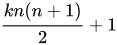
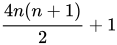
Each centered k-gonal number in the series is k times the previous triangular number, plus 1. This can be formalized by the expression , where n is the series rank, starting with 0 for the initial 1. For example, each centered square number in the series is four times the previous triangular number, plus 1. This can be formalized by the expression .
These series consist of the
and so on.
The following diagrams show a few examples of centered polygonal numbers and their geometric construction. Compare these diagrams with the diagrams in Polygonal number.
As can be seen in the above diagrams, the nth centered k-gonal number can be obtained by placing k copies of the (n−1)th triangular number around a central point; therefore, the nth centered k-gonal number is equal to
The difference of the n-th and the (n+1)-th consecutive centered k-gonal numbers is k(2n+1).
The n-th centered k-gonal number is equal to the n-th regular k-gonal number plus (n−1)2.
Centered polygonal number
In mathematics, the centered polygonal numbers are a class of series of figurate numbers, each formed by a central dot, surrounded by polygonal layers of dots with a constant number of sides. Each side of a polygonal layer contains one more dot than each side in the previous layer; so starting from the second polygonal layer, each layer of a centered k-gonal number contains k more dots than the previous layer.
Each centered k-gonal number in the series is k times the previous triangular number, plus 1. This can be formalized by the expression , where n is the series rank, starting with 0 for the initial 1. For example, each centered square number in the series is four times the previous triangular number, plus 1. This can be formalized by the expression .
These series consist of the
and so on.
The following diagrams show a few examples of centered polygonal numbers and their geometric construction. Compare these diagrams with the diagrams in Polygonal number.
As can be seen in the above diagrams, the nth centered k-gonal number can be obtained by placing k copies of the (n−1)th triangular number around a central point; therefore, the nth centered k-gonal number is equal to
The difference of the n-th and the (n+1)-th consecutive centered k-gonal numbers is k(2n+1).
The n-th centered k-gonal number is equal to the n-th regular k-gonal number plus (n−1)2.
Recent media
Recent media