



Community hub
Recent from talks
Contribute something
Nothing was collected or created yet.
Polygonal number
View on WikipediaIn mathematics, a polygonal number is a number that counts dots arranged in the shape of a regular polygon.[1]: 2-3 These are one type of 2-dimensional figurate numbers.
Polygonal numbers were first studied during the 6th century BC by the Ancient Greeks, who investigated and discussed properties of oblong, triangular, and square numbers.[1]: 1
Definition and examples
[edit]The number 10 for example, can be arranged as a triangle (see triangular number):

But 10 cannot be arranged as a square. The number 9, on the other hand, can be (see square number):

Some numbers, like 36, can be arranged both as a square and as a triangle (see square triangular number):
By convention, 1 is the first polygonal number for any number of sides. The rule for enlarging the polygon to the next size is to extend two adjacent arms by one point and to then add the required extra sides between those points. In the following diagrams, each extra layer is shown as in red.
Triangular numbers
[edit]
The triangular number sequence is the representation of the numbers in the form of equilateral triangle arranged in a series or sequence. These numbers are in a sequence of 1, 3, 6, 10, 15, 21, 28, 36, 45, and so on.
Square numbers
[edit]
Polygons with higher numbers of sides, such as pentagons and hexagons, can also be constructed according to this rule, although the dots will no longer form a perfectly regular lattice like above.
Pentagonal numbers
[edit]
Hexagonal numbers
[edit]
Formula
[edit]
If s is the number of sides in a polygon, the formula for the nth s-gonal number P(s,n) is

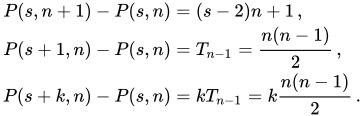
The nth s-gonal number is also related to the triangular numbers Tn as follows:[2]

Thus:
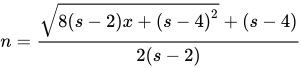
For a given s-gonal number P(s,n) = x, one can find n by
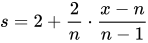
and one can find s by
- .
Every hexagonal number is also a triangular number
[edit]
Applying the formula above:

to the case of 6 sides gives:

but since:
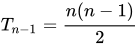
it follows that:

This shows that the nth hexagonal number P(6,n) is also the (2n − 1)th triangular number T2n−1. We can find every hexagonal number by simply taking the odd-numbered triangular numbers:[2]
- 1, 3, 6, 10, 15, 21, 28, 36, 45, 55, 66, ...
Table of values
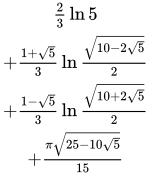
[edit]The first six values in the column "sum of reciprocals", for triangular to octagonal numbers, come from a published solution to the general problem, which also gives a general formula for any number of sides, in terms of the digamma function.[3]
| s | Name | Formula | n | Sum of reciprocals[3][4] | OEIS number | ||||||||||
|---|---|---|---|---|---|---|---|---|---|---|---|---|---|---|---|
| 1 | 2 | 3 | 4 | 5 | 6 | 7 | 8 | 9 | 10 | 11 | |||||
| 2 | Natural (line segment) | 1/2(0n2 + 2n) = n | 1 | 2 | 3 | 4 | 5 | 6 | 7 | 8 | 9 | 10 | 11 | ∞ (diverges) | A000027 |
| 3 | Triangular | 1/2(n2 + n) | 1 | 3 | 6 | 10 | 15 | 21 | 28 | 36 | 45 | 55 | 66 | 2[3] | A000217 |
| 4 | Square | 1/2(2n2 − 0n) = n2 |
1 | 4 | 9 | 16 | 25 | 36 | 49 | 64 | 81 | 100 | 121 | π2/6[3][α] | A000290 |
| 5 | Pentagonal | 1/2(3n2 − n) | 1 | 5 | 12 | 22 | 35 | 51 | 70 | 92 | 117 | 145 | 176 | 3 ln 3 − π√3/3[3] | A000326 |
| 6 | Hexagonal | 1/2(4n2 − 2n) = 2n2 − n |
1 | 6 | 15 | 28 | 45 | 66 | 91 | 120 | 153 | 190 | 231 | 2 ln 2[3] | A000384 |
| 7 | Heptagonal | 1/2(5n2 − 3n) | 1 | 7 | 18 | 34 | 55 | 81 | 112 | 148 | 189 | 235 | 286 | [3] | A000566 |
| 8 | Octagonal | 1/2(6n2 − 4n) = 3n2 − 2n |
1 | 8 | 21 | 40 | 65 | 96 | 133 | 176 | 225 | 280 | 341 | 3/4 ln 3 + π√3/12[3] | A000567 |
| 9 | Nonagonal | 1/2(7n2 − 5n) | 1 | 9 | 24 | 46 | 75 | 111 | 154 | 204 | 261 | 325 | 396 | A001106 | |
| 10 | Decagonal | 1/2(8n2 − 6n) = 4n2 − 3n |
1 | 10 | 27 | 52 | 85 | 126 | 175 | 232 | 297 | 370 | 451 | ln 2 + π/6 | A001107 |
| 11 | Hendecagonal | 1/2(9n2 − 7n) | 1 | 11 | 30 | 58 | 95 | 141 | 196 | 260 | 333 | 415 | 506 | A051682 | |
| 12 | Dodecagonal | 1/2(10n2 − 8n) | 1 | 12 | 33 | 64 | 105 | 156 | 217 | 288 | 369 | 460 | 561 | A051624 | |
| 13 | Tridecagonal | 1/2(11n2 − 9n) | 1 | 13 | 36 | 70 | 115 | 171 | 238 | 316 | 405 | 505 | 616 | A051865 | |
| 14 | Tetradecagonal | 1/2(12n2 − 10n) | 1 | 14 | 39 | 76 | 125 | 186 | 259 | 344 | 441 | 550 | 671 | 2/5 ln 2 + 3/10 ln 3 + π√3/10 | A051866 |
| 15 | Pentadecagonal | 1/2(13n2 − 11n) | 1 | 15 | 42 | 82 | 135 | 201 | 280 | 372 | 477 | 595 | 726 | A051867 | |
| 16 | Hexadecagonal | 1/2(14n2 − 12n) | 1 | 16 | 45 | 88 | 145 | 216 | 301 | 400 | 513 | 640 | 781 | A051868 | |
| 17 | Heptadecagonal | 1/2(15n2 − 13n) | 1 | 17 | 48 | 94 | 155 | 231 | 322 | 428 | 549 | 685 | 836 | A051869 | |
| 18 | Octadecagonal | 1/2(16n2 − 14n) | 1 | 18 | 51 | 100 | 165 | 246 | 343 | 456 | 585 | 730 | 891 | 4/7 ln 2 − √2/14 ln (3 − 2√2) + π(1 + √2)/14 | A051870 |
| 19 | Enneadecagonal | 1/2(17n2 − 15n) | 1 | 19 | 54 | 106 | 175 | 261 | 364 | 484 | 621 | 775 | 946 | A051871 | |
| 20 | Icosagonal | 1/2(18n2 − 16n) | 1 | 20 | 57 | 112 | 185 | 276 | 385 | 512 | 657 | 820 | 1001 | A051872 | |
| 21 | Icosihenagonal | 1/2(19n2 − 17n) | 1 | 21 | 60 | 118 | 195 | 291 | 406 | 540 | 693 | 865 | 1056 | A051873 | |
| 22 | Icosidigonal | 1/2(20n2 − 18n) | 1 | 22 | 63 | 124 | 205 | 306 | 427 | 568 | 729 | 910 | 1111 | A051874 | |
| 23 | Icositrigonal | 1/2(21n2 − 19n) | 1 | 23 | 66 | 130 | 215 | 321 | 448 | 596 | 765 | 955 | 1166 | A051875 | |
| 24 | Icositetragonal | 1/2(22n2 − 20n) | 1 | 24 | 69 | 136 | 225 | 336 | 469 | 624 | 801 | 1000 | 1221 | A051876 | |
| s = 25 | 1/2(23n2 − 21n) | 1 | 25 | 72 | 142 | 235 | 351 | 490 | 652 | 837 | 1045 | 1276 | |||
The On-Line Encyclopedia of Integer Sequences eschews terms using Greek prefixes (e.g., "octagonal") in favor of terms using numerals (i.e., "8-gonal").
A property of this table can be expressed by the following identity (see A086270):

with

Combinations
[edit]Some numbers, such as 36 which is both square and triangular, fall into two polygonal sets. The problem of determining, given two such sets, all numbers that belong to both can be solved by reducing the problem to Pell's equation. The simplest example of this is the sequence of square triangular numbers.
The following table summarizes the set of s-gonal t-gonal numbers for small values of s and t.
s t Sequence OEIS number 4 3 1, 36, 1225, 41616, 1413721, 48024900, 1631432881, 55420693056, 1882672131025, 63955431761796, 2172602007770041, 73804512832419600, 2507180834294496361, 85170343853180456676, 2893284510173841030625, 98286503002057414584576, 3338847817559778254844961, ... A001110 5 3 1, 210, 40755, 7906276, 1533776805, 297544793910, 57722156241751, 11197800766105800, 2172315626468283465, … A014979 5 4 1, 9801, 94109401, 903638458801, 8676736387298001, 83314021887196947001, 799981229484128697805801, ... A036353 6 3 All hexagonal numbers are also triangular. A000384 6 4 1, 1225, 1413721, 1631432881, 1882672131025, 2172602007770041, 2507180834294496361, 2893284510173841030625, 3338847817559778254844961, 3853027488179473932250054441, ... A046177 6 5 1, 40755, 1533776805, … A046180 7 3 1, 55, 121771, 5720653, 12625478965, 593128762435, 1309034909945503, 61496776341083161, 135723357520344181225, 6376108764003055554511, 14072069153115290487843091, … A046194 7 4 1, 81, 5929, 2307361, 168662169, 12328771225, 4797839017609, 350709705290025, 25635978392186449, 9976444135331412025, … A036354 7 5 1, 4347, 16701685, 64167869935, … A048900 7 6 1, 121771, 12625478965, … A048903 8 3 1, 21, 11781, 203841, … A046183 8 4 1, 225, 43681, 8473921, 1643897025, 318907548961, 61866420601441, 12001766689130625, 2328280871270739841, 451674487259834398561, 87622522247536602581025, 16998317641534841066320321, … A036428 8 5 1, 176, 1575425, 234631320, … A046189 8 6 1, 11781, 113123361, … A046192 8 7 1, 297045, 69010153345, … A048906 9 3 1, 325, 82621, 20985481, … A048909 9 4 1, 9, 1089, 8281, 978121, 7436529, 878351769, 6677994961, 788758910641, 5996832038649, 708304623404049, 5385148492712041, 636056763057925561, ... A036411 9 5 1, 651, 180868051, … A048915 9 6 1, 325, 5330229625, … A048918 9 7 1, 26884, 542041975, … A048921 9 8 1, 631125, 286703855361, … A048924
In some cases, such as s = 10 and t = 4, there are no numbers in both sets other than 1.[citation needed]
The problem of finding numbers that belong to three polygonal sets is more difficult. Katayama[5] proved that if three different integers s, t, and u are all at least 3 and not equal to 6, then only finitely many numbers are simultaneously s-gonal, t-gonal, and u-gonal.
Katayama, Furuya, and Nishioka[6] proved that if the integer s is such that or , then the only s-gonal square triangular number is 1. For example, that paper gave the following proof for the case where .[7] Suppose that for some positive integers n, p, and q. A calculation shows that the point defined by is on the curve . That fact forces (as an elliptic curve database[8] confirms), so and the result follows.


The number 1225 is hecatonicositetragonal (s = 124), hexacontagonal (s = 60), icosienneagonal (s = 29), hexagonal, square, and triangular.
See also
[edit]Notes
[edit]- ^ See Basel problem.
References
[edit]- ^ a b Tattersall, James J. (2005). Elementary Number Theory in Nine Chapters (2nd ed.). New York: Cambridge University Press. ISBN 978-0-511-75634-4.
- ^ a b Conway, John H.; Guy, Richard (2012-12-06). The Book of Numbers. Springer Science & Business Media. pp. 38–41. ISBN 978-1-4612-4072-3.
- ^ a b c d e f g h "Sums of Reciprocals of Polygonal Numbers and a Theorem of Gauss" (PDF). Archived from the original (PDF) on 2011-06-15. Retrieved 2010-06-13.
- ^ "Beyond the Basel Problem: Sums of Reciprocals of Figurate Numbers" (PDF). Archived from the original (PDF) on 2013-05-29. Retrieved 2010-05-13.
- ^ Katayama, S. (2021). "On Polygonal Square Triangular Numbers II" (PDF). J. Math. Tokushima Univ. 55: 1–10.
- ^ Katayama, S.; Furuya, N.; Nishioka, Y. (2020). "On Polygonal Square Triangular Numbers" (PDF). J. Math. Tokushima Univ. 54: 1–12.
- ^ Ibid., p. 4.
- ^ The LMFDB Collaboration (2025). "Elliptic curve with LMFDB label 192.a2 (Cremona label 192a2)". The L-functions and modular forms database. Retrieved July 12, 2025.
Bibliography
[edit]- The Penguin Dictionary of Curious and Interesting Numbers, David Wells (Penguin Books, 1997) [ISBN 0-14-026149-4].
- Polygonal number at PlanetMath.
- Weisstein, Eric W. "Polygonal Numbers". MathWorld.
- F. Tapson (1999). The Oxford Mathematics Study Dictionary (2nd ed.). Oxford University Press. pp. 88–89. ISBN 0-19-914-567-9.
External links
[edit]- "Polygonal number", Encyclopedia of Mathematics, EMS Press, 2001 [1994]
- Polygonal Numbers: Every s-polygonal number between 1 and 1000 clickable for 2<=s<=337
- Polygonal Numbers on the Ulam Spiral grid on YouTube
- Polygonal Number Counting Function
Classes of natural numbers | |||||||||||||||||||||||||
|---|---|---|---|---|---|---|---|---|---|---|---|---|---|---|---|---|---|---|---|---|---|---|---|---|---|
| |||||||||||||||||||||||||
| |||||||||||||||||||||||||
| |||||||||||||||||||||||||
| |||||||||||||||||||||||||
| |||||||||||||||||||||||||
| |||||||||||||||||||||||||
| |||||||||||||||||||||||||
| |||||||||||||||||||||||||
| |||||||||||||||||||||||||
| |||||||||||||||||||||||||

| Integer sequences |
|  | ||||
|---|---|---|---|---|---|---|
| Properties of sequences | ||||||
| Properties of series |
| |||||
| Explicit series | ||||||
| Kinds of series | ||||||
| Hypergeometric series | ||||||

| National | |
|---|---|
| Other | |

Polygonal number
View on GrokipediaDefinition and Basic Concepts
General Definition
A polygonal number is a figurate number that represents the number of dots or points arranged to form the shape of a regular polygon with sides.[1] These numbers generalize patterns observed in simpler geometric arrangements, capturing the structure of polygons through successive layers of points.[4] The -th -gonal number, denoted , quantifies the total points in the -th iteration of such a figure, constructed by adding successive polygonal layers around a central point or along the sides of the polygon.[1] Here, specifies the number of sides, while indicates the term's position in the sequence for that polygon type.[5] The concept originated in ancient Greek mathematics, with early explorations by Pythagoreans around 500 BC and a formal definition provided by Hypsicles circa 150 BC, linking polygonal numbers to arithmetic progressions.[4] Systematic study advanced in the 16th and 17th centuries, notably through Pierre de Fermat's 1638 proposal of the polygonal number theorem—that every positive integer is a sum of at most -gonal numbers—and Blaise Pascal's 1654 treatise on the arithmetical triangle, which connected figurate numbers to combinatorial patterns.[1][6] Unlike broader categories of figurate numbers, which encompass one-dimensional linear arrangements or three-dimensional polyhedral forms, polygonal numbers are distinctly limited to two-dimensional representations of regular polygons.[1] The simplest case arises with triangular numbers, .[5]Visual and Geometric Interpretation
Polygonal numbers can be visualized as arrangements of dots forming the filled shape of a regular polygon with sides, constructed layer by layer to represent the -th polygonal number. The process begins with a single central dot for , which forms the initial "layer" or core of the figure. Subsequent layers are added around this core, with each new layer consisting of dots placed along the sides of the emerging polygon, where corners are shared between adjacent sides to avoid double-counting. This layered buildup creates a symmetric, discrete pattern that grows outward, with the number of dots added per layer increasing progressively to maintain the polygonal symmetry.[1][5] In this geometric construction, each layer intuitively expands the figure by encircling the previous one, adding dots in a way that forms straight edges along each side while ensuring the overall shape remains a regular -gon. For instance, the incremental dots per layer build upon the prior structure, resulting in a cumulative total that visually scales with the polygon's size. This method emphasizes the additive nature of the arrangement, where the shared corners and aligned edges prevent overlaps and maintain uniformity.[4][1] For , the triangular numbers appear as dots arranged in an equilateral triangle, with each layer adding a new row of dots parallel to the base, forming a stepped triangular lattice that approximates the continuous triangle shape. Similarly, for , square numbers form a square lattice of dots, where layers add perimeter dots around the inner square, creating nested squares that highlight the orthogonal grid alignment. These visualizations illustrate how higher values extend the pattern to pentagons, hexagons, and beyond, with dots positioned at lattice points to evoke the polygon's vertices and edges.[5][4] Unlike continuous polygonal shapes defined by smooth boundaries and areas in Euclidean geometry, polygonal numbers focus solely on the discrete count of dots at integer coordinates, representing a finite, countable approximation rather than an infinite or filled region. This distinction underscores their role as figurate numbers, bridging arithmetic sequences with geometric intuition through point-based configurations.[1][4]Specific Examples
Triangular Numbers
Triangular numbers constitute the polygonal numbers for the case of triangles, with 3 sides (), forming the simplest non-trivial sequence in this family.[7] The first few terms of the sequence are 1, 3, 6, 10, 15, and so on, generated by accumulating successive integers in a triangular arrangement.[8] These numbers can be interpreted geometrically as the count of dots arranged in an equilateral triangle, with the -th triangular number representing the total dots up to rows.[7] Algebraically, the -th triangular number is given by the formula where the summation reflects the arithmetic progression of natural numbers, and the binomial coefficient arises from combinatorial selection principles.[8] In combinatorics, triangular numbers hold significant applications, notably as the sum of the first natural numbers, which underpins many counting problems in discrete mathematics.[7] They also feature prominently in the hockey-stick identity, which states that ; for , this directly yields , providing a binomial proof for the summation formula and extending to broader enumerative identities.[9] A distinctive combinatorial appearance of triangular numbers occurs along the second diagonal of Pascal's triangle, where the entries 1, 3, 6, 10, and subsequent terms align precisely with this sequence, illustrating their embedded role in binomial expansions.[10]Square Numbers
Square numbers, also known as quadratic numbers or perfect squares, represent the second type of polygonal numbers, corresponding to the case where the polygon has four sides ( in the general polygonal formula). They are integers of the form , where is a positive integer, and form the sequence 1, 4, 9, 16, 25, 36, and so on.[11][12] Geometrically, square numbers can be visualized as arrangements of dots or objects in a square grid with dots along each side, forming a lattice that encloses an area proportional to . This interpretation underscores their role as figurate numbers, where the incremental addition of a "gnomon"—a border of units—builds the next larger square from the previous one.[11] In number theory, these numbers are fundamental, appearing in contexts such as Diophantine equations and quadratic residues. A notable property is their connection to the Pythagorean theorem, which states that in a right-angled triangle, the square of the hypotenuse equals the sum of the squares of the other two sides (); this can be visualized by constructing squares on each side of the triangle, demonstrating the equality of areas through dissection and rearrangement.[13][11] One distinctive relation of square numbers to other polygonal sequences is that every square number equals the sum of two consecutive triangular numbers: the -th square is , where is the -th triangular number. For example, , corresponding to the third and second triangular numbers. This identity highlights interdependencies among low-order polygonal numbers and can be illustrated geometrically by combining two adjacent rows of a triangular arrangement to form a square.[11]Pentagonal and Hexagonal Numbers
Pentagonal numbers are the fifth polygonal numbers, representing the number of dots that form a figure composed of successive layers arranged in the shape of a regular pentagon. The sequence begins with 1, 5, 12, 22, 35, and continues accordingly. The -th pentagonal number is given by .[14][15] Geometrically, these numbers arise from starting with a central dot and adding layers around it, where each layer consists of dots along the five sides of the pentagon; due to the odd number of sides, the layer additions do not align as symmetrically as in even-sided polygons, resulting in a more irregular incremental structure compared to triangular or square figures.[15][16] Hexagonal numbers, the sixth polygonal numbers, denote the count of dots forming a hexagonal figure through layered additions. Their sequence starts as 1, 6, 15, 28, 45, and so on. The -th hexagonal number is given by .[17][18] In geometric terms, they are constructed by surrounding a central dot with successive hexagonal layers, each comprising six sides; this arrangement aligns naturally with the hexagonal lattice, akin to the structure observed in centered hexagonal patterns and extending to three-dimensional interpretations like cubic close-packing efficiencies in sphere arrangements.[18] A notable application of pentagonal numbers appears in Euler's pentagonal number theorem, which relates the infinite product for the partition generating function to a series involving generalized pentagonal numbers as exponents, providing key insights into integer partitions.[19][20]Mathematical Formulas
General Formula
The general formula for the th -gonal number, denoted , is given by This expression arises from the geometric construction where the th term adds layers of dots around a central polygon, with the number of added dots in each successive layer following an arithmetic progression dependent on the number of sides .[5][21][1] An equivalent closed-form expression, quadratic in the index with coefficients depending on the number of sides , is This form highlights the polynomial nature of the sequence for fixed , where the leading coefficient scales quadratically with .[1][5] To verify the formula, consider specific cases. For (triangular numbers), it reduces to , the standard th triangular number. For (square numbers), it simplifies to , matching the th square. These reductions confirm the formula's consistency with well-known special cases.[1][21] For integer values and , is always an integer, as the formula represents the total count of dots in a discrete geometric arrangement, equivalent to a sum of consecutive integers adjusted by the side length. This integer property holds due to the even denominator dividing the numerator, which combines even and odd terms appropriately for integer inputs.[5][21]Derivation of the Formula
The derivation of the general formula for the nth k-gonal number, denoted , begins with the geometric construction of the figure as a central dot surrounded by successive layers or gnomons. The central dot contributes 1 to the total. Each subsequent layer (for to ) adds a gnomon consisting of new dots, where is the number of sides and is the order of the polygonal number.[21] This incremental addition reflects the structure: the "1" accounts for the corner dot shared across sides in the layer, while accounts for the additional dots along the extending sides.[5] Thus, the total number of dots is expressed as the summation This separates into using the standard formulas for the sum of the first natural numbers and the sum of ones.[21] Simplifying the expression yields [5] Further algebraic manipulation confirms the quadratic form. Rewriting the combined term gives which is the standard closed-form expression for the nth k-gonal number. This derivation relies directly on the summation of layer contributions and holds for all .[21] An equivalent approach expresses as , which simplifies identically using arithmetic series sums, emphasizing the linear progression in each layer's addition.[5]Key Properties and Identities
Interrelations Among Polygonal Numbers
Polygonal numbers exhibit notable overlaps, where certain integers belong to multiple polygonal sequences. For example, 1 is the first term in every polygonal sequence, while 36 serves as both the 6th square number and the 8th triangular number. Such intersections are not isolated; infinitely many square-triangular numbers exist, arising as solutions to the Diophantine equation , which transforms into the Pell equation .[1] Transformation formulas reveal how polygonal numbers interrelate through lower-order sequences, particularly triangular numbers. The -th -gonal number can be expressed as , where is the -th triangular number; this relation builds higher polygonal forms by scaling and shifting triangular contributions. Similar expressions connect other sequences, such as pentagonal numbers as . These formulas underscore triangular numbers as a foundational basis for the broader family.[5][1] In number theory, interrelations among polygonal numbers often involve Diophantine equations, whose integer or rational solutions identify multi-polygonal numbers or generalized representations. For instance, determining if a number is -gonal requires solving for integer , yielding the index ; rational solutions extend this to non-integer indices, representing rational polygonal values. Fermat's polygonal number theorem further links them by asserting that every natural number is the sum of at most -gonal numbers for .[1][3] The density of -gonal numbers diminishes with increasing , reflecting their asymptotic growth ; up to a large , the count is roughly , highlighting sparser distributions for higher polygons compared to squares or triangles.[1]Specific Cases: Hexagonal as Triangular and Other Links
One notable identity among polygonal numbers is that every hexagonal number is also a triangular number. The -th hexagonal number is given by .[1] This matches the formula for the -th triangular number, .[7] To see this explicitly, substitute into the general polygonal formula , yielding , which is identical to the triangular form.[1] Another key link connects triangular numbers to squares through the identity for any triangular number .[7] This follows from direct substitution: .[7] Geometrically, this can be visualized by arranging eight copies of the triangular figure around a central point to form a larger square with side length .[7] Centered hexagonal numbers, given by , exhibit a relation to cubes: the sum of the first such numbers equals .[22] This identity underscores further connections between figurate numbers and higher powers.[22]Sequences and Enumerations
Table of Initial Values
The table below enumerates the first ten values (for to ) of the -th polygonal number for polygons with to sides, corresponding to triangular, square, pentagonal, hexagonal, heptagonal, and octagonal numbers, respectively. These values are computed using the general formula for the -th -gonal number, .[1]| Triangular () | Square () | Pentagonal () | Hexagonal () | Heptagonal () | Octagonal () | |
|---|---|---|---|---|---|---|
| 1 | 1 | 1 | 1 | 1 | 1 | 1 |
| 2 | 3 | 4 | 5 | 6 | 7 | 8 |
| 3 | 6 | 9 | 12 | 15 | 18 | 21 |
| 4 | 10 | 16 | 22 | 28 | 34 | 40 |
| 5 | 15 | 25 | 35 | 45 | 55 | 65 |
| 6 | 21 | 36 | 51 | 66 | 81 | 96 |
| 7 | 28 | 49 | 70 | 91 | 112 | 133 |
| 8 | 36 | 64 | 92 | 120 | 148 | 176 |
| 9 | 45 | 81 | 117 | 153 | 189 | 225 |
| 10 | 55 | 100 | 145 | 190 | 235 | 280 |