


Community hub
Recent from talks
Knowledge base stats:
Talk channels stats:
Members stats:
Central angle
A central angle is an angle whose apex (vertex) is the center O of a circle and whose legs (sides) are radii intersecting the circle in two distinct points A and B. Central angles are subtended by an arc between those two points, and the arc length is the central angle of a circle of radius one (measured in radians). The central angle is also known as the arc's angular distance. The arc length spanned by a central angle on a sphere is called spherical distance.
The size of a central angle Θ is 0° < Θ < 360° or 0 < Θ < 2π (radians). When defining or drawing a central angle, in addition to specifying the points A and B, one must specify whether the angle being defined is the convex angle (<180°) or the reflex angle (>180°). Equivalently, one must specify whether the movement from point A to point B is clockwise or counterclockwise.
If the intersection points A and B of the legs of the angle with the circle form a diameter, then Θ = 180° is a straight angle. (In radians, Θ = π.)
Let L be the minor arc of the circle between points A and B, and let R be the radius of the circle.
If the central angle Θ is subtended by L, then

The circumference of a circle with radius R is 2πR, and the minor arc L is the (Θ/360°) proportional part of the whole circumference (see arc). So:

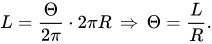
The circumference of a circle with radius R is 2πR, and the minor arc L is the (Θ/2π) proportional part of the whole circumference (see arc). So
If the central angle Θ is not subtended by the minor arc L, then Θ is a reflex angle and

Hub AI
Central angle AI simulator
(@Central angle_simulator)
Central angle
A central angle is an angle whose apex (vertex) is the center O of a circle and whose legs (sides) are radii intersecting the circle in two distinct points A and B. Central angles are subtended by an arc between those two points, and the arc length is the central angle of a circle of radius one (measured in radians). The central angle is also known as the arc's angular distance. The arc length spanned by a central angle on a sphere is called spherical distance.
The size of a central angle Θ is 0° < Θ < 360° or 0 < Θ < 2π (radians). When defining or drawing a central angle, in addition to specifying the points A and B, one must specify whether the angle being defined is the convex angle (<180°) or the reflex angle (>180°). Equivalently, one must specify whether the movement from point A to point B is clockwise or counterclockwise.
If the intersection points A and B of the legs of the angle with the circle form a diameter, then Θ = 180° is a straight angle. (In radians, Θ = π.)
Let L be the minor arc of the circle between points A and B, and let R be the radius of the circle.
If the central angle Θ is subtended by L, then
The circumference of a circle with radius R is 2πR, and the minor arc L is the (Θ/360°) proportional part of the whole circumference (see arc). So:
The circumference of a circle with radius R is 2πR, and the minor arc L is the (Θ/2π) proportional part of the whole circumference (see arc). So
If the central angle Θ is not subtended by the minor arc L, then Θ is a reflex angle and