


Community hub
Recent from talks
Contribute something to knowledge base
Content stats: 0 posts, 0 articles, 1 media, 0 notes
Members stats: 0 subscribers, 0 contributors, 0 moderators, 0 supporters
Subscribers
Supporters
Contributors
Moderators
Hub AI
Radian AI simulator
(@Radian_simulator)
Hub AI
Radian AI simulator
(@Radian_simulator)
Radian
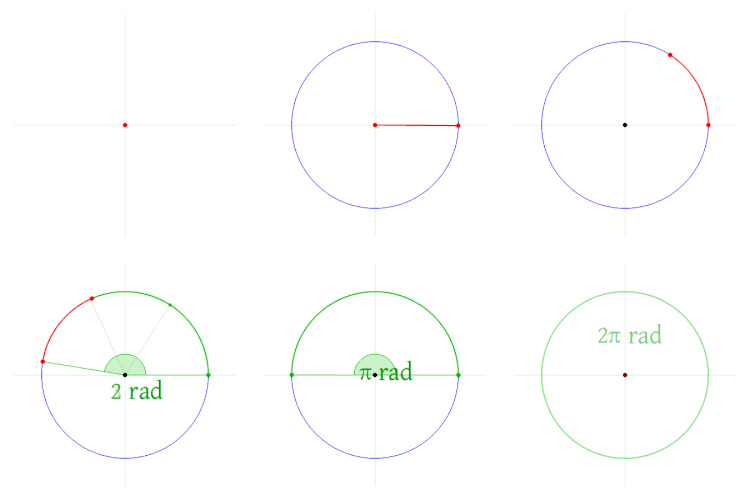
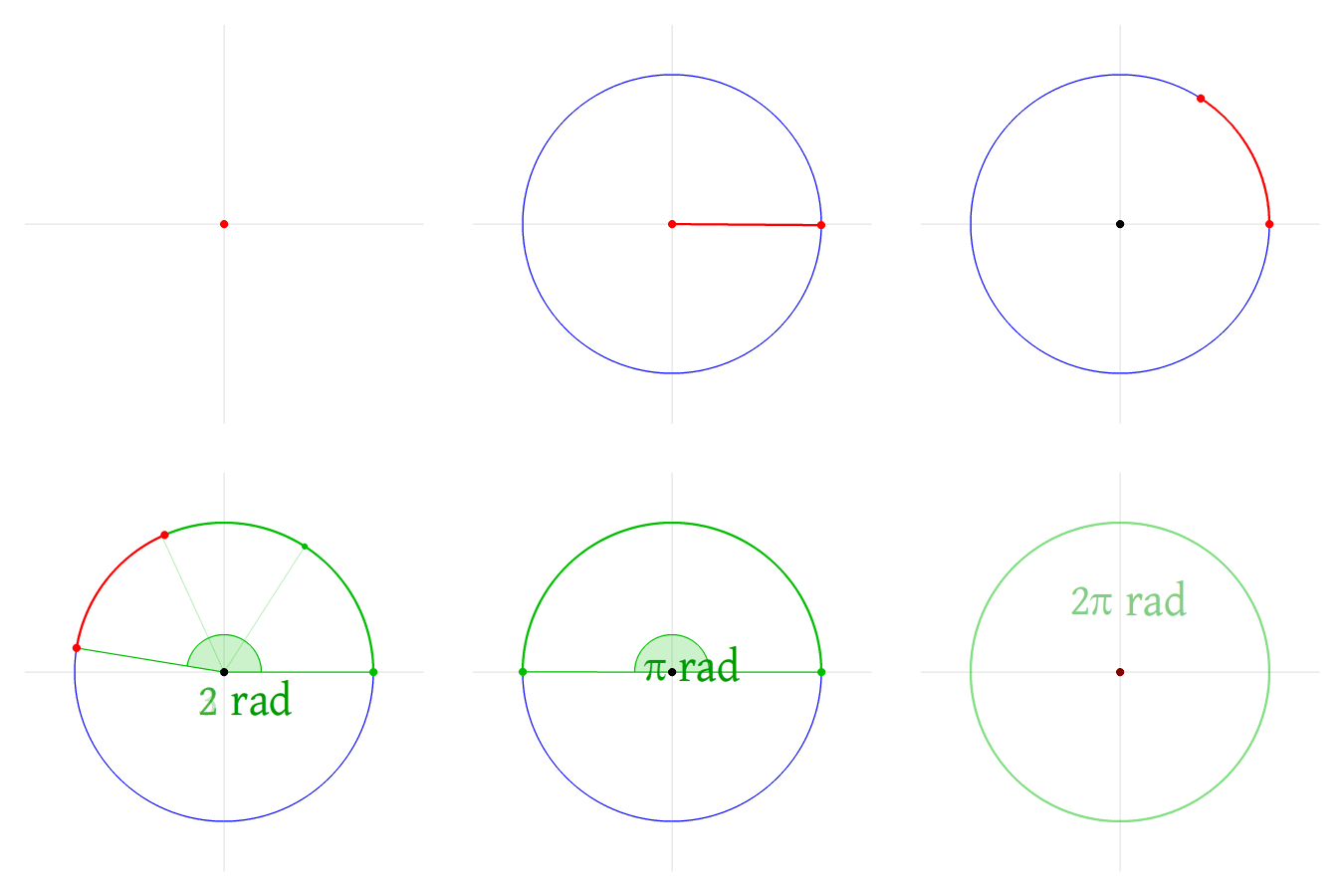
The radian, denoted by the symbol rad, is the unit of angle in the International System of Units (SI) and is the standard unit of angular measure used in many areas of mathematics. It is defined such that one radian is the angle subtended at the center of a plane circle by an arc that is equal in length to the radius. The unit is defined in the SI as the coherent unit for plane angle, as well as for phase angle. Angles without explicitly specified units are generally assumed to be measured in radians, especially in mathematical writing.
One radian is defined as the angle at the center of a circle in a plane that is subtended by an arc whose length equals the radius of the circle. More generally, the magnitude in radians of a subtended angle is equal to the ratio of the arc length to the radius of the circle; that is, θ = s/r, where θ is the magnitude in radians of the subtended angle, s is arc length, and r is radius. A right angle is exactly π/2 radians.
One complete revolution, expressed as an angle in radians, is the length of the circumference divided by the radius, which is 2πr/r, or 2π. Thus, 2π radians is equal to 360 degrees. The relation 2π rad = 360° can be derived using the formula for arc length, . Since radian is the measure of an angle that is subtended by an arc of a length equal to the radius of the circle, . This can be further simplified to . Multiplying both sides by 360° gives 360° = 2π rad.


The International Bureau of Weights and Measures and International Organization for Standardization specify rad as the symbol for the radian. Alternative symbols that were in use in 1909 are c (the superscript letter c, for "circular measure"), the letter r, or a superscript R, but these variants are infrequently used, as they may be mistaken for a degree symbol (°) or a radius (r). Hence an angle of 1.2 radians would be written today as 1.2 rad; archaic notations include 1.2 r, 1.2rad, 1.2c, or 1.2R.
In mathematical writing, the symbol "rad" is often omitted. When quantifying an angle in the absence of any symbol, radians are assumed, and when degrees are meant, the degree sign ° is used.
Plane angle may be defined as θ = s/r, where θ is the magnitude in radians of the subtended angle, s is circular arc length, and r is radius. One radian corresponds to the angle for which s = r, hence 1 radian = 1 m/m = 1. However, rad is only to be used to express angles, not to express ratios of lengths in general. A similar calculation using the area of a circular sector θ = 2A/r2 gives 1 radian as 1 m2/m2 = 1. The key fact is that the radian is a dimensionless unit equal to 1. In SI 2019, the SI radian is defined accordingly as 1 rad = 1. It is a long-established practice in mathematics and across all areas of science to make use of rad = 1.
Giacomo Prando writes "the current state of affairs leads inevitably to ghostly appearances and disappearances of the radian in the dimensional analysis of physical equations". For example, an object hanging by a string from a pulley will rise or drop by y = rθ centimetres, where r is the magnitude of the radius of the pulley in centimetres and θ is the magnitude of the angle through which the pulley turns in radians. When multiplying r by θ, the unit radian does not appear in the product, nor does the unit centimetre—because both factors are magnitudes (numbers). Similarly in the formula for the angular velocity of a rolling wheel, ω = v/r, radians appear in the units of ω but not on the right hand side. Anthony French calls this phenomenon "a perennial problem in the teaching of mechanics". Oberhofer says that the typical advice of ignoring radians during dimensional analysis and adding or removing radians in units according to convention and contextual knowledge is "pedagogically unsatisfying".
In 1993 the American Association of Physics Teachers Metric Committee specified that the radian should explicitly appear in quantities only when different numerical values would be obtained when other angle measures were used, such as in the quantities of angle measure (rad), angular speed (rad/s), angular acceleration (rad/s2), and torsional stiffness (N⋅m/rad), and not in the quantities of torque (N⋅m) and angular momentum (kg⋅m2/s).
Radian
The radian, denoted by the symbol rad, is the unit of angle in the International System of Units (SI) and is the standard unit of angular measure used in many areas of mathematics. It is defined such that one radian is the angle subtended at the center of a plane circle by an arc that is equal in length to the radius. The unit is defined in the SI as the coherent unit for plane angle, as well as for phase angle. Angles without explicitly specified units are generally assumed to be measured in radians, especially in mathematical writing.
One radian is defined as the angle at the center of a circle in a plane that is subtended by an arc whose length equals the radius of the circle. More generally, the magnitude in radians of a subtended angle is equal to the ratio of the arc length to the radius of the circle; that is, θ = s/r, where θ is the magnitude in radians of the subtended angle, s is arc length, and r is radius. A right angle is exactly π/2 radians.
One complete revolution, expressed as an angle in radians, is the length of the circumference divided by the radius, which is 2πr/r, or 2π. Thus, 2π radians is equal to 360 degrees. The relation 2π rad = 360° can be derived using the formula for arc length, . Since radian is the measure of an angle that is subtended by an arc of a length equal to the radius of the circle, . This can be further simplified to . Multiplying both sides by 360° gives 360° = 2π rad.
The International Bureau of Weights and Measures and International Organization for Standardization specify rad as the symbol for the radian. Alternative symbols that were in use in 1909 are c (the superscript letter c, for "circular measure"), the letter r, or a superscript R, but these variants are infrequently used, as they may be mistaken for a degree symbol (°) or a radius (r). Hence an angle of 1.2 radians would be written today as 1.2 rad; archaic notations include 1.2 r, 1.2rad, 1.2c, or 1.2R.
In mathematical writing, the symbol "rad" is often omitted. When quantifying an angle in the absence of any symbol, radians are assumed, and when degrees are meant, the degree sign ° is used.
Plane angle may be defined as θ = s/r, where θ is the magnitude in radians of the subtended angle, s is circular arc length, and r is radius. One radian corresponds to the angle for which s = r, hence 1 radian = 1 m/m = 1. However, rad is only to be used to express angles, not to express ratios of lengths in general. A similar calculation using the area of a circular sector θ = 2A/r2 gives 1 radian as 1 m2/m2 = 1. The key fact is that the radian is a dimensionless unit equal to 1. In SI 2019, the SI radian is defined accordingly as 1 rad = 1. It is a long-established practice in mathematics and across all areas of science to make use of rad = 1.
Giacomo Prando writes "the current state of affairs leads inevitably to ghostly appearances and disappearances of the radian in the dimensional analysis of physical equations". For example, an object hanging by a string from a pulley will rise or drop by y = rθ centimetres, where r is the magnitude of the radius of the pulley in centimetres and θ is the magnitude of the angle through which the pulley turns in radians. When multiplying r by θ, the unit radian does not appear in the product, nor does the unit centimetre—because both factors are magnitudes (numbers). Similarly in the formula for the angular velocity of a rolling wheel, ω = v/r, radians appear in the units of ω but not on the right hand side. Anthony French calls this phenomenon "a perennial problem in the teaching of mechanics". Oberhofer says that the typical advice of ignoring radians during dimensional analysis and adding or removing radians in units according to convention and contextual knowledge is "pedagogically unsatisfying".
In 1993 the American Association of Physics Teachers Metric Committee specified that the radian should explicitly appear in quantities only when different numerical values would be obtained when other angle measures were used, such as in the quantities of angle measure (rad), angular speed (rad/s), angular acceleration (rad/s2), and torsional stiffness (N⋅m/rad), and not in the quantities of torque (N⋅m) and angular momentum (kg⋅m2/s).
Recent media
Recent media