



Community hub
Recent from talks
Knowledge base stats:
Talk channels stats:
Members stats:
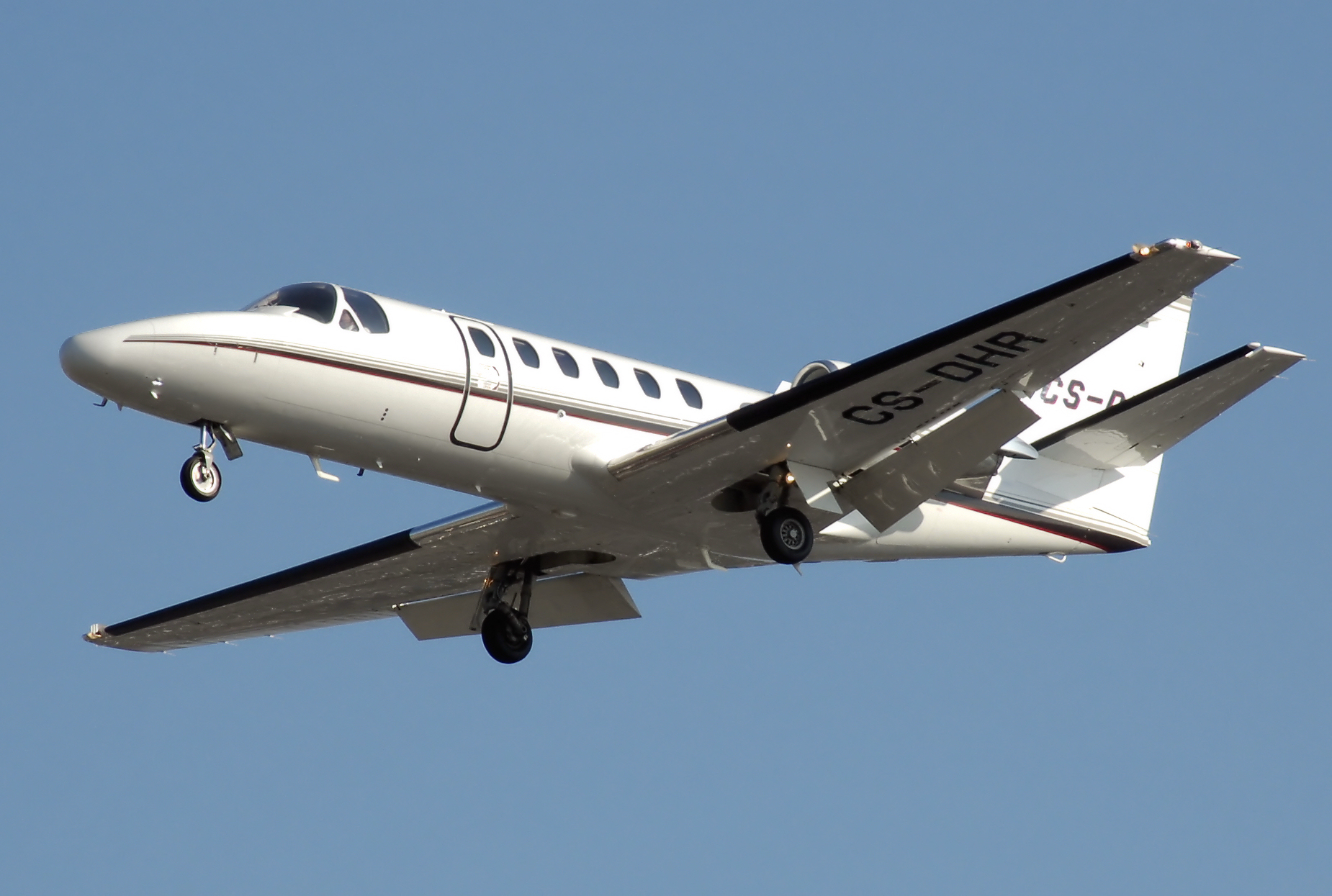
Cessna Citation II
The Cessna Citation II models are light corporate jets built by Cessna as part of the Citation family. Stretched from the Citation I, the Model 550 was announced in September 1976, first flew on January 31, 1977, and was certified in March 1978. The II/SP is a single pilot version, the improved S/II first flew on February 14, 1984 and the Citation Bravo, a stretched S/II with new avionics and more powerful P&WC PW530A turbofans, first flew on April 25, 1995. The United States Navy adopted a version of the S/II as the T-47A. Production ceased in 2006 after 1,184 of all variants were delivered.
The Citation II (Model 550) was developed to provide the same docile low-speed handling and good short-field performance as the preceding Citation I while addressing a primary criticism of that aircraft — its relatively slow cruise speed of around 350 kn (650 km/h) at altitude. The II stretches the Citation I fuselage by 1.14m (3 ft 9in), increasing seating capacity to ten (two pilots and eight passengers) and gross weight to 13,300 lb (6,000 kg). Wingspan was increased by 5.1 ft (1.6 m), fuel capacity was increased from 544 US gal (2,060 L) to 742 US gal (2,810 L), and more powerful, 2,500 lbf (11 kN) Pratt & Whitney Canada JT15D-4 engines were installed for a higher cruise speed of 385 kn (713 km/h) and a longer range of 1,159 nmi (2,146 km). The cabin interior was also redesigned to increase headroom by 5 in (13 cm).
The stretched Citation was announced in September 1976, it first flew on January 31, 1977, and FAA certification was awarded in March 1978. The II/SP (Model 551) is the single pilot version, type certificated to slightly less stringent FAR Part 23 standards, with a slightly reduced maximum takeoff weight (MTOW) at 12,500 lb (5,700 kg) and minor changes in cockpit equipment. As the II and II/SP are otherwise largely similar, the 800 lb (360 kg) reduction in MTOW of the II/SP often mandates operating with a reduced fuel load, shortening the aircraft's loaded range compared to the standard II. Both the II and II/SP require special training to be operated by a single pilot. A total of 688 II and II/SP aircraft were delivered.
The improved Citation S/II (Model S550) was announced in October 1983 and first flew on February 14, 1984, before certification in July. It gained a supercritical airfoil with swept wing roots, aileron and flap gap seals, and a fluid deicing system instead of the pneumatic deicing boots used on earlier Citations. To further reduce drag, the fuselage and engine nacelle pylons were redesigned, and nacelle fairings were added. Fuel capacity was increased by 120 US gal (450 L). The result of the improvements was a cruise speed of 403 kn (746 km/h)—exceeding 400 kn, felt to be an important marketing benchmark by Cessna—and a range of 1,378 nmi (2,552 km) with a 45-minute fuel reserve. The improved 2,500 lbf (11 kN) JT15D-4B engines had higher temperature-rated components, allowing more thrust at higher altitudes.
The S/II replaced the II from 1984, but some potential buyers objected to the sharp price increase from US$2.6 million for the II to $3.3M for the S/II, prompting Cessna to reintroduce the II in late 1985; both were built until the Bravo was introduced. Deliveries of the S/II amounted to 160, including fifteen T-47A aircraft purchased by the U.S. Navy. The S/II's higher performance coupled with its relatively low production total led to substantially higher demand on the used aircraft market compared to the standard II and II/SP.
The US Customs & Border Protection purchased ten Citation IIs configured with fire control radar (initially the F-16's AN/APG-66(V), later the Selex ES Vixen 500E system) and the WF-360TL imaging system. These aircraft have been used effectively in Panama, Honduras, Colombia, Peru, Venezuela, Mexico and Aruba. The similar OT-47B aircraft are based on the Cessna Citation V airframe.
The T-47A was a modified version of the Citation S/II (Model 552) for the U.S. Navy, featuring a 5 ft (1.5 m) wingspan reduction and hydraulically boosted ailerons for improved maneuverability, 2,900 lbf (13 kN) thrust JT15D-5 engines, a cockpit roof window for better pilot visibility during hard maneuvering, strengthened windshields for protection against bird strikes during high-speed low-altitude sorties, multiple radar consoles, and the AN/APQ-167 radar system. Intended to replace the North American T-39D as a radar systems trainer aircraft, fifteen aircraft were purchased in 1984 to train naval radar intercept officers.
All T-47A aircraft were operated with civil aircraft registration numbers by Training Air Squadron VT-86 based at Naval Air Station Pensacola, Florida. On July 20, 1993, ten of the fifteen aircraft were destroyed when a roofing contractor accidentally set fire to a hangar at Forbes Field where the aircraft were being stored by Cessna. The five survivors were subsequently transferred to Cessna and other civil owners.
Hub AI
Cessna Citation II AI simulator
(@Cessna Citation II_simulator)
Cessna Citation II
The Cessna Citation II models are light corporate jets built by Cessna as part of the Citation family. Stretched from the Citation I, the Model 550 was announced in September 1976, first flew on January 31, 1977, and was certified in March 1978. The II/SP is a single pilot version, the improved S/II first flew on February 14, 1984 and the Citation Bravo, a stretched S/II with new avionics and more powerful P&WC PW530A turbofans, first flew on April 25, 1995. The United States Navy adopted a version of the S/II as the T-47A. Production ceased in 2006 after 1,184 of all variants were delivered.
The Citation II (Model 550) was developed to provide the same docile low-speed handling and good short-field performance as the preceding Citation I while addressing a primary criticism of that aircraft — its relatively slow cruise speed of around 350 kn (650 km/h) at altitude. The II stretches the Citation I fuselage by 1.14m (3 ft 9in), increasing seating capacity to ten (two pilots and eight passengers) and gross weight to 13,300 lb (6,000 kg). Wingspan was increased by 5.1 ft (1.6 m), fuel capacity was increased from 544 US gal (2,060 L) to 742 US gal (2,810 L), and more powerful, 2,500 lbf (11 kN) Pratt & Whitney Canada JT15D-4 engines were installed for a higher cruise speed of 385 kn (713 km/h) and a longer range of 1,159 nmi (2,146 km). The cabin interior was also redesigned to increase headroom by 5 in (13 cm).
The stretched Citation was announced in September 1976, it first flew on January 31, 1977, and FAA certification was awarded in March 1978. The II/SP (Model 551) is the single pilot version, type certificated to slightly less stringent FAR Part 23 standards, with a slightly reduced maximum takeoff weight (MTOW) at 12,500 lb (5,700 kg) and minor changes in cockpit equipment. As the II and II/SP are otherwise largely similar, the 800 lb (360 kg) reduction in MTOW of the II/SP often mandates operating with a reduced fuel load, shortening the aircraft's loaded range compared to the standard II. Both the II and II/SP require special training to be operated by a single pilot. A total of 688 II and II/SP aircraft were delivered.
The improved Citation S/II (Model S550) was announced in October 1983 and first flew on February 14, 1984, before certification in July. It gained a supercritical airfoil with swept wing roots, aileron and flap gap seals, and a fluid deicing system instead of the pneumatic deicing boots used on earlier Citations. To further reduce drag, the fuselage and engine nacelle pylons were redesigned, and nacelle fairings were added. Fuel capacity was increased by 120 US gal (450 L). The result of the improvements was a cruise speed of 403 kn (746 km/h)—exceeding 400 kn, felt to be an important marketing benchmark by Cessna—and a range of 1,378 nmi (2,552 km) with a 45-minute fuel reserve. The improved 2,500 lbf (11 kN) JT15D-4B engines had higher temperature-rated components, allowing more thrust at higher altitudes.
The S/II replaced the II from 1984, but some potential buyers objected to the sharp price increase from US$2.6 million for the II to $3.3M for the S/II, prompting Cessna to reintroduce the II in late 1985; both were built until the Bravo was introduced. Deliveries of the S/II amounted to 160, including fifteen T-47A aircraft purchased by the U.S. Navy. The S/II's higher performance coupled with its relatively low production total led to substantially higher demand on the used aircraft market compared to the standard II and II/SP.
The US Customs & Border Protection purchased ten Citation IIs configured with fire control radar (initially the F-16's AN/APG-66(V), later the Selex ES Vixen 500E system) and the WF-360TL imaging system. These aircraft have been used effectively in Panama, Honduras, Colombia, Peru, Venezuela, Mexico and Aruba. The similar OT-47B aircraft are based on the Cessna Citation V airframe.
The T-47A was a modified version of the Citation S/II (Model 552) for the U.S. Navy, featuring a 5 ft (1.5 m) wingspan reduction and hydraulically boosted ailerons for improved maneuverability, 2,900 lbf (13 kN) thrust JT15D-5 engines, a cockpit roof window for better pilot visibility during hard maneuvering, strengthened windshields for protection against bird strikes during high-speed low-altitude sorties, multiple radar consoles, and the AN/APQ-167 radar system. Intended to replace the North American T-39D as a radar systems trainer aircraft, fifteen aircraft were purchased in 1984 to train naval radar intercept officers.
All T-47A aircraft were operated with civil aircraft registration numbers by Training Air Squadron VT-86 based at Naval Air Station Pensacola, Florida. On July 20, 1993, ten of the fifteen aircraft were destroyed when a roofing contractor accidentally set fire to a hangar at Forbes Field where the aircraft were being stored by Cessna. The five survivors were subsequently transferred to Cessna and other civil owners.