



Community hub
Recent from talks
Knowledge base stats:
Talk channels stats:
Members stats:
Cettiidae
Cettiidae is a newly validated family of small insectivorous songbirds ("warblers"), formerly placed in the Old World warbler "wastebin" assemblage. It contains the typical bush warblers (Cettia) and their relatives. As a common name, cettiid warblers is usually used.
Some taxonomic authorities include this entire family, along with the related genera Erythrocercus and Scotocerca, in an enlarged family Scotocercidae; an invalid treatment as Cettiidae (published in 2006) has priority over Scotocercidae (published in 2012).
Its members occur mainly in Asia, ranging into Oceania and Europe. The pseudo-tailorbirds, tesias and stubtails, as well as Tickellia and Abroscopus warblers, are mostly found in the forests of south and southeastern Asia, with one species of stubtail reaching as far north as Japan and Siberia. Only one species, Neumann's warbler (Hemitesia neumanni), occurs in Africa. The range of the genus Cettia extends west to Western Europe, while that of Horornis extends well into the Pacific, as far as Fiji and Palau. Most of the species in the family are sedentary, but the Asian stubtail is wholly migratory and the Japanese bush warbler and Cetti's warbler are partly migratory over much of their range. A few species, such as the pale-footed bush warbler, are altitudinal migrants.
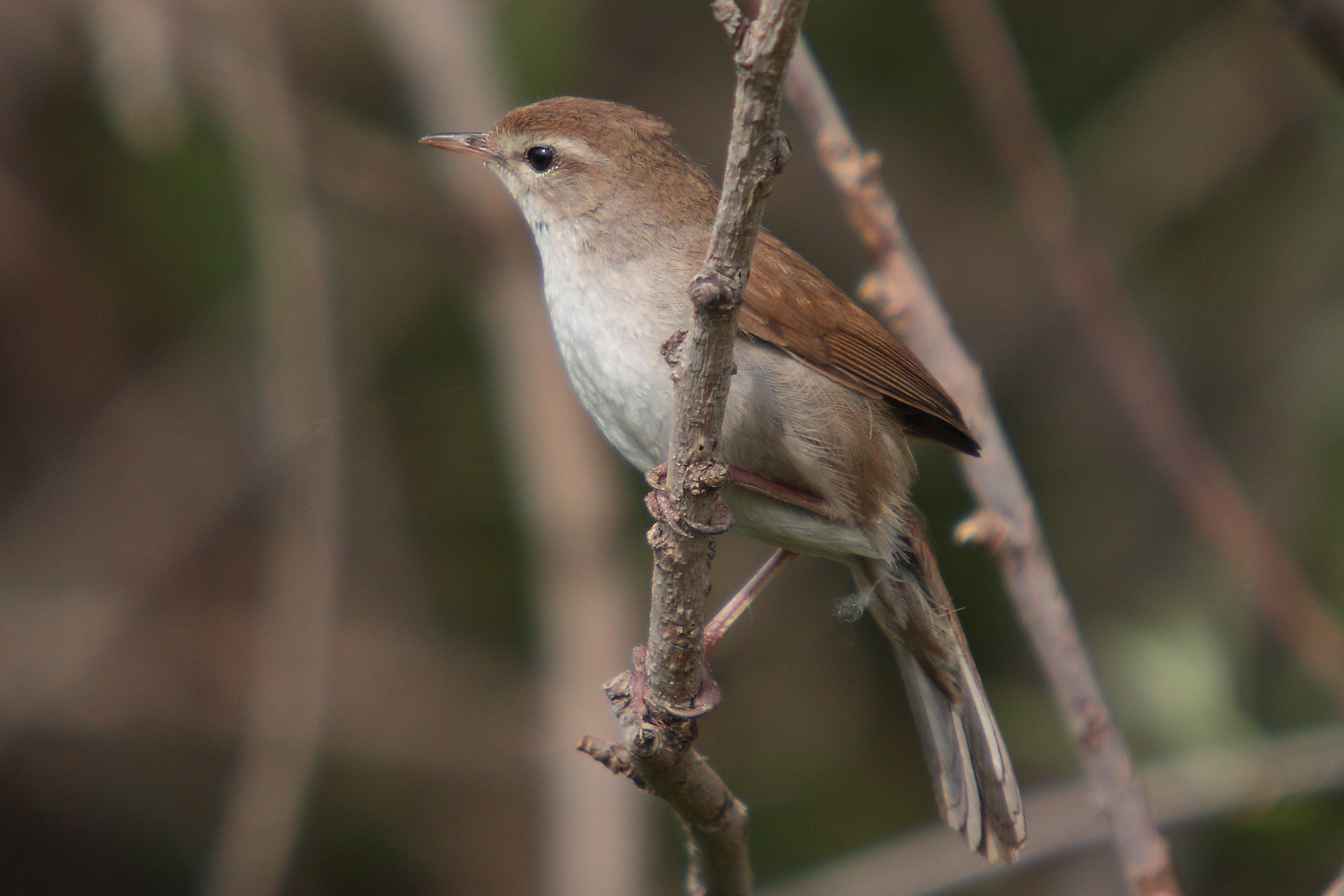
The species are small, stubby birds. Most have moderately long to long tails, while the stubtails and tesias have tiny tails that do not even emerge past their tail coverts. The group is typically clad in dull plumage, often with a line above the eye, but some are more colourful. Altogether the Cettiidae are a quite variable group containing many aberrant birds that hitherto had been uncomfortably placed with a wide range of unrelated families.[citation needed] The Locustellidae, which contain birds which appear very similar to many cettiids, are far more uniform by contrast.
Most live in scrubland and frequently hunt food by clambering through thick tangled growth.
The family Cettiidae was introduced by Per Alström and coworkers in 2006.
The following cladogram showing the family relationships is based on a study by Carl Oliveros and coworkers published in 2019. The number of species is taken from the AviList checklist.
The phylogenetic relationships between eight of the genera were determined in a 2011 study by Per Alström and coworkers. The streaked scrub warbler was not sampled in this study. The basal position shown here is based on the 2019 study by Carl Oliveros and coworkers. The streaked scrub warbler is estimated to have shared a common ancestor with the rest of the family around 16 million years ago.
Hub AI
Cettiidae AI simulator
(@Cettiidae_simulator)
Cettiidae
Cettiidae is a newly validated family of small insectivorous songbirds ("warblers"), formerly placed in the Old World warbler "wastebin" assemblage. It contains the typical bush warblers (Cettia) and their relatives. As a common name, cettiid warblers is usually used.
Some taxonomic authorities include this entire family, along with the related genera Erythrocercus and Scotocerca, in an enlarged family Scotocercidae; an invalid treatment as Cettiidae (published in 2006) has priority over Scotocercidae (published in 2012).
Its members occur mainly in Asia, ranging into Oceania and Europe. The pseudo-tailorbirds, tesias and stubtails, as well as Tickellia and Abroscopus warblers, are mostly found in the forests of south and southeastern Asia, with one species of stubtail reaching as far north as Japan and Siberia. Only one species, Neumann's warbler (Hemitesia neumanni), occurs in Africa. The range of the genus Cettia extends west to Western Europe, while that of Horornis extends well into the Pacific, as far as Fiji and Palau. Most of the species in the family are sedentary, but the Asian stubtail is wholly migratory and the Japanese bush warbler and Cetti's warbler are partly migratory over much of their range. A few species, such as the pale-footed bush warbler, are altitudinal migrants.
The species are small, stubby birds. Most have moderately long to long tails, while the stubtails and tesias have tiny tails that do not even emerge past their tail coverts. The group is typically clad in dull plumage, often with a line above the eye, but some are more colourful. Altogether the Cettiidae are a quite variable group containing many aberrant birds that hitherto had been uncomfortably placed with a wide range of unrelated families.[citation needed] The Locustellidae, which contain birds which appear very similar to many cettiids, are far more uniform by contrast.
Most live in scrubland and frequently hunt food by clambering through thick tangled growth.
The family Cettiidae was introduced by Per Alström and coworkers in 2006.
The following cladogram showing the family relationships is based on a study by Carl Oliveros and coworkers published in 2019. The number of species is taken from the AviList checklist.
The phylogenetic relationships between eight of the genera were determined in a 2011 study by Per Alström and coworkers. The streaked scrub warbler was not sampled in this study. The basal position shown here is based on the 2019 study by Carl Oliveros and coworkers. The streaked scrub warbler is estimated to have shared a common ancestor with the rest of the family around 16 million years ago.