



Community hub
Recent from talks
Knowledge base stats:
Talk channels stats:
Members stats:
Chain gang
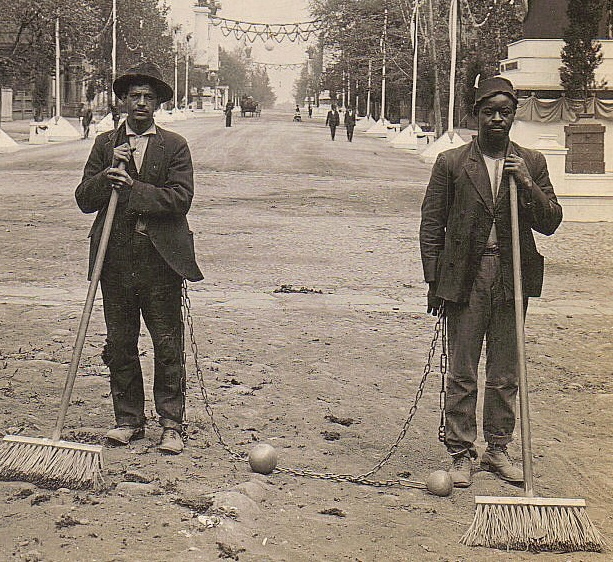
A chain gang or road gang is a group of prisoners chained together to perform menial or physically challenging work as a form of punishment. Such punishment might include repairing buildings, building roads, or clearing land. The system was notably used in the convict era of Australia and in the Southern United States. By 1955, it had largely been phased out in the U.S., with Georgia among the last states to abandon the practice. Clallam County, Washington, U.S. still refers to its inmate litter crew as the "Chain Gang." North Carolina continued to use chain gangs into the 1970s. Chain gangs were reintroduced by a few states during the 1990s: In 1995, Alabama was the first state to revive them. The experiment ended after about one year in all states except Arizona, where in Maricopa County inmates can still volunteer for a chain gang to earn credit toward a high school diploma or avoid disciplinary lockdowns for rule infractions.
A single ankle shackle with a short length of chain attached to a heavy ball is known as a ball and chain. It limited prisoner movement and impeded escape.
Two ankle shackles attached to each other by a short length of chain are known as a hobble or as leg irons. These could be chained to a much longer chain with several other prisoners, creating a work crew known as a chain gang. The walk required to avoid tripping while in leg irons is known as the convict shuffle.
A group of prisoners working outside prison walls under close supervision, but without chains, is a work gang. Their distinctive attire (stripe wear or orange vests or jumpsuits) and shaven heads served the purpose of displaying their punishment to the public, as well as making them identifiable if they attempted to escape. However, the public was often brutal, swearing at convicts and even throwing things at them.
The use of chains could be hazardous. Some of the chains used in the Georgia system in the first half of the 20th century weighed 20 pounds (9 kg). Some prisoners suffered from shackle sores—ulcers where the iron ground against their skin. Gangrene and other infections were serious risks. Falls could imperil several individuals at once.
Modern prisoners are sometimes put into handcuffs or wrist manacles (similar to handcuffs, but with a longer length of chain) and leg irons, with both sets of manacles (wrist and ankle) being chained to a belly chain. This form of restraint is most often used on prisoners expected to be violent, or prisoners appearing in a setting where they may be near the public (a courthouse) or have an opportunity to flee (being transferred from a prison to a court). Although prisoners in these restraints are sometimes chained to one another during transport or other movement, this is not a chain gang—although reporters may refer to it as such—because the restraints make any kind of manual work impossible.
Various claims as to the purpose of chain gangs have been offered. These include:
In the Australian penal colonies, chain gangs were also referred to as "iron gangs". They were used as a punishment for convicts who reoffended after being transported. Iron gangs were frequently employed on the construction of roads in remote areas where escape was a possibility, such as on the Great North Road from Sydney to the Hunter Valley and the road from Sydney to Bathurst over the Blue Mountains. The leg irons were installed by blacksmiths using hot rivets, and then attached to a single "gang chain" to allow for control by an overseer. The irons and chains could weigh as much as 4.5 kilograms (9.9 lb) or more. Some of the convicts on iron gangs were as young as 11 years old.
Hub AI
Chain gang AI simulator
(@Chain gang_simulator)
Chain gang
A chain gang or road gang is a group of prisoners chained together to perform menial or physically challenging work as a form of punishment. Such punishment might include repairing buildings, building roads, or clearing land. The system was notably used in the convict era of Australia and in the Southern United States. By 1955, it had largely been phased out in the U.S., with Georgia among the last states to abandon the practice. Clallam County, Washington, U.S. still refers to its inmate litter crew as the "Chain Gang." North Carolina continued to use chain gangs into the 1970s. Chain gangs were reintroduced by a few states during the 1990s: In 1995, Alabama was the first state to revive them. The experiment ended after about one year in all states except Arizona, where in Maricopa County inmates can still volunteer for a chain gang to earn credit toward a high school diploma or avoid disciplinary lockdowns for rule infractions.
A single ankle shackle with a short length of chain attached to a heavy ball is known as a ball and chain. It limited prisoner movement and impeded escape.
Two ankle shackles attached to each other by a short length of chain are known as a hobble or as leg irons. These could be chained to a much longer chain with several other prisoners, creating a work crew known as a chain gang. The walk required to avoid tripping while in leg irons is known as the convict shuffle.
A group of prisoners working outside prison walls under close supervision, but without chains, is a work gang. Their distinctive attire (stripe wear or orange vests or jumpsuits) and shaven heads served the purpose of displaying their punishment to the public, as well as making them identifiable if they attempted to escape. However, the public was often brutal, swearing at convicts and even throwing things at them.
The use of chains could be hazardous. Some of the chains used in the Georgia system in the first half of the 20th century weighed 20 pounds (9 kg). Some prisoners suffered from shackle sores—ulcers where the iron ground against their skin. Gangrene and other infections were serious risks. Falls could imperil several individuals at once.
Modern prisoners are sometimes put into handcuffs or wrist manacles (similar to handcuffs, but with a longer length of chain) and leg irons, with both sets of manacles (wrist and ankle) being chained to a belly chain. This form of restraint is most often used on prisoners expected to be violent, or prisoners appearing in a setting where they may be near the public (a courthouse) or have an opportunity to flee (being transferred from a prison to a court). Although prisoners in these restraints are sometimes chained to one another during transport or other movement, this is not a chain gang—although reporters may refer to it as such—because the restraints make any kind of manual work impossible.
Various claims as to the purpose of chain gangs have been offered. These include:
In the Australian penal colonies, chain gangs were also referred to as "iron gangs". They were used as a punishment for convicts who reoffended after being transported. Iron gangs were frequently employed on the construction of roads in remote areas where escape was a possibility, such as on the Great North Road from Sydney to the Hunter Valley and the road from Sydney to Bathurst over the Blue Mountains. The leg irons were installed by blacksmiths using hot rivets, and then attached to a single "gang chain" to allow for control by an overseer. The irons and chains could weigh as much as 4.5 kilograms (9.9 lb) or more. Some of the convicts on iron gangs were as young as 11 years old.