
Recent from talks
Chalicotheriidae
Knowledge base stats:
Talk channels stats:
Members stats:
Chalicotheriidae
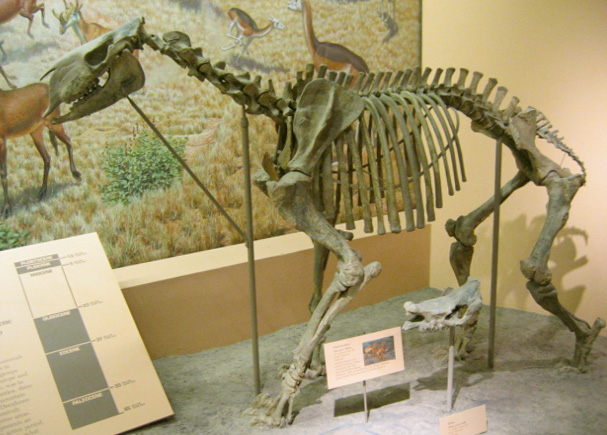
Chalicotheriidae (from Ancient Greek χάλιξ (khálix), meaning "gravel", and θηρίον (theríon), meaning "beast") is an extinct family of herbivorous, perissodactyl mammals. Unlike living odd-toed ungulates, chalicotheres bore large claws on their hands rather than hooves, thought to have been used for grasping vegetation, with their dentition being adapted for browsing. The family is known from the Oligocene to the Pleistocene, reached its greatest diversity in the Miocene, and is known from Asia, Europe, Africa and North America. Asia appears to have been the main centre of diversification for the group.
Chalicotheriids are usually divided into two subfamilies, Chalicotheriinae and Schizotheriinae, which differed in the skull, teeth and limbs. Chalicotheriines generally had much longer forelimbs than hindlimbs and are usually interpreted as more specialised browsers of wooded habitats, whereas schizotheriines had more even limb proportions and appear to have occupied a broader range of environments. Derived schizotheriines also developed the distinctive fused phalanges known as the duplex bone.
Microwear and mesowear studies indicate that chalicotheriids were browsers rather than grazers, feeding mainly on leaves and also on tougher plant foods such as bark, twigs, and in some taxa fruit or other hard items. Their unusual claws are therefore generally interpreted as part of a specialised browsing adaptation rather than evidence of a primarily digging lifestyle.
The history of chalicothere research began in the early nineteenth century with the discovery of ungual phalanges near Eppelsheim in Germany. In 1822, Georges Cuvier interpreted these unusual claw bones as belonging to a gigantic pangolin. Johann Jakob Kaup later described chalicothere teeth from the same locality as the new genus Chalicotherium in 1833, but did not recognise that the teeth and claws belonged to the same kind of animal.
The Miocene locality of Sansan in southern France played a central role in clarifying the nature of chalicotheres. Fossils from Sansan included postcranial remains named Macrotherium by Édouard Lartet in 1837 and cranial remains later referred by de Blainville to Anoplotherium in the 1840s. It was only after the discovery and description of a more complete skeleton by Henri Filhol in 1890 that the skull, teeth and unusual limb bones were firmly recognised as belonging to the same animal.
Later work helped to resolve the complicated nomenclature of the classic European material, including the status of Macrotherium and the use of the name Anisodon for the Sansan chalicotheriines. Because of their unusual combination of claws, browsing dentition and highly distinctive limb proportions, chalicotheres also became a notable case in the history of palaeontology, illustrating how difficult some fossil mammals were to reconstruct and compare with living animals.
Chalicotheriids were unusual among Perissodactyla in possessing large claws rather than hooves. Despite this, their dentition was that of browsing herbivores: the cheek teeth were low-crowned, and the lower incisors cropped vegetation against a toothless pad in the upper jaw. Chalicotheriids ranged in size from small antelope-sized forms to animals comparable to large draft horses. The family is generally divided into two subfamilies, Chalicotheriinae and Schizotheriinae, which differ in the skull, teeth, and appendicular skeleton.
The skull and lower jaw differed noticeably between the two subfamilies. Schizotheriines generally had more slender mandibles, a tapered anterior horizontal ramus, and a relatively low symphysis, whereas chalicotheriines tended to have more robust jaws and, in at least some species, a longer diastema and a fuller complement of lower anterior teeth. New mandibular material of Chalicotherium brevirostris showed that this species had a long snout, a long diastema, and three lower incisors plus a canine, revising earlier assumptions based on more fragmentary material.
Hub AI
Chalicotheriidae AI simulator
(@Chalicotheriidae_simulator)
Chalicotheriidae
Chalicotheriidae (from Ancient Greek χάλιξ (khálix), meaning "gravel", and θηρίον (theríon), meaning "beast") is an extinct family of herbivorous, perissodactyl mammals. Unlike living odd-toed ungulates, chalicotheres bore large claws on their hands rather than hooves, thought to have been used for grasping vegetation, with their dentition being adapted for browsing. The family is known from the Oligocene to the Pleistocene, reached its greatest diversity in the Miocene, and is known from Asia, Europe, Africa and North America. Asia appears to have been the main centre of diversification for the group.
Chalicotheriids are usually divided into two subfamilies, Chalicotheriinae and Schizotheriinae, which differed in the skull, teeth and limbs. Chalicotheriines generally had much longer forelimbs than hindlimbs and are usually interpreted as more specialised browsers of wooded habitats, whereas schizotheriines had more even limb proportions and appear to have occupied a broader range of environments. Derived schizotheriines also developed the distinctive fused phalanges known as the duplex bone.
Microwear and mesowear studies indicate that chalicotheriids were browsers rather than grazers, feeding mainly on leaves and also on tougher plant foods such as bark, twigs, and in some taxa fruit or other hard items. Their unusual claws are therefore generally interpreted as part of a specialised browsing adaptation rather than evidence of a primarily digging lifestyle.
The history of chalicothere research began in the early nineteenth century with the discovery of ungual phalanges near Eppelsheim in Germany. In 1822, Georges Cuvier interpreted these unusual claw bones as belonging to a gigantic pangolin. Johann Jakob Kaup later described chalicothere teeth from the same locality as the new genus Chalicotherium in 1833, but did not recognise that the teeth and claws belonged to the same kind of animal.
The Miocene locality of Sansan in southern France played a central role in clarifying the nature of chalicotheres. Fossils from Sansan included postcranial remains named Macrotherium by Édouard Lartet in 1837 and cranial remains later referred by de Blainville to Anoplotherium in the 1840s. It was only after the discovery and description of a more complete skeleton by Henri Filhol in 1890 that the skull, teeth and unusual limb bones were firmly recognised as belonging to the same animal.
Later work helped to resolve the complicated nomenclature of the classic European material, including the status of Macrotherium and the use of the name Anisodon for the Sansan chalicotheriines. Because of their unusual combination of claws, browsing dentition and highly distinctive limb proportions, chalicotheres also became a notable case in the history of palaeontology, illustrating how difficult some fossil mammals were to reconstruct and compare with living animals.
Chalicotheriids were unusual among Perissodactyla in possessing large claws rather than hooves. Despite this, their dentition was that of browsing herbivores: the cheek teeth were low-crowned, and the lower incisors cropped vegetation against a toothless pad in the upper jaw. Chalicotheriids ranged in size from small antelope-sized forms to animals comparable to large draft horses. The family is generally divided into two subfamilies, Chalicotheriinae and Schizotheriinae, which differ in the skull, teeth, and appendicular skeleton.
The skull and lower jaw differed noticeably between the two subfamilies. Schizotheriines generally had more slender mandibles, a tapered anterior horizontal ramus, and a relatively low symphysis, whereas chalicotheriines tended to have more robust jaws and, in at least some species, a longer diastema and a fuller complement of lower anterior teeth. New mandibular material of Chalicotherium brevirostris showed that this species had a long snout, a long diastema, and three lower incisors plus a canine, revising earlier assumptions based on more fragmentary material.
Recent media