



Community hub
Recent from talks
Knowledge base stats:
Talk channels stats:
Members stats:
Chaos terrain
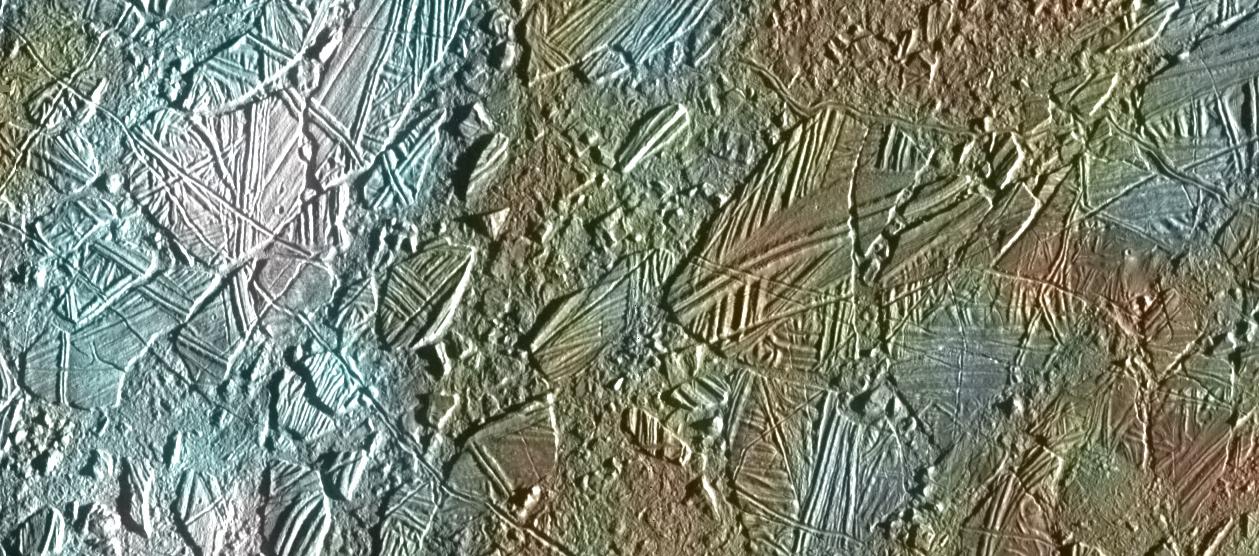
In astrogeology, chaos terrain, or chaotic terrain, is a planetary surface area where features such as ridges, cracks, and plains appear jumbled and enmeshed with one another. Chaos terrain is a notable feature of the planets Mars and Mercury, Jupiter's moon Europa, and the dwarf planet Pluto. In scientific nomenclature, "chaos" is used as a component of proper nouns (e.g., "Aureum Chaos" on Mars).
On April 1, 2010, NASA released the first images under the HiWish program in which citizens suggested places for HiRISE to photograph. One of the eight locations was Aureum Chaos. The first image below gives a wide view of the area. The next two images are from the HiRISE image.
On Mercury, chaos terrain can be hilly or lineated. An original theory for the formation of chaos terrain on Mercury is an impact basin on the opposite side of the planet. However, there is some terrain on Mercury that has no connections to an impact basin, so this theory doesn't fully explain Mercury's chaos terrain.
A large portion of chaos terrain on Mercury is antipodal to the Caloris basin. They are the result of the ejecta and resurfacing caused by such a large impact.
Chaos terrain is plentiful on Europa, covering between 20 and 40% of the surface. While many theories have been proposed, none yet fully explains the origin of this terrain. On Europa, "chaos terrain" includes geological features such as chaos lenticulae, pits, spots, and domes. Chaos terrain has been observed at both a higher and lower altitude than surrounding non-chaos terrain but is most often uplifted from nearby topography.
Nearly all observed chaos terrain lies on top of its surroundings, indicating chaos terrain is a relatively young feature on Europa. Chaos terrain can fall into two categories on Europa: "fresh" and "modified". Fresh chaos terrain is very young and has not been crosscut by other geological features. Modified chaos terrain is older, with smoother edges and crosscutting features.
A possible origin of the lenticulae on Europa's surface is the strong gravitational pull of Jupiter. As the surface is stretched and squished, the surface may crack and pull apart, or be pushed together. Another potential origin of various chaos terrain on Europa is interactions between the icy surface and liquid ocean under Europa's surface. Warm water plumes can melt the surface of Europa, and then movements of the shell can move chaos terrain to a different location than where it was formed.
Chaos terrain on Pluto is not as well understood as that on other bodies. On Pluto, chaos terrain is referred to most often as "Montes" and are likely made up mostly of water ice, which at the temperature of Pluto's surface acts as bedrock. Additionally, at Pluto's temperature, nitrogen ice is not able to form the tall topographical features we observe around the Sputnik basin, further proving water ice as the main component of the montes formations. Most of the montes on Pluto are on the outside edges of Sputnik Planitia, a giant impact basin. The cause of this is the uplift and disruption due to the high-energy impact.
Hub AI
Chaos terrain AI simulator
(@Chaos terrain_simulator)
Chaos terrain
In astrogeology, chaos terrain, or chaotic terrain, is a planetary surface area where features such as ridges, cracks, and plains appear jumbled and enmeshed with one another. Chaos terrain is a notable feature of the planets Mars and Mercury, Jupiter's moon Europa, and the dwarf planet Pluto. In scientific nomenclature, "chaos" is used as a component of proper nouns (e.g., "Aureum Chaos" on Mars).
On April 1, 2010, NASA released the first images under the HiWish program in which citizens suggested places for HiRISE to photograph. One of the eight locations was Aureum Chaos. The first image below gives a wide view of the area. The next two images are from the HiRISE image.
On Mercury, chaos terrain can be hilly or lineated. An original theory for the formation of chaos terrain on Mercury is an impact basin on the opposite side of the planet. However, there is some terrain on Mercury that has no connections to an impact basin, so this theory doesn't fully explain Mercury's chaos terrain.
A large portion of chaos terrain on Mercury is antipodal to the Caloris basin. They are the result of the ejecta and resurfacing caused by such a large impact.
Chaos terrain is plentiful on Europa, covering between 20 and 40% of the surface. While many theories have been proposed, none yet fully explains the origin of this terrain. On Europa, "chaos terrain" includes geological features such as chaos lenticulae, pits, spots, and domes. Chaos terrain has been observed at both a higher and lower altitude than surrounding non-chaos terrain but is most often uplifted from nearby topography.
Nearly all observed chaos terrain lies on top of its surroundings, indicating chaos terrain is a relatively young feature on Europa. Chaos terrain can fall into two categories on Europa: "fresh" and "modified". Fresh chaos terrain is very young and has not been crosscut by other geological features. Modified chaos terrain is older, with smoother edges and crosscutting features.
A possible origin of the lenticulae on Europa's surface is the strong gravitational pull of Jupiter. As the surface is stretched and squished, the surface may crack and pull apart, or be pushed together. Another potential origin of various chaos terrain on Europa is interactions between the icy surface and liquid ocean under Europa's surface. Warm water plumes can melt the surface of Europa, and then movements of the shell can move chaos terrain to a different location than where it was formed.
Chaos terrain on Pluto is not as well understood as that on other bodies. On Pluto, chaos terrain is referred to most often as "Montes" and are likely made up mostly of water ice, which at the temperature of Pluto's surface acts as bedrock. Additionally, at Pluto's temperature, nitrogen ice is not able to form the tall topographical features we observe around the Sputnik basin, further proving water ice as the main component of the montes formations. Most of the montes on Pluto are on the outside edges of Sputnik Planitia, a giant impact basin. The cause of this is the uplift and disruption due to the high-energy impact.