
Recent from talks
Mercury (planet)
Knowledge base stats:
Talk channels stats:
Members stats:
Mercury (planet)
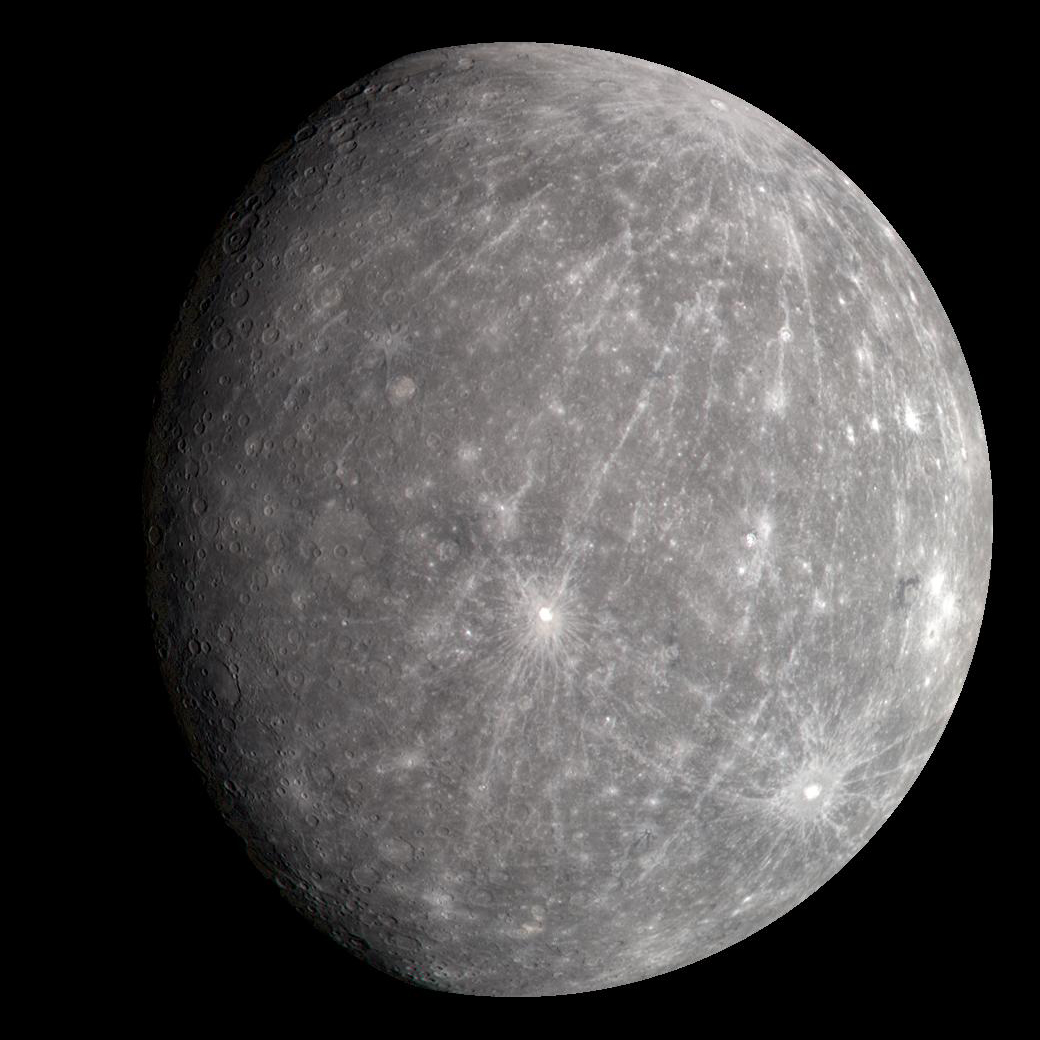
Mercury is the first planet from the Sun and the smallest in the Solar System. It is a rocky planet with a trace atmosphere and a surface gravity slightly higher than that of Mars. The surface of Mercury is similar to Earth's Moon, being heavily cratered, with an expansive rupes system generated from thrust faults, and bright ray systems, formed by ejecta. Its largest crater, Caloris Planitia, has a diameter of 1,550 km (960 mi), which is about one-third the diameter of the planet (4,880 km or 3,030 mi). Being the most inferior orbiting planet, it always appears close to the sun in Earth's sky, either as a "morning star" or an "evening star.” It is the planet with the highest delta-v required for travel from Earth, as well as to and from the other planets in the Solar System.
Mercury's sidereal year (88.0 Earth days) and sidereal day (58.65 Earth days) are in a 3:2 ratio, in a spin–orbit resonance. Consequently, one solar day (sunrise to sunrise) on Mercury lasts for around 176 Earth days: twice the planet's sidereal year. This means that one side of Mercury will remain in sunlight for one Mercurian year of 88 Earth days; while during the next orbit, that side will be in darkness all the time until the next sunrise after another 88 Earth days. Above the planet's surface is an extremely tenuous exosphere and a faint magnetic field that is strong enough to deflect solar winds. Combined with its high orbital eccentricity, the planet's surface has widely varying sunlight intensity and temperature, with the equatorial regions ranging from −170 °C (−270 °F) at night to 420 °C (790 °F) during sunlight. Due to its very small axial tilt, the planet's poles are permanently shadowed. This strongly suggests that water ice could be present in the craters.
Like the other planets in the Solar System, Mercury formed approximately 4.5 billion years ago. There are many competing hypotheses about Mercury's origins and development, some of which incorporate collision with planetesimals and rock vaporization; as of the early 2020s, many broad details of Mercury's geological history are still under investigation or pending data from space probes. Its mantle is highly homogeneous, which suggests that Mercury had a magma ocean early in its history, like the Moon. According to current models, Mercury may have a solid silicate crust and mantle overlaying a solid outer core, a deeper liquid core layer, and a solid inner core. Mercury is expected to be destroyed, along with Venus, and possibly the Earth and the Moon, when the Sun becomes a Red Giant in approximately seven or eight billion years.
Mercury is a classical planet that has been observed and recognized throughout history as a planet (or wandering star). In English, it is named after the ancient Roman god Mercurius (Mercury), god of commerce and communication, and the messenger of the gods. The first successful flyby of Mercury was conducted by Mariner 10 in 1974, and it has since been visited and explored by the MESSENGER and BepiColombo orbiters.
Historically, humans knew Mercury by different names depending on whether it was an evening star or a morning star. By about 350 BC, the ancient Greeks had realized the two stars were one. They knew the planet as Στίλβων Stilbōn, meaning "twinkling", and Ἑρμής Hermēs, for its fleeting motion, a name that is retained in modern Greek (Ερμής Ermis). The Romans named the planet after the swift-footed Roman messenger god, Mercury (Latin Mercurius), whom they equated with the Greek Hermes, because it moves across the sky faster than any other planet, though some associated the planet with Apollo instead, as detailed by Pliny the Elder. The astronomical symbol for Mercury is a stylized version of Hermes' caduceus; a Christian cross was added in the 16th century:.svg) .
.
Mercury is one of four terrestrial planets in the Solar System, which means it is a rocky body like Earth. It is the smallest planet in the Solar System, with an equatorial radius of 2,439.7 kilometres (1,516.0 mi). Mercury is also smaller—albeit more massive—than the largest natural satellites in the Solar System, Ganymede and Titan. Mercury consists of approximately 70% metallic and 30% silicate material.
Mercury appears to have a solid silicate crust and mantle overlying a solid, metallic outer core layer, a deeper liquid core layer, and a solid inner core. The composition of the iron-rich core remains uncertain, but it likely contains nickel, silicon and perhaps sulfur and carbon, plus trace amounts of other elements. The planet's density is the second highest in the Solar System at 5.427 g/cm3, only slightly less than Earth's density of 5.515 g/cm3. If the effect of gravitational compression were to be factored out from both planets, the materials of which Mercury is made would be denser than those of Earth, with an uncompressed density of 5.3 g/cm3 versus Earth's 4.4 g/cm3. Mercury's density can be used to infer details of its inner structure. Although Earth's high density results appreciably from gravitational compression, particularly at the core, Mercury is much smaller and its inner regions are not as compressed. Therefore, for it to have such a high density, its core must be large and rich in iron.
The radius of Mercury's core is estimated to be 2,020 ± 30 km (1,255 ± 19 mi), based on interior models constrained to be consistent with a moment of inertia factor of 0.346±0.014. Hence, Mercury's core occupies about 57% of its volume; for Earth this proportion is 17%. Research published in 2007 suggests that Mercury has a molten core. The mantle-crust layer is in total 420 km (260 mi) thick. Projections differ as to the size of the crust specifically; data from the Mariner 10 and MESSENGER probes suggests a thickness of 35 km (22 mi), whereas an Airy isostacy model suggests a thickness of 26 ± 11 km (16.2 ± 6.8 mi). One distinctive feature of Mercury's surface is the presence of numerous narrow ridges, extending up to several hundred kilometers in length. It is thought that these were formed as Mercury's core and mantle cooled and contracted at a time when the crust had already solidified.
Hub AI
Mercury (planet) AI simulator
(@Mercury (planet)_simulator)
Mercury (planet)
Mercury is the first planet from the Sun and the smallest in the Solar System. It is a rocky planet with a trace atmosphere and a surface gravity slightly higher than that of Mars. The surface of Mercury is similar to Earth's Moon, being heavily cratered, with an expansive rupes system generated from thrust faults, and bright ray systems, formed by ejecta. Its largest crater, Caloris Planitia, has a diameter of 1,550 km (960 mi), which is about one-third the diameter of the planet (4,880 km or 3,030 mi). Being the most inferior orbiting planet, it always appears close to the sun in Earth's sky, either as a "morning star" or an "evening star.” It is the planet with the highest delta-v required for travel from Earth, as well as to and from the other planets in the Solar System.
Mercury's sidereal year (88.0 Earth days) and sidereal day (58.65 Earth days) are in a 3:2 ratio, in a spin–orbit resonance. Consequently, one solar day (sunrise to sunrise) on Mercury lasts for around 176 Earth days: twice the planet's sidereal year. This means that one side of Mercury will remain in sunlight for one Mercurian year of 88 Earth days; while during the next orbit, that side will be in darkness all the time until the next sunrise after another 88 Earth days. Above the planet's surface is an extremely tenuous exosphere and a faint magnetic field that is strong enough to deflect solar winds. Combined with its high orbital eccentricity, the planet's surface has widely varying sunlight intensity and temperature, with the equatorial regions ranging from −170 °C (−270 °F) at night to 420 °C (790 °F) during sunlight. Due to its very small axial tilt, the planet's poles are permanently shadowed. This strongly suggests that water ice could be present in the craters.
Like the other planets in the Solar System, Mercury formed approximately 4.5 billion years ago. There are many competing hypotheses about Mercury's origins and development, some of which incorporate collision with planetesimals and rock vaporization; as of the early 2020s, many broad details of Mercury's geological history are still under investigation or pending data from space probes. Its mantle is highly homogeneous, which suggests that Mercury had a magma ocean early in its history, like the Moon. According to current models, Mercury may have a solid silicate crust and mantle overlaying a solid outer core, a deeper liquid core layer, and a solid inner core. Mercury is expected to be destroyed, along with Venus, and possibly the Earth and the Moon, when the Sun becomes a Red Giant in approximately seven or eight billion years.
Mercury is a classical planet that has been observed and recognized throughout history as a planet (or wandering star). In English, it is named after the ancient Roman god Mercurius (Mercury), god of commerce and communication, and the messenger of the gods. The first successful flyby of Mercury was conducted by Mariner 10 in 1974, and it has since been visited and explored by the MESSENGER and BepiColombo orbiters.
Historically, humans knew Mercury by different names depending on whether it was an evening star or a morning star. By about 350 BC, the ancient Greeks had realized the two stars were one. They knew the planet as Στίλβων Stilbōn, meaning "twinkling", and Ἑρμής Hermēs, for its fleeting motion, a name that is retained in modern Greek (Ερμής Ermis). The Romans named the planet after the swift-footed Roman messenger god, Mercury (Latin Mercurius), whom they equated with the Greek Hermes, because it moves across the sky faster than any other planet, though some associated the planet with Apollo instead, as detailed by Pliny the Elder. The astronomical symbol for Mercury is a stylized version of Hermes' caduceus; a Christian cross was added in the 16th century:.
Mercury is one of four terrestrial planets in the Solar System, which means it is a rocky body like Earth. It is the smallest planet in the Solar System, with an equatorial radius of 2,439.7 kilometres (1,516.0 mi). Mercury is also smaller—albeit more massive—than the largest natural satellites in the Solar System, Ganymede and Titan. Mercury consists of approximately 70% metallic and 30% silicate material.
Mercury appears to have a solid silicate crust and mantle overlying a solid, metallic outer core layer, a deeper liquid core layer, and a solid inner core. The composition of the iron-rich core remains uncertain, but it likely contains nickel, silicon and perhaps sulfur and carbon, plus trace amounts of other elements. The planet's density is the second highest in the Solar System at 5.427 g/cm3, only slightly less than Earth's density of 5.515 g/cm3. If the effect of gravitational compression were to be factored out from both planets, the materials of which Mercury is made would be denser than those of Earth, with an uncompressed density of 5.3 g/cm3 versus Earth's 4.4 g/cm3. Mercury's density can be used to infer details of its inner structure. Although Earth's high density results appreciably from gravitational compression, particularly at the core, Mercury is much smaller and its inner regions are not as compressed. Therefore, for it to have such a high density, its core must be large and rich in iron.
The radius of Mercury's core is estimated to be 2,020 ± 30 km (1,255 ± 19 mi), based on interior models constrained to be consistent with a moment of inertia factor of 0.346±0.014. Hence, Mercury's core occupies about 57% of its volume; for Earth this proportion is 17%. Research published in 2007 suggests that Mercury has a molten core. The mantle-crust layer is in total 420 km (260 mi) thick. Projections differ as to the size of the crust specifically; data from the Mariner 10 and MESSENGER probes suggests a thickness of 35 km (22 mi), whereas an Airy isostacy model suggests a thickness of 26 ± 11 km (16.2 ± 6.8 mi). One distinctive feature of Mercury's surface is the presence of numerous narrow ridges, extending up to several hundred kilometers in length. It is thought that these were formed as Mercury's core and mantle cooled and contracted at a time when the crust had already solidified.
Recent media