
Recent from talks
Chatti
Knowledge base stats:
Talk channels stats:
Members stats:
Chatti
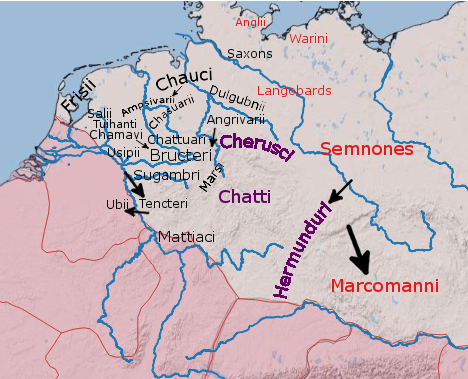
The Chatti were a Roman era Germanic people that lived during the times of the empire in approximately the same region as modern German federal state of Hesse.
The Batavians and Cananefates, Germanic peoples who lived in the Rhine delta within the Roman Empire, were reportedly descended from the Chatti, and it is likely that the Mattiaci, neighbours of the Chatti who also lived within the empire, were also a related people. Modern scholars also believe that the name of the Chattuarii indicates they lived, or had previously lived, in a land once inhabited by the Chatti.
The name of the Chatti was written in many ways by classical authors using Latin or Greek, and there is no clear consensus about what it meant, or which language it originally derived from. The language of the Chatti is unclear, and there is very little evidence. Archaeological evidence shows that the region of Hesse, where they may have already lived before the Romans, indicates that the people there used La Tène material goods, which were also used throughout Gaul, and are strongly associated with Celtic languages. From the second half of the 1st century AD the Chatti are counted by archaeologists among the Rhine-Weser Germanic peoples, implying a connection to Germanic languages..
While linguists typically seek to explain names from this period and region as either Celtic or Germanic, the significant spelling variations in the Chatti name are seen by scholars as showing patterns known from both language families in this period. However, neither of these explain on their own how the name evolved to become medieval or modern German "Hesse(n)". It been therefore been argued that the name as it came to Roman era authors was originally Celtic, although most of the Chatti had recently become Germanic speakers when they came into contact with Rome. The name could have evolved further in two different ways, among Celtic and Germanic speakers.
In the 21st century, the idea that the Chatti were Germanised Celts has been expanded upon in different ways by Wagner and Toorians to explain how the medieval and modern name of Hesse apparently evolved from an originally Celtic name of the Chatti. Toorians derives it from Proto-Celtic *kassis from earlier *katsi-, meaning "hate". Wagner derives it instead from an adjective *cad-ti- coming from *katus, meaning "battle".
However, many other proposals including derivations from Germanic also exist, beginning with Jakob Grimm who proposed that the name is related to English "hat".
According to Tacitus, writing in about 100 AD reported that the Batavi were originally been a part of the Chatti. Domestic strife (seditione domestica) forced the Batavi to move away from the other Chatti and settle in the Rhine delta as special military allies of Rome, before their first clear appearance of the Chatti or Batavi in Roman records.
Tacitus also described the Canninefates, who lived in the delta, sharing the same large island with the Batavi, as being the same as the Batavi in origin, language, and valour, but smaller in numbers.
Hub AI
Chatti AI simulator
(@Chatti_simulator)
Chatti
The Chatti were a Roman era Germanic people that lived during the times of the empire in approximately the same region as modern German federal state of Hesse.
The Batavians and Cananefates, Germanic peoples who lived in the Rhine delta within the Roman Empire, were reportedly descended from the Chatti, and it is likely that the Mattiaci, neighbours of the Chatti who also lived within the empire, were also a related people. Modern scholars also believe that the name of the Chattuarii indicates they lived, or had previously lived, in a land once inhabited by the Chatti.
The name of the Chatti was written in many ways by classical authors using Latin or Greek, and there is no clear consensus about what it meant, or which language it originally derived from. The language of the Chatti is unclear, and there is very little evidence. Archaeological evidence shows that the region of Hesse, where they may have already lived before the Romans, indicates that the people there used La Tène material goods, which were also used throughout Gaul, and are strongly associated with Celtic languages. From the second half of the 1st century AD the Chatti are counted by archaeologists among the Rhine-Weser Germanic peoples, implying a connection to Germanic languages..
While linguists typically seek to explain names from this period and region as either Celtic or Germanic, the significant spelling variations in the Chatti name are seen by scholars as showing patterns known from both language families in this period. However, neither of these explain on their own how the name evolved to become medieval or modern German "Hesse(n)". It been therefore been argued that the name as it came to Roman era authors was originally Celtic, although most of the Chatti had recently become Germanic speakers when they came into contact with Rome. The name could have evolved further in two different ways, among Celtic and Germanic speakers.
In the 21st century, the idea that the Chatti were Germanised Celts has been expanded upon in different ways by Wagner and Toorians to explain how the medieval and modern name of Hesse apparently evolved from an originally Celtic name of the Chatti. Toorians derives it from Proto-Celtic *kassis from earlier *katsi-, meaning "hate". Wagner derives it instead from an adjective *cad-ti- coming from *katus, meaning "battle".
However, many other proposals including derivations from Germanic also exist, beginning with Jakob Grimm who proposed that the name is related to English "hat".
According to Tacitus, writing in about 100 AD reported that the Batavi were originally been a part of the Chatti. Domestic strife (seditione domestica) forced the Batavi to move away from the other Chatti and settle in the Rhine delta as special military allies of Rome, before their first clear appearance of the Chatti or Batavi in Roman records.
Tacitus also described the Canninefates, who lived in the delta, sharing the same large island with the Batavi, as being the same as the Batavi in origin, language, and valour, but smaller in numbers.
Recent media