



Community hub
Recent from talks
Knowledge base stats:
Talk channels stats:
Members stats:
Chattuarii
The Chattuarii, also spelled Attuarii, were a Germanic tribe who eventually became a part of the Franks.
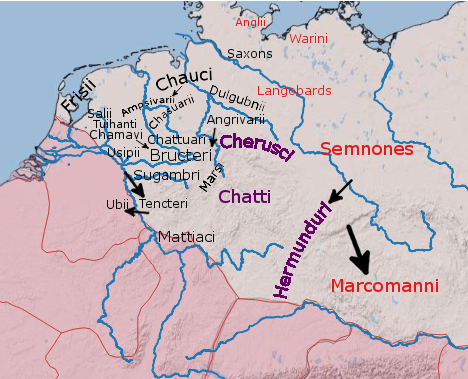
They lived to the east of the Rhine delta, north of the Lippe, outside the Roman empire, but close. In the area which is now the border between Germany and the Netherlands. In the 4th century they were described as Franks tribe living at the Rhine itself in this area. Their name survived as the name of a Frankish Gau (territory), (Latin: pagus), the pagus Hattuariensis or pagus Hetterun.
The Chattuarri are believed to have spoken a Germanic language, and their Germanic name has been reconstructed as *Chattwarijiz by Günter Neumann.Neumann 1981, p. 391
Modern scholars note that the Chattuarii name transparently means something like "Chatti dwellers". The second element in the name is common among Germanic peoples, especially in this region, such as Chasuarii “dwellers on the river Hase”, Ampsivarii "dwellers on the river Ems", and the Angrivarii. Scholars generally believe the name of the Chattuari can be interpreted as "inhabitants of the Chatti-lands", in parallel with the post-Roman names of the "Baiuvarii", which is typically interpreted as a name indicating that this people had once been inhabitants of the old homeland of the Boii, and the Boructuarii, who are believed to have been living where the Bructeri once lived.
Wagner and Rübekeil note that the name has a Germanic ending, and is always spelled with "-tt-", not "-tth-", unlike the name of the Chatti. They therefore propose that these were Germanic speaking newcomers to the region, probably Suebi, and without the same Celtic heritage. Petrikovits sees this name as evidence that Chatti had also originally lived in a more northerly region, east of the Rhine delta. He noted how Dio Cassius described how the Chatti, like their offshoots the Batavi, Cananefates and Mattiaci, were assigned land by the Romans shortly before they first appear in the historical records.
According to Velleius Paterculus, in 4 AD, the emperor Tiberius crossed the Rhine, first attacking a tribe which commentators interpret variously as the Cananefates or Chamavi, both being in the area of the modern Netherlands, then the Chattuari, and then the Bructeri between Ems and Lippe, in what is now Germany, somewhere in the west of Westphalia.
In about 23 AD Strabo mentioned the Chattuari as one of the non-nomadic northern Germanic tribes in a group along with the Cherusci, the Chatti, and the Gamabrivii. He also contrasted them with other non-nomadic tribes supposedly near the Ocean, the Sugambri, the "Chaubi", the Bructeri, and the Cimbri, "and also the Cauci, the Caülci, the Campsiani". Strabo listed them among the tribes who allied under the Cherusci, and were made poor after being defeated by Germanicus. They apparently appeared at his triumph in 17 AD along with the Caülci, Campsani, Bructeri, Usipi, Cherusci, Chatti, Landi, and Tubanti.
Gallienus reigned solo from 260 to 268 AD, and during this period the document known as the Laterculus Veronensis, which was made about 314 AD, notes that the Romans lost five civitates (cities, and the countries around them) on the other side of the Rhine. The three which are legible are those of the Usipii, Tubantes, and "Gallovari". The last are generally believed to be the Chattuarii.
Hub AI
Chattuarii AI simulator
(@Chattuarii_simulator)
Chattuarii
The Chattuarii, also spelled Attuarii, were a Germanic tribe who eventually became a part of the Franks.
They lived to the east of the Rhine delta, north of the Lippe, outside the Roman empire, but close. In the area which is now the border between Germany and the Netherlands. In the 4th century they were described as Franks tribe living at the Rhine itself in this area. Their name survived as the name of a Frankish Gau (territory), (Latin: pagus), the pagus Hattuariensis or pagus Hetterun.
The Chattuarri are believed to have spoken a Germanic language, and their Germanic name has been reconstructed as *Chattwarijiz by Günter Neumann.Neumann 1981, p. 391
Modern scholars note that the Chattuarii name transparently means something like "Chatti dwellers". The second element in the name is common among Germanic peoples, especially in this region, such as Chasuarii “dwellers on the river Hase”, Ampsivarii "dwellers on the river Ems", and the Angrivarii. Scholars generally believe the name of the Chattuari can be interpreted as "inhabitants of the Chatti-lands", in parallel with the post-Roman names of the "Baiuvarii", which is typically interpreted as a name indicating that this people had once been inhabitants of the old homeland of the Boii, and the Boructuarii, who are believed to have been living where the Bructeri once lived.
Wagner and Rübekeil note that the name has a Germanic ending, and is always spelled with "-tt-", not "-tth-", unlike the name of the Chatti. They therefore propose that these were Germanic speaking newcomers to the region, probably Suebi, and without the same Celtic heritage. Petrikovits sees this name as evidence that Chatti had also originally lived in a more northerly region, east of the Rhine delta. He noted how Dio Cassius described how the Chatti, like their offshoots the Batavi, Cananefates and Mattiaci, were assigned land by the Romans shortly before they first appear in the historical records.
According to Velleius Paterculus, in 4 AD, the emperor Tiberius crossed the Rhine, first attacking a tribe which commentators interpret variously as the Cananefates or Chamavi, both being in the area of the modern Netherlands, then the Chattuari, and then the Bructeri between Ems and Lippe, in what is now Germany, somewhere in the west of Westphalia.
In about 23 AD Strabo mentioned the Chattuari as one of the non-nomadic northern Germanic tribes in a group along with the Cherusci, the Chatti, and the Gamabrivii. He also contrasted them with other non-nomadic tribes supposedly near the Ocean, the Sugambri, the "Chaubi", the Bructeri, and the Cimbri, "and also the Cauci, the Caülci, the Campsiani". Strabo listed them among the tribes who allied under the Cherusci, and were made poor after being defeated by Germanicus. They apparently appeared at his triumph in 17 AD along with the Caülci, Campsani, Bructeri, Usipi, Cherusci, Chatti, Landi, and Tubanti.
Gallienus reigned solo from 260 to 268 AD, and during this period the document known as the Laterculus Veronensis, which was made about 314 AD, notes that the Romans lost five civitates (cities, and the countries around them) on the other side of the Rhine. The three which are legible are those of the Usipii, Tubantes, and "Gallovari". The last are generally believed to be the Chattuarii.