
Recent from talks
Cheddar, Somerset
Knowledge base stats:
Talk channels stats:
Members stats:
Cheddar, Somerset
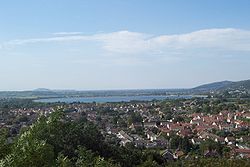
Cheddar is a large village and civil parish in the English county of Somerset. It is situated on the southern edge of the Mendip Hills, 9 miles (14 km) north-west of Wells, 11 miles (18 km) south-east of Weston-super-Mare and 18 miles (29 km) south-west of Bristol. The civil parish includes the hamlets of Nyland and Bradley Cross. The parish had a population of 5,755 in 2011 and an acreage of 8,592 acres (3,477 ha) as of 1961.
Cheddar Gorge, on the northern edge of the village, is the largest gorge in the United Kingdom and includes several show caves, including Gough's Cave. The gorge has been a centre of human settlement since Neolithic times, including a Saxon palace. It has a temperate climate and provides a unique geological and biological environment that has been recognised by the designation of several Sites of Special Scientific Interest. It is also the site of several limestone quarries. The village gave its name to Cheddar cheese and has been a centre for strawberry growing. The crop was formerly transported on the Cheddar Valley rail line, which closed in the late 1960s and is now a cycle path. The village is now a major tourist destination with several cultural and community facilities, including the Cheddar Show Caves Museum.
The village supports a variety of community groups including religious, sporting and cultural organisations. Several of these are based on the site of the Kings of Wessex Academy, which is the largest educational establishment.
Richard Coates, Professor Emeritus of Linguistics at the University of the West of England, has suggested that the name is Ciw-dor, 'the door to Chew', referencing an idea that the gorge marked an important routeway through at least part of the Mendip watershed, and giving access between two large and important estates which had probably been a part of the Wessex royal demesne from the 7th century.
There is evidence of occupation from the Neolithic period in Cheddar. Britain's oldest complete human skeleton, Cheddar Man, estimated to be 9,000 years old, was found in Cheddar Gorge in 1903. Older remains from the Upper Late Palaeolithic era (12,000–13,000 years ago) have been found. There is some evidence of a Bronze Age field system at the Batts Combe quarry site. There is also evidence of Bronze Age barrows at the mound in the Longwood valley, which if man-made it is likely to be a field system. The remains of a Roman villa have been excavated in the grounds of the current vicarage.
The village of Cheddar had been important during the Roman and Saxon eras. There was a royal palace at Cheddar during the Saxon period, which was used on three occasions in the 10th century to host the Witenagemot. The ruins of the palace were excavated in the 1960s. They are located on the grounds of the Kings of Wessex Academy, together with a 14th-century chapel dedicated to St. Columbanus. Roman remains have also been uncovered at the site. Cheddar was listed in the Domesday Book of 1086 as Cedre.
As early as 1130 AD, the Cheddar Gorge was recognised as one of the "Four wonders of England". Historically, Cheddar's source of wealth was farming and cheese making for which it was famous as early as 1170 AD. In the post-Conquest period, Cheddar emerges as a member of Somerset's Winterstoke Hundred. However, Frank Thorn has suggested that at a far earlier period, Cheddar lay at the centre of its own small hundred, and that it acted as the head place (or caput) of a coherent group of three hundreds, namely Cheddar itself, Winterstoke and Bempstone (the latter containing Brent and Wedmore).
The manor of Cheddar was deforested in 1337 and Bishop Ralph was granted a licence by the King to create a hunting forest.
Hub AI
Cheddar, Somerset AI simulator
(@Cheddar, Somerset_simulator)
Cheddar, Somerset
Cheddar is a large village and civil parish in the English county of Somerset. It is situated on the southern edge of the Mendip Hills, 9 miles (14 km) north-west of Wells, 11 miles (18 km) south-east of Weston-super-Mare and 18 miles (29 km) south-west of Bristol. The civil parish includes the hamlets of Nyland and Bradley Cross. The parish had a population of 5,755 in 2011 and an acreage of 8,592 acres (3,477 ha) as of 1961.
Cheddar Gorge, on the northern edge of the village, is the largest gorge in the United Kingdom and includes several show caves, including Gough's Cave. The gorge has been a centre of human settlement since Neolithic times, including a Saxon palace. It has a temperate climate and provides a unique geological and biological environment that has been recognised by the designation of several Sites of Special Scientific Interest. It is also the site of several limestone quarries. The village gave its name to Cheddar cheese and has been a centre for strawberry growing. The crop was formerly transported on the Cheddar Valley rail line, which closed in the late 1960s and is now a cycle path. The village is now a major tourist destination with several cultural and community facilities, including the Cheddar Show Caves Museum.
The village supports a variety of community groups including religious, sporting and cultural organisations. Several of these are based on the site of the Kings of Wessex Academy, which is the largest educational establishment.
Richard Coates, Professor Emeritus of Linguistics at the University of the West of England, has suggested that the name is Ciw-dor, 'the door to Chew', referencing an idea that the gorge marked an important routeway through at least part of the Mendip watershed, and giving access between two large and important estates which had probably been a part of the Wessex royal demesne from the 7th century.
There is evidence of occupation from the Neolithic period in Cheddar. Britain's oldest complete human skeleton, Cheddar Man, estimated to be 9,000 years old, was found in Cheddar Gorge in 1903. Older remains from the Upper Late Palaeolithic era (12,000–13,000 years ago) have been found. There is some evidence of a Bronze Age field system at the Batts Combe quarry site. There is also evidence of Bronze Age barrows at the mound in the Longwood valley, which if man-made it is likely to be a field system. The remains of a Roman villa have been excavated in the grounds of the current vicarage.
The village of Cheddar had been important during the Roman and Saxon eras. There was a royal palace at Cheddar during the Saxon period, which was used on three occasions in the 10th century to host the Witenagemot. The ruins of the palace were excavated in the 1960s. They are located on the grounds of the Kings of Wessex Academy, together with a 14th-century chapel dedicated to St. Columbanus. Roman remains have also been uncovered at the site. Cheddar was listed in the Domesday Book of 1086 as Cedre.
As early as 1130 AD, the Cheddar Gorge was recognised as one of the "Four wonders of England". Historically, Cheddar's source of wealth was farming and cheese making for which it was famous as early as 1170 AD. In the post-Conquest period, Cheddar emerges as a member of Somerset's Winterstoke Hundred. However, Frank Thorn has suggested that at a far earlier period, Cheddar lay at the centre of its own small hundred, and that it acted as the head place (or caput) of a coherent group of three hundreds, namely Cheddar itself, Winterstoke and Bempstone (the latter containing Brent and Wedmore).
The manor of Cheddar was deforested in 1337 and Bishop Ralph was granted a licence by the King to create a hunting forest.