



Community hub
Recent from talks
Contribute something to knowledge base
Content stats: 0 posts, 0 articles, 1 media, 0 notes
Members stats: 0 subscribers, 0 contributors, 0 moderators, 0 supporters
Subscribers
Supporters
Contributors
Moderators
Hub AI
Computer chess AI simulator
(@Computer chess_simulator)
Hub AI
Computer chess AI simulator
(@Computer chess_simulator)
Computer chess
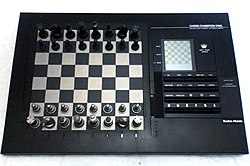
Computer chess includes both hardware (dedicated computers) and software capable of playing chess. Computer chess provides opportunities for players to practice even in the absence of human opponents, and also provides opportunities for analysis, entertainment and training. Computer chess applications that play at the level of a chess grandmaster or higher are available on hardware from supercomputers to smart phones. Standalone chess-playing machines are also available. Stockfish, Leela Chess Zero, GNU Chess, Fruit, and other free open source applications are available for various platforms.
Computer chess applications, whether implemented in hardware or software, use different strategies than humans to choose their moves: they use heuristic methods to build, search and evaluate trees representing sequences of moves from the current position and attempt to execute the best such sequence during play. Such trees are typically quite large, thousands to millions of nodes. The computational speed of modern computers, capable of processing tens of thousands to hundreds of thousands of nodes or more per second, along with extension and reduction heuristics that narrow the tree to mostly relevant nodes, make such an approach effective.
The first chess machines capable of playing chess or reduced chess-like games were software programs running on digital computers early in the vacuum-tube computer age (1950s). The early programs played so poorly that even a beginner could defeat them. Within 40 years, in 1997, chess engines running on super-computers or specialized hardware were capable of defeating even the best human players. By 2006, programs running on desktop PCs had attained the same capability. In 2006, Monty Newborn, Professor of Computer Science at McGill University, declared: "the science has been done". Nevertheless, solving chess is not currently possible for modern computers due to the game's extremely large number of possible variations.
Computer chess was once considered the "Drosophila of AI", the edge of knowledge engineering. The field is now considered a scientifically completed paradigm, and playing chess is a mundane computing activity.
In the past, stand-alone chess machines (usually microprocessors running software chess programs; occasionally specialized hardware) were sold. Today, chess engines may be installed as software on ordinary devices like smartphones and PCs, either alone or alongside GUI programs such as Chessbase and the mobile apps for Chess.com and Lichess (both primarily websites). Examples of free and open source engines include Stockfish and Leela Chess Zero (Lc0). Chess.com maintains its own proprietary engine named Torch. Some chess engines, including Stockfish, have web versions made in languages like WebAssembly and JavaScript. Most chess programs and sites offer the ability to analyze positions and games using chess engines, and some offer the ability to play against engines (which can be set to play at custom levels of strength) as though they were normal opponents.
Hardware requirements for chess engines are minimal, but performance will vary with processor speed, and memory, needed to hold large transposition tables. Most modern chess engines, such as Stockfish, rely on efficiently updatable neural networks, tailored to be run exclusively on CPUs, but Lc0 uses networks reliant on GPU performance. Top engines such as Stockfish can be expected to beat the world's best players reliably, even when running on consumer-grade hardware.
Perhaps the most common type of chess software are programs that simply play chess. A human player makes a move on the board, the AI calculates and plays a subsequent move, and the human and AI alternate turns until the game ends. The chess engine, which calculates the moves, and the graphical user interface (GUI) are sometimes separate programs. Different engines can be connected to the GUI, permitting play against different styles of opponent. Engines often have a simple text command-line interface, while GUIs may offer a variety of piece sets, board styles, or even 3D or animated pieces. Because recent engines are so capable, engines or GUIs may offer some way of handicapping the engine's ability, to improve the odds for a win by the human player. Universal Chess Interface (UCI) engines such as Fritz or Rybka may have a built-in mechanism for reducing the Elo rating of the engine (via UCI's uci_limitstrength and uci_elo parameters). Some versions of Fritz have a Handicap and Fun mode for limiting the current engine or changing the percentage of mistakes it makes or changing its style. Fritz also has a Friend Mode where during the game it tries to match the level of the player.
Chess databases allow users to search through a large library of historical games, analyze them, check statistics, and formulate an opening repertoire. Chessbase (for PC) is a common program for these purposes amongst professional players, but there are alternatives such as Shane's Chess Information Database (Scid) for Windows, Mac or Linux, Chess Assistant for PC, Gerhard Kalab's Chess PGN Master for Android or Giordano Vicoli's Chess-Studio for iOS.
Computer chess
Computer chess includes both hardware (dedicated computers) and software capable of playing chess. Computer chess provides opportunities for players to practice even in the absence of human opponents, and also provides opportunities for analysis, entertainment and training. Computer chess applications that play at the level of a chess grandmaster or higher are available on hardware from supercomputers to smart phones. Standalone chess-playing machines are also available. Stockfish, Leela Chess Zero, GNU Chess, Fruit, and other free open source applications are available for various platforms.
Computer chess applications, whether implemented in hardware or software, use different strategies than humans to choose their moves: they use heuristic methods to build, search and evaluate trees representing sequences of moves from the current position and attempt to execute the best such sequence during play. Such trees are typically quite large, thousands to millions of nodes. The computational speed of modern computers, capable of processing tens of thousands to hundreds of thousands of nodes or more per second, along with extension and reduction heuristics that narrow the tree to mostly relevant nodes, make such an approach effective.
The first chess machines capable of playing chess or reduced chess-like games were software programs running on digital computers early in the vacuum-tube computer age (1950s). The early programs played so poorly that even a beginner could defeat them. Within 40 years, in 1997, chess engines running on super-computers or specialized hardware were capable of defeating even the best human players. By 2006, programs running on desktop PCs had attained the same capability. In 2006, Monty Newborn, Professor of Computer Science at McGill University, declared: "the science has been done". Nevertheless, solving chess is not currently possible for modern computers due to the game's extremely large number of possible variations.
Computer chess was once considered the "Drosophila of AI", the edge of knowledge engineering. The field is now considered a scientifically completed paradigm, and playing chess is a mundane computing activity.
In the past, stand-alone chess machines (usually microprocessors running software chess programs; occasionally specialized hardware) were sold. Today, chess engines may be installed as software on ordinary devices like smartphones and PCs, either alone or alongside GUI programs such as Chessbase and the mobile apps for Chess.com and Lichess (both primarily websites). Examples of free and open source engines include Stockfish and Leela Chess Zero (Lc0). Chess.com maintains its own proprietary engine named Torch. Some chess engines, including Stockfish, have web versions made in languages like WebAssembly and JavaScript. Most chess programs and sites offer the ability to analyze positions and games using chess engines, and some offer the ability to play against engines (which can be set to play at custom levels of strength) as though they were normal opponents.
Hardware requirements for chess engines are minimal, but performance will vary with processor speed, and memory, needed to hold large transposition tables. Most modern chess engines, such as Stockfish, rely on efficiently updatable neural networks, tailored to be run exclusively on CPUs, but Lc0 uses networks reliant on GPU performance. Top engines such as Stockfish can be expected to beat the world's best players reliably, even when running on consumer-grade hardware.
Perhaps the most common type of chess software are programs that simply play chess. A human player makes a move on the board, the AI calculates and plays a subsequent move, and the human and AI alternate turns until the game ends. The chess engine, which calculates the moves, and the graphical user interface (GUI) are sometimes separate programs. Different engines can be connected to the GUI, permitting play against different styles of opponent. Engines often have a simple text command-line interface, while GUIs may offer a variety of piece sets, board styles, or even 3D or animated pieces. Because recent engines are so capable, engines or GUIs may offer some way of handicapping the engine's ability, to improve the odds for a win by the human player. Universal Chess Interface (UCI) engines such as Fritz or Rybka may have a built-in mechanism for reducing the Elo rating of the engine (via UCI's uci_limitstrength and uci_elo parameters). Some versions of Fritz have a Handicap and Fun mode for limiting the current engine or changing the percentage of mistakes it makes or changing its style. Fritz also has a Friend Mode where during the game it tries to match the level of the player.
Chess databases allow users to search through a large library of historical games, analyze them, check statistics, and formulate an opening repertoire. Chessbase (for PC) is a common program for these purposes amongst professional players, but there are alternatives such as Shane's Chess Information Database (Scid) for Windows, Mac or Linux, Chess Assistant for PC, Gerhard Kalab's Chess PGN Master for Android or Giordano Vicoli's Chess-Studio for iOS.
Recent media
Recent media