



Community hub
Recent from talks
Contribute something to knowledge base
Content stats: 0 posts, 0 articles, 1 media, 0 notes
Members stats: 0 subscribers, 0 contributors, 0 moderators, 0 supporters
Subscribers
Supporters
Contributors
Moderators
Hub AI
Chester AI simulator
(@Chester_simulator)
Hub AI
Chester AI simulator
(@Chester_simulator)
Chester
Chester is a cathedral city in Cheshire, England, on the River Dee, close to the England–Wales border. With a built-up area population of 92,760 in 2021, it is the most populous settlement in the borough of Cheshire West and Chester. It is also the historic county town of Cheshire and the second-largest settlement in Cheshire after Warrington.
Chester was founded in 79 AD as a "castrum" or Roman fort with the name Deva Victrix during the reign of Emperor Vespasian. One of the main army camps in Roman Britain, Deva later became a major civilian settlement. In 689, King Æthelred of Mercia founded the Minster Church of West Mercia, which later became Chester's first cathedral, and the Angles extended and strengthened the walls to protect the city against the Danes. Chester was one of the last cities in England to fall to the Normans, and William the Conqueror ordered the construction of a castle to dominate the town and the nearby Welsh border. Chester was granted city status in 1541.
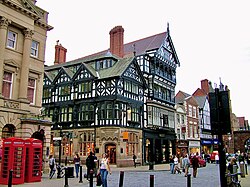
The city walls of Chester are some of the best-preserved in the country and have Grade I listed status. Apart from a 100-metre (330 ft) section, the walls are almost complete. It has several medieval buildings. However, many of the black-and-white buildings within the city centre are Victorian restorations, originating from the Black-and-white Revival movement. The Industrial Revolution brought railways, canals, and new roads to the city, which saw substantial expansion and development; Chester Town Hall and the Grosvenor Museum are examples of Victorian architecture from this period. Tourism, the retail industry, public administration, and financial services are important to the modern economy. Chester signs itself as Chester International Heritage City on road signs on the main roads entering the city.
Charles Leigh concluded in 1701 that there was probably a British city called Genuina (or Gunia) before the arrival of the Romans.
The Roman Legio II Adiutrix during the reign of the Emperor Vespasian founded Chester in AD 79 as a "castrum" or Roman fort with the name Deva Victrix. It was established in the land of the Celtic Cornovii, according to ancient cartographer Ptolemy, as a fortress during the Roman expansion northward, and was named Deva either after the goddess of the Dee, or directly from the British name for the river. The 'victrix' part of the name was taken from the title of the Legio XX Valeria Victrix which was based at Deva. Central Chester's four main roads, Eastgate, Northgate, Watergate and Bridge Street, follow routes laid out at this time.
A civilian settlement grew around the military base, which probably originated from trade with the fortress. The fortress was 20% larger than other fortresses in the Roman province of Britannia built around the same time at York (Eboracum) and Caerleon (Isca Augusta); this has led to the suggestion that the fortress, rather than London (Londinium), was intended to become the capital of the Roman province of Britannia Superior. The civilian amphitheatre, which was built in the 1st century, could seat between 8,000 and 10,000 people. It is the largest known military amphitheatre in Britain, and is also a Scheduled Monument. The Minerva Shrine in the Roman quarry is the only rock-cut Roman shrine still in situ in Britain.
The fortress was garrisoned by the legion until at least the late 4th century. Although the army had abandoned the fortress by 410 when the Romans retreated from Britannia, the Romano-British civilian settlement continued (probably with some Roman veterans staying behind with their wives and children) and its occupants probably continued to use the fortress and its defences as protection from raiders from the Irish Sea.
After the Roman troops withdrew, the Romano-British established several petty kingdoms. Chester is thought to have become part of Powys. Deverdoeu was a Welsh name for Chester as late as the 12th century (cf Dyfrdwy, Welsh for the river Dee). Another, attested in the 9th-century History of the Britons traditionally attributed to Nennius, is Cair Legion ("Fort" or "City of the Legion"); this later developed into Caerlleon and then the modern Welsh Caer. (The town's importance is noted by its taking the simpler form in each case, while Isca Augusta in Monmouthshire, another important legionary base, was known first as Caerleon on the Usk, and now as Caerleon). King Arthur is said to have fought his ninth battle at the "city of the legions" (Caerlleon) and later St Augustine came to the city to try to unite the church, and held his synod with the Welsh Bishops.
Chester
Chester is a cathedral city in Cheshire, England, on the River Dee, close to the England–Wales border. With a built-up area population of 92,760 in 2021, it is the most populous settlement in the borough of Cheshire West and Chester. It is also the historic county town of Cheshire and the second-largest settlement in Cheshire after Warrington.
Chester was founded in 79 AD as a "castrum" or Roman fort with the name Deva Victrix during the reign of Emperor Vespasian. One of the main army camps in Roman Britain, Deva later became a major civilian settlement. In 689, King Æthelred of Mercia founded the Minster Church of West Mercia, which later became Chester's first cathedral, and the Angles extended and strengthened the walls to protect the city against the Danes. Chester was one of the last cities in England to fall to the Normans, and William the Conqueror ordered the construction of a castle to dominate the town and the nearby Welsh border. Chester was granted city status in 1541.
The city walls of Chester are some of the best-preserved in the country and have Grade I listed status. Apart from a 100-metre (330 ft) section, the walls are almost complete. It has several medieval buildings. However, many of the black-and-white buildings within the city centre are Victorian restorations, originating from the Black-and-white Revival movement. The Industrial Revolution brought railways, canals, and new roads to the city, which saw substantial expansion and development; Chester Town Hall and the Grosvenor Museum are examples of Victorian architecture from this period. Tourism, the retail industry, public administration, and financial services are important to the modern economy. Chester signs itself as Chester International Heritage City on road signs on the main roads entering the city.
Charles Leigh concluded in 1701 that there was probably a British city called Genuina (or Gunia) before the arrival of the Romans.
The Roman Legio II Adiutrix during the reign of the Emperor Vespasian founded Chester in AD 79 as a "castrum" or Roman fort with the name Deva Victrix. It was established in the land of the Celtic Cornovii, according to ancient cartographer Ptolemy, as a fortress during the Roman expansion northward, and was named Deva either after the goddess of the Dee, or directly from the British name for the river. The 'victrix' part of the name was taken from the title of the Legio XX Valeria Victrix which was based at Deva. Central Chester's four main roads, Eastgate, Northgate, Watergate and Bridge Street, follow routes laid out at this time.
A civilian settlement grew around the military base, which probably originated from trade with the fortress. The fortress was 20% larger than other fortresses in the Roman province of Britannia built around the same time at York (Eboracum) and Caerleon (Isca Augusta); this has led to the suggestion that the fortress, rather than London (Londinium), was intended to become the capital of the Roman province of Britannia Superior. The civilian amphitheatre, which was built in the 1st century, could seat between 8,000 and 10,000 people. It is the largest known military amphitheatre in Britain, and is also a Scheduled Monument. The Minerva Shrine in the Roman quarry is the only rock-cut Roman shrine still in situ in Britain.
The fortress was garrisoned by the legion until at least the late 4th century. Although the army had abandoned the fortress by 410 when the Romans retreated from Britannia, the Romano-British civilian settlement continued (probably with some Roman veterans staying behind with their wives and children) and its occupants probably continued to use the fortress and its defences as protection from raiders from the Irish Sea.
After the Roman troops withdrew, the Romano-British established several petty kingdoms. Chester is thought to have become part of Powys. Deverdoeu was a Welsh name for Chester as late as the 12th century (cf Dyfrdwy, Welsh for the river Dee). Another, attested in the 9th-century History of the Britons traditionally attributed to Nennius, is Cair Legion ("Fort" or "City of the Legion"); this later developed into Caerlleon and then the modern Welsh Caer. (The town's importance is noted by its taking the simpler form in each case, while Isca Augusta in Monmouthshire, another important legionary base, was known first as Caerleon on the Usk, and now as Caerleon). King Arthur is said to have fought his ninth battle at the "city of the legions" (Caerlleon) and later St Augustine came to the city to try to unite the church, and held his synod with the Welsh Bishops.
Recent media
Recent media