



Community hub
Recent from talks
Contribute something to knowledge base
Content stats: 0 posts, 0 articles, 1 media, 0 notes
Members stats: 0 subscribers, 0 contributors, 0 moderators, 0 supporters
Subscribers
Supporters
Contributors
Moderators
Hub AI
Angles (tribe) AI simulator
(@Angles (tribe)_simulator)
Hub AI
Angles (tribe) AI simulator
(@Angles (tribe)_simulator)
Angles (tribe)
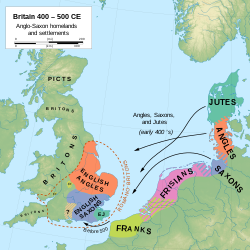
The Angles (Old English: Engle, Latin: Anglii) were one of the main Germanic peoples who settled in Great Britain in the post-Roman period. They founded several kingdoms of the Heptarchy in Anglo-Saxon England. Their name, which probably derives from the Angeln peninsula, is the root of the name England ("Engla land", "Land of the Angles"), and English, in reference to both for its people and language. According to Tacitus, writing around 100 AD, a people known as Angles (Anglii) lived beyond (apparently northeast of) the Langobards and Semnones, who lived near the River Elbe.
The name of the Angles may have been first recorded in Latinised form, as Anglii, in the Germania of Tacitus. It is thought to derive from the name of the area they originally inhabited, the Angeln peninsula, which is on the Baltic Sea coast of Schleswig-Holstein.
Two related theories have been advanced, which attempt to give the name a Germanic etymology:
In Old English, the same term Engle refers the Angles before and after the migration to Britain. As most Germanic settlers in Britain during this time were Angles, the settled area became referred to as England ("Engla land", "the land or country of the Angles"). While Latin and Celtic-speaking populations referred to the Germanic speakers in Britain in general by terms related to "Saxons", they came to refer to themselves as Engle ("Angles", "English people"). "Angle" and related terms therefore have some ambiguity in their scope. From Engle is also derived "English" (Old English: Englisc).
According to Gesta Danorum, the brothers Dan and Angul were made rulers by the consent of their people because of their bravery and the Danes and Angles are respectively named from them.
The earliest surviving mention of the Angles is in chapter 40 of Tacitus's Germania written around AD 98. Tacitus describes the "Anglii" as one of the more remote Suebic tribes living beyond the Semnones and Langobardi, who lived near the lower Elbe, and were better known to the Romans. He grouped the Angles with several other tribes in that region, the Reudigni, Aviones, Varini, Eudoses, Suarines, and Nuithones. According to Tacitus, they were all living behind ramparts of rivers and woods, and therefore inaccessible to attack.
He gives no precise indication of their geographical situation but states that, together with the six other tribes, they worshipped Nerthus, or Mother Earth, whose sanctuary was located on "an island in the Ocean". The Eudoses are generally considered to be the Jutes and these names have been associated with localities in Jutland or on the Baltic coast. The coast contains sufficient estuaries, inlets, rivers, islands, swamps, and marshes to have been inaccessible to those not familiar with the terrain, such as the Romans, who considered it unknown and inaccessible.
The majority of scholars believe that the Anglii lived on the coasts of the Baltic Sea, probably in the southern part of the Jutland peninsula. This view is based partly on Old English and Danish traditions regarding persons and events of the fourth century, and partly because striking affinities to the cult of Nerthus as described by Tacitus are to be found in pre-Christian Scandinavian religion.
Angles (tribe)
The Angles (Old English: Engle, Latin: Anglii) were one of the main Germanic peoples who settled in Great Britain in the post-Roman period. They founded several kingdoms of the Heptarchy in Anglo-Saxon England. Their name, which probably derives from the Angeln peninsula, is the root of the name England ("Engla land", "Land of the Angles"), and English, in reference to both for its people and language. According to Tacitus, writing around 100 AD, a people known as Angles (Anglii) lived beyond (apparently northeast of) the Langobards and Semnones, who lived near the River Elbe.
The name of the Angles may have been first recorded in Latinised form, as Anglii, in the Germania of Tacitus. It is thought to derive from the name of the area they originally inhabited, the Angeln peninsula, which is on the Baltic Sea coast of Schleswig-Holstein.
Two related theories have been advanced, which attempt to give the name a Germanic etymology:
In Old English, the same term Engle refers the Angles before and after the migration to Britain. As most Germanic settlers in Britain during this time were Angles, the settled area became referred to as England ("Engla land", "the land or country of the Angles"). While Latin and Celtic-speaking populations referred to the Germanic speakers in Britain in general by terms related to "Saxons", they came to refer to themselves as Engle ("Angles", "English people"). "Angle" and related terms therefore have some ambiguity in their scope. From Engle is also derived "English" (Old English: Englisc).
According to Gesta Danorum, the brothers Dan and Angul were made rulers by the consent of their people because of their bravery and the Danes and Angles are respectively named from them.
The earliest surviving mention of the Angles is in chapter 40 of Tacitus's Germania written around AD 98. Tacitus describes the "Anglii" as one of the more remote Suebic tribes living beyond the Semnones and Langobardi, who lived near the lower Elbe, and were better known to the Romans. He grouped the Angles with several other tribes in that region, the Reudigni, Aviones, Varini, Eudoses, Suarines, and Nuithones. According to Tacitus, they were all living behind ramparts of rivers and woods, and therefore inaccessible to attack.
He gives no precise indication of their geographical situation but states that, together with the six other tribes, they worshipped Nerthus, or Mother Earth, whose sanctuary was located on "an island in the Ocean". The Eudoses are generally considered to be the Jutes and these names have been associated with localities in Jutland or on the Baltic coast. The coast contains sufficient estuaries, inlets, rivers, islands, swamps, and marshes to have been inaccessible to those not familiar with the terrain, such as the Romans, who considered it unknown and inaccessible.
The majority of scholars believe that the Anglii lived on the coasts of the Baltic Sea, probably in the southern part of the Jutland peninsula. This view is based partly on Old English and Danish traditions regarding persons and events of the fourth century, and partly because striking affinities to the cult of Nerthus as described by Tacitus are to be found in pre-Christian Scandinavian religion.
Recent media
Recent media