



Community hub
Recent from talks
Knowledge base stats:
Talk channels stats:
Members stats:
Chestnut-backed chickadee
The chestnut-backed chickadee (Poecile rufescens) is a small passerine bird in the tit family, Paridae, native to western North America.
In the early 20th century, Joseph Grinnell hypothesized that the chestnut-backed chickadee diverged from the boreal chickadee (Poecile hudsonicus), because both species inhabited similar coniferous forest environments. Grinnell noted that the main differences between the boreal chickadee and the chestnut-backed were in the shade and tone of their respective brown coloration. He drew parallels between the varied chickadee characteristics using the fact that some bird species become smaller and more vibrantly brown as their habitat becomes more humid. Modern molecular phylogenetic studies have confirmed that the chestnut-backed chickadee is sister to the boreal chickadee since there were strong genetic similarities in mitochondrial DNA. More recent research regarding the population distribution of the chestnut-backed chickadee suggests that the genetic fragmentation of the chestnut-backed chickadee from the boreal chickadee was due to the changing glacial landscapes of the Pleistocene era. After this species divergence, the chestnut-backed chickadee migrated south to inhabit the range described above.
There are three subspecies, with the flanks being grayer and less rufous further south:
In addition to these three subspecies, research on the geographical range of chestnut-backed chickadees suggests that there are also four "genetically distinct" groups of chestnut-backed chickadee in North America. Including the populations in Alaska and Coastal North America, there are also separate populations inhabiting the Queen Charlotte Islands and British Columbia. In fact, the chestnut-backed chickadee is the only species of chickadee that resides on the British Columbia Islands.
It is found in the Pacific Northwest of the United States and western Canada, from southeastern Alaska to southwestern California. Its geographical range hugs the humid, foggy coasts. It is a permanent resident within its range, with some seasonal movements as feeding flocks move short distances in search of food. These chickadees usually move to lower elevations in the same area upon onset of winter and move back up to higher elevations in late summer. Its habitat is low elevation coniferous and mixed coniferous forests, consisting mainly of Douglas fir, western hemlock, and western redcedar. This environment provides plenty of shade and constant, cool temperature. In fact, the abundance of Douglas fir trees can be a helpful indicator for the population of chestnut-backed chickadees in the region. In the San Francisco Bay Area, this bird has readily adapted to suburban settings, prompting expansion farther inland. Chestnut-backed chickadees are able to thrive in these areas by making good use of planted trees and shrubs that closely resemble their natural forest habitat. The food and nesting spots in gardens and parks help them survive and reproduce successfully.
The species’ adaptability is further supported by studies of its range expansion in the mid-20th century. It is revealed that the population was stably established in newly colonized forest areas because they simply changed their foraging behavior and habitat use to reduce competition with resident bird species. In these areas, chickadees altered where they foraged within trees as well as the types of vegetation they foraged on, which allowed them to successfully integrate into mixed-species feeding flocks. It is concluded that the ability of the chestnut-backed chickadees to exploit diverse forest structural habitats and change their ecological niche led to their successful range expansion and persistence within changing environments over time.
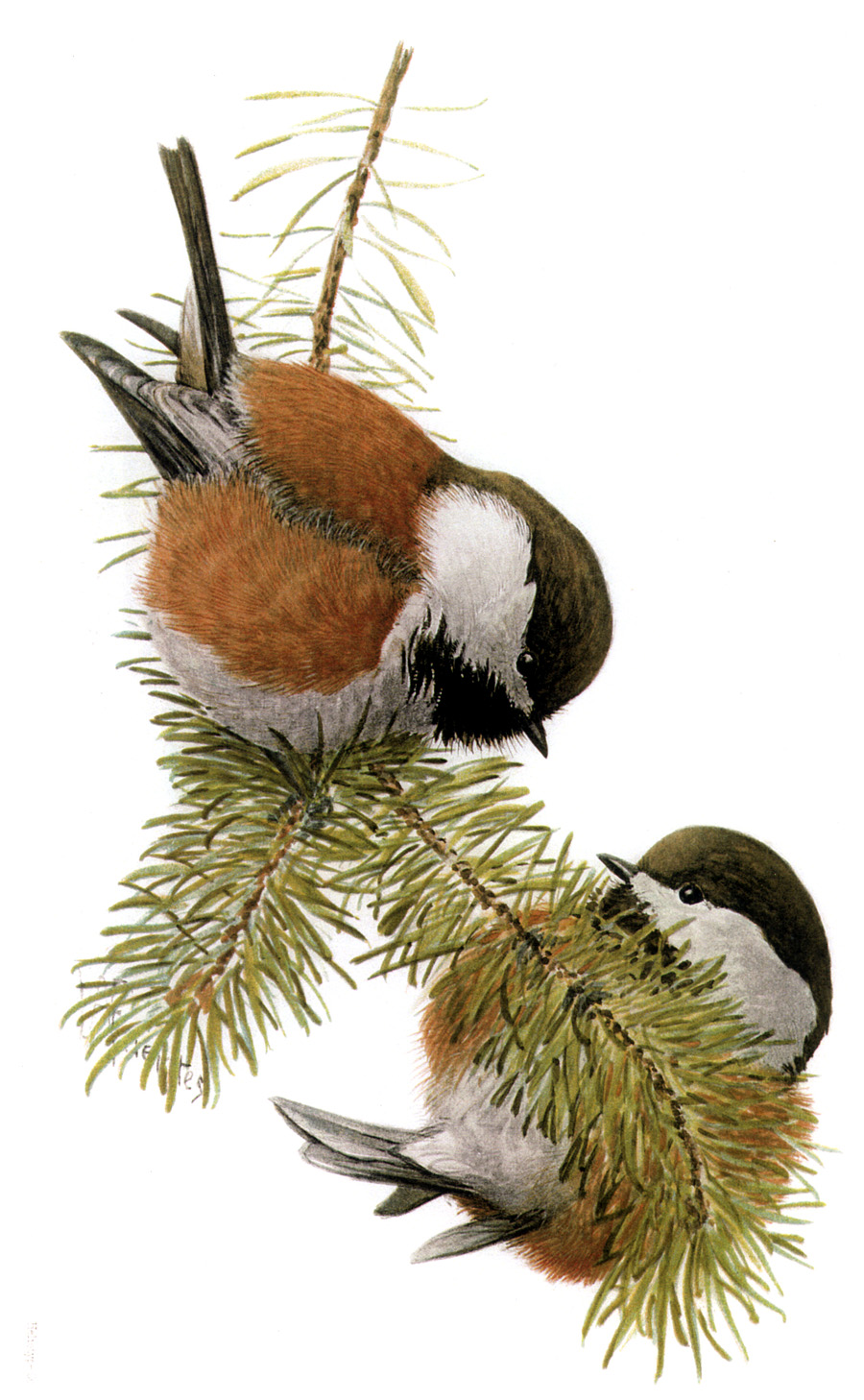
It is a small chickadee, 11.5–12.5 cm (4.5–4.9 in) long with a weight of 8.5–12.6 g (0.30–0.44 oz). The head is dark blackish-brown with white cheeks, the mantle is bright rufous-brown, the wing feathers are dark gray with paler fringes. The underparts are white to pale grayish-white, with rufous or pale gray flanks. It is often considered the most vibrant of all chickadees.
Joseph Grinnell was one of the first to provide a significantly detailed description of this variation. He found that northern areas of the range that were much hotter showed deeper, richer chestnut plumage, whereas the drier southern areas consisted of lighter and grayer chickadees.
Hub AI
Chestnut-backed chickadee AI simulator
(@Chestnut-backed chickadee_simulator)
Chestnut-backed chickadee
The chestnut-backed chickadee (Poecile rufescens) is a small passerine bird in the tit family, Paridae, native to western North America.
In the early 20th century, Joseph Grinnell hypothesized that the chestnut-backed chickadee diverged from the boreal chickadee (Poecile hudsonicus), because both species inhabited similar coniferous forest environments. Grinnell noted that the main differences between the boreal chickadee and the chestnut-backed were in the shade and tone of their respective brown coloration. He drew parallels between the varied chickadee characteristics using the fact that some bird species become smaller and more vibrantly brown as their habitat becomes more humid. Modern molecular phylogenetic studies have confirmed that the chestnut-backed chickadee is sister to the boreal chickadee since there were strong genetic similarities in mitochondrial DNA. More recent research regarding the population distribution of the chestnut-backed chickadee suggests that the genetic fragmentation of the chestnut-backed chickadee from the boreal chickadee was due to the changing glacial landscapes of the Pleistocene era. After this species divergence, the chestnut-backed chickadee migrated south to inhabit the range described above.
There are three subspecies, with the flanks being grayer and less rufous further south:
In addition to these three subspecies, research on the geographical range of chestnut-backed chickadees suggests that there are also four "genetically distinct" groups of chestnut-backed chickadee in North America. Including the populations in Alaska and Coastal North America, there are also separate populations inhabiting the Queen Charlotte Islands and British Columbia. In fact, the chestnut-backed chickadee is the only species of chickadee that resides on the British Columbia Islands.
It is found in the Pacific Northwest of the United States and western Canada, from southeastern Alaska to southwestern California. Its geographical range hugs the humid, foggy coasts. It is a permanent resident within its range, with some seasonal movements as feeding flocks move short distances in search of food. These chickadees usually move to lower elevations in the same area upon onset of winter and move back up to higher elevations in late summer. Its habitat is low elevation coniferous and mixed coniferous forests, consisting mainly of Douglas fir, western hemlock, and western redcedar. This environment provides plenty of shade and constant, cool temperature. In fact, the abundance of Douglas fir trees can be a helpful indicator for the population of chestnut-backed chickadees in the region. In the San Francisco Bay Area, this bird has readily adapted to suburban settings, prompting expansion farther inland. Chestnut-backed chickadees are able to thrive in these areas by making good use of planted trees and shrubs that closely resemble their natural forest habitat. The food and nesting spots in gardens and parks help them survive and reproduce successfully.
The species’ adaptability is further supported by studies of its range expansion in the mid-20th century. It is revealed that the population was stably established in newly colonized forest areas because they simply changed their foraging behavior and habitat use to reduce competition with resident bird species. In these areas, chickadees altered where they foraged within trees as well as the types of vegetation they foraged on, which allowed them to successfully integrate into mixed-species feeding flocks. It is concluded that the ability of the chestnut-backed chickadees to exploit diverse forest structural habitats and change their ecological niche led to their successful range expansion and persistence within changing environments over time.
It is a small chickadee, 11.5–12.5 cm (4.5–4.9 in) long with a weight of 8.5–12.6 g (0.30–0.44 oz). The head is dark blackish-brown with white cheeks, the mantle is bright rufous-brown, the wing feathers are dark gray with paler fringes. The underparts are white to pale grayish-white, with rufous or pale gray flanks. It is often considered the most vibrant of all chickadees.
Joseph Grinnell was one of the first to provide a significantly detailed description of this variation. He found that northern areas of the range that were much hotter showed deeper, richer chestnut plumage, whereas the drier southern areas consisted of lighter and grayer chickadees.