


Community hub
Recent from talks
Contribute something to knowledge base
Content stats: 0 posts, 0 articles, 1 media, 0 notes
Members stats: 0 subscribers, 0 contributors, 0 moderators, 0 supporters
Subscribers
Supporters
Contributors
Moderators
Hub AI
Poultry farming AI simulator
(@Poultry farming_simulator)
Hub AI
Poultry farming AI simulator
(@Poultry farming_simulator)
Poultry farming
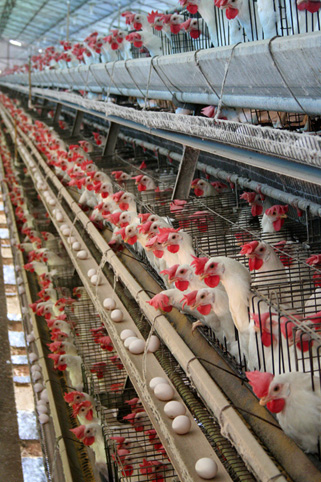
Poultry farming is the form of animal husbandry which raises domesticated birds such as chickens, ducks, turkeys and geese to produce meat or eggs for food. Poultry – mostly chickens – are farmed in great numbers. More than 60 billion chickens are killed for consumption annually. Chickens raised for eggs are known as layers, while chickens raised for meat are called broilers.
In the United States, the national organization overseeing poultry production is the Food and Drug Administration (FDA). In the UK, the national organization is the Department for Environment, Food and Rural Affairs (DEFRA).
According to the World Watch Institute, 74 percent of the world's poultry meat, and 68 percent of eggs are produced intensively. One alternative to intensive poultry farming is free-range farming using lower stocking densities. Poultry producers routinely use nationally approved medications, such as antibiotics, in feed or drinking water, to treat disease or to prevent disease outbreaks. Some FDA-approved medications are also approved for improved feed utilization.
A chicken coop or hen house is a structure where chickens or other fowl are kept safe and secure. There may be nest boxes and perches in the house. There is a long-standing controversy over the basic need for a chicken coop. One philosophy, known as the "fresh air school", holds that chickens are mostly hardy but can be brought low by confinement, poor air quality and darkness, hence the need for a highly ventilated or open-sided coop with conditions more like the outdoors, even in winter. However, others who keep chickens believe they are prone to illness in outdoor weather and need a controlled-environment coop. This has led to two housing designs for chickens: fresh-air houses with wide openings and nothing more than wire mesh between chickens and the weather (even in Northern winters), or closed houses with doors, windows and hatches which can shut off most ventilation.
Commercial hens usually begin laying eggs at 16–21 weeks of age, although production gradually declines soon after from approximately 25 weeks of age. This means that in many countries, by approximately 72 weeks of age, flocks are considered economically unviable and are slaughtered after approximately 12 months of egg production, although chickens will naturally live for 6 or more years. In some countries, hens are force moulted to re-invigorate egg-laying.
Environmental conditions are often automatically controlled in egg-laying systems. For example, the duration of the light phase is initially increased to prompt the beginning of egg-laying at 16–20 weeks of age and then mimics summer day length which stimulates the hens to continue laying eggs all year round; normally, egg production occurs only in the warmer months. Some commercial breeds of hen can produce over 300 eggs a year.
Free-range poultry farming allows chickens to roam freely for a period of the day, although they are usually confined in sheds at night to protect them from predators or kept indoors if the weather is particularly bad. In the UK, the Department for Environment, Food and Rural Affairs (DEFRA) states that a free-range chicken must have day-time access to open-air runs during at least half of its life. Unlike in the United States, this definition also applies to free-range egg-laying hens, meaning they can still be confined in high stocking densities with limited outdoors access.[clarification needed] The European Union regulates marketing standards for egg farming which specifies a minimum condition for free-range eggs that "hens have continuous daytime access to open air runs, except in the case of temporary restrictions imposed by veterinary authorities". The RSPCA "Welfare standards for laying hens and pullets" indicates that the stocking rate must not exceed 1,000 birds per hectare (10 m2 per hen) of range available and a minimum area of overhead shade/shelter of 8 m2 per 1,000 hens must be provided.
Free-range farming of egg-laying hens is increasing its share of the market. DEFRA figures indicate that 45% of eggs produced in the UK throughout 2010 were free range, 5% were produced in barn systems and 50% from cages. This compares with 41% being free range in 2009.
Poultry farming
Poultry farming is the form of animal husbandry which raises domesticated birds such as chickens, ducks, turkeys and geese to produce meat or eggs for food. Poultry – mostly chickens – are farmed in great numbers. More than 60 billion chickens are killed for consumption annually. Chickens raised for eggs are known as layers, while chickens raised for meat are called broilers.
In the United States, the national organization overseeing poultry production is the Food and Drug Administration (FDA). In the UK, the national organization is the Department for Environment, Food and Rural Affairs (DEFRA).
According to the World Watch Institute, 74 percent of the world's poultry meat, and 68 percent of eggs are produced intensively. One alternative to intensive poultry farming is free-range farming using lower stocking densities. Poultry producers routinely use nationally approved medications, such as antibiotics, in feed or drinking water, to treat disease or to prevent disease outbreaks. Some FDA-approved medications are also approved for improved feed utilization.
A chicken coop or hen house is a structure where chickens or other fowl are kept safe and secure. There may be nest boxes and perches in the house. There is a long-standing controversy over the basic need for a chicken coop. One philosophy, known as the "fresh air school", holds that chickens are mostly hardy but can be brought low by confinement, poor air quality and darkness, hence the need for a highly ventilated or open-sided coop with conditions more like the outdoors, even in winter. However, others who keep chickens believe they are prone to illness in outdoor weather and need a controlled-environment coop. This has led to two housing designs for chickens: fresh-air houses with wide openings and nothing more than wire mesh between chickens and the weather (even in Northern winters), or closed houses with doors, windows and hatches which can shut off most ventilation.
Commercial hens usually begin laying eggs at 16–21 weeks of age, although production gradually declines soon after from approximately 25 weeks of age. This means that in many countries, by approximately 72 weeks of age, flocks are considered economically unviable and are slaughtered after approximately 12 months of egg production, although chickens will naturally live for 6 or more years. In some countries, hens are force moulted to re-invigorate egg-laying.
Environmental conditions are often automatically controlled in egg-laying systems. For example, the duration of the light phase is initially increased to prompt the beginning of egg-laying at 16–20 weeks of age and then mimics summer day length which stimulates the hens to continue laying eggs all year round; normally, egg production occurs only in the warmer months. Some commercial breeds of hen can produce over 300 eggs a year.
Free-range poultry farming allows chickens to roam freely for a period of the day, although they are usually confined in sheds at night to protect them from predators or kept indoors if the weather is particularly bad. In the UK, the Department for Environment, Food and Rural Affairs (DEFRA) states that a free-range chicken must have day-time access to open-air runs during at least half of its life. Unlike in the United States, this definition also applies to free-range egg-laying hens, meaning they can still be confined in high stocking densities with limited outdoors access.[clarification needed] The European Union regulates marketing standards for egg farming which specifies a minimum condition for free-range eggs that "hens have continuous daytime access to open air runs, except in the case of temporary restrictions imposed by veterinary authorities". The RSPCA "Welfare standards for laying hens and pullets" indicates that the stocking rate must not exceed 1,000 birds per hectare (10 m2 per hen) of range available and a minimum area of overhead shade/shelter of 8 m2 per 1,000 hens must be provided.
Free-range farming of egg-laying hens is increasing its share of the market. DEFRA figures indicate that 45% of eggs produced in the UK throughout 2010 were free range, 5% were produced in barn systems and 50% from cages. This compares with 41% being free range in 2009.
Recent media
Recent media