


Community hub
Recent from talks
Contribute something to knowledge base
Content stats: 0 posts, 0 articles, 1 media, 0 notes
Members stats: 0 subscribers, 0 contributors, 0 moderators, 0 supporters
Subscribers
Supporters
Contributors
Moderators
Hub AI
Chile Ridge AI simulator
(@Chile Ridge_simulator)
Hub AI
Chile Ridge AI simulator
(@Chile Ridge_simulator)
Chile Ridge
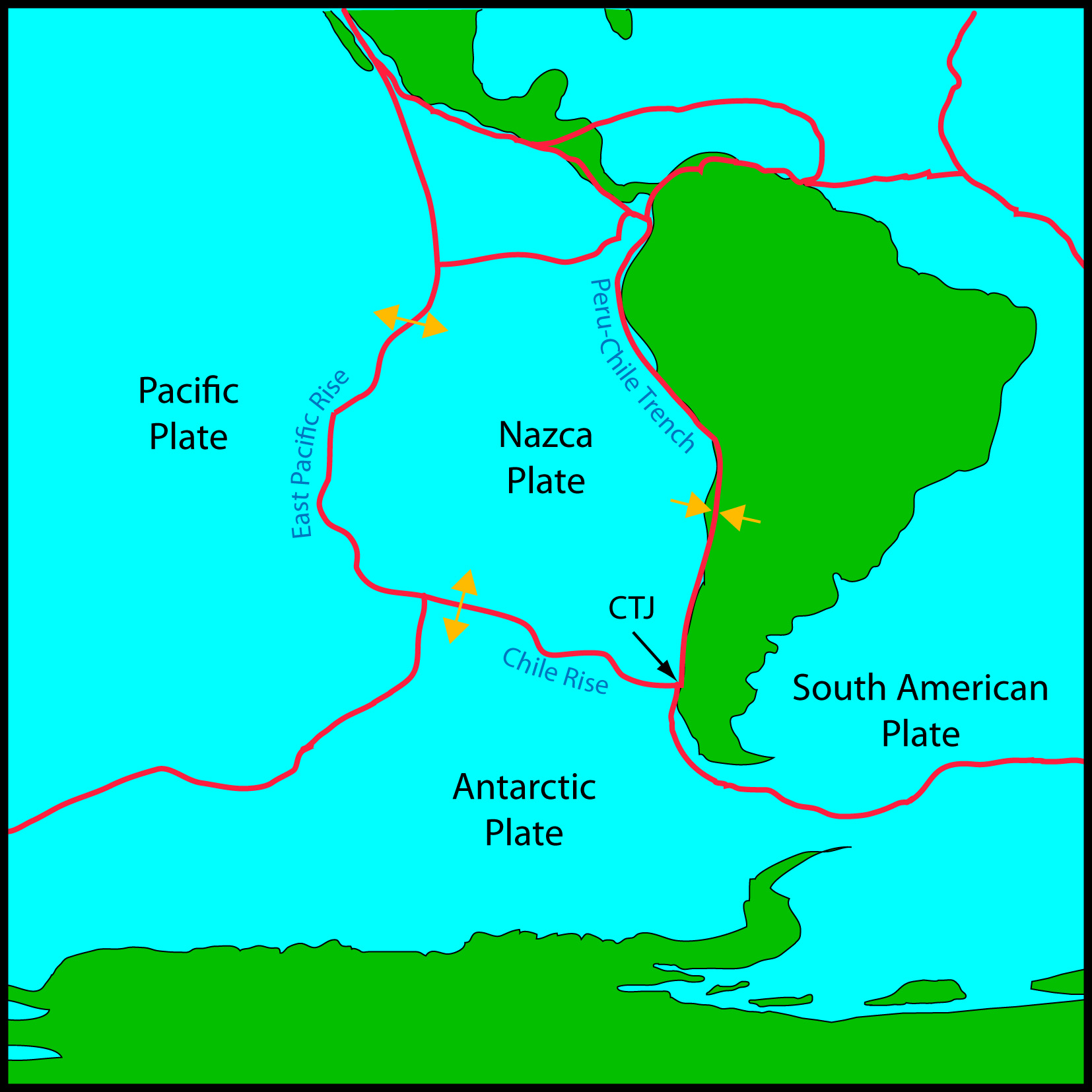
The Chile Ridge, also known as the Chile Rise, is a submarine oceanic ridge formed by the divergent plate boundary between the Nazca plate and the Antarctic plate. It extends from the triple junction of the Nazca, Pacific, and Antarctic plates to the Southern coast of Chile. The Chile Ridge is easy to recognize on the map, as the ridge is divided into several segmented fracture zones which are perpendicular to the ridge segments, showing an orthogonal shape toward the spreading direction. The total length of the ridge segments is about 550–600 km (340–370 mi; 300–320 nmi).
The continuously spreading Chile Ridge collides with the southern South American plate to the east, and the ridge has been subducting underneath the Taitao Peninsula since 14 million years (Ma). The ridge-collision has generated a slab window beneath the overlying South America plate, with smaller volume of upper mantle magma melt, proven by an abrupt low velocity of magma flow rate below the separating Chile ridge. The subduction generates a special type of igneous rocks, represented by the Taitao ophiolites, which is an ultramafic rock composed of olivine and pyroxene, usually found in oceanic plates. In addition, the subduction of the Chile Ridge also creates Taitao granite in Taitao Peninsula which appeared as plutons.
The Chile Ridge involves spreading ridge subduction which is worth studying because it explains how the Archean continental crust initiation formed from deep oceanic crust.
From approximately 14 to 3 million years ago, a series of trenches collided the Chile Trench, forming what is part of the Chile Ridge.[citation needed]
In the 2010 Concepcion earthquake (magnitude 8.8) struck the ridge.[citation needed]
The geology of the Chile ridge is closely related to the geology of the Taitao Peninsula (East of the Chile ridge). This is because the Chile ridge subducts beneath the Taitao Peninsula, which give rise to unique lithologies there. The lithological units would be discussed from youngest to oldest, and Taitao Granites and Taitao Ophiolite would be our main focus.
Adakite magmatism is formed by the melting of the Nazca plate's trailing edge. Due to the subduction of the Chile Ridge beneath the South American plate, there were intrusive magmatism which generates granite. This is also formed by the partial melting of the subducted oceanic crust. The young Nazca crust (less than 18 Myr old) are warmer so that the metamorphosed subducted basalts are melted. In normal mid-oceanic ridge, the presence of volatiles like water also reduces the solidus temperature. However, in Chile Ridge, there is relatively low-extent (20%) of partial melting of the lithosphere, the pressure and the temperature of the partial melting is less than 10 kbar and higher than 650° respectively. This is because the warm young Nazca plate has hindered high rate of cooling and dehydration. The partial melting of the Taitao granite creates plutons like the Cabo Raper adakitic pluton.
Adakite is a felsic to intermediate rock and are usually calc-alkaline in composition. It is also silica-rich. The partial melting causes the alteration of the subducted basalts into eclogite and amphibolite which contains garnet.
Chile Ridge
The Chile Ridge, also known as the Chile Rise, is a submarine oceanic ridge formed by the divergent plate boundary between the Nazca plate and the Antarctic plate. It extends from the triple junction of the Nazca, Pacific, and Antarctic plates to the Southern coast of Chile. The Chile Ridge is easy to recognize on the map, as the ridge is divided into several segmented fracture zones which are perpendicular to the ridge segments, showing an orthogonal shape toward the spreading direction. The total length of the ridge segments is about 550–600 km (340–370 mi; 300–320 nmi).
The continuously spreading Chile Ridge collides with the southern South American plate to the east, and the ridge has been subducting underneath the Taitao Peninsula since 14 million years (Ma). The ridge-collision has generated a slab window beneath the overlying South America plate, with smaller volume of upper mantle magma melt, proven by an abrupt low velocity of magma flow rate below the separating Chile ridge. The subduction generates a special type of igneous rocks, represented by the Taitao ophiolites, which is an ultramafic rock composed of olivine and pyroxene, usually found in oceanic plates. In addition, the subduction of the Chile Ridge also creates Taitao granite in Taitao Peninsula which appeared as plutons.
The Chile Ridge involves spreading ridge subduction which is worth studying because it explains how the Archean continental crust initiation formed from deep oceanic crust.
From approximately 14 to 3 million years ago, a series of trenches collided the Chile Trench, forming what is part of the Chile Ridge.[citation needed]
In the 2010 Concepcion earthquake (magnitude 8.8) struck the ridge.[citation needed]
The geology of the Chile ridge is closely related to the geology of the Taitao Peninsula (East of the Chile ridge). This is because the Chile ridge subducts beneath the Taitao Peninsula, which give rise to unique lithologies there. The lithological units would be discussed from youngest to oldest, and Taitao Granites and Taitao Ophiolite would be our main focus.
Adakite magmatism is formed by the melting of the Nazca plate's trailing edge. Due to the subduction of the Chile Ridge beneath the South American plate, there were intrusive magmatism which generates granite. This is also formed by the partial melting of the subducted oceanic crust. The young Nazca crust (less than 18 Myr old) are warmer so that the metamorphosed subducted basalts are melted. In normal mid-oceanic ridge, the presence of volatiles like water also reduces the solidus temperature. However, in Chile Ridge, there is relatively low-extent (20%) of partial melting of the lithosphere, the pressure and the temperature of the partial melting is less than 10 kbar and higher than 650° respectively. This is because the warm young Nazca plate has hindered high rate of cooling and dehydration. The partial melting of the Taitao granite creates plutons like the Cabo Raper adakitic pluton.
Adakite is a felsic to intermediate rock and are usually calc-alkaline in composition. It is also silica-rich. The partial melting causes the alteration of the subducted basalts into eclogite and amphibolite which contains garnet.
Recent media
Recent media