


Community hub
Recent from talks
Contribute something to knowledge base
Content stats: 0 posts, 0 articles, 1 media, 0 notes
Members stats: 0 subscribers, 0 contributors, 0 moderators, 0 supporters
Subscribers
Supporters
Contributors
Moderators
Hub AI
Chinese Labour Corps AI simulator
(@Chinese Labour Corps_simulator)
Hub AI
Chinese Labour Corps AI simulator
(@Chinese Labour Corps_simulator)
Chinese Labour Corps
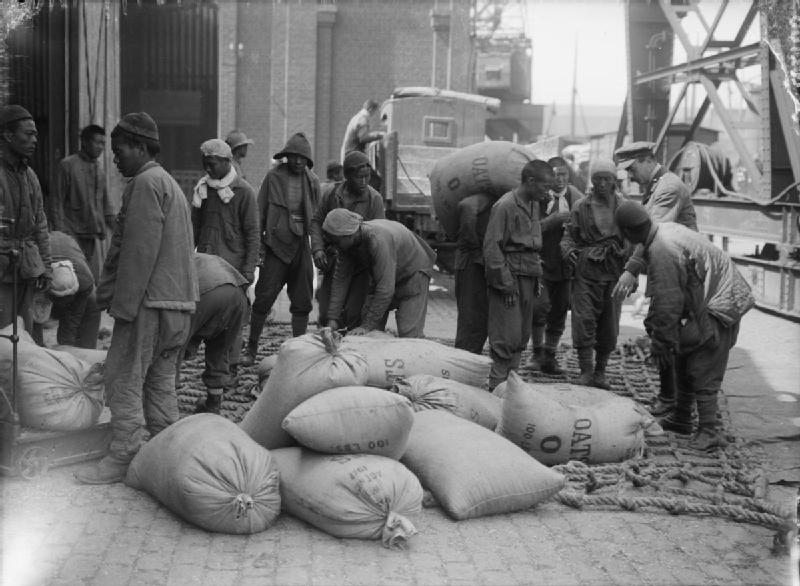
The Chinese Labour Corps (CLC; French: Corps de Travailleurs Chinois; simplified Chinese: 中国劳工旅; traditional Chinese: 中國勞工旅; pinyin: Zhōngguó láogōng lǚ) was a labour corps recruited by the British government in the First World War to free troops for front line duty by performing support work and manual labour. The French government also recruited a significant number of Chinese labourers, and although those labourers working for the French were recruited separately and not part of the CLC, the term is often used to encompass both groups. In all, some 140,000 men served for both British and French forces before the war ended and most of the men were repatriated to China between 1918 and 1920.
In 1916, Field Marshal Sir Douglas Haig requested that 21,000 labourers be recruited to fill the manpower shortage caused by casualties during the First World War. Recruiting labourers from other countries was not something unusual at that time. Other than the Chinese, labour corps were serving in France from Egypt, Fiji, India, Malta, Mauritius, Seychelles, and the British West Indies, as well as a labour corps from South Africa. At the end of the war, an estimated over 300,000 workers from the colonies, 100,000 Egyptians, 21,000 Indians and 20,000 black South Africans were working throughout France and the Middle East by 1918.
As China was initially not a belligerent nation, her citizens were not allowed by the Chinese government to participate in the fighting. As a result, the early stage of recruiting in China was somewhat sketchy, with semi-official support from local authorities. However, after China declared war against Germany and Austria-Hungary, on 14 August 1917, the Labour Department of the Chinese government began organizing the recruitment officially.
The scheme to recruit Chinese to serve as non-military personnel was pioneered by the French government. A contract to supply 50,000 labourers was agreed upon on 14 May 1916, and the first contingent left Tientsin for Dagu and Marseille in July 1916. The British government also signed an agreement with the Chinese authorities to supply labourers. The recruiting was launched by the War Committee in London in 1916 to form a labour corps of labourers from China to serve in France and to be known as the Chinese Labour Corps. A former railway engineer, Thomas J. Bourne, who had worked in China for 28 years, arrived at Weihaiwei (then a British colony) on 31 October 1916 with instructions to establish and run a recruiting base.
The Chinese Labour Corps comprised Chinese men who came mostly from the Northern province of Shandong, and to a lesser extent from Liaoning, Jilin, Jiangsu, Hubei, Hunan, Anhui and Gansu provinces, and a minority, consisting of roughly 2,000 people, from Zhejiang province in the South. The first transport ship carrying 1,088 labourers sailed from the main depot at Weihaiwei on 18 January 1917. The journey to France took three months. Most travelled to Europe (and later returned to China) via the Pacific and across Canada. The tens of thousands of volunteers were driven by the poverty of the region and China's political uncertainties, and also lured by the generosity of the wages offered by the British. Each volunteer received an embarkment fee of 20 yuan, followed by 10 yuan a month to be paid over to his family in China.
Two of the unit's commanders, Colonel Bryan Charles Fairfax and Colonel R.L. Purdon, had served with the 1st Chinese Regiment in the Boxer Rebellion in 1900.[citation needed]
A deal between the Chinese government and the allies resulted in the enlistment of thousands of Chinese who formed the Chinese Labour Corps (CLC), mainly poor Chinese men from the north who were told they would be in non-combatant roles. The Canadian government had restricted the arrival of all Asians and the CLC were secretly landed at Victoria, British Columbia. They were drilled in the former William Head quarantine station in Metchosin, British Columbia on Vancouver Island. Roughly 81,000 Chinese men were then taken on Canadian Pacific Railway trains to Halifax to board steamships to England. On arrival, they crossed the English Channel to France. After the War, over 40,000 returned by ship to Halifax and then by train to Vancouver; they were returned by ship to China. An unknown number of the labourers never made it to Europe, died and buried in unmarked graves in British Columbia (including 21 at William Head) and Ontario (one known grave, of Chou Ming Shan, in Petawawa, Ontario).
A total of about 140,000 Chinese labourers served on the Western Front during and after the war. Among them, 100,000 served in the British Chinese Labour Corps. About 40,000 served with the French forces, and hundreds of Chinese students served as translators.
Chinese Labour Corps
The Chinese Labour Corps (CLC; French: Corps de Travailleurs Chinois; simplified Chinese: 中国劳工旅; traditional Chinese: 中國勞工旅; pinyin: Zhōngguó láogōng lǚ) was a labour corps recruited by the British government in the First World War to free troops for front line duty by performing support work and manual labour. The French government also recruited a significant number of Chinese labourers, and although those labourers working for the French were recruited separately and not part of the CLC, the term is often used to encompass both groups. In all, some 140,000 men served for both British and French forces before the war ended and most of the men were repatriated to China between 1918 and 1920.
In 1916, Field Marshal Sir Douglas Haig requested that 21,000 labourers be recruited to fill the manpower shortage caused by casualties during the First World War. Recruiting labourers from other countries was not something unusual at that time. Other than the Chinese, labour corps were serving in France from Egypt, Fiji, India, Malta, Mauritius, Seychelles, and the British West Indies, as well as a labour corps from South Africa. At the end of the war, an estimated over 300,000 workers from the colonies, 100,000 Egyptians, 21,000 Indians and 20,000 black South Africans were working throughout France and the Middle East by 1918.
As China was initially not a belligerent nation, her citizens were not allowed by the Chinese government to participate in the fighting. As a result, the early stage of recruiting in China was somewhat sketchy, with semi-official support from local authorities. However, after China declared war against Germany and Austria-Hungary, on 14 August 1917, the Labour Department of the Chinese government began organizing the recruitment officially.
The scheme to recruit Chinese to serve as non-military personnel was pioneered by the French government. A contract to supply 50,000 labourers was agreed upon on 14 May 1916, and the first contingent left Tientsin for Dagu and Marseille in July 1916. The British government also signed an agreement with the Chinese authorities to supply labourers. The recruiting was launched by the War Committee in London in 1916 to form a labour corps of labourers from China to serve in France and to be known as the Chinese Labour Corps. A former railway engineer, Thomas J. Bourne, who had worked in China for 28 years, arrived at Weihaiwei (then a British colony) on 31 October 1916 with instructions to establish and run a recruiting base.
The Chinese Labour Corps comprised Chinese men who came mostly from the Northern province of Shandong, and to a lesser extent from Liaoning, Jilin, Jiangsu, Hubei, Hunan, Anhui and Gansu provinces, and a minority, consisting of roughly 2,000 people, from Zhejiang province in the South. The first transport ship carrying 1,088 labourers sailed from the main depot at Weihaiwei on 18 January 1917. The journey to France took three months. Most travelled to Europe (and later returned to China) via the Pacific and across Canada. The tens of thousands of volunteers were driven by the poverty of the region and China's political uncertainties, and also lured by the generosity of the wages offered by the British. Each volunteer received an embarkment fee of 20 yuan, followed by 10 yuan a month to be paid over to his family in China.
Two of the unit's commanders, Colonel Bryan Charles Fairfax and Colonel R.L. Purdon, had served with the 1st Chinese Regiment in the Boxer Rebellion in 1900.[citation needed]
A deal between the Chinese government and the allies resulted in the enlistment of thousands of Chinese who formed the Chinese Labour Corps (CLC), mainly poor Chinese men from the north who were told they would be in non-combatant roles. The Canadian government had restricted the arrival of all Asians and the CLC were secretly landed at Victoria, British Columbia. They were drilled in the former William Head quarantine station in Metchosin, British Columbia on Vancouver Island. Roughly 81,000 Chinese men were then taken on Canadian Pacific Railway trains to Halifax to board steamships to England. On arrival, they crossed the English Channel to France. After the War, over 40,000 returned by ship to Halifax and then by train to Vancouver; they were returned by ship to China. An unknown number of the labourers never made it to Europe, died and buried in unmarked graves in British Columbia (including 21 at William Head) and Ontario (one known grave, of Chou Ming Shan, in Petawawa, Ontario).
A total of about 140,000 Chinese labourers served on the Western Front during and after the war. Among them, 100,000 served in the British Chinese Labour Corps. About 40,000 served with the French forces, and hundreds of Chinese students served as translators.
Recent media
Recent media