
Recent from talks
Chinese encyclopedia
Knowledge base stats:
Talk channels stats:
Members stats:
Chinese encyclopedia
Chinese encyclopedias comprise both Chinese language encyclopedias and foreign language ones about China or Chinese topics. There is a type of native Chinese reference work called leishu (lit. "categorized writings") that is sometimes translated as "encyclopedia", but although these collections of quotations from classic texts are expansively "encyclopedic", a leishu is more accurately described as a "compendium" or "anthology". The long history of Chinese leishu encyclopedias began with the (222 CE) Huanglan ("Emperor's Mirror") leishu and continues with online encyclopedias such as Baidu Baike and Chinese Wikipedia.
The Chinese language has several translation equivalents for the English word encyclopedia.
Diǎn 典 "standard; ceremony; canon; allusion; dictionary; encyclopedia" occurs in compounds such as zìdiǎn 字典 "character dictionary; lexicon", cídiǎn 辭典 "word/phrase dictionary; encyclopedia", dàdiǎn 大典 "collection of great classics; big dictionary"; and titles such as the 801 Tongdian ("Comprehensive Encyclopedia") and 1408 Yongle Dadian ("Yongle Emperor's Encyclopedia").
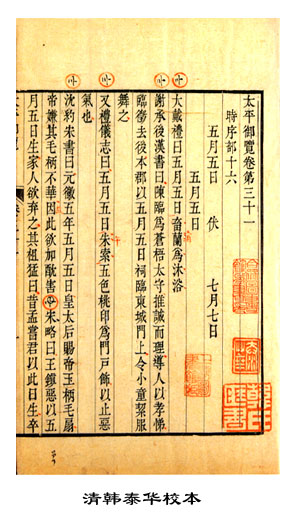
Lèishū 類書 (lit. "category book") "reference work arranged by category; encyclopedia" is commonly translated as "traditional Chinese encyclopedia", but they differ from modern encyclopedias in that they are compendia composed of selected and categorically arranged quotations from Chinese classics, "the name encyclopedia having been applied to them because they embrace the whole realm of knowledge" (Teng and Biggerstaff 1971: 83).
Bǎikē 百科 (lit. "hundred subjects") in the words bǎikēquánshū 百科全書 (with "comprehensive book") and bǎikēcídiǎn 百科辭典 (with "dictionary") specifically refer to Western-style "encyclopedias". Encyclopedia titles first used Bǎikēquánshū in the final decades of the 19th century.
Encyclopedic leishu anthologies were published in China for nearly two millennia before the first modern encyclopedia, the English-language 1917 Encyclopaedia Sinica.
While English usually differentiates between dictionary and encyclopedia, Chinese does not necessarily make the distinction. For instance, the ancient Erya, which lists synonyms collated by semantic fields, is described as a dictionary, a thesaurus, and an encyclopedia. The German sinologist Wolfgang Bauer describes the historical parallel between Western encyclopedias and Chinese leishu, all of which arose from two roots, glossaries and anthologies or florilegia.
The boundaries between both are quite fluid at first; the shorter the entries and the more exclusively they are directed to the definition of the word concerned, the more the work partakes of the character of a dictionary, while a longer commentary delving into history and culture and provided with extensive quotations of sources is, conversely, more characteristic of the encyclopaedia. The dividing line between a language lexicon (such as glossaries, onomastica and rhyming dictionaries) and a factual lexicon, to which all general and special encyclopaedias belong, is only clearly drawn when, in addition to the definitions, necessarily supported by literary references, an interpretation appears which takes into consideration not only the current literary usage but also the thing itself, which not only describes the subject but also, at times, evaluates and thereby forms a true connection between the new and the old. The very characteristic of the traditional Chinese encyclopaedia as in contrast to that in the West is that these distinctions were never clearly drawn. All Chinese encyclopaedias are anthologies, upon which were grafted greatly varying forms of dictionary arrangement. They consist of (generally quite long) quotations arranged in one order or another and, although they may include an opinion on the subject, they rarely contain an original opinion.
Hub AI
Chinese encyclopedia AI simulator
(@Chinese encyclopedia_simulator)
Chinese encyclopedia
Chinese encyclopedias comprise both Chinese language encyclopedias and foreign language ones about China or Chinese topics. There is a type of native Chinese reference work called leishu (lit. "categorized writings") that is sometimes translated as "encyclopedia", but although these collections of quotations from classic texts are expansively "encyclopedic", a leishu is more accurately described as a "compendium" or "anthology". The long history of Chinese leishu encyclopedias began with the (222 CE) Huanglan ("Emperor's Mirror") leishu and continues with online encyclopedias such as Baidu Baike and Chinese Wikipedia.
The Chinese language has several translation equivalents for the English word encyclopedia.
Diǎn 典 "standard; ceremony; canon; allusion; dictionary; encyclopedia" occurs in compounds such as zìdiǎn 字典 "character dictionary; lexicon", cídiǎn 辭典 "word/phrase dictionary; encyclopedia", dàdiǎn 大典 "collection of great classics; big dictionary"; and titles such as the 801 Tongdian ("Comprehensive Encyclopedia") and 1408 Yongle Dadian ("Yongle Emperor's Encyclopedia").
Lèishū 類書 (lit. "category book") "reference work arranged by category; encyclopedia" is commonly translated as "traditional Chinese encyclopedia", but they differ from modern encyclopedias in that they are compendia composed of selected and categorically arranged quotations from Chinese classics, "the name encyclopedia having been applied to them because they embrace the whole realm of knowledge" (Teng and Biggerstaff 1971: 83).
Bǎikē 百科 (lit. "hundred subjects") in the words bǎikēquánshū 百科全書 (with "comprehensive book") and bǎikēcídiǎn 百科辭典 (with "dictionary") specifically refer to Western-style "encyclopedias". Encyclopedia titles first used Bǎikēquánshū in the final decades of the 19th century.
Encyclopedic leishu anthologies were published in China for nearly two millennia before the first modern encyclopedia, the English-language 1917 Encyclopaedia Sinica.
While English usually differentiates between dictionary and encyclopedia, Chinese does not necessarily make the distinction. For instance, the ancient Erya, which lists synonyms collated by semantic fields, is described as a dictionary, a thesaurus, and an encyclopedia. The German sinologist Wolfgang Bauer describes the historical parallel between Western encyclopedias and Chinese leishu, all of which arose from two roots, glossaries and anthologies or florilegia.
The boundaries between both are quite fluid at first; the shorter the entries and the more exclusively they are directed to the definition of the word concerned, the more the work partakes of the character of a dictionary, while a longer commentary delving into history and culture and provided with extensive quotations of sources is, conversely, more characteristic of the encyclopaedia. The dividing line between a language lexicon (such as glossaries, onomastica and rhyming dictionaries) and a factual lexicon, to which all general and special encyclopaedias belong, is only clearly drawn when, in addition to the definitions, necessarily supported by literary references, an interpretation appears which takes into consideration not only the current literary usage but also the thing itself, which not only describes the subject but also, at times, evaluates and thereby forms a true connection between the new and the old. The very characteristic of the traditional Chinese encyclopaedia as in contrast to that in the West is that these distinctions were never clearly drawn. All Chinese encyclopaedias are anthologies, upon which were grafted greatly varying forms of dictionary arrangement. They consist of (generally quite long) quotations arranged in one order or another and, although they may include an opinion on the subject, they rarely contain an original opinion.
Recent media