
Recent from talks
Chinese home run
Knowledge base stats:
Talk channels stats:
Members stats:
Chinese home run
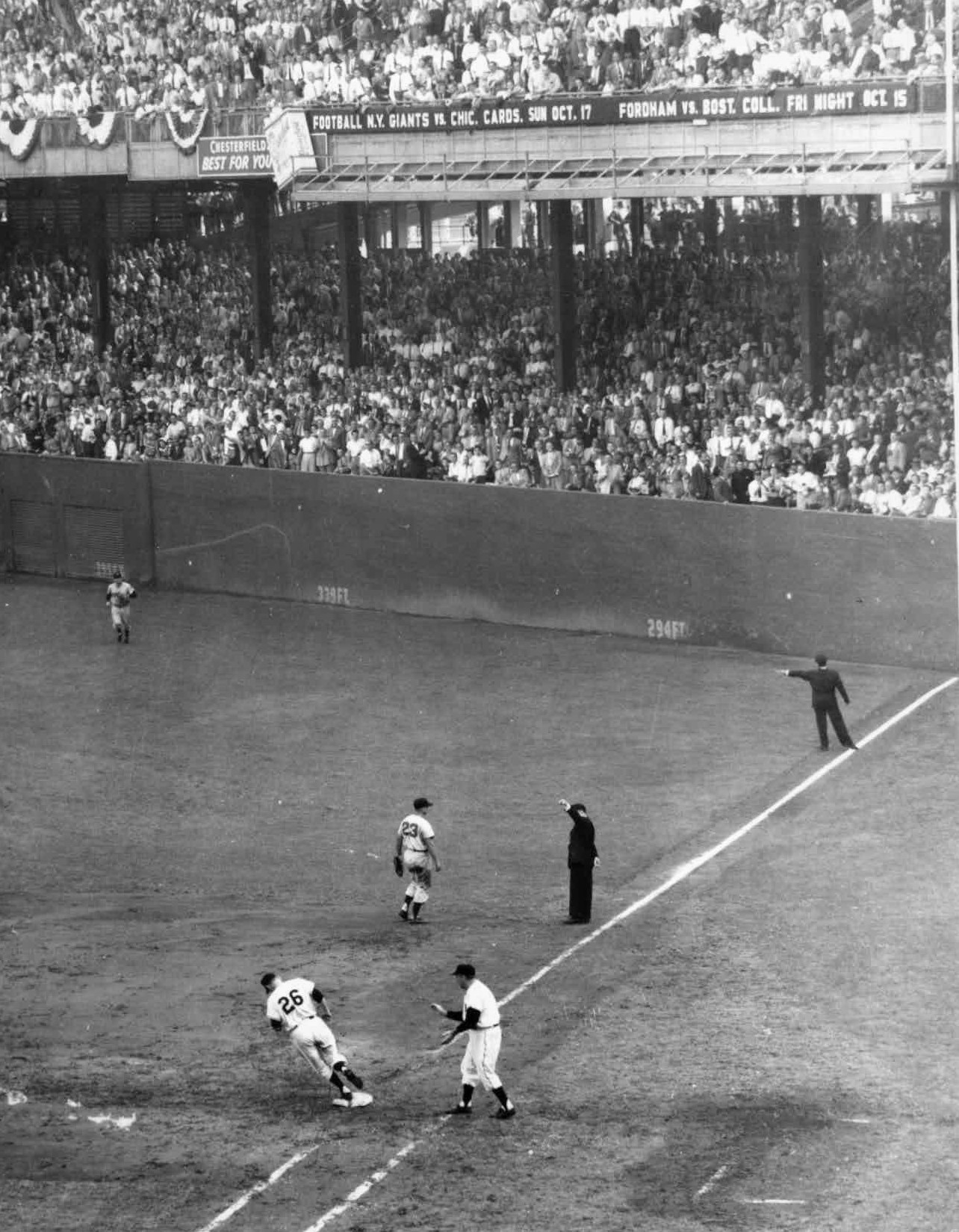
Chinese home run, also a Chinese homer, Harlem home run, Polo home run, or Pekinese poke, is a derogatory and archaic baseball term for a hit that just barely clears the outfield fence at its closest distance to home plate. It is essentially the shortest home run possible in the ballpark in question, particularly if the park has an atypically short fence. The term was most commonly used in reference to home runs hit along the right field foul line at the Polo Grounds, home of the New York Giants, where that distance was short even by contemporary standards. When the Giants moved to San Francisco in 1958, the Los Angeles Coliseum, temporary home of the newly relocated Los Angeles Dodgers, gained the same reputation for four seasons until the team took up residence in its permanent home at Dodger Stadium in 1962. Following two seasons of use by the expansion New York Mets in the early 1960s, the Polo Grounds were demolished, and the term gradually dropped out of use.
Why these home runs were called "Chinese" is not definitely known, but it is believed to have reflected an early 20th-century perception that Chinese immigrants to the United States did the menial labor they were consigned to with a bare minimum of adequacy, and were content with minimal reward for it. A Tad Dorgan cartoon has been proposed as the likely origin, but that has not been proven; the earliest known usages are in a 1927 newspaper account of a Pittsburgh Pirates–Philadelphia Phillies major-league game, and in a 1919 newspaper account of a Los Angeles Angels–Sacramento Senators minor-league game. In the 1950s, an extended take on the term in the New York Daily News led the city's Chinese-American community to ask sportswriters not to use it. This perception of ethnic insensitivity has further contributed to its disuse.
It has been used to disparage not only the hit but the batter, since it implies minimal effort on his part. Giants' outfielder Mel Ott, who hit many such home runs in the Polo Grounds during his career, was a frequent target of this as his physique and unusual batting stance were not those associated with a power hitter. The hit most frequently recalled as a Chinese home run was the three-run pinch hit walk-off shot by Dusty Rhodes that won the first game of the 1954 World Series for the Giants on their way to a sweep of the Cleveland Indians.
A secondary meaning, which continues today, is of a foul ball that travels high and far, often behind home plate. However, this appears to be confined to sandlot and high-school games in New England. Research into this usage suggests that it may not, in fact, have had anything initially to do with Chinese people, but is instead a corruption of "Chaney's home run", from a foul by a player of that name which supposedly won a game when the ball thus hit, the only one remaining, could not be found.
As early as the late 19th century, baseball players and fans had recognized that parks with shorter distances to the foul poles and back fence allowed for home runs that were regarded as undeserved or unearned, since fly balls of the same distance hit closer to or in center field could easily be caught for outs. In 1896, Jim Nolan of The Daily News of Galveston, Texas, reporting on the expansion of the local ballpark, wrote: "The enlarged size of the grounds will enable the outfielders to cover more ground and take in fly balls that went for cheap home runs before. Batsmen will have to earn their triples and home runs hereafter".
In 2010, Jonathan E. Lighter, editor of the Historical Dictionary of American Slang, posted on the American Dialect Society's (ADS) listserv that he had found the earliest use of the term "Chinese home run" for that type of hit in a Charleroi, Pennsylvania, newspaper's 1927 account of a National League game between the Philadelphia Phillies and Pittsburgh Pirates: "The Phillies went into a deadlock on Cy's Chinese homer only to see the Buccos hammer over four runs a little later."
An article in the Los Angeles Times in August 1919 used the term while summarizing a minor league game in the Pacific Coast League between the Los Angeles Angels and Sacramento Senators. "Ellis hit a tremendous Chinese home run just back of Pinelli's head", sportswriter Ed O'Malley wrote, in describing a home run by the Angels' Rube Ellis that, apparently, had not been hit very far past Babe Pinelli, the Senators' third baseman.
The above instances predate the earliest use that Paul Dickson found when researching The Dickson Baseball Dictionary. In a 1930 story for The Washington Post, writer Brian Bell quoted Dan Howley, manager of the Cincinnati Reds, defending the hitting prowess of Harry Heilmann, who was then finishing his career under Howley. "[They] were real home runs", Howley said, pointing out how far from the field they had landed. "They were not Chinese home runs in that short bleacher at right", referring to the back fence on the foul line at the Polo Grounds, a mere 258 feet (79 m) from home.
Hub AI
Chinese home run AI simulator
(@Chinese home run_simulator)
Chinese home run
Chinese home run, also a Chinese homer, Harlem home run, Polo home run, or Pekinese poke, is a derogatory and archaic baseball term for a hit that just barely clears the outfield fence at its closest distance to home plate. It is essentially the shortest home run possible in the ballpark in question, particularly if the park has an atypically short fence. The term was most commonly used in reference to home runs hit along the right field foul line at the Polo Grounds, home of the New York Giants, where that distance was short even by contemporary standards. When the Giants moved to San Francisco in 1958, the Los Angeles Coliseum, temporary home of the newly relocated Los Angeles Dodgers, gained the same reputation for four seasons until the team took up residence in its permanent home at Dodger Stadium in 1962. Following two seasons of use by the expansion New York Mets in the early 1960s, the Polo Grounds were demolished, and the term gradually dropped out of use.
Why these home runs were called "Chinese" is not definitely known, but it is believed to have reflected an early 20th-century perception that Chinese immigrants to the United States did the menial labor they were consigned to with a bare minimum of adequacy, and were content with minimal reward for it. A Tad Dorgan cartoon has been proposed as the likely origin, but that has not been proven; the earliest known usages are in a 1927 newspaper account of a Pittsburgh Pirates–Philadelphia Phillies major-league game, and in a 1919 newspaper account of a Los Angeles Angels–Sacramento Senators minor-league game. In the 1950s, an extended take on the term in the New York Daily News led the city's Chinese-American community to ask sportswriters not to use it. This perception of ethnic insensitivity has further contributed to its disuse.
It has been used to disparage not only the hit but the batter, since it implies minimal effort on his part. Giants' outfielder Mel Ott, who hit many such home runs in the Polo Grounds during his career, was a frequent target of this as his physique and unusual batting stance were not those associated with a power hitter. The hit most frequently recalled as a Chinese home run was the three-run pinch hit walk-off shot by Dusty Rhodes that won the first game of the 1954 World Series for the Giants on their way to a sweep of the Cleveland Indians.
A secondary meaning, which continues today, is of a foul ball that travels high and far, often behind home plate. However, this appears to be confined to sandlot and high-school games in New England. Research into this usage suggests that it may not, in fact, have had anything initially to do with Chinese people, but is instead a corruption of "Chaney's home run", from a foul by a player of that name which supposedly won a game when the ball thus hit, the only one remaining, could not be found.
As early as the late 19th century, baseball players and fans had recognized that parks with shorter distances to the foul poles and back fence allowed for home runs that were regarded as undeserved or unearned, since fly balls of the same distance hit closer to or in center field could easily be caught for outs. In 1896, Jim Nolan of The Daily News of Galveston, Texas, reporting on the expansion of the local ballpark, wrote: "The enlarged size of the grounds will enable the outfielders to cover more ground and take in fly balls that went for cheap home runs before. Batsmen will have to earn their triples and home runs hereafter".
In 2010, Jonathan E. Lighter, editor of the Historical Dictionary of American Slang, posted on the American Dialect Society's (ADS) listserv that he had found the earliest use of the term "Chinese home run" for that type of hit in a Charleroi, Pennsylvania, newspaper's 1927 account of a National League game between the Philadelphia Phillies and Pittsburgh Pirates: "The Phillies went into a deadlock on Cy's Chinese homer only to see the Buccos hammer over four runs a little later."
An article in the Los Angeles Times in August 1919 used the term while summarizing a minor league game in the Pacific Coast League between the Los Angeles Angels and Sacramento Senators. "Ellis hit a tremendous Chinese home run just back of Pinelli's head", sportswriter Ed O'Malley wrote, in describing a home run by the Angels' Rube Ellis that, apparently, had not been hit very far past Babe Pinelli, the Senators' third baseman.
The above instances predate the earliest use that Paul Dickson found when researching The Dickson Baseball Dictionary. In a 1930 story for The Washington Post, writer Brian Bell quoted Dan Howley, manager of the Cincinnati Reds, defending the hitting prowess of Harry Heilmann, who was then finishing his career under Howley. "[They] were real home runs", Howley said, pointing out how far from the field they had landed. "They were not Chinese home runs in that short bleacher at right", referring to the back fence on the foul line at the Polo Grounds, a mere 258 feet (79 m) from home.
Recent media