Hubbry Logo
Out (baseball)Out (baseball)Main
Open search
Out (baseball)
Community hub
Out (baseball)
logo
8 pages, 0 posts
0 subscribers
Be the first to start a discussion here.
Out (baseball)
Out (baseball)
from Wikipedia

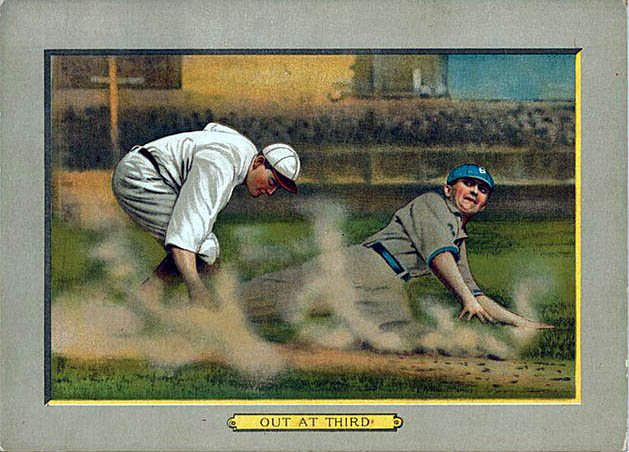
A 1911 American Tobacco Company baseball card illustrating a baserunner being tagged out at third base

In baseball, an out occurs when the umpire rules a batter or baserunner out. When a batter or runner is out, they lose their ability to score a run and must return to the dugout until their next turn at bat. When three outs are recorded in a half-inning, the batting team's turn expires.

To signal an out, an umpire generally makes a fist with one hand, and then flexes that arm either upward, particularly on pop flies, or forward, particularly on routine plays at first base. Home plate umpires often use a "punch-out" motion to signal a called strikeout.

Ways of making outs

[edit]
  • The most common ways batters or runners are put out are when:
    • The batter strikes out (they make three batting mistakes, known as strikes, without hitting the ball into fair territory);
    • The batter flies out (they hit the ball and it is caught before landing);
      • A baserunner fails to return to their time-of-pitch base after a flyout occurs and a fielder with the ball touches the base (commonly known as "doubling off" or "doubling up", as this would constitute a double play);
    • a baserunner is tagged out (they are touched by the ball, held in an opponent's hand, while not on a base);
    • a baserunner is forced out (an opponent with the ball reaches the base the runner is forced to advance to before the runner does).
  • The batter is out when:
    • Strikeout-related outs:
      • with two strikes, the batter swings at a pitched ball and misses;[1]
      • with two strikes, they do not swing at a pitch that the umpire judges to be in the strike zone (and the catcher catches the ball and does not drop it);[1]
      • with two strikes, the batter foul tips a pitch directly back into the catcher's mitt, and the catcher holds the ball and does not drop it;[2][3]: 5.09(a)(2) 
      • with two strikes, they bunt a pitch into foul territory;[1][3]: 5.09(a)(4) 
      • the third strike is pitched and caught in flight;[3]: 5.09(a)(1) 
      • on any third strike, if a baserunner is on first and there are fewer than two outs (even when not caught);[3]: 5.09(a)(3) 
    • Outs related to the batter's box:
      • they are hit by their own fair ball, outside the batter's box, before the ball is played by a fielder;[3]: 5.09(a)(7) 
      • they hit a pitch while one foot is entirely outside the batter's box;
      • they step from one batter's box to the other when the pitcher is ready to pitch;
    • Other ways of being out:
  • Ways that runners can be out:
    • The batter-runner is out when:
      • a preceding runner interferes with a fielder trying to complete a double play on the batter-runner;
      • Tag-related outs:
        • a fielder with a live ball in their possession touches first base or tags the batter-runner before the batter-runner reaches first base (except when the batter is awarded first base, such as on a base on balls)
        • the batter-runner does not return directly to first base after overrunning the bag and they are tagged with the ball by a fielder.
      • Flyout-related outs:
        • a batted ball is caught in flight (fly out);
        • they hit an infield popup while the infield fly rule applies;
        • a fielder intentionally drops a line drive with fewer than two outs in a force situation (man on first, men on first and second, men on first and third, bases loaded) in an attempt to create a double play;
    • Any baserunner, other than the batter-runner, is out when:
      • they are forced out; that is, they fail to reach their force base before a fielder with a live ball touches that base;
      • a fielder catches a batted ball in flight, and subsequently, some fielder with a live ball in possession touches the runner's time of pitch base before the runner returns to it (appeal play);
      • while they are attempting to reach home plate with fewer than two outs, the batter interferes with a fielder and such action hinders a potential tag out near home plate;
      • they are found to have committed a mockery of the game, for example, a stolen base of first from the second; or
      • they are found to be an illegal substitute.
    • Any baserunner, including the batter-runner, is out when:
      • they are tagged out; that is, touched by a fielder's hand holding a live ball while in jeopardy, such as while not touching a base;
      • they stray more than three feet (0.9 meters) from their running baseline in attempting to avoid a tag;
      • they pass a base without touching it and a member of the defensive team properly executes a live ball appeal;
      • they pass a preceding runner who is not out;
      • they commit interference, such as when they contact a fielder playing a batted ball, or when they contact a live batted ball before it passes a fielder other than the pitcher;
      • they are touched by a fair ball in fair territory before the ball has touched or passed an infielder. The ball is dead and no runner may score, nor runners advance, except runners forced to advance. EXCEPTION: If a runner is touching their base when touched by an infield fly, they are not out, although the batter is out;
      • they intentionally abandon their effort to run the bases after touching first base; or
      • they run the bases in reverse order in an attempt to confuse the defence or to make a travesty of the game.[3]: 5.09(b)(10) 

Note: When a fielder makes a putout, they must maintain secure possession of the ball. The general exception is when a fielder loses possession of the ball because they attempt to throw it immediately after making the out.

Crediting outs

[edit]

In baseball statistics, each out must be credited to exactly one defensive player, namely the player who was the direct cause of the out. When referring to outs credited to a defensive player, the term putout is used. Example: a batter hits a fair ball that is fielded by the shortstop. The shortstop then throws the ball to the first baseman. The first baseman then steps on first base before the batter reaches it. For this play, only the first baseman is credited with a putout, while the shortstop is credited with an assist. For a strikeout, the catcher is credited with a putout, because the batter is not out until the pitched ball is caught by the catcher. (If the catcher drops the third strike and has to throw the batter-runner out at the first base, the first baseman receives the putout while the catcher receives an assist.) When an out is recorded without a fielder's direct involvement, such as where a runner is hit by a batted ball, the fielder nearest to the action is usually credited with the putout.

Although pitchers seldom get credited with putouts, they are credited with their role in getting outs through various pitching statistics such as innings pitched (a measure of the number of outs made by the pitcher, used in calculating their ERA) and strikeouts.

Outs that occur in specific situations

[edit]

Certain terms are sometimes used to better describe the circumstances under which an out occurred.

For strike outs:

  • A strike out looking means that a third strike was called because the ball was in the strike zone
  • A strikeout swinging refers to a swinging third strike.

For force outs and/or tag outs (outs that retire runners):

  • Throw out: refers to when a throw is made to a fielder covering a base, who then uses the ball to put out a runner coming to that base.[4]
  • Ground out: when the batter hits a ground ball that leads to them being thrown out.

For fly outs:

  • Pop out: When the batter hits a pop up (a fly ball that goes high but not far) and it is caught.[5]
  • Line out: A line drive that is caught.
  • Foul out: A foul fly ball that is caught.

See also

[edit]

Further reading

[edit]

References

[edit]
Revisions and contributorsEdit on WikipediaRead on Wikipedia
from Grokipedia
In baseball, an out occurs when an declares an offensive player—a batter or baserunner—retired by the defense, thereby ending that player's opportunity to advance bases or score a run during the current play. This ruling is governed by Rule 5.09, which details the specific circumstances under which a player is put out, ensuring fair play and progression of the game. Three such outs retire the side, concluding the half-inning and prompting the teams to switch roles between offense and defense. The rule distinguishes between retiring the batter and retiring a runner, with multiple methods for each. For the batter, common outs include a fielder legally catching or foul fly ball (other than a foul tip) before it touches the ground; a third strike legally caught by the catcher; or the batter-runner being tagged or having first base tagged before reaching it after hitting or a third strike. Other scenarios encompass bunting foul on the third strike, an infield fly declaration with less than two outs and runners on first and second (or bases loaded), or the batter intentionally deflecting while running to first base. Interference plays also apply, such as the batter running outside the three-foot lane approaching first base and hindering the fielder receiving the throw, or a teammate obstructing a fielder's attempt to field a batted ball. For baserunners, an out is recorded when the runner is legally tagged off base with a live ball, fails to retouch a base after a caught fly ball before being tagged (via appeal), or is forced out by a fielder tagging the base ahead while the runner is compelled to advance. Runners can also be retired for running more than three feet from the baseline to evade a tag (unless avoiding fielder interference with a batted ball), intentionally interfering with a thrown ball or fielder, or passing a preceding runner before that runner is out. Less common cases involve the runner being touched by a fair ball in fair territory before it passes an infielder (making the ball dead), running bases in reverse order, or abandoning the effort to run the bases after overrunning first. Appeal plays under Rule 5.09(c) allow the defense to retroactively call a runner out for violations like missing a base in order or leaving early on a caught fly, provided the appeal is made before the next pitch or the defensive team leaves the field. If a preceding runner's appeal results in the third out (unless via force play), no subsequent runners may score, preventing runs from counting after the inning ends. These mechanisms emphasize the strategic depth of baseball, where defensive execution directly counters offensive advances.

Definition and Fundamentals

Definition of an Out

In baseball, an out is recorded when a member of the offensive team—a batter, runner, or retired runner—is legally retired by the defensive team or violates a playing rule, thereby preventing further advancement or participation until their next turn at bat. This retirement, governed by Rule 5.09 of the Official Baseball Rules, encompasses scenarios where the defense catches a fly ball, tags a player off base, forces a runner out, or the offense commits interference or other infractions. Such actions contribute to the three outs required to end a half-inning for the batting team. Umpires signal an out using the right arm extended horizontally at or near head level, with a closed facing outward in a "hammering" motion to emphasize the call. This gesture, accompanied by the verbal declaration "Out" or "He's out," distinguishes the call from a "" ruling, which involves both arms extended open-palmed horizontally. Variations may occur for specific situations, such as a tag play, where the umpire first points to the tag with the left hand before delivering the out signal, ensuring clear communication to players, coaches, and spectators. Outs apply specifically to offensive players who are actively batting, , or have been retired but remain subject to appeals; they do not affect defensive players or neutral situations like dead balls without violation. For instance, a batter is out when a third strike is legally caught by the . If the third strike is not caught and first base is occupied with fewer than two outs, the batter is out. Otherwise, such as when first base is unoccupied or there are two outs, the batter becomes a runner on an uncaught third strike and can be put out if they fail to reach first base safely before being tagged or forced out. Similarly, a runner is out when tagged by a fielder holding the ball while the runner is off base during live play. These prerequisites ensure the call only occurs when the ball is live and the offensive player has legally acquired or is attempting to acquire a base.

Role in Innings and Games

In baseball, a half-inning ends when the defensive team records three outs, limiting the offensive team's opportunities to score runs during their time at bat. Each full inning consists of two half-innings—one for the visiting team batting against the home team's defense, and one for the home team batting against the visiting team's defense—alternating roles between offense and defense. A standard regulation game spans nine innings, resulting in each team typically recording 27 outs against their opponent to complete the contest, assuming no ties, forfeits, or early terminations. Outs play a pivotal role in shaping strategic decisions throughout the game, as they directly constrain the number of batters a team can send to the plate and thus cap potential scoring. With fewer than two outs, managers often opt for maneuvers like intentional walks to load the bases and create force situations at multiple bases, increasing the likelihood of multiple outs on a single play while avoiding a dangerous hitter. The count of outs in the inning also influences pitching changes, with relievers frequently entering to face specific batters or preserve a starter's pitch count, particularly in high-leverage situations where minimizing further baserunners is critical. One efficient defensive tactic involving outs is the double play, where two outs are recorded in a single continuous action, such as a ground ball hit with a runner on first base allowing the defense to force out the runner at second and then the batter at first. This play accelerates the end of a half-inning, reducing the offense's chances to rally and conserving pitcher energy by shortening the inning. The accumulation of outs culminates in the game's conclusion during the ninth inning, where the third out in the top half ends the visiting team's at-bat; if the home team then leads or ties, the game ends without a bottom half, but a deficit requires their turn until three outs or a lead is secured. In the event of a tie after nine innings, extra innings follow the same format, with play continuing until one team holds a lead after a completed full inning—marked by three outs in both halves—without a predetermined limit.

Standard Methods of Recording Outs

Strikeouts

A strikeout occurs when a batter accumulates three strikes during their time , resulting in an out, unless the third strike is uncaught under specific conditions. There are three primary types of strikeouts: looking strikeouts, where the batter does not swing at three pitches judged to pass through the ; swinging strikeouts, where the batter swings and misses at the third strike; and strikeouts via a caught foul tip on the third strike, in which a sharply deflected ball is legally caught by the catcher. The strike zone, which determines called strikes, is the area over home plate defined by an upper boundary at the midpoint between the top of the batter's shoulders and the top of their uniform pants, and a lower boundary at the hollow beneath the kneecap, as observed from the batter's stance ready to swing. Horizontally, the zone extends over the width of home plate, from foul line to foul line. Umpires exercise judgment in calling the strike zone based on the batter's natural stance. Automated ball-strike (ABS) challenge systems, tested in the minor leagues since 2021 and used in the 2025 All-Star Game, will be implemented in Major League Baseball starting in the 2026 season to enhance consistency. If the third strike is not caught by the catcher, the batter is not automatically out and may become a runner eligible to advance to first base, provided first base is unoccupied or there are two outs; otherwise, with fewer than two outs and first base occupied, the batter is out regardless. In such cases, the batter must reach first base safely before being put out by a fielder's tag or force play, but the strikeout is still recorded statistically. In baseball statistics, a strikeout is credited to the pitcher as a "K" and charged to the batter, symbolizing the third strike and originating from 19th-century scorekeeping conventions where "K" represented the last letter of "struck." This notation distinguishes strikeouts from other outs and is tracked for both individual and team performance metrics.

Contact and Fielder Outs

Contact and fielder outs occur when a batter makes contact with the pitched ball, resulting in a fair or foul batted ball that is fielded by the defense to retire the batter, typically without involving force plays or tags on advancing runners. These outs emphasize the defensive team's ability to catch airborne balls or field grounders and throw to a base before the batter arrives safely. Unlike strikeouts, which require no contact, these methods reward successful hitting but immediate fielding execution. A fly out is recorded when a batter hits a fair or foul ball into the air that an opposing fielder catches before it touches the ground or any other object besides a fielder. This includes pop flies, which are high-arcing balls often caught by infielders, and distinguishes from line drives by the ball's trajectory—fly balls arc upward rather than traveling nearly level. According to MLB rules, the catch must be legal, meaning the fielder maintains control of the ball while in possession, even if the ball touches the glove and hand simultaneously. Runners must tag up and advance at their own risk after a fair fly out, but the batter is always retired regardless of territory. Foul outs specifically arise when a foul ball—defined as a batted ball that settles in foul territory or is first touched by a fielder in foul ground—is caught in flight before touching the ground. Like fair fly outs, foul outs require baserunners to tag up (retouch their base after the catch) before advancing at their own risk; there is no force play involved. The batter is out under the same catching criteria as fair balls. This type of out often occurs on pitches near the edges of the strike zone, where batters foul off potential strikes; however, it counts as the third out if it completes an inning, preventing any further advancement. The distinction ensures that foul territory catches do not alter baserunner positions beyond basic rules. Ground outs happen when a batter hits a fair ball that bounces or rolls on the ground, allowing a fielder to pick it up and throw to first base before the batter reaches it, or step on the base themselves. These are common on ground-ball pitches like sinkers or sliders that induce downward swings, minimizing the batter's time to adjust. The play requires quick infield fielding, as outfield grounders are rarer due to the distance to bases; for instance, a shortstop might field a grounder and throw across the diamond for the out. No contact with runners is needed beyond the throw to the base. Line outs represent a subset of airborne contact outs where the batter hits a hard, low-trajectory —known as a line drive—that travels nearly parallel to the ground and is caught directly off the bat without bouncing. Unlike traditional fly outs, which exclude line drives in statistical classification, line outs demand precise timing by fielders due to the ball's speed and flat path, often resulting in spectacular diving catches. MLB scoring distinguishes them to reflect the difficulty, as line drives have a higher hit probability if not caught, but a catch retires the batter immediately. Fielder positioning plays a crucial role in executing these outs, with infielders positioned closer to home plate to handle ground balls and pop flies, while outfielders cover deeper fair territory for longer fly balls. Infield catches, such as pop flies near the pitcher's mound, rely on ordinary effort and communication to avoid collisions, whereas outfield plays may involve tracking balls over greater distances, sometimes near the fence. Defensive shifts can adjust these positions based on batter tendencies, but standard alignments prioritize covering likely contact zones to maximize out conversions.

Force and Tag Plays

In baseball, a force out occurs when a baserunner is compelled to advance to the next base because the batter becomes a runner or a preceding runner advances, and the defense records the out by touching the base the runner is forced to reach with the ball before the runner arrives. This situation typically arises on ground balls hit into fair territory with runners on base, such as a runner on first base who must move to second on a batted ball. The force applies at all bases except home, and it is removed once the forced runner touches the base they are advancing to; after that, any subsequent out requires tagging the runner rather than the base. A tag out, by contrast, is recorded when a fielder with a live ball in their hand or glove touches a runner who is not in contact with a base, or touches the batter outside the batter's box. This play requires physical contact with the runner and applies in non-force situations, such as when a runner is off base attempting a steal or has overrun a base without the force in effect. The ball must be held securely during the tag; if it is dropped, the play is not complete. For the batter-runner specifically, they are out on a tag if they fail to reach first base safely on a hit ball or if they interfere with a fielder making a play, but they are protected from being tagged out immediately after overrunning first base provided they return to the base without attempting to advance further. Common scenarios involving these plays include the 6-4-3 double play, where the shortstop fields a ground ball and throws to the second baseman to force out a runner at second, who then throws to the first baseman to force out the batter-runner at first. Another frequent tag out situation is the rundown, also known as a pickle, in which a runner caught between bases is chased by fielders who pass the ball and tag the runner off base to record the out. In force play nuances, if a fly ball is caught with a runner forced to tag up, the force is removed, and the runner must be tagged if they leave early or fail to retouch properly; similarly, recording an out on a preceding runner removes the force for trailing runners, shifting to a tag requirement.

Crediting and Statistical Attribution

Putouts and Assists

In baseball scoring, a putout (PO) is credited to the fielder who physically records the act of completing an out, such as by catching a fly ball, tagging a runner, or stepping on a base for a force play. This statistic is defined under Official Baseball Rule 9.09, which specifies that the putout goes to the fielder whose action directly causes the out of a batter-runner or runner. For instance, on a routine fly ball caught by the center fielder, that fielder receives the putout, denoted as "8 PO" in scorekeeping notation. An assist (A) is awarded to a fielder whose action contributes to a putout by throwing or deflecting a batted or thrown ball in a way that enables another fielder to record the out, as outlined in Official Baseball Rule 9.10. No assist is credited on unassisted putouts, such as a direct catch by a single fielder, but multiple assists can be recorded in plays involving relays or run-downs, with only one assist per fielder per play. A common example is a ground ball fielded by the shortstop and thrown to first base for the out, scored as "6-3" with the shortstop earning an assist and the first baseman the putout. Scoring rules ensure precise attribution: the last throw or deflection before the putout determines the primary assist, while the fielder completing the out receives the putout credit. In tag plays following a throw, such as an outfielder relaying to the second baseman who tags a runner, both the outfielder and second baseman may receive assists, with the tagger getting the putout. For strikeouts, the catcher is credited with the putout, though no assists are typically involved unless the pitcher fields an uncaught third strike and throws to a base. Putouts and assists contribute to team defensive statistics, notably fielding percentage, calculated as the sum of putouts and assists divided by the sum of putouts, assists, and errors, per Official Baseball Rule 9.21(d). This metric evaluates overall defensive reliability, with individual totals highlighting fielder performance across positions.

Pitcher and Team Outs

In baseball, outs play a pivotal role in crediting pitchers for their contributions to team success, particularly through strikeouts and their broader impact on wins and losses. A strikeout, denoted as "K," is credited to the pitcher when a batter accumulates three strikes—whether swinging, looking, or foul tips that do not result in fair balls—leading to an out. This credit reflects the pitcher's direct role in retiring the batter, with the putout attributed to the catcher in such cases. Strikeouts influence wins and losses by reducing the number of baserunners and opportunities for runs, as fewer batters reaching base means fewer potential scoring threats. The winning pitcher is the one of record whose team assumes a lead while they are in the game, or during the half-inning on offense in which they are replaced, provided that lead is not relinquished; a starting pitcher must complete at least five innings in a regulation nine-inning game (or a proportionate share in shorter games) to qualify. Losses are similarly charged to the pitcher of record when the opposing team scores the go-ahead run that proves decisive. Innings pitched (IP), a key measure of a pitcher's workload, is calculated from outs recorded: three outs equal one full inning, with partial innings denoted in thirds (e.g., retiring two batters credits 2/3 of an inning). Save opportunities further highlight how outs secure victories for relief pitchers. A save is awarded to a relief pitcher who finishes a game won by their team, is not the winning pitcher, pitches at least 1/3 of an inning, and satisfies one of three conditions: entering with a lead of no more than three runs and pitching at least one full inning; entering with the potential tying run either on base, at bat, or on deck; or pitching effectively for at least three innings to protect the lead. In these situations, the pitcher must record the final outs without allowing the lead to be lost or tied, emphasizing their ability to close out the game through defensive retirements. Aggregate statistics like earned run average (ERA) incorporate outs indirectly by assessing runs prevented relative to pitching volume. ERA is computed as (earned runs allowed × 9) / innings pitched, where earned runs are those scored without the aid of errors or passed balls, and innings pitched derives from total outs; thus, pitchers who efficiently record outs to strand runners or induce weak contact contribute to lower ERAs by limiting earned runs. Rule specifics designate the pitcher of record for outcomes involving runners in scoring position—defined as second or third base—as the one pitching when such runners advance to score, affecting win/loss credits and run charges; performance in these high-leverage spots is tracked via splits like outs recorded with runners in scoring position to evaluate a pitcher's effectiveness in preventing runs from key threats. For teams, outs aggregate into broader defensive metrics that gauge collective efficiency in retiring batters. In a standard nine-inning game, each team records exactly 27 outs on defense, or three per full inning, forming the baseline for game completion. Defensive efficiency metrics, such as the Defensive Efficiency Ratio (DER), quantify how well a team converts balls in play into outs, using the formula 1 - ((hits + reached on error - home runs) / (plate appearances - walks - strikeouts - hit by pitch - home runs)); a higher DER indicates superior out conversion rates, often averaging close to 0.700 across MLB teams, and ties directly to outs per inning by measuring the rate at which non-home run contact results in retirements rather than advancing runners. These team-level outs per inning, ideally three but varying by defensive execution, underpin evaluations of overall fielding prowess and run prevention.

Special Situational Outs

Infield Fly Rule

The infield fly rule designates a fair fly ball (excluding line drives or bunts) as an automatic out for the batter if it can be caught by an infielder with ordinary effort, provided there are fewer than two outs and runners occupy first and second base (or all bases are loaded). The rule applies to fair balls that meet the catchability criterion. The primary purpose of the infield fly rule is to prevent the defense from exploiting runners by intentionally dropping a catchable fly ball, which would allow them to secure a force double play without the risk of catching the ball. By ruling the batter out immediately, the rule protects base runners from being forced to advance under such deceptive circumstances, thereby promoting fairness in the game. Upon determining an infield fly situation, the umpire must promptly announce and signal "infield fly" to alert players and spectators. The batter is considered out regardless of whether the ball is caught or dropped, treating the play as equivalent to a caught fly ball; however, runners may attempt to advance at their own risk, as the ball remains live. The rule was enacted by the National League in 1895 to address exploitative defensive tactics that had emerged as baseball strategies evolved, ensuring that easy pop-ups could not be used to unfairly disadvantage the offense.

Interference, Obstruction, and Appeals

In baseball, interference refers to an act by the offensive team—such as the batter or a runner—that illegally hinders a defensive player attempting to make a play, often resulting in an out declaration. Under Official Baseball Rule 6.01(a), offensive interference includes scenarios where the batter-runner clearly impedes the catcher's attempt to field or throw an uncaught third strike, leading to the batter being called out and the ball becoming dead, with other runners returning to their last legally touched bases. For instance, if a batter steps out of the batter's box and interferes with the catcher's throw to a base, the batter is declared out, nullifying any advance by runners unless the interference is deemed accidental and minimal. Runner interference occurs when a baserunner willfully collides with a fielder or deliberately hinders a batted ball to disrupt a potential double play, resulting in the runner being called out; if two runners interfere, the umpire shall call out the runner(s) who, in their judgment, committed the interference. Catcher's interference, a specific form of defensive interference, happens when the catcher or another fielder impedes the batter during a pitch, entitling the batter to first base without liability to be put out, and forcing any runners to advance accordingly. Per Rule 6.01(c), if a play develops following the interference, the offensive manager may elect to decline the penalty and accept the play's result, a decision that must be made immediately after the action concludes. This rule protects the batter from defensive misconduct, such as the catcher's mitt contacting the bat during a swing, and no out is recorded against the offense. Obstruction, conversely, involves defensive misconduct where a fielder without possession of the ball impedes a runner's progress, typically resulting in no out but an award of bases to nullify the infraction. Rule 6.01(h) distinguishes two types: Type 1 (or A), where a play is being made on the obstructed runner, immediately deadens the ball and awards the runner at least one base beyond their last legally touched base, while preceding runners advance if forced; Type 2 (or B) allows the play to continue until completion, after which the umpire imposes awards to restore the runner's progress as if the obstruction had not occurred. A fake tag by a fielder constitutes obstruction, potentially leading to the nullification of an out if the runner altered their path to avoid contact. Malicious acts in either interference or obstruction, such as intentional collisions, may result in ejections under umpire judgment for unsportsmanlike conduct. Appeal plays enable the defense to challenge a runner's compliance with baserunning requirements, potentially declaring an out if the violation is upheld. According to Rule 5.09(c), a runner is called out on appeal for failing to retouch their original base after a caught fly ball before advancing, missing a base in order while advancing or returning, oversliding first base without immediately returning, or failing to touch home plate without attempting to return. Appeals can be live-ball (e.g., tagging the runner or base during play) or dead-ball (e.g., throwing to the base after time is called), but must occur before the next pitch, an intervening play, or the defense leaving the field, with the ball remaining live unless specified otherwise. For example, if a runner misses home plate on a potential scoring play, the defense may appeal by tagging the plate or the runner, resulting in an out if confirmed.

Historical Evolution

Early Development

The origins of the out in baseball trace back to pre-19th-century folk games in England and early America, particularly rounders, where a batter or runner could be retired by a fielder catching a batted ball on the fly or by "plugging" the runner—throwing the ball directly at them to hit them while off base. These methods emphasized physical defense and direct confrontation, reflecting the informal, community-based nature of the games that influenced baseball's development in colonial America. The first formal codification of out rules occurred with the Knickerbocker Rules of 1845, drafted by members of the Knickerbocker Base Ball Club of New York, which established three outs per turn at bat—termed "three hands out, all out"—marking a shift from all-out or fixed-run formats in earlier games to a structured defensive sequence. Under these rules, an out was recorded if a struck or tipped ball was caught on the fly or the first bound, while runners advanced only on fair hits that eluded fielders, and the practice of plugging was explicitly prohibited to reduce injury risks. This framework prioritized defensive skill in catching and fielding, aligning with the amateur ethos of the era where games were played for recreation among gentlemen rather than professional competition. In the 1850s, baseball's out rules evolved amid growing popularity and inter-club play, introducing precursors to the modern strike zone through umpire-called strikes on pitches not swung at, which began in 1858 and compelled batters to engage more aggressively. Force outs also emerged, requiring fielders to touch the base with the ball before a runner arrived on certain plays, while tagging the runner became standard for other advances, refining the balance between offense and defense beyond simple catching. A pivotal key event was the 1857 convention of 16 New York-area clubs, organized by the Knickerbockers, which standardized the three-strike rule for an out—clarifying that three balls struck at and missed, with the last not caught on the fly or bound, allowed the batter to run—while retaining the one-bounce catch for outs and addressing ambiguities in play. Early disputes arose over foul balls, which were declared dead under the rules with no advance allowed and no out on catch until later refinements, leading to debates on fair territory boundaries that tested umpires and players in amateur matches. In this formative amateur period, outs underscored a defensive focus, as low-scoring games—often decided by fielding prowess—highlighted the sport's emphasis on strategy and restraint over aggressive hitting.

Rule Changes and Modern Updates

In the early 20th century, Major League Baseball introduced the sacrifice fly rule in 1908, allowing a batter to avoid being charged with a time at bat if a runner advanced home on a caught fly ball, thereby not counting the out against the batter's statistics while still recording the out for the team. This change encouraged strategic play by prioritizing run production over individual batting metrics. Additionally, the live-ball era began around 1920 with several rule changes, including the banning of the spitball, more frequent replacement of soiled balls, and refinements to the baseball's construction (with the cork center having been introduced in 1911), which increased offensive output through higher batting averages and more extra-base hits, consequently reducing the relative frequency of routine outs per game as balls traveled farther and fielders covered more ground less effectively. Mid-century rule adjustments included clarifications to the dropped third strike in 1950, specifically amending Rule 7.09(a) to address when a batter could be called out for hindering the catcher after an uncaught third strike, refining the conditions under which the batter-runner could advance without interference penalties. The introduction of the designated hitter rule in the American League in 1973 further altered out dynamics by exempting pitchers from batting duties, leading to fewer weak-at-bat outs from pitchers—who historically hit below .200—and boosting overall league offense with stronger hitters in the lineup, though it widened statistical disparities between leagues. The expansion of instant replay review, beginning in 2014 and refined in 2015, significantly impacted out calls, particularly for close tags and safe/out decisions at bases. In 2015, over 1,300 reviews occurred, overturning numerous plays and improving accuracy on force outs and tag plays by centralizing reviews in New York. In the 2020s, the pitch clock rule implemented in 2023—limiting time between pitches to 15-20 seconds—indirectly accelerated out opportunities by shortening game pace and increasing pitch volume, resulting in about 24 fewer minutes per game and more defensive chances without altering core out mechanics. Rare situational outs have also evolved, including under Rule 5.09 for unsportsmanlike conduct such as a batter mocking a fielder or interfering maliciously, which can result in an immediate out declaration to maintain game integrity. During the COVID-19 era, the 2020 extra-innings rule placed a runner on second base at the start of each extra frame to expedite resolutions and limit exposure, affecting out strategies by pressuring defenses earlier but was made permanent in 2023 despite controversy over altering traditional play. In 2025, MLB introduced a baserunning rule adjustment allowing umpires to call a trail runner out for abandoning second or third base during an overrun designed to draw a throw and permit a run to score, even if the runner reaches the base safely. This change aims to prevent exploitative plays and standardizes out calls in such scenarios.

References

Add your contribution
Related Hubs
User Avatar
No comments yet.