
Recent from talks
Chingford branch line
Knowledge base stats:
Talk channels stats:
Members stats:
Chingford branch line
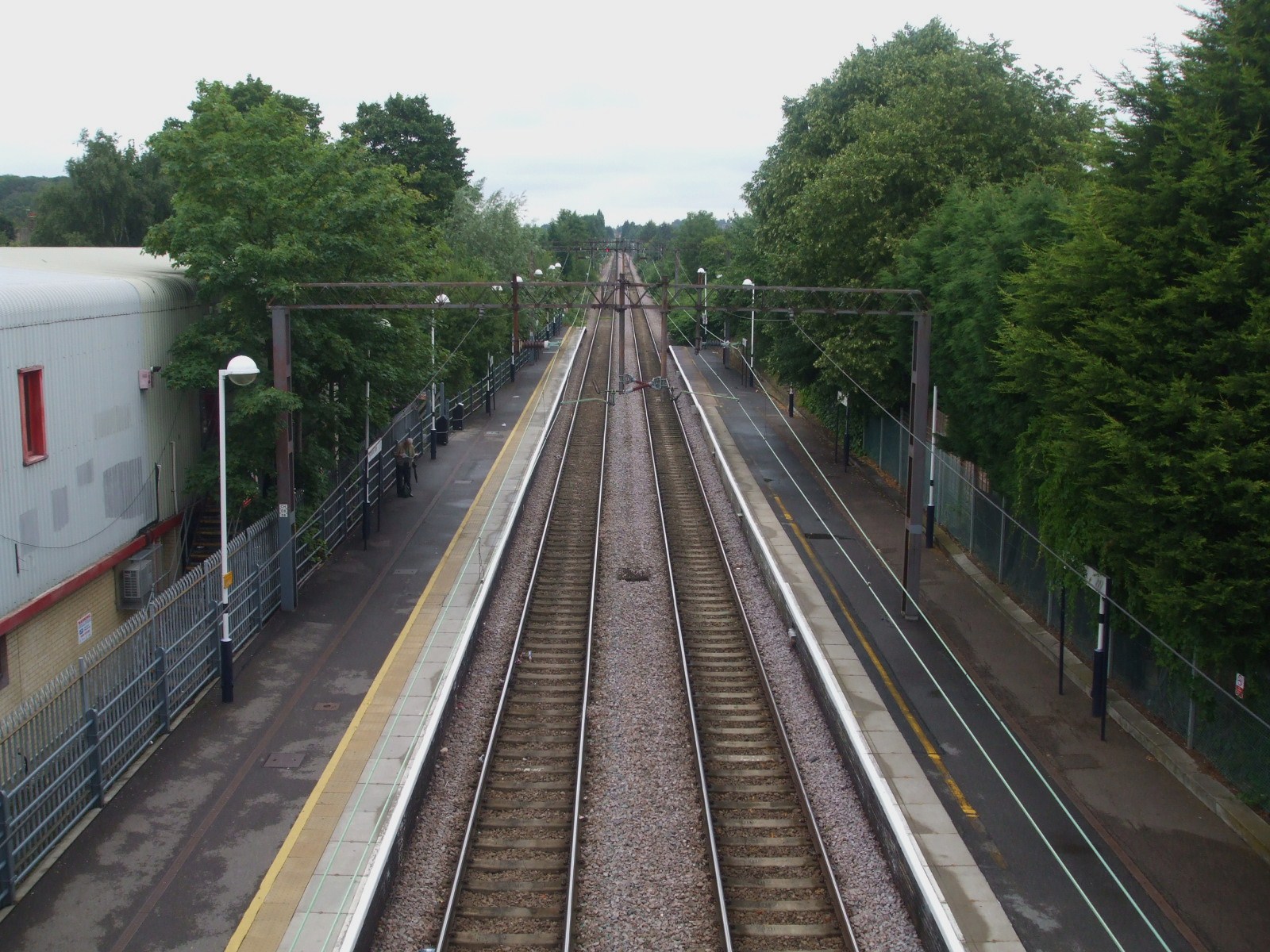
The Chingford branch line is a railway line between Clapton Junction (just northeast of Clapton station) and Chingford station. Services run between Liverpool Street station and Chingford, and are operated by London Overground. The branch is part of the Lea Valley Lines.
By the middle of the 19th century, Walthamstow had a population of 5,000 people and was a rural retreat for London businessmen. The nearest railway station was at Lea Bridge and a horse bus service ran from Walthamstow to meet the train services. The 1860s saw the beginnings of suburban development in the area encouraged by a number of developers hoping to attract the middle classes to the area. The Great Eastern Railway (GER) was promoting a scheme in 1864 but this found little favour with one developer James Higham who promoted a competing scheme which would have run from a junction just north of Stratford station. However, by 1867 the GER was in financial difficulties and although construction work had started on the branch it had ceased by 1868. Housing construction was continuing apace and Higham approached the GER board with money to build the line. Time was running out on the Great Eastern Railway (Highbeech Branch) Act 1864 (27 & 28 Vict. c. xcv) but Parliament extended this and instructed the GER it should build a branch from its main line between Stratford and Tottenham Hale to Walthamstow.
The GER managed to raise funds and a single-line branch was built from just north of Lea Bridge station to a temporary station at Shern Hall Street with intermediate stations at St James Street and Hoe Street.
In 1870, a line was opened from Lea Bridge Road to Shern Hall Street station (a temporary station located west of the present day Wood Street station) and a shuttle service operated commencing traffic on 24 April 1870. The train service was not operated as a through service and passengers had to change for trains to Bishopsgate station (this was the destination before Liverpool Street opened).
The line between Hackney Downs and Church Hall Junction opened on 1 August 1872 and direct services to Bishopsgate commenced as a result. In 1873 the line was extended to a temporary terminus at Chingford (where the engines refilled their tanks from a farm pond). This extension saw the closure of Shern Hall station and the opening of Wood Street and Hale End (since renamed Highams Park).
The permanent terminus at Chingford opened on 2 September 1878. It had been planned to extend the line to High Beach and indeed a bill was deposited before Parliament in 1882. However Queen Victoria visited Chingford on 6 May 1882 to declare Epping Forest open to the public and opponents of the extension used the possible desecration of the forest as an effective way of stopping the extension in its tracks.
In 1885 a curve from Coppermill Junction to Hall Farm Junction gave access from the branch to the West Anglia Main Line. As well as goods traffic this saw match day specials from c1930 for Tottenham Hotspur home games at White Hart Lane. The late part of the 19th century saw significant housing development in the Walthamstow area although Chingford remained largely rural with pleasure traffic being its major source of revenue.
In 1894 Hale End was renamed Highams Park (Hale End) on 1 October 1894 and it was around this time that terraced housing started appearing south and west of the station. The arrival of the British Xylonite Company in 1894 saw traffic to and from the goods yard increase (Xylonite is an early form of plastic)
Hub AI
Chingford branch line AI simulator
(@Chingford branch line_simulator)
Chingford branch line
The Chingford branch line is a railway line between Clapton Junction (just northeast of Clapton station) and Chingford station. Services run between Liverpool Street station and Chingford, and are operated by London Overground. The branch is part of the Lea Valley Lines.
By the middle of the 19th century, Walthamstow had a population of 5,000 people and was a rural retreat for London businessmen. The nearest railway station was at Lea Bridge and a horse bus service ran from Walthamstow to meet the train services. The 1860s saw the beginnings of suburban development in the area encouraged by a number of developers hoping to attract the middle classes to the area. The Great Eastern Railway (GER) was promoting a scheme in 1864 but this found little favour with one developer James Higham who promoted a competing scheme which would have run from a junction just north of Stratford station. However, by 1867 the GER was in financial difficulties and although construction work had started on the branch it had ceased by 1868. Housing construction was continuing apace and Higham approached the GER board with money to build the line. Time was running out on the Great Eastern Railway (Highbeech Branch) Act 1864 (27 & 28 Vict. c. xcv) but Parliament extended this and instructed the GER it should build a branch from its main line between Stratford and Tottenham Hale to Walthamstow.
The GER managed to raise funds and a single-line branch was built from just north of Lea Bridge station to a temporary station at Shern Hall Street with intermediate stations at St James Street and Hoe Street.
In 1870, a line was opened from Lea Bridge Road to Shern Hall Street station (a temporary station located west of the present day Wood Street station) and a shuttle service operated commencing traffic on 24 April 1870. The train service was not operated as a through service and passengers had to change for trains to Bishopsgate station (this was the destination before Liverpool Street opened).
The line between Hackney Downs and Church Hall Junction opened on 1 August 1872 and direct services to Bishopsgate commenced as a result. In 1873 the line was extended to a temporary terminus at Chingford (where the engines refilled their tanks from a farm pond). This extension saw the closure of Shern Hall station and the opening of Wood Street and Hale End (since renamed Highams Park).
The permanent terminus at Chingford opened on 2 September 1878. It had been planned to extend the line to High Beach and indeed a bill was deposited before Parliament in 1882. However Queen Victoria visited Chingford on 6 May 1882 to declare Epping Forest open to the public and opponents of the extension used the possible desecration of the forest as an effective way of stopping the extension in its tracks.
In 1885 a curve from Coppermill Junction to Hall Farm Junction gave access from the branch to the West Anglia Main Line. As well as goods traffic this saw match day specials from c1930 for Tottenham Hotspur home games at White Hart Lane. The late part of the 19th century saw significant housing development in the Walthamstow area although Chingford remained largely rural with pleasure traffic being its major source of revenue.
In 1894 Hale End was renamed Highams Park (Hale End) on 1 October 1894 and it was around this time that terraced housing started appearing south and west of the station. The arrival of the British Xylonite Company in 1894 saw traffic to and from the goods yard increase (Xylonite is an early form of plastic)
Recent media