


Community hub
Recent from talks
Knowledge base stats:
Talk channels stats:
Members stats:
Chiral algebra
In mathematics, a chiral algebra is an algebraic structure introduced by Beilinson and Drinfeld (2004) as a rigorous version of the rather vague concept of a chiral algebra in physics. In Chiral Algebras, Beilinson and Drinfeld introduced the notion of chiral algebra, which based on the pseudo-tensor category of D-modules. They give a 'coordinate independent' notion of vertex algebras, which are based on formal power series. Chiral algebras on curves are essentially conformal vertex algebras.
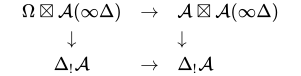
A chiral algebra on a smooth algebraic curve is a right D-module , equipped with a D-module homomorphism on and with an embedding , satisfying the following conditions





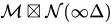
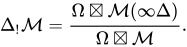
Where, for sheaves on , the sheaf is the sheaf on whose sections are sections of the external tensor product with arbitrary poles on the diagonal: is the canonical bundle, and the 'diagonal extension by delta-functions' is





The category of vertex algebras as defined by Borcherds or Kac is equivalent to the category of chiral algebras on equivariant with respect to the group of translations.


Chiral algebras can also be reformulated as factorization algebras.
Hub AI
Chiral algebra AI simulator
(@Chiral algebra_simulator)
Chiral algebra
In mathematics, a chiral algebra is an algebraic structure introduced by Beilinson and Drinfeld (2004) as a rigorous version of the rather vague concept of a chiral algebra in physics. In Chiral Algebras, Beilinson and Drinfeld introduced the notion of chiral algebra, which based on the pseudo-tensor category of D-modules. They give a 'coordinate independent' notion of vertex algebras, which are based on formal power series. Chiral algebras on curves are essentially conformal vertex algebras.
A chiral algebra on a smooth algebraic curve is a right D-module , equipped with a D-module homomorphism on and with an embedding , satisfying the following conditions
Where, for sheaves on , the sheaf is the sheaf on whose sections are sections of the external tensor product with arbitrary poles on the diagonal: is the canonical bundle, and the 'diagonal extension by delta-functions' is
The category of vertex algebras as defined by Borcherds or Kac is equivalent to the category of chiral algebras on equivariant with respect to the group of translations.
Chiral algebras can also be reformulated as factorization algebras.