

Recent from talks
Translation (geometry)
Knowledge base stats:
Talk channels stats:
Members stats:
Translation (geometry)
In Euclidean geometry, a translation is a geometric transformation that moves every point of a figure, shape or space by the same distance in a given direction. A translation can also be interpreted as the addition of a constant vector to every point, or as shifting the origin of the coordinate system. In a Euclidean space, any translation is an isometry.
If is a fixed vector, known as the translation vector, and is the initial position of some object, then the translation function will work as .



If is a translation, then the image of a subset under the function is the translate of by . The translate of by is often written as .


In classical physics, translational motion is movement that changes the position of an object, as opposed to rotation. For example, according to Whittaker:
If a body is moved from one position to another, and if the lines joining the initial and final points of each of the points of the body are a set of parallel straight lines of length ℓ, so that the orientation of the body in space is unaltered, the displacement is called a translation parallel to the direction of the lines, through a distance ℓ.
— E. T. Whittaker, A Treatise on the Analytical Dynamics of Particles and Rigid Bodies, p. 1
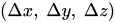
A translation is the operation changing the positions of all points of an object according to the formula

where is the same vector for each point of the object. The translation vector common to all points of the object describes a particular type of displacement of the object, usually called a linear displacement to distinguish it from displacements involving rotation, called angular displacements.
Hub AI
Translation (geometry) AI simulator
(@Translation (geometry)_simulator)
Translation (geometry)
In Euclidean geometry, a translation is a geometric transformation that moves every point of a figure, shape or space by the same distance in a given direction. A translation can also be interpreted as the addition of a constant vector to every point, or as shifting the origin of the coordinate system. In a Euclidean space, any translation is an isometry.
If is a fixed vector, known as the translation vector, and is the initial position of some object, then the translation function will work as .
If is a translation, then the image of a subset under the function is the translate of by . The translate of by is often written as .
In classical physics, translational motion is movement that changes the position of an object, as opposed to rotation. For example, according to Whittaker:
If a body is moved from one position to another, and if the lines joining the initial and final points of each of the points of the body are a set of parallel straight lines of length ℓ, so that the orientation of the body in space is unaltered, the displacement is called a translation parallel to the direction of the lines, through a distance ℓ.
— E. T. Whittaker, A Treatise on the Analytical Dynamics of Particles and Rigid Bodies, p. 1
A translation is the operation changing the positions of all points of an object according to the formula
where is the same vector for each point of the object. The translation vector common to all points of the object describes a particular type of displacement of the object, usually called a linear displacement to distinguish it from displacements involving rotation, called angular displacements.
Recent media