
Recent from talks
Extended chord
Knowledge base stats:
Talk channels stats:
Members stats:
Extended chord
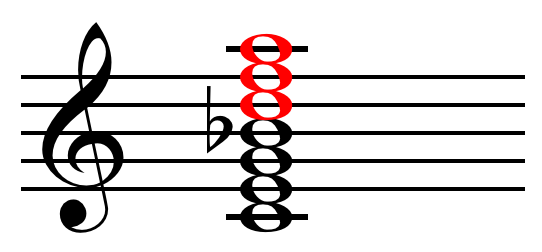
In music, extended chords are certain chords (built from thirds) or triads with notes extended, or added, beyond the seventh. Ninth, eleventh, and thirteenth chords are extended chords. The thirteenth is the farthest extension diatonically possible as, by that point, all seven tonal degrees are represented within the chord (the next extension, the fifteenth, is the same as the root of the chord). In practice however, extended chords do not typically use all the chord members; when it is not altered, the fifth is often omitted, as are notes between the seventh and the highest note (i.e., the ninth is often omitted in an eleventh chord; the ninth and eleventh are usually omitted in a thirteenth chord), unless they are altered to give a special texture.
Chords extended beyond the seventh are rarely seen in the Baroque era, and are used more frequently in the Classical era. The Romantic era saw greatly increased use of extended harmony. Extended harmony prior to the 20th century usually has dominant function – as V9, V11, and V13, or V9/V, V13/ii etc.
Examples of the extended chords used as tonic harmonies include Wild Cherry's "Play That Funky Music" (either a dominant ninth or dominant thirteenth).
During the common practice period of Western classical music, composers orchestrating chords that are voiced in four or fewer parts would select which notes to use so as to give the desired sonority, or effect of the intended chord. Generally, priority was given to the third, seventh and the most extended tone, as these factors most strongly influence the quality and function of the chord. The root is never omitted from the texture. The third defines the chord's quality as major or minor. The extended note defines the quality of the extended pitch, which may be major, minor, perfect, or augmented. The seventh factor helps to define the chord as an extended chord (and not an added note chord), and also adds to the texture. Any notes which happen to be altered, such as a flatted fifth or ninth, should also be given priority. For example: in a thirteenth chord, one would play the root, third, seventh, and thirteenth, and be able to leave out the fifth, ninth, and eleventh without affecting the function of the chord. The eleventh chord is an exception to this voicing, in which the root, seventh, ninth, and eleventh are most commonly used.
In the classical practices of western music, extended chords most often have dominant function (dominant or secondary dominant), and will resolve in circle progression (down a fifth) in much the same way that V7, V7/ii, V/IV, etc. might resolve to their respective tonics. Extended chords can also be altered dominants, and the extended pitch may be altered in several ways (such as V flat 13 in a major key).
Following standard voice leading rules:
An important distinction between extended and added chords must be made, since the added tones and extended tones are enharmonic, but differ in function. Extended chords always have at least one octave between their lowest pitch, and extended note, otherwise the extended factor would be considered an added pitch. Extended chords usually must be resolved when used in a dominant function, whereas added chords are most often textures added to a tonic.
In the 18th century, ninth and eleventh chords were theorized as downward extensions of seventh chords, according to theories of supposition.
Hub AI
Extended chord AI simulator
(@Extended chord_simulator)
Extended chord
In music, extended chords are certain chords (built from thirds) or triads with notes extended, or added, beyond the seventh. Ninth, eleventh, and thirteenth chords are extended chords. The thirteenth is the farthest extension diatonically possible as, by that point, all seven tonal degrees are represented within the chord (the next extension, the fifteenth, is the same as the root of the chord). In practice however, extended chords do not typically use all the chord members; when it is not altered, the fifth is often omitted, as are notes between the seventh and the highest note (i.e., the ninth is often omitted in an eleventh chord; the ninth and eleventh are usually omitted in a thirteenth chord), unless they are altered to give a special texture.
Chords extended beyond the seventh are rarely seen in the Baroque era, and are used more frequently in the Classical era. The Romantic era saw greatly increased use of extended harmony. Extended harmony prior to the 20th century usually has dominant function – as V9, V11, and V13, or V9/V, V13/ii etc.
Examples of the extended chords used as tonic harmonies include Wild Cherry's "Play That Funky Music" (either a dominant ninth or dominant thirteenth).
During the common practice period of Western classical music, composers orchestrating chords that are voiced in four or fewer parts would select which notes to use so as to give the desired sonority, or effect of the intended chord. Generally, priority was given to the third, seventh and the most extended tone, as these factors most strongly influence the quality and function of the chord. The root is never omitted from the texture. The third defines the chord's quality as major or minor. The extended note defines the quality of the extended pitch, which may be major, minor, perfect, or augmented. The seventh factor helps to define the chord as an extended chord (and not an added note chord), and also adds to the texture. Any notes which happen to be altered, such as a flatted fifth or ninth, should also be given priority. For example: in a thirteenth chord, one would play the root, third, seventh, and thirteenth, and be able to leave out the fifth, ninth, and eleventh without affecting the function of the chord. The eleventh chord is an exception to this voicing, in which the root, seventh, ninth, and eleventh are most commonly used.
In the classical practices of western music, extended chords most often have dominant function (dominant or secondary dominant), and will resolve in circle progression (down a fifth) in much the same way that V7, V7/ii, V/IV, etc. might resolve to their respective tonics. Extended chords can also be altered dominants, and the extended pitch may be altered in several ways (such as V flat 13 in a major key).
Following standard voice leading rules:
An important distinction between extended and added chords must be made, since the added tones and extended tones are enharmonic, but differ in function. Extended chords always have at least one octave between their lowest pitch, and extended note, otherwise the extended factor would be considered an added pitch. Extended chords usually must be resolved when used in a dominant function, whereas added chords are most often textures added to a tonic.
In the 18th century, ninth and eleventh chords were theorized as downward extensions of seventh chords, according to theories of supposition.
Recent media