Hubbry Logo
Enharmonic equivalenceEnharmonic equivalenceMain
Open search
Enharmonic equivalence
Community hub
Enharmonic equivalence
logo
7 pages, 0 posts
0 subscribers
Be the first to start a discussion here.
Enharmonic equivalence
from Wikipedia

In music, two written notes have enharmonic equivalence if they produce the same pitch but are notated differently. Similarly, written intervals, chords, or key signatures are considered enharmonic if they represent identical pitches that are notated differently. The term derives from Latin enharmonicus, in turn from Late Latin enarmonius, from Ancient Greek ἐναρμόνιος (enarmónios), from ἐν ('in') and ἁρμονία ('harmony').

Definition

[edit]
{ \magnifyStaff #5/4 \omit Score.TimeSignature \clef F \time 2/1 fis2 s ges s }
The notes F and G are enharmonic equivalents in 12 TET.
\relative c' { \magnifyStaff #5/4 \omit Score.TimeSignature \clef C \time 2/1 gisis2 s beses s}
Gdouble sharp and Bdouble flat are enharmonic equivalents; both are the same as A in 12 TET.

The predominant tuning system in Western music is twelve-tone equal temperament (12 TET), where each octave is divided into twelve equal half-steps, or semitones; each half-step is both a chromatic semitone (a sharp or a flat) and a diatonic semitone (a minor step between two diatonic notes). The notes F and G are a whole step apart, so the note one semitone above F (F) and the note one semitone below G (G) indicate the same pitch. These written notes are enharmonic, or enharmonically equivalent. The choice of notation for a pitch can depend on its role in harmony; this notation keeps modern music compatible with earlier tuning systems, such as meantone temperaments. The choice can also depend on the note's readability in the context of the surrounding pitches. Multiple sharps or flats can produce other enharmonic equivalents; for example, Fdouble sharp (double-sharp) is enharmonically equivalent to G.

When other tuning systems were in use, prior to the adoption of 12 TET, the term enharmonic referred to notes that were very close in pitch — closer than the smallest step of a diatonic scale — but not quite identical. In a tuning system without equal half steps, F and G do not indicate the same pitch, although the two pitches would be called enharmonically equivalent.

\relative c' { \magnifyStaff #5/4 \omit Score.TimeSignature \time 2/1 <c fis>1 <c ges'>}
Enharmonic tritones: 12 TET aug 4th = dim 5th on C.
A musical passage notated as flats.
The same passage notated as sharps, requiring fewer canceling natural signs.

Sets of notes that involve pitch relationships — scales, key signatures, or intervals,[1] for example — can also be referred to as enharmonic (e.g., in 12 TET the keys of C major and D major contain identical pitches and are therefore enharmonic). Identical intervals notated with different, enharmonically equivalent, written pitches are also referred to as enharmonic. The interval of a tritone above C may be written as a diminished fifth from C to G, or as an augmented fourth (C to F). In modern 12 TET, notating the C as a B leads to other enharmonically equivalent notations, an option which does not exist in most earlier notation systems.

Enharmonic equivalents can be used to improve the readability of music, as when a sequence of notes is more easily read using sharps or flats. This may also reduce the number of accidentals required.

Examples

[edit]

At the end of the bridge section of Jerome Kern's "All the Things You Are", a G (the sharp 5th of an augmented C chord) becomes an enharmonically equivalent A (the third of an F minor chord) at the beginning of the returning A section.[2][3]

Beethoven's Piano Sonata in E Minor, Op. 90, contains a passage where a B becomes an A, altering its overt musical function. The first two bars of the following passage contain a descending B major scale. Immediately following this, the Bs become As, the leading tone of B minor:

Beethoven Sonata in E Minor Op. 90, first movement, bars 37–45

Chopin's Prelude No. 15, known as the "Raindrop Prelude", features a pedal point on the note A throughout its opening section.

Chopin Prelude No. 15, opening

In the middle section, these are changed to Gs as the key changes to C minor. The new key is not notated as D minor because that key signature would require a double-flat:

Chopin Prelude No. 15, bar 28–29

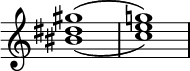
The concluding passage of the slow movement of Schubert's final piano sonata in B (D960) contains an enharmonic change in bars 102–103, where there is a B that functions as the third of a G major triad. When the prevailing harmony changes to C major that pitch is notated as C:

\relative c'' { \magnifyStaff #5/4 \omit Score.TimeSignature \set doubleSlurs = ##t <bis dis gis>1 (<c e g!>)}
G to C progression.
Schubert Piano Sonata, D960, second movement, bars 98–106

Other tuning conventions

[edit]
Comparison of intervals near or enharmonic with the unison

In twelve-tone equal temperament tuning, the standard tuning system of Western music, an octave is divided into 12 equal semitones. Written notes that produce the same pitch, such as C and D, are called enharmonic. In other tuning systems, such pairs of written notes do not produce an identical pitch, but can still be called "enharmonic" using the older sense of the word.[4]

Pythagorean

[edit]

In Pythagorean tuning, all pitches are generated from a series of justly tuned perfect fifths, each with a frequency ratio of 3 to 2. If the first note in the series is an A, the thirteenth note in the series, G is higher than the seventh octave (1 octave = frequency ratio of 2 to 1 = 2 ; 7 octaves is 27 to 1 = 128 ) of the A by a small interval called a Pythagorean comma. This interval is expressed mathematically as:

Meantone

[edit]

In quarter-comma meantone, there will be a discrepancy between, for example, G and A. If middle C's frequency is f, the next highest C has a frequency of 2 f . The quarter-comma meantone has perfectly tuned ("just") major thirds, which means major thirds with a frequency ratio of exactly  5 / 4 . To form a just major third with the C above it, A and the C above it must be in the ratio 5 to 4, so A needs to have the frequency

To form a just major third above E, however, G needs to form the ratio 5 to 4 with E, which, in turn, needs to form the ratio 5 to 4 with C, making the frequency of G

This leads to G and A being different pitches; G is, in fact 41 cents (41% of a semitone) lower in pitch. The difference is the interval called the enharmonic diesis, or a frequency ratio of  128 / 125 . On a piano tuned in equal temperament, both G and A are played by striking the same key, so both have a frequency

Such small differences in pitch can skip notice when presented as melodic intervals; however, when they are sounded as chords, especially as long-duration chords, the difference between meantone intonation and equal-tempered intonation can be quite noticeable.

Enharmonically equivalent pitches can be referred to with a single name in many situations, such as the numbers of integer notation used in serialism and musical set theory and as employed by MIDI.

Enharmonic genus

[edit]

In ancient Greek music the enharmonic was one of the three Greek genera in music; in the enharmonic genus, the tetrachords are divided (in descending pitch order) as a ditone (M3) plus two microtones. The ditone can be anywhere from 16/ 13  (359.5 cents) to 9/ 7  (435.1 cents) (3.55 to 4.35 semitones) and the microtones can be anything smaller than 1 semitone.[5] Some examples of enharmonic genera in modern ascending pitch order are

  Tonic     Lower  
µ‑tone
  Higher  
µ‑tone
  ( wide    
  gap )
  Ditone  
1/ 1  36/ 35  16/ 15    4/ 3 
1/ 1  28/ 27  16/ 15    4/ 3 
1/ 1  64/ 63  28/ 27    4/ 3 
1/ 1  49/ 48  28/ 27    4/ 3 
1/ 1  25/ 24  13/ 12    4/ 3 

Enharmonic key

[edit]

Some key signatures have an enharmonic equivalent that contains the same pitches, albeit spelled differently. In twelve-tone equal temperament, there are three pairs each of major and minor enharmonically equivalent keys: B major/C major, G minor/A minor, F major/G major, D minor/E minor, C major/D major and A minor/B minor.

If a key were to use more than 7 sharps or flats it would require at least one double flat or double sharp. These key signatures are extremely rare since they have enharmonically equivalent keys with simpler, conventional key signatures. For example, G sharp major would require eight sharps (six sharps plus F double-sharp), but would almost always be replaced by the enharmonically equivalent key signature of A flat major, with four flats.

See also

[edit]

References

[edit]

Further reading

[edit]
[edit]
Revisions and contributorsEdit on WikipediaRead on Wikipedia
from Grokipedia
Enharmonic equivalence in music theory denotes the phenomenon where distinct notational spellings represent the same audible pitch within a given tuning system, such as the pitches notated as A♭ and G♯, which coincide in twelve-tone (12-TET). This equivalence arises from the fixed pitch classes in equal-tempered systems, where the octave is divided into twelve equal semitones, allowing notes that would otherwise differ by a —approximately 23.5 cents—to be treated as identical despite their different letter names and accidentals. In practical terms, enharmonic equivalents facilitate fluid modulation and chord progressions by enabling composers to respell notes for contextual , such as reinterpreting a dominant seventh chord's leading tone to resolve differently. The concept extends beyond single notes to intervals, chords, and keys; for instance, the (e.g., B-D-F-A♭), due to its intervallic symmetry, can be enharmonically respelled in four ways (e.g., as D-F-A♭-B, F-A♭-B-D, or A♭-B-D-F) and serve as a pivot for remote modulations, as seen in Beethoven's in , Op. 57, where symmetrical divisions exploit such equivalences to create chromatic tension. Similarly, a French augmented sixth chord (e.g., A♭-C-D-F♯, often respelled as A♭-C-D-G♭) underpins advanced techniques like the omnibus progression for stepwise key shifts. In 12-TET, this equivalence is exact, but in or meantone temperaments, true enharmonic identity is absent, highlighting how tuning systems influence perceptual and notational practices. Enharmonic respellings are essential for readability and analysis, preventing awkward notations like multiple sharps or flats. Historically, the roots of enharmonic thinking trace to , where the enharmonic genus—a scale division featuring two quarter-tones and a diatonic fourth—prioritized expressive microintervals over equal spacing, as described by theorists like around 350 BCE. In the and eras, microtonal experiments by figures like Nicola Vicentino revived these ideas, but enharmonic equivalence in its modern form emerged with the widespread adoption of 12-TET in the , driven by the need for versatile keyboard tuning amid expanding in works by composers such as J.S. Bach. This shift, gradual and complete by the early 19th century, enabled the enharmonic reinterpretations central to , including Wagner's Tristan und Isolde, where such equivalences blur tonal boundaries and enhance dramatic narrative. Today, enharmonic equivalence remains foundational in composition, performance, and theory, adapting to contemporary genres like and electronic music while underscoring the interplay between notation, acoustics, and expression.

Core Concepts

Definition

Enharmonic equivalence is a fundamental concept in music theory referring to the phenomenon where two or more pitches with different notations produce the same or perceptually indistinguishable sound. For instance, the pitches notated as C♯ and D♭ are enharmonically equivalent because they correspond to the identical key on a piano keyboard and share the same in systems. This equivalence stems from the cyclic nature of the , where accidentals (sharps, flats, and their doubles) allow multiple spellings for the same . The principle extends to enharmonic notes, intervals, and chords, broadening its application in and . Enharmonic notes are individual pitches with alternate spellings, such as A♯ and B♭, which maintain the same sonic identity despite differing visual representation on the staff. Enharmonic intervals, like the augmented second (C to D♯) and (C to E♭), sound identical but differ in interval quality and harmonic implications, influencing and modulation. Likewise, enharmonic chords, such as a respelled as a (e.g., enharmonically equivalent to B°7 in certain contexts), enable reinterpretation for smoother transitions between keys. A key distinction exists between exact and approximate enharmonic equivalence depending on the tuning system employed. In , which divides the into twelve equal semitones of 100 cents each, enharmonic pitches have precisely the same , ensuring perfect sonic identity. In contrast, unequal temperaments like meantone introduce slight discrepancies; for example, D♯ and E♭ may differ by the enharmonic diesis (approximately 41 cents in quarter-comma meantone), resulting in approximate equivalence. Acoustically, enharmonic pitches are deemed equivalent if their frequencies align within the human auditory perception limits, specifically the (JND) for pitch, which is approximately 5 cents for pure tones under ideal listening conditions. This perceptual threshold, equivalent to about 0.3% frequency variation at middle pitches, underscores why minor tuning deviations in unequal systems often go unnoticed, preserving practical equivalence in performance.

Basic Principles

Enharmonic equivalence emerges within the 12-note of Western music notation, where distinct letter names combined with accidentals (sharps or flats) can represent the same , such as C♯ and D♭. This duality stems from the scale's structure, which divides the into 12 equal semitones, allowing multiple spellings for each of the 12 pitch classes while maintaining diatonic letter-name sequences for scales and chords. Notation conventions prioritize spellings that minimize accidentals in key signatures, enabling composers to select enharmonic equivalents that align with the prevailing tonal center and reduce complexity in staff notation—for instance, preferring B♯ over C in certain sharp-heavy contexts to avoid an additional flat or sharp. These choices are governed by signature vectors in theoretical models, where integer assignments to the seven letter names define standard key signatures and facilitate enharmonic reinterpretations without altering the underlying pitch content. Perceptually, enharmonic equivalents are indistinguishable to human hearing when their frequencies match exactly, as in , because the auditory system's pitch resolution cannot differentiate identical stimuli. Typical pitch discrimination thresholds for adults range from 10 to 20 cents (where 100 cents equal one ), meaning frequency deviations below this level—such as those arising in non-tempered systems—are often imperceptible without specialized training or equipment. In contexts, enharmonic equivalence preserves functional roles across pitch classes, allowing to proceed smoothly toward resolutions without altering the intervallic structure or tonal implications of a progression. This enables composers to respell notes for contrapuntal efficiency while maintaining the same set of pitch classes, ensuring that tension and release remain intact regardless of notation. Mathematically, in , enharmonic notes share the same ratio relative to a pitch, calculated as f×2n/12f \times 2^{n/12}, where ff is the and nn is the number of semitones. For example, if C has ff, then C♯ (or its enharmonic D♭) is at f×21/12f \times 2^{1/12}, demonstrating their exact equivalence in this system. More distant equivalents, such as the C♯ one higher (reached by 13 semitones), yield f×213/12f \times 2^{13/12}, underscoring the logarithmic scaling that unifies all 12 pitch classes within the .

Historical Development

Ancient and Medieval Origins

The concept of enharmonic equivalence traces its roots to , particularly in the enharmonic genus, one of three primary genera used to divide the —a fundamental interval spanning a . , in his Harmonics (circa 350 BCE), described the enharmonic genus as consisting of two small intervals known as dieses, each approximately a quarter-tone (about 50 cents), followed by a larger interval of a ditone (roughly 400 cents), creating a structure where the two dieses formed a pyknon or "dense" interval that allowed for subtle pitch variations perceived as equivalent in melodic context. This microtonal approach emphasized auditory perception over strict numerical ratios, distinguishing it from the diatonic and chromatic genera. Ptolemy, in his Harmonics (2nd century CE), further refined these ideas by integrating empirical tuning with mathematical precision, proposing divisions of the enharmonic that approximated the quarter-tone diesis while acknowledging its role in achieving progressions through near-equivalent pitches. Building on Pythagorean foundations from the 6th-5th centuries BCE, early theorists like approximated enharmonic intervals within tetrachords using ratios such as 28/27 for the leimma (a small semitone-like step) and 36/35 for the diesis, highlighting how these microintervals enabled pitch equivalences in scales despite slight discrepancies. The , arising from the accumulation of 12 pure fifths (3:2 ratio) exceeding seven octaves by the factor 531441:524288 (approximately 23.46 cents), represented an early theoretical recognition of such enharmonic inconsistencies in cycle-of-fifths constructions, influencing approximations in tetrachordal tuning. In medieval Europe, around the 11th century, Guido d'Arezzo advanced these concepts through his hexachord system, a solmization framework dividing the gamut into overlapping six-note segments (e.g., starting on G, C, and F) to facilitate sight-singing of plainchant. This system introduced distinctions like b durum (B natural) and b molle (B flat), allowing singers to navigate pitch ambiguities in monophonic plainchant where certain notes could serve equivalent functions across transpositions, foreshadowing enharmonic flexibility without fixed temperament. Guido's innovations, detailed in works like Micrologus (circa 1025-1028), thus marked an early practical acknowledgment of perceptual pitch equivalences in ecclesiastical music, bridging ancient theoretical insights with liturgical performance needs.

Renaissance to Baroque Evolution

During the Renaissance, the rise of polyphony introduced significant challenges in tuning for instruments like the lute and organ, particularly as composers explored chromatic elements that highlighted enharmonic ambiguities. In lute tuning, which often relied on meantone temperament to favor pure thirds, the placement of frets created tensions between enharmonic equivalents such as G♯ and A♭, where slight pitch discrepancies could arise due to the instrument's fixed layout, leading to interpretive flexibility in performance. Organ tuning faced similar issues, with early 16th-century keyboards employing irregular meantone systems that struggled to accommodate chromatic alterations without distorting intervals, resulting in enharmonic notes like G♯ being tuned lower than A♭ to extend the scale while preserving consonance in common keys. These ambiguities were evident in works by Josquin des Prez, such as his motet Absalon, fili mi, where manuscript variants show partial key signatures with G♭ or A♭ in the bass, reflecting scribal adjustments for tuning variations and chromatic counterparts within a 10-pitch-class gamut, which allowed expressive tonal shifts from major to minor modes. Theoretical debates in the late further shaped the understanding of enharmonic equivalence, pitting advocates of just s against proponents of tempered systems. , in his Dialogo della musica antica et della moderna (1581), argued for dividing the into 12 equal s using the 18/17 to approximate the semitone, enabling smoother enharmonic transitions and challenging the Pythagorean reliance on pure fifths that caused the . built on this in his 1585 treatise Van de Spiegheling der singconst, calculating logarithmically to resolve ratio-based inconsistencies, emphasizing practical modulation over strict intonation and influencing later keyboard designs by treating enharmonic pairs as identical pitches. These discussions underscored a shift from genera—briefly referenced as foundational—to instrumental necessities, prioritizing usability in polyphonic contexts. A pivotal event in this evolution was the publication of Marin Mersenne's Harmonie Universelle in 1636, which systematically addressed enharmonic intervals within the diatonic, chromatic, and enharmonic genera, proposing extended keyboards (up to 32 notes per ) to better realize while acknowledging compromises for . Mersenne's work bridged theory and emerging practices by analyzing how enharmonic scales could enhance expressive on organs and lutes, influencing subsequent tuning reforms. In the Baroque era, innovations in well temperaments facilitated enharmonic key changes, allowing composers to exploit all 24 major and minor keys without severe dissonance. Andreas Werckmeister's tunings, detailed in Musicalische Temperatur (1687 and 1691), distributed the unevenly to create a circulating system where enharmonic equivalents like C♯ and D♭ were tuned identically yet permitted distinct key characters, enabling fluid modulations in polyphonic works. Johann Philipp Kirnberger advanced this in the 1760s with his well-tempered schemes, such as Kirnberger III, which tempered fifths to favor pure thirds in select keys while allowing enharmonic shifts, providing a practical framework for keyboard music that balanced consonance and versatility. Johann Sebastian Bach's (Book I, 1722) marked a milestone, demonstrating these principles through 24 preludes and fugues that traverse all keys, including enharmonic pairs like (rather than ) to showcase the tuning's capacity for expressive key changes without retuning the instrument.

Tuning Systems and Equivalence

Pythagorean and Just Intonation

In , intervals are generated by stacking perfect fifths with the ratio 3:2, forming a circle of twelve fifths that approximates the but results in enharmonic notes being distinct pitches. For instance, ascending twelve fifths from a starting note yields E♯, while descending seven s to the same nominal pitch yields F♭; these enharmonic equivalents differ by the , an interval of approximately 23.46 cents with the ratio (3/2)12/27=531441/524288(3/2)^{12} / 2^{7} = 531441/524288. This discrepancy arises because twelve perfect fifths exceed seven s by this small but audible amount, preventing exact enharmonic equivalence in the system. Just intonation extends this by incorporating additional prime ratios, such as the at 5:4, to achieve purer consonances, but it similarly produces multiple pitches for each note name due to differences. Enharmonic shifts occur via the , with ratio 81/80 and approximately 21.51 cents, which measures the gap between a Pythagorean (81/64) and its just counterpart (). In practice, this leads to chains of intervals where enharmonic notes like D♯ and E♭ are separated by this , requiring performers to select pitches contextually rather than treating them as identical. These pure interval-based tunings offer no true enharmonic equivalence, as the commas create perceptible distinctions that limit free modulation between keys; instead, music remains confined to modal frameworks to avoid dissonant clashes from accumulations. Such systems suit flexible ensembles like vocal groups or string consorts, where singers and players can adjust intonation dynamically to maintain consonance within a given mode. Historically, underpinned ancient Greek modes, emphasizing mathematical ratios for philosophical and ethical purposes, while informed Renaissance consorts and , as theorists like Zarlino advocated simple ratios for vocal purity in unaccompanied settings.

Meantone and Unequal Temperaments

Meantone tunings prioritize major thirds over perfect fifths, achieving this by systematically flattening the just fifth. In quarter-comma meantone, the most prominent variant, each fifth is tempered downward by one-quarter of the —a small interval of 81/80 (approximately 21.5 cents) arising from ratios—to produce pure thirds of (386.3 cents). This tempering yields a fifth size of approximately 696.6 cents, calculated as the just fifth of 702 cents minus the adjustment of about 5.4 cents. The adjustment per fifth follows the formula 14log2(8180)×12005.4-\frac{1}{4} \log_2 \left( \frac{81}{80} \right) \times 1200 \approx -5.4 cents, distributing the evenly across four fifths that form a major third. In this system, enharmonic pairs such as G♯ and A♭ exhibit near-equivalence rather than exact coincidence, differing by the lesser diesis (approximately 41.1 cents) when calculated separately along sharp and flat chains of fifths. On Renaissance and Baroque keyboard instruments like organs and harpsichords, however, a single pitch is assigned to each key, forcing approximate equivalence that favors one side of the pair (typically the flat) and compromises the other. This leads to practical limitations, including "wolf" intervals—dissonant fifths enlarged to about 737 cents to close the circle of fifths—which restrict enharmonic substitutions and key modulations to avoid harsh dissonances in remote tonalities. Unequal temperaments, such as Werckmeister III, represent circulating systems that temper the (approximately 23.5 cents) unevenly across the twelve fifths, ensuring the circle closes exactly while varying interval purity to enable broader key usage. In Werckmeister III, four fifths are flattened by one-quarter of the (about 5.9 cents each), while others remain closer to just, resulting in some major thirds sharpened by around 4 cents but without outright wolves. Enharmonic equivalents like G♯/A♭ coincide precisely on the twelve-key keyboard, facilitating enharmonic changes within the system's limited palette, though consonance degrades in distant keys, constraining full exploration compared to pure approximations. These temperaments' effects on performance were profound: wolf intervals in meantone confined composers to a subset of keys with pure thirds, while unequal variants like Werckmeister III expanded possibilities for modulation on fixed-pitch instruments, albeit with audible color variations that influenced harmonic practice.

Equal Temperament

, also known as twelve-tone equal temperament (12-TET), is a tuning system that divides the into twelve equal semitones, each with a frequency ratio of 21/122^{1/12} and an interval size of exactly 100 cents (where the spans 1200 cents). In this system, enharmonic equivalents such as F♯ and G♭ are precisely identical in pitch, eliminating the subtle discrepancies present in earlier unequal temperaments and rendering enharmonic distinctions purely notational. The adoption of as the modern standard occurred gradually, becoming widespread in the alongside the rise of as a versatile capable of playing in all keys without retuning. Johann Sebastian Bach's (1722) played a foundational role by demonstrating the musical possibilities of well-tempered systems that approximated equal divisions, influencing later developments toward full despite debates over whether Bach intended strict equality. By the late , had solidified as the norm for piano manufacturing and orchestral tuning, driven by the need for consistent pitch across instruments in expanding repertoires. A primary advantage of is its facilitation of unlimited modulation between keys, as the uniform spacing allows seamless transitions without the "wolf intervals" or retuning required in unequal systems. This uniformity also means enharmonic spellings serve solely for readability and theoretical clarity, such as choosing D♯ over E♭ to better convey in a passage. However, renders all intervals except the octave slightly impure relative to , with the , for instance, detuned by about 14 cents from its pure of 5:4. Despite this compromise, the exact enharmonic equivalence enables sophisticated in , as exemplified by Richard Wagner's in (1859), where ambiguous harmonies exploit notational flexibility without pitch conflicts.

Applications in Music Theory

Enharmonic Keys

Enharmonic keys refer to pairs of key signatures that produce identical pitches in but differ in notation, allowing composers to select spellings that align with musical context or readability. Common examples include , which features seven sharps and is enharmonically equivalent to with one flat, and , notated with seven flats and equivalent to with five sharps. These equivalences arise because the twelve semitones of the repeat every , enabling such pairings without altering the sounded result. In practice, notation choices for enharmonic keys prioritize keys with fewer accidentals to enhance and reduce performer errors, particularly in complex scores. For instance, , requiring five flats, is typically preferred over its enharmonic counterpart , which demands seven sharps, as the simpler signature minimizes on-page alterations and aligns better with instrumental fingering conventions. This preference extends to orchestral and , where clarity in key signatures supports efficient ensemble performance and . Historical composers exploited enharmonic keys to explore expressive possibilities within tonal frameworks. employed enharmonic respellings in his late string quartets. Similarly, incorporated enharmonic changes in his Preludes, Op. 28, using alternative spellings to highlight harmonic tensions and resolutions that enhance the Romantic idiom's emotional depth. The use of enharmonic keys enables the notation of theoretically remote tonalities without changing the actual pitches, which aids analytical interpretation by revealing intended harmonic relationships and . This flexibility proves essential in music theory analysis, as it clarifies functional progressions that might otherwise appear ambiguous in .

Enharmonic Modulations and Changes

Enharmonic modulation occurs when a composer pivots to a new key by reinterpreting a chord enharmonically, allowing the same pitches to function differently in distinct tonal contexts. This technique relies on ambiguous chords, such as or , which can be respelled to shift the abruptly. For instance, an in one key can be enharmonically equivalent to a in another, facilitating a seamless yet surprising key change. A common chordal change involves the German sixth (♭VI⁶), which resolves as a predominant harmony but can be respelled as a dominant seventh (V⁷) for modulation. In the German sixth, the notes A♭-C-E♭-F♯ in C major function as ♭VI⁶, leading to V; enharmonically, F♯ becomes G♭, transforming it into A♭⁷ (V⁷ of ). This reinterpretation creates a pivot that propels the music into a distantly related key, often a half-step away. employs this in his Die Entführung aus dem Seraglio (K. 384), where the "Wer ein Liebchen hat gefunden" features an . In Romantic music, enharmonic modulations enable surprise resolutions that heighten emotional expressivity. Liszt masterfully uses enharmonic pivots to create tonal ambiguity, as seen in his First Mephisto Waltz (S. 514), where a pivot from A major to A♭ major (mm. 134–137) reinterprets chords to evoke deception and sudden shifts, reflecting the character's cunning nature. These techniques expand harmonic possibilities beyond Classical norms, allowing composers to delay or subvert resolutions for greater narrative impact. Analysis of enharmonic modulations often contrasts Roman numeral notation, which labels chords by scale degree in a specific key (e.g., Ger⁺⁶ in C major as ♭VI⁶, respelled as V⁷ in D♭ major), with functional notation, which emphasizes harmonic roles like predominant (PD) to dominant (D). Roman numerals highlight structural relationships and key signatures, while functional labels prioritize progression toward resolution, aiding in understanding enharmonic reinterpretations as shifts in tension-release dynamics. This dual approach reveals how enharmonic equivalence maintains pitch identity while altering perceptual function.

Theoretical Extensions

Enharmonic Genus

In , the enharmonic genus represented one of the three primary genera—alongside —characterized by a specific division of the into two small intervals known as dieses (each approximately a quarter-tone) followed by a larger ditone (). , in his Harmonics, described this structure as forming a pyknon (a cluster of two close notes) at the bottom of the descending , with the movable notes parhypate and lichanos positioned such that the intervals were diesis-diesis-ditone, exemplified in modern notation as e–f (diesis)–g (diesis)–a (ditone), where the first two steps are microtonal approximations of 50 cents each. This configuration contrasted sharply with the diatonic genus (semitone + tone + tone) and chromatic genus (two s + or variations), emphasizing the enharmonic's use of finer divisions for heightened expressive potential. The enharmonic genus was distinguished by its association with intense emotional effects, often described as "stirring and pleasing" in contrast to the diatonic's "masculine and austere" quality or the chromatic's "sweet and plaintive" tone, as noted by later theorists like Quintilianus building on Aristoxenian principles. This emotional intensity arose from the pyknon's tension, enabling subtle pitch inflections that conveyed in tragic and dithyrambic music, though critiqued extreme versions as potentially unmelodic. The diesis itself, as the smallest melodic interval in this system—perceptually a quarter-tone of about 50 cents—differed fundamentally from modern , where such microtonal distinctions are collapsed into semitones of 100 cents, rendering the ancient enharmonic's nuanced equivalences inaudible within 12-tone frameworks. In the 20th century, the enharmonic genus experienced a revival among microtonal composers seeking to reclaim ancient tunings beyond 12-TET limitations. , in works like his 1946 composition Two Studies on Ancient Greek Scales: II. Study on Archytas' Enharmonic, adapted the genus using ratios derived from (e.g., 28/27 for the diesis, approximately 63 cents), integrating it into his 43-tone scale to evoke the original's harmonic depth while contrasting it with contemporary enharmonic equivalences that treat notes like D♭ and C♯ as identical rather than microtonally distinct. This adaptation highlighted the genus's theoretical legacy as a bridge between perceptual tuning and emotional resonance, influencing later microtonal explorations without relying on tempered approximations.

Microtonal Contexts

In microtonal tuning systems that divide the octave into more than 12 equal parts, enharmonic equivalence expands beyond the limited pairs found in 12-tone equal temperament, allowing for multiple spellings of the same pitch class while distinguishing finer intervals such as quarter-tones. For instance, in 19-tone equal temperament (19-TET), which approximates just intervals with steps of approximately 63.16 cents, enharmonic pairs include Cx/Db (degree 2, ~126 cents from C), Dx/Eb (degree 5, ~316 cents), and E#/Fb (degree 7, ~442 cents), among others like Fx/Gb and Gx/Ab, enabling richer harmonic and melodic possibilities without collapsing distant notes into identity. Similarly, 31-tone equal temperament (31-TET), with steps of about 38.71 cents, introduces even more equivalents through semisharps and semiflats; for example, between C and D, there are four equivalents such as C semisharp equaling D double flat, while E to F has two, like E semisharp = F flat, reflecting the system's capacity for quarter-tone distinctions that create additional enharmonic ambiguities compared to coarser tunings. Harry Partch's 43-tone scale further exemplifies this in experimental Western composition, deriving 43 distinct pitches from an 11-limit tonality diamond with irregular intervals based on rational ratios up to 11, such as 81/80 (, ~21.5 cents), which separates what might be enharmonic in equal temperaments and allows for subtle perceptual equivalences in . In non-Western traditions, systems incorporate quarter-tones (e.g., ~50 cents) within tetrachords, leading to enharmonic ambiguities where notes like the neutral second (between seconds) can function interchangeably in , as seen in the enharmonic genus structure of maqamat like Rast, where quarter-tone adjustments create perceptual near-equivalences without fixed identity. Likewise, Indian classical music's 22 shrutis—microtonal divisions of the , with intervals like 81/80 separating variants of swaras (e.g., komal Re and shuddha Re)—produce near-equivalent pitches that performers select contextually in ragas, treating them as enharmonically flexible for expressive intonation rather than strictly identical. Contemporary electronic music leverages these concepts through synthesizers capable of fine tunings, exploiting enharmonic equivalences for subtle timbral shifts and harmonic ambiguity; Easley Blackwood's Twelve Microtonal Etudes for Electronic Music Media (1980), for example, uses synthesized realizations in tunings like 19-TET and 31-TET to explore how microtonal equivalences alter perceptual fusion and dissonance in electronic contexts. Such applications highlight challenges in notation, addressed by systems like Sagittal, which employs arrow-based accidentals to denote precise microtonal deviations (e.g., symbols for 81/80 or 243/256 ratios) and resolve equivalences across and equal divisions, ensuring clarity in transcribing complex enharmonic relationships without ambiguity.

References

Add your contribution
Related Hubs
User Avatar
No comments yet.