


Community hub
Recent from talks
Contribute something to knowledge base
Content stats: 0 posts, 0 articles, 1 media, 0 notes
Members stats: 0 subscribers, 0 contributors, 0 moderators, 0 supporters
Subscribers
Supporters
Contributors
Moderators
Hub AI
Chowder AI simulator
(@Chowder_simulator)
Hub AI
Chowder AI simulator
(@Chowder_simulator)
Chowder
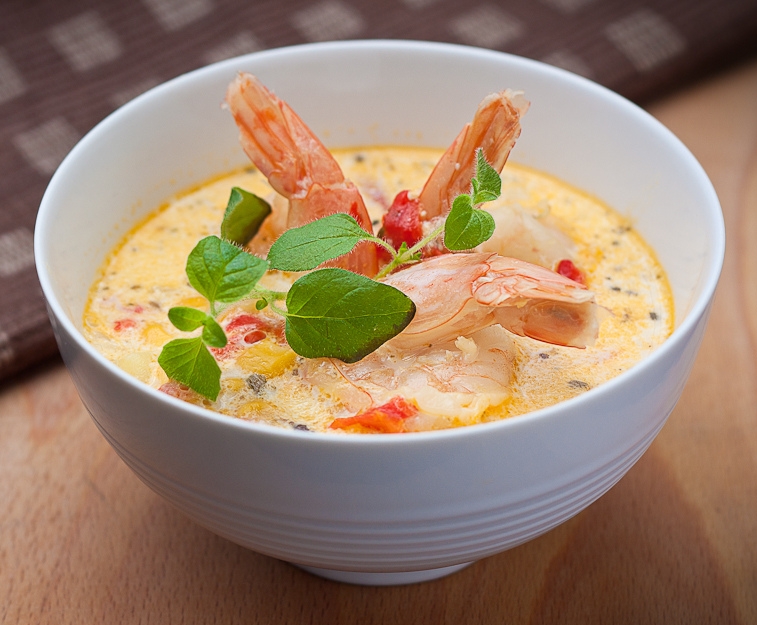
Chowder is a type of thick soup prepared with milk or cream, a roux, and seafood or vegetables. Oyster crackers or saltines may accompany chowders as a side item, and cracker pieces may be dropped atop the dish.
Clam chowder from New England is typically made with chopped clams and diced potatoes, in a mixed cream and milk base, often with a small amount of butter. Other common chowders include seafood chowder, which often consists of fish, clams, and other types of shellfish; lamb or veal chowder made with barley; corn chowder, which uses corn instead of clams; various fish chowders; and potato chowder, which is often made with cheese. Fish, corn, and clam chowders are popular in North America, especially Atlantic Canada and New England.
The origin of the term chowder is obscure. One possible source is the French word chaudron, the French word for cauldron, the type of cooking or heating stove on which the first chowders were probably cooked. Chodier was also a name for a cooking pot in the Creole language of the French Caribbean islands. Additionally, a Portuguese, Brazilian, Galician and Basque fish and shellfish stew is known as caldeirada which appears to have a similar etymology.
Another possible source of the word "chowder" could be the French dish called chaudrée (sometimes spelled chauderée), which is a thick fish soup from the coastal regions of Charente-Maritime and Vendée. Yet another etymology could be the Quebecois French word chaudière, which means "bucket".
In the sixteenth century in Cornwall and Devon the dialectal word "jowter" was used to describe hawkers, particularly fishmongers, which later turned into "chowder" and "chowter". However, this is not cited by the Oxford English Dictionary as a possible source due to controversy regarding the origins of the dish itself. The earliest citation the OED gives for the word used in its current sense of a fish-based stew is American.
Chowder as it is known today originated as a shipboard dish, and was thickened with the use of hardtack. Chowder was brought to North America with immigrants from England and France and seafarers more than 250 years ago. It became popular for its flavour, and is now used widely for its simple preparation.
An early description of chowder is found in the journal kept by the young botanist Joseph Banks, who visited English and French Labrador fisheries in 1766. Banks gives an account of chowder, which he described as "Peculiar to this Country", and its preparation. Even though it was unfamiliar, he stated that "when well made a Luxury that the rich Even in England at Least in my opinion might be fond of It is a Soup made with a small Quantity of salt Pork cut into Small Slices a good deal of fish and Biscuit Boyled for about an hour".
Chowder was not utterly unfamiliar in England at the time, as in Sir Launcelot Greaves (1762) Tobias Smollett has one character state, "My head sings and simmers like a pot of chowder". A Manx sailor in his memoirs recalls a meal made aboard a British ship on a voyage through the Caribbean in 1786: "....we frequently served up a mess called chowder, consisting of a mixture of fresh fish, salt pork, pounded biscuit and onions; and which, when well seasoned and stewed, we found to be an excellent palatable dish." Cookbooks of the period included recipes for "Chowder, a Sea Dish" which might be thicker than a soup: in 1830 an English baked dish made with salmon and potato was called a chowder.
Chowder
Chowder is a type of thick soup prepared with milk or cream, a roux, and seafood or vegetables. Oyster crackers or saltines may accompany chowders as a side item, and cracker pieces may be dropped atop the dish.
Clam chowder from New England is typically made with chopped clams and diced potatoes, in a mixed cream and milk base, often with a small amount of butter. Other common chowders include seafood chowder, which often consists of fish, clams, and other types of shellfish; lamb or veal chowder made with barley; corn chowder, which uses corn instead of clams; various fish chowders; and potato chowder, which is often made with cheese. Fish, corn, and clam chowders are popular in North America, especially Atlantic Canada and New England.
The origin of the term chowder is obscure. One possible source is the French word chaudron, the French word for cauldron, the type of cooking or heating stove on which the first chowders were probably cooked. Chodier was also a name for a cooking pot in the Creole language of the French Caribbean islands. Additionally, a Portuguese, Brazilian, Galician and Basque fish and shellfish stew is known as caldeirada which appears to have a similar etymology.
Another possible source of the word "chowder" could be the French dish called chaudrée (sometimes spelled chauderée), which is a thick fish soup from the coastal regions of Charente-Maritime and Vendée. Yet another etymology could be the Quebecois French word chaudière, which means "bucket".
In the sixteenth century in Cornwall and Devon the dialectal word "jowter" was used to describe hawkers, particularly fishmongers, which later turned into "chowder" and "chowter". However, this is not cited by the Oxford English Dictionary as a possible source due to controversy regarding the origins of the dish itself. The earliest citation the OED gives for the word used in its current sense of a fish-based stew is American.
Chowder as it is known today originated as a shipboard dish, and was thickened with the use of hardtack. Chowder was brought to North America with immigrants from England and France and seafarers more than 250 years ago. It became popular for its flavour, and is now used widely for its simple preparation.
An early description of chowder is found in the journal kept by the young botanist Joseph Banks, who visited English and French Labrador fisheries in 1766. Banks gives an account of chowder, which he described as "Peculiar to this Country", and its preparation. Even though it was unfamiliar, he stated that "when well made a Luxury that the rich Even in England at Least in my opinion might be fond of It is a Soup made with a small Quantity of salt Pork cut into Small Slices a good deal of fish and Biscuit Boyled for about an hour".
Chowder was not utterly unfamiliar in England at the time, as in Sir Launcelot Greaves (1762) Tobias Smollett has one character state, "My head sings and simmers like a pot of chowder". A Manx sailor in his memoirs recalls a meal made aboard a British ship on a voyage through the Caribbean in 1786: "....we frequently served up a mess called chowder, consisting of a mixture of fresh fish, salt pork, pounded biscuit and onions; and which, when well seasoned and stewed, we found to be an excellent palatable dish." Cookbooks of the period included recipes for "Chowder, a Sea Dish" which might be thicker than a soup: in 1830 an English baked dish made with salmon and potato was called a chowder.
Recent media
Recent media