
Recent from talks
Chris Ofili
Knowledge base stats:
Talk channels stats:
Members stats:
Chris Ofili
Christopher Ofili, CBE (born 10 October 1968) is a British painter who won the Turner Prize in 1998. He has utilized resin, beads, oil paint, glitter, lumps of elephant dung and cut-outs from pornographic magazines as painting elements. Ofili's work has been classified as punk art. He currently lives in Trinidad.
Ofili was born in Manchester, England, to parents May and Michael Ofili of Nigerian descent. When he was eleven, his father left the family and moved back to Nigeria. Ofili was for some years educated at St. Pius X High School for Boys, and then at Xaverian College in Victoria Park, Manchester. Ofili completed a foundation course in art at Tameside College in Ashton-under-Lyne in Greater Manchester and then studied in London, at the Chelsea School of Art from 1988 to 1991 and at the Royal College of Art from 1991 to 1993. In the autumn of 1992, he got a one-year exchange scholarship to Universität der Künste Berlin.
Ofili's early work was heavily influenced by Jean-Michel Basquiat, Georg Baselitz, Philip Guston, and George Condo. Peter Doig was doing graduate work at the Chelsea College of Arts when Ofili was an undergraduate, and they soon became friends. In 2014, art critic Roberta Smith held that Ofili has much in common with painters like Mickalene Thomas, Kerry James Marshall, Robert Colescott and Ellen Gallagher, and with more distant precedents such as Bob Thompson, Beauford Delaney and William H. Johnson.
Ofili was established through exhibitions by Charles Saatchi at his gallery in north London and the travelling exhibition Sensation (1997), becoming recognised as one of the few British artists of African / Caribbean descent to break through as a member of the Young British Artists group. Ofili has also had numerous solo shows since the early 1990s, including at Southampton City Art Gallery. In 1998, Ofili won the Turner Prize, and in 2003 he was selected to represent Britain at the 50th Venice Biennale of that year, where his work for the British Pavilion was done in collaboration with the architect David Adjaye.
In 1992, Ofili won a scholarship that allowed him to travel to Zimbabwe. He studied cave paintings there, which had some effect on his style.[citation needed] His work is often built up in layers of paint, resin, glitter, dung (mainly elephant) and other materials to create a collage.
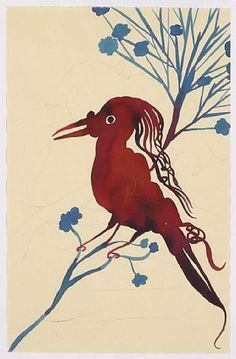
Between 1995 and 2005, Ofili focused on a series of watercolors, each about 9½ by 6½ inches and produced in a single sitting. They predominantly feature heads of men and women, as well as some studies of flowers and birds. Ofili's paintings also make reference to blaxploitation films and gangsta rap, seeking to question racial and sexual stereotypes in a humorous way. In a series of faces that Ofili called Harems, each arrangement consists of one man with as many as four women on each side of him.
After relocating to Trinidad in 2005, Ofili began a series of blue paintings inspired by the Jab Jab or "blue devils" who participate in the Trinidad and Tobago Carnival, and the Expressionist group of German and Russian artists, Der Blaue Reiter. These paintings often employed the use of a silver, acrylic background with layers of dark oil pigment on top. Later iterations of these works were shown at Ofili's solo show Chris Ofili: Day and Night at The New Museum of New York which were installed in a very dimly lit room, causing viewers to adjust their eyes to the darkness in order to see the paintings.
Ofili was appointed Commander of the Order of the British Empire (CBE) in the 2017 New Year Honours for services to art. Ofili was included in the 2019 edition of the Powerlist, ranking the 100 most influential Black Britons.
Hub AI
Chris Ofili AI simulator
(@Chris Ofili_simulator)
Chris Ofili
Christopher Ofili, CBE (born 10 October 1968) is a British painter who won the Turner Prize in 1998. He has utilized resin, beads, oil paint, glitter, lumps of elephant dung and cut-outs from pornographic magazines as painting elements. Ofili's work has been classified as punk art. He currently lives in Trinidad.
Ofili was born in Manchester, England, to parents May and Michael Ofili of Nigerian descent. When he was eleven, his father left the family and moved back to Nigeria. Ofili was for some years educated at St. Pius X High School for Boys, and then at Xaverian College in Victoria Park, Manchester. Ofili completed a foundation course in art at Tameside College in Ashton-under-Lyne in Greater Manchester and then studied in London, at the Chelsea School of Art from 1988 to 1991 and at the Royal College of Art from 1991 to 1993. In the autumn of 1992, he got a one-year exchange scholarship to Universität der Künste Berlin.
Ofili's early work was heavily influenced by Jean-Michel Basquiat, Georg Baselitz, Philip Guston, and George Condo. Peter Doig was doing graduate work at the Chelsea College of Arts when Ofili was an undergraduate, and they soon became friends. In 2014, art critic Roberta Smith held that Ofili has much in common with painters like Mickalene Thomas, Kerry James Marshall, Robert Colescott and Ellen Gallagher, and with more distant precedents such as Bob Thompson, Beauford Delaney and William H. Johnson.
Ofili was established through exhibitions by Charles Saatchi at his gallery in north London and the travelling exhibition Sensation (1997), becoming recognised as one of the few British artists of African / Caribbean descent to break through as a member of the Young British Artists group. Ofili has also had numerous solo shows since the early 1990s, including at Southampton City Art Gallery. In 1998, Ofili won the Turner Prize, and in 2003 he was selected to represent Britain at the 50th Venice Biennale of that year, where his work for the British Pavilion was done in collaboration with the architect David Adjaye.
In 1992, Ofili won a scholarship that allowed him to travel to Zimbabwe. He studied cave paintings there, which had some effect on his style.[citation needed] His work is often built up in layers of paint, resin, glitter, dung (mainly elephant) and other materials to create a collage.
Between 1995 and 2005, Ofili focused on a series of watercolors, each about 9½ by 6½ inches and produced in a single sitting. They predominantly feature heads of men and women, as well as some studies of flowers and birds. Ofili's paintings also make reference to blaxploitation films and gangsta rap, seeking to question racial and sexual stereotypes in a humorous way. In a series of faces that Ofili called Harems, each arrangement consists of one man with as many as four women on each side of him.
After relocating to Trinidad in 2005, Ofili began a series of blue paintings inspired by the Jab Jab or "blue devils" who participate in the Trinidad and Tobago Carnival, and the Expressionist group of German and Russian artists, Der Blaue Reiter. These paintings often employed the use of a silver, acrylic background with layers of dark oil pigment on top. Later iterations of these works were shown at Ofili's solo show Chris Ofili: Day and Night at The New Museum of New York which were installed in a very dimly lit room, causing viewers to adjust their eyes to the darkness in order to see the paintings.
Ofili was appointed Commander of the Order of the British Empire (CBE) in the 2017 New Year Honours for services to art. Ofili was included in the 2019 edition of the Powerlist, ranking the 100 most influential Black Britons.
Recent media