



Community hub
Recent from talks
Contribute something to knowledge base
Content stats: 0 posts, 0 articles, 1 media, 0 notes
Members stats: 0 subscribers, 0 contributors, 0 moderators, 0 supporters
Subscribers
Supporters
Contributors
Moderators
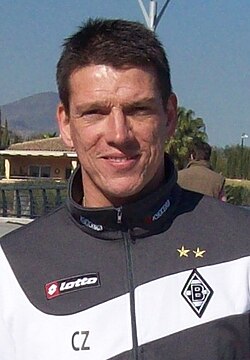
Christian Ziege
Christian Ziege (German pronunciation: [ˈkʁɪsti̯a(ː)n ˈtsiːɡə]; born 1 February 1972) is a German football manager and former player. He most recently coached FC Pinzgau.
Ziege started his playing career at FC Bayern Munich, where he won two Bundesliga titles and a UEFA Cup before moving to AC Milan, winning an Italian Scudetto. In 1999, he joined Middlesbrough of the English Premier League, where he was voted the club's Player of the Year in his only season. A year later, he joined Liverpool and was part of the squad that won a treble of the Football League Cup, the FA Cup and the UEFA Cup in 2000–01. In 2001, he moved to Tottenham Hotspur, before ending his career back in Germany with Borussia Mönchengladbach.
With the Germany national team, Ziege won UEFA Euro 1996 and finished runner-up at the 2002 FIFA World Cup. He also represented the country at UEFA Euro 2000, UEFA Euro 2004 and the 1998 FIFA World Cup. An attacking left wing-back, Ziege was considered a dead-ball specialist.
At club level, Ziege played for Bayern Munich (1990–97), AC Milan (1997–99) and Middlesbrough (1999–2000). The reason he left Milan was his conflict with manager Alberto Zaccheroni, who later reflected: "my biggest regret there [at Milan] was Christian Ziege. I tried to convince Ziege to play as a wing-back. I was sure he could have been great in that role. He had the technical ability of a number 10 – a great left foot with which he could score goals and provide assists – but he could also run up and down for 90 minutes. He never fully accepted the idea of not playing as a left-back, however, and after leaving AC Milan he didn’t have a great career".
In the summer of 2000, Liverpool F.C. made a £5.5m bid which exactly matched a get-out clause in Ziege's contract. Middlesbrough insisted they had received offers in excess of £8m for Ziege, but were forced contractually to allow Ziege to talk to Liverpool, who then signed him. He made his debut for Liverpool in a 3–2 home win over Manchester City on 9 September 2000, replacing Steven Gerrard in the second half. A combination of knee injuries and the improving form of Jamie Carragher, meant he was transferred to Tottenham Hotspur at the end of that season. He scored two goals during his spell at Liverpool; against Leeds in the league and Stoke in the League Cup. Ziege also contributed to their treble in the 2000–01 season. He came on as an extra time substitute in the 2001 Football League Cup Final and scored a penalty in the shootout as Liverpool defeated Birmingham City, but he was not part of the match days squads for either the 2001 FA Cup Final or 2001 UEFA Cup Final.
On 14 March 2002, Liverpool were fined £20,000 by The Football Association for having made an illegal approach for Ziege when he had been at Middlesbrough. The player himself was fined £10,000. Whilst at Spurs he scored in the 2002 Football League Cup Final but he ended up on the losing side. However, by this time Ziege's injury problems were escalating, and by 2004 his contract was terminated by mutual consent so he could return to Germany.
Ziege returned to Germany with Borussia Mönchengladbach in June 2004, but announced his retirement in October 2005, having not played since the previous December due to a persistent ankle injury.
Ziege was capped 72 times for Germany, scoring nine goals. Other than the Euro 96 win, he also played for his country at the 1998 and 2002 World Cups (during which he played the final game and sported a rather amusing mohawk), as well as Euro 2000 (he was a member of the Euro 2004 squad, but didn't play). Ziege was not initially named in Rudi Völler's UEFA Euro 2004 squad, but was then called up after an injury to Christian Rahn.
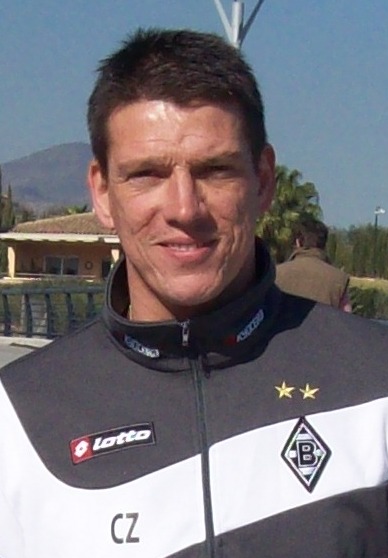
Christian Ziege
Christian Ziege (German pronunciation: [ˈkʁɪsti̯a(ː)n ˈtsiːɡə]; born 1 February 1972) is a German football manager and former player. He most recently coached FC Pinzgau.
Ziege started his playing career at FC Bayern Munich, where he won two Bundesliga titles and a UEFA Cup before moving to AC Milan, winning an Italian Scudetto. In 1999, he joined Middlesbrough of the English Premier League, where he was voted the club's Player of the Year in his only season. A year later, he joined Liverpool and was part of the squad that won a treble of the Football League Cup, the FA Cup and the UEFA Cup in 2000–01. In 2001, he moved to Tottenham Hotspur, before ending his career back in Germany with Borussia Mönchengladbach.
With the Germany national team, Ziege won UEFA Euro 1996 and finished runner-up at the 2002 FIFA World Cup. He also represented the country at UEFA Euro 2000, UEFA Euro 2004 and the 1998 FIFA World Cup. An attacking left wing-back, Ziege was considered a dead-ball specialist.
At club level, Ziege played for Bayern Munich (1990–97), AC Milan (1997–99) and Middlesbrough (1999–2000). The reason he left Milan was his conflict with manager Alberto Zaccheroni, who later reflected: "my biggest regret there [at Milan] was Christian Ziege. I tried to convince Ziege to play as a wing-back. I was sure he could have been great in that role. He had the technical ability of a number 10 – a great left foot with which he could score goals and provide assists – but he could also run up and down for 90 minutes. He never fully accepted the idea of not playing as a left-back, however, and after leaving AC Milan he didn’t have a great career".
In the summer of 2000, Liverpool F.C. made a £5.5m bid which exactly matched a get-out clause in Ziege's contract. Middlesbrough insisted they had received offers in excess of £8m for Ziege, but were forced contractually to allow Ziege to talk to Liverpool, who then signed him. He made his debut for Liverpool in a 3–2 home win over Manchester City on 9 September 2000, replacing Steven Gerrard in the second half. A combination of knee injuries and the improving form of Jamie Carragher, meant he was transferred to Tottenham Hotspur at the end of that season. He scored two goals during his spell at Liverpool; against Leeds in the league and Stoke in the League Cup. Ziege also contributed to their treble in the 2000–01 season. He came on as an extra time substitute in the 2001 Football League Cup Final and scored a penalty in the shootout as Liverpool defeated Birmingham City, but he was not part of the match days squads for either the 2001 FA Cup Final or 2001 UEFA Cup Final.
On 14 March 2002, Liverpool were fined £20,000 by The Football Association for having made an illegal approach for Ziege when he had been at Middlesbrough. The player himself was fined £10,000. Whilst at Spurs he scored in the 2002 Football League Cup Final but he ended up on the losing side. However, by this time Ziege's injury problems were escalating, and by 2004 his contract was terminated by mutual consent so he could return to Germany.
Ziege returned to Germany with Borussia Mönchengladbach in June 2004, but announced his retirement in October 2005, having not played since the previous December due to a persistent ankle injury.
Ziege was capped 72 times for Germany, scoring nine goals. Other than the Euro 96 win, he also played for his country at the 1998 and 2002 World Cups (during which he played the final game and sported a rather amusing mohawk), as well as Euro 2000 (he was a member of the Euro 2004 squad, but didn't play). Ziege was not initially named in Rudi Völler's UEFA Euro 2004 squad, but was then called up after an injury to Christian Rahn.
Recent media
Recent media