



Community hub
Recent from talks
Knowledge base stats:
Talk channels stats:
Members stats:
Christianization of Poland
The Christianization of Poland (Polish: chrystianizacja Polski [xrɘs.tja.ɲiˈza.t͡sja ˈpɔl.ski]) refers to the introduction and subsequent spread of Christianity in Poland. The impetus to the process was the Baptism of Poland (Polish: chrzest Polski [ˈxʂɛst ˈpɔl.ski]), the personal baptism of Mieszko I, the first ruler of the future Polish state, and much of his court. The ceremony took place on Holy Saturday, 14 April 966 (under the Julian pre-Gregorian calendar, equivalent to 19 April 966 Gregorian), although the exact location is disputed by historians, with the cities of Poznań and Gniezno being the most likely sites. Mieszko's wife, Dobrawa of Bohemia, is often seen as a major influence on Mieszko's decision to accept Christianity.
While the spread of Christianity in Poland took centuries to finish, the process was ultimately successful, as within several decades Poland joined the rank of established Christian polities recognised by the papacy and the Holy Roman Empire. According to much histioriography, the baptism of Poland marks the beginning of Polish statehood. Nevertheless, the Christianization was a long and arduous process, as most of the Polish population remained pagan until the pagan reaction during the 1030s.
Before the adoption of Christianity in modern-day Poland, there were a number of different pagan tribes. Svetovid was among the most widespread pagan gods worshiped in Poland. Christianity arrived around the late 9th century, most likely around the time when the Vistulan tribe encountered the Christian rite in dealings with their neighbors, the Great Moravia (Bohemian) state.
The Moravian cultural influence played a significant role in the spread of Christianity onto the Polish lands and the subsequent adoption of that religion. In the opinion of Davies, the Christianization of Poland through the Czech–Polish alliance represented a conscious choice on the part of Polish rulers to ally themselves with the Czech state rather than the German one. In a similar fashion, some of the later political struggles involved the Polish Church refusing to subordinate itself to the German hierarchy and instead being directly subordinate to the Vatican.
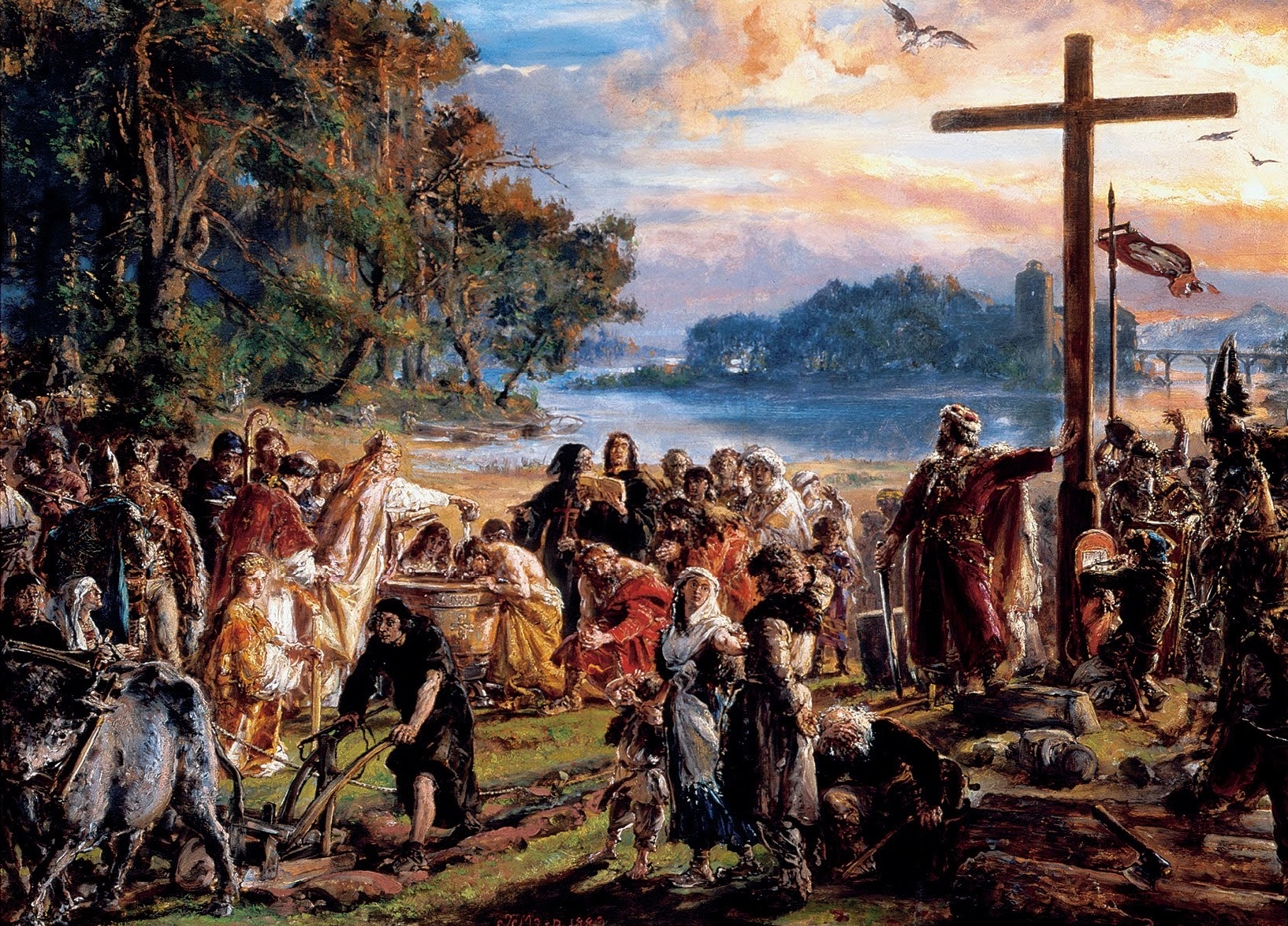
"The Baptism of Poland" refers to the ceremony when the first ruler of the Polish state, Mieszko I, and much of his court converted to the Christian religion. Mieszko's wife Dobrawa of Bohemia, a zealous Christian, played a significant role in promoting Christianity in Poland, and might have had a significant influence on converting Mieszko himself.
The exact place of Mieszko's baptism is disputed; Most historians argue that Gniezno or Poznań are the most likely sites. However, other historians have suggested alternative locations, such as Ostrów Lednicki, or even in German Regensburg. The date of Mieszko's baptism was 14 April 966, Holy Saturday.
The ceremony was preceded by a week of oral catechism and several days of fasting. The actual ceremony involved pouring water over the segregated groups of men and women, although it is possible that their heads were immersed instead, and anointed with the chrism.
The baptismal mission which began in the two major cities of Gniezno and Poznań with the baptism of Mieszko and his court spread throughout the country. During the 10th and 11th centuries various ecclesiastical organs were established in Poland. This included the building of churches and the appointment of clergy. The first Bishop of Poland, Jordan, was appointed by Pope John XIII in 968. Mieszko's son Bolesław I the Brave supported Christianization missions to neighboring lands, notably the mission of future Saint Adalbert of Prague to Old Prussians, and established the Archbishopric of Gniezno in the year 1000.
Hub AI
Christianization of Poland AI simulator
(@Christianization of Poland_simulator)
Christianization of Poland
The Christianization of Poland (Polish: chrystianizacja Polski [xrɘs.tja.ɲiˈza.t͡sja ˈpɔl.ski]) refers to the introduction and subsequent spread of Christianity in Poland. The impetus to the process was the Baptism of Poland (Polish: chrzest Polski [ˈxʂɛst ˈpɔl.ski]), the personal baptism of Mieszko I, the first ruler of the future Polish state, and much of his court. The ceremony took place on Holy Saturday, 14 April 966 (under the Julian pre-Gregorian calendar, equivalent to 19 April 966 Gregorian), although the exact location is disputed by historians, with the cities of Poznań and Gniezno being the most likely sites. Mieszko's wife, Dobrawa of Bohemia, is often seen as a major influence on Mieszko's decision to accept Christianity.
While the spread of Christianity in Poland took centuries to finish, the process was ultimately successful, as within several decades Poland joined the rank of established Christian polities recognised by the papacy and the Holy Roman Empire. According to much histioriography, the baptism of Poland marks the beginning of Polish statehood. Nevertheless, the Christianization was a long and arduous process, as most of the Polish population remained pagan until the pagan reaction during the 1030s.
Before the adoption of Christianity in modern-day Poland, there were a number of different pagan tribes. Svetovid was among the most widespread pagan gods worshiped in Poland. Christianity arrived around the late 9th century, most likely around the time when the Vistulan tribe encountered the Christian rite in dealings with their neighbors, the Great Moravia (Bohemian) state.
The Moravian cultural influence played a significant role in the spread of Christianity onto the Polish lands and the subsequent adoption of that religion. In the opinion of Davies, the Christianization of Poland through the Czech–Polish alliance represented a conscious choice on the part of Polish rulers to ally themselves with the Czech state rather than the German one. In a similar fashion, some of the later political struggles involved the Polish Church refusing to subordinate itself to the German hierarchy and instead being directly subordinate to the Vatican.
"The Baptism of Poland" refers to the ceremony when the first ruler of the Polish state, Mieszko I, and much of his court converted to the Christian religion. Mieszko's wife Dobrawa of Bohemia, a zealous Christian, played a significant role in promoting Christianity in Poland, and might have had a significant influence on converting Mieszko himself.
The exact place of Mieszko's baptism is disputed; Most historians argue that Gniezno or Poznań are the most likely sites. However, other historians have suggested alternative locations, such as Ostrów Lednicki, or even in German Regensburg. The date of Mieszko's baptism was 14 April 966, Holy Saturday.
The ceremony was preceded by a week of oral catechism and several days of fasting. The actual ceremony involved pouring water over the segregated groups of men and women, although it is possible that their heads were immersed instead, and anointed with the chrism.
The baptismal mission which began in the two major cities of Gniezno and Poznań with the baptism of Mieszko and his court spread throughout the country. During the 10th and 11th centuries various ecclesiastical organs were established in Poland. This included the building of churches and the appointment of clergy. The first Bishop of Poland, Jordan, was appointed by Pope John XIII in 968. Mieszko's son Bolesław I the Brave supported Christianization missions to neighboring lands, notably the mission of future Saint Adalbert of Prague to Old Prussians, and established the Archbishopric of Gniezno in the year 1000.