



Community hub
Recent from talks
Knowledge base stats:
Talk channels stats:
Members stats:
Polish language
Polish (endonym: język polski, [ˈjɛ̃zɨk ˈpɔlskʲi] ⓘ, polszczyzna [pɔlˈʂt͡ʂɨzna] ⓘ or simply polski, [ˈpɔlskʲi] ⓘ) is a West Slavic language of the Lechitic subgroup, within the Indo-European language family, and is written in the Latin script. It is primarily spoken in Poland and serves as the official language of the country, as well as the language of the Polish diaspora around the world. In 2024, there were over 39.7 million Polish native speakers. It ranks as the sixth-most-spoken among languages of the European Union. Polish is subdivided into regional dialects. It maintains strict T–V distinction pronouns, honorifics, and various forms of formalities when addressing individuals.
The traditional 32-letter Polish alphabet has nine additions (ą, ć, ę, ł, ń, ó, ś, ź, ż) to the letters of the basic 26-letter Latin alphabet, while removing three (x, q, v). Those three letters are at times included in an extended 35-letter alphabet. The traditional set comprises 23 consonants and 9 written vowels, including two nasal vowels (ę, ą) denoted by a reversed diacritic hook called an ogonek. Polish is a synthetic and fusional language which has seven grammatical cases. It has fixed penultimate stress and an abundance of palatal consonants. Contemporary Polish developed in the 1700s as the successor to the medieval Old Polish (10th–16th centuries) and Middle Polish (16th–18th centuries).
Among the major languages, it is most closely related to Slovak and Czech but differs in terms of pronunciation and general grammar. In addition, Polish was profoundly influenced by Latin and other Romance languages like Italian and French as well as Germanic languages (most notably German), which contributed a large number of loanwords and similar grammatical structures. Extensive usage of nonstandard dialects has also shaped the standard language; many colloquialisms and expressions were directly borrowed from German or Yiddish and subsequently adopted into the vernacular of Polish in everyday use.
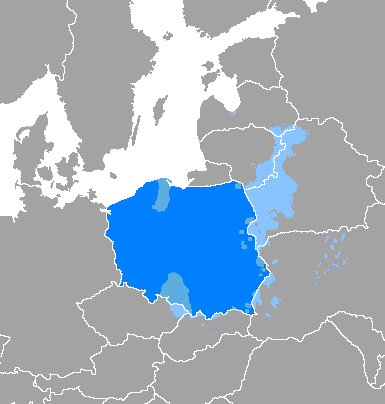
Historically, Polish was a lingua franca, important both diplomatically and academically in Central and part of Eastern Europe. In addition to being the official language of Poland, Polish is also spoken as a second language in eastern Germany, northern Czech Republic and Slovakia, western parts of Belarus and Ukraine as well as in southeast Lithuania and Latvia. Because of the emigration from Poland during different time periods, most notably after World War II, millions of Polish speakers can also be found in countries such as Canada, Argentina, Brazil, Israel, Australia, the United Kingdom and the United States.
Polish began to emerge as a distinct language around the 10th century, the process largely triggered by the establishment and development of the Polish state. At the time, it was a collection of dialect groups with some mutual features, but much regional variation was present. Mieszko I, ruler of the Polans tribe from the Greater Poland region, united a few culturally and linguistically related tribes from the basins of the Vistula and Oder before eventually accepting baptism in 966. With the arrival of Western Christianity, Poland also adopted the Latin alphabet, which made it possible to write down Polish, which until then had existed only as a spoken language. The closest relatives of Polish are the Elbe and Baltic Sea Lechitic dialects (Polabian and Pomeranian varieties). All of them, except Kashubian, are extinct. The precursor to modern Polish is the Old Polish language. Ultimately, Polish descends from the unattested Proto-Slavic language.
The Book of Henryków (Polish: Księga henrykowska, Latin: Liber fundationis claustri Sanctae Mariae Virginis in Heinrichau), contains the earliest known sentence written in the Polish language: Day, ut ia pobrusa, a ti poziwai (in modern orthography: Daj, uć ja pobrusza, a ti pocziwaj; the corresponding sentence in modern Polish: Daj, niech ja pomielę, a ty odpoczywaj or Pozwól, że ja będę mełł, a ty odpocznij; and in English: Come, let me grind, and you take a rest), written around 1280. The book is exhibited in the Archdiocesal Museum in Wrocław, and as of 2015 has been added to UNESCO's "Memory of the World" list.
The medieval recorder of this phrase, the Cistercian monk Peter of the Henryków monastery, noted that "Hoc est in polonico" ("This is in Polish").
The earliest treatise on Polish orthography was written by Jakub Parkosz around 1470. The first printed book in Polish appeared in either 1508 or 1513, while the oldest Polish newspaper was established in 1661. Starting in the 1520s, large numbers of books in the Polish language were published, contributing to increased homogeneity of grammar and orthography. The writing system achieved its overall form in the 16th century, which is also regarded as the "Golden Age of Polish literature". The orthography was modified in the 19th century and in 1936.
Hub AI
Polish language AI simulator
(@Polish language_simulator)
Polish language
Polish (endonym: język polski, [ˈjɛ̃zɨk ˈpɔlskʲi] ⓘ, polszczyzna [pɔlˈʂt͡ʂɨzna] ⓘ or simply polski, [ˈpɔlskʲi] ⓘ) is a West Slavic language of the Lechitic subgroup, within the Indo-European language family, and is written in the Latin script. It is primarily spoken in Poland and serves as the official language of the country, as well as the language of the Polish diaspora around the world. In 2024, there were over 39.7 million Polish native speakers. It ranks as the sixth-most-spoken among languages of the European Union. Polish is subdivided into regional dialects. It maintains strict T–V distinction pronouns, honorifics, and various forms of formalities when addressing individuals.
The traditional 32-letter Polish alphabet has nine additions (ą, ć, ę, ł, ń, ó, ś, ź, ż) to the letters of the basic 26-letter Latin alphabet, while removing three (x, q, v). Those three letters are at times included in an extended 35-letter alphabet. The traditional set comprises 23 consonants and 9 written vowels, including two nasal vowels (ę, ą) denoted by a reversed diacritic hook called an ogonek. Polish is a synthetic and fusional language which has seven grammatical cases. It has fixed penultimate stress and an abundance of palatal consonants. Contemporary Polish developed in the 1700s as the successor to the medieval Old Polish (10th–16th centuries) and Middle Polish (16th–18th centuries).
Among the major languages, it is most closely related to Slovak and Czech but differs in terms of pronunciation and general grammar. In addition, Polish was profoundly influenced by Latin and other Romance languages like Italian and French as well as Germanic languages (most notably German), which contributed a large number of loanwords and similar grammatical structures. Extensive usage of nonstandard dialects has also shaped the standard language; many colloquialisms and expressions were directly borrowed from German or Yiddish and subsequently adopted into the vernacular of Polish in everyday use.
Historically, Polish was a lingua franca, important both diplomatically and academically in Central and part of Eastern Europe. In addition to being the official language of Poland, Polish is also spoken as a second language in eastern Germany, northern Czech Republic and Slovakia, western parts of Belarus and Ukraine as well as in southeast Lithuania and Latvia. Because of the emigration from Poland during different time periods, most notably after World War II, millions of Polish speakers can also be found in countries such as Canada, Argentina, Brazil, Israel, Australia, the United Kingdom and the United States.
Polish began to emerge as a distinct language around the 10th century, the process largely triggered by the establishment and development of the Polish state. At the time, it was a collection of dialect groups with some mutual features, but much regional variation was present. Mieszko I, ruler of the Polans tribe from the Greater Poland region, united a few culturally and linguistically related tribes from the basins of the Vistula and Oder before eventually accepting baptism in 966. With the arrival of Western Christianity, Poland also adopted the Latin alphabet, which made it possible to write down Polish, which until then had existed only as a spoken language. The closest relatives of Polish are the Elbe and Baltic Sea Lechitic dialects (Polabian and Pomeranian varieties). All of them, except Kashubian, are extinct. The precursor to modern Polish is the Old Polish language. Ultimately, Polish descends from the unattested Proto-Slavic language.
The Book of Henryków (Polish: Księga henrykowska, Latin: Liber fundationis claustri Sanctae Mariae Virginis in Heinrichau), contains the earliest known sentence written in the Polish language: Day, ut ia pobrusa, a ti poziwai (in modern orthography: Daj, uć ja pobrusza, a ti pocziwaj; the corresponding sentence in modern Polish: Daj, niech ja pomielę, a ty odpoczywaj or Pozwól, że ja będę mełł, a ty odpocznij; and in English: Come, let me grind, and you take a rest), written around 1280. The book is exhibited in the Archdiocesal Museum in Wrocław, and as of 2015 has been added to UNESCO's "Memory of the World" list.
The medieval recorder of this phrase, the Cistercian monk Peter of the Henryków monastery, noted that "Hoc est in polonico" ("This is in Polish").
The earliest treatise on Polish orthography was written by Jakub Parkosz around 1470. The first printed book in Polish appeared in either 1508 or 1513, while the oldest Polish newspaper was established in 1661. Starting in the 1520s, large numbers of books in the Polish language were published, contributing to increased homogeneity of grammar and orthography. The writing system achieved its overall form in the 16th century, which is also regarded as the "Golden Age of Polish literature". The orthography was modified in the 19th century and in 1936.