


Community hub
Recent from talks
Contribute something
Nothing was collected or created yet.
Christopher Payne
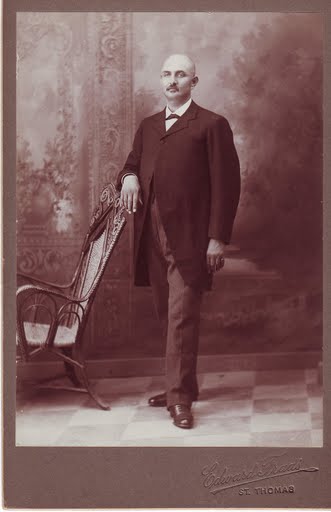
View on WikipediaChristopher Harrison Payne (September 7, 1845 – December 5, 1925) was an African American religious, educational, and political leader of the late nineteenth and early twentieth centuries. Born in the American South during the time of slavery, Payne rose to a level of prominence achieved by few, regardless of race. His many accomplishments include being the first African American elected to the West Virginia Legislature.[1][2] He served as U.S. consul to St. Thomas from 1903 to 1917.[3]
Key Information


Early life
[edit]Payne was born in Red Sulphur Springs[3] in Monroe County, Virginia (now West Virginia), on September 7, 1845 to Thomas Payne and Barsheba Ellison, both of whom were by then free from slavery. Thomas Payne, a cattle drover, died of smallpox when his only child, Christopher, was two years old. Christopher's mother, Barsheba, was taught to read and write by her father, the slave owner James Ellison, and her enslaved mother Fanny who was freed upon the death of Ellison's wife according to his will. Christopher's mother, in turn, taught him to read and write at a very early age. Education would remain a guiding tenet of the Payne family.[4]
During the American Civil War, Payne was forced to serve as an orderly in the Confederate Army. He was able to return home in 1864[4] and begin formal education for the first time after the war by attending night school while working as a farmhand during the day. He received a teaching certificate in 1868, becoming one of the first African American teachers in Summers County, West Virginia. He continued to teach and farm until he was baptized in 1875. He was licensed to preach in February 1876 and was ordained as a Baptist minister in May 1877.[4]
Religious leader
[edit]Following his ordination in 1877, Payne founded Second Baptist Church in Hinton, West Virginia. He pastored many other churches and was said to have delivered over 1,500 sermons and converted 500 people.[5] After ministering for six years, Payne graduated from the Richmond Theological Institute in 1883[4] as well as State University, now the Virginia Union University. Payne's involvement in his religious community continued as he presided over the West Virginia Baptist State Convention for 16 years, and, on several occasions, he spoke at the national assemblies of white Baptists.
Newspaper publisher
[edit]Payne established three newspapers in West Virginia: West Virginia Enterprise,[4] The Pioneer, and Mountain Eagle. When founded, the West Virginia Enterprise was the only Black newspaper in West Virginia. Payne was also a correspondent for other journals, including those geared toward the white community. Payne used these venues to pursue equality between the races as well as to encourage Black people to improve their circumstances through education and the purchase of their land and homes.
Attorney
[edit]Payne studied law and was admitted to the West Virginia Bar in 1889, becoming one of the first Black lawyers in West Virginia.[6]
Politician
[edit]Payne's growing stature within both the Black and white communities led to his appointment as an alternate delegate to the 1884 Republican National Convention, later serving as a regular delegate to the 1888 Republican National Convention where Benjamin Harrison was nominated for President of the United States. State leaders pushed for Payne's appointment as Ambassador to Liberia. Instead, he was appointed Deputy Collector for the United States Internal Revenue Service in Charleston, West Virginia. Along with Byrd Prillerman, another prominent African American educator, Payne was able to persuade the West Virginia Legislature to establish the West Virginia Colored Institute, now West Virginia State University, in 1891.[7]
In 1896, Payne was elected to the West Virginia legislature, becoming the first African American to serve in that elective body. When the Spanish–American War of 1898 followed, Payne raised a volunteer Black regiment and saw to their arrival at the war time encampment of Camp Atkinson.[8]
Ambassador
[edit]
Due to his faithful service to the Republican Party, in 1903 United States President Theodore Roosevelt named Payne as Consul General to the Danish West Indies, a rare appointment for an African American at that time.[9] Payne replaced as consul another African American politician, Mahlon Van Horne, who had been impeached and removed from office for alleged interference in local politics and financial regularities at his consulate.[10]
NAACP
[edit]Payne worked with the NAACP, serving on the planning committee for the 1917 Negro Silent Protest Parade.[11]
Family life
[edit]Payne married Ann Delilah Hargo at a young age and they had eight children. His youngest son and namesake, Christopher Hansen Payne (1881–1914), graduated from Howard University and received a medical degree. He practiced medicine in Hinton, West Virginia until his early death in 1914.
Children of Christopher Payne and Ann Delilah Hargo:
- Arabella Geneva Payne, 1860–1930
- Lewis W. Payne, 1862–1927
- Martha Adelaide Payne, 1866–1944
- Mary Jane Payne, 1869–1932
- James Robert Payne, 1872–1943
- Charles Henry Payne, 1874–1950
- Cyrus Alexander Payne, 1877–1944
- Christopher Hansen Payne, 1881–1914
Later life
[edit]Payne remained in the Danish West Indies after they were sold to the United States in 1917 and became the United States Virgin Islands. With the closing of the consulate, he then became prosecuting attorney and police judge in St. Thomas, capital of the Virgin Islands. He died in the Virgin Islands on December 5, 1925, at the age of eighty.[12]
See also
[edit]References
[edit]- ^ "Christopher Payne". Wvculture.org. 1925-12-05. Archived from the original on 2012-08-29. Retrieved 2012-06-09.
- ^ "'History on Main' program set for Saturday". 14 February 2013.
- ^ a b "The Political Graveyard: African ancestry Politicians in West Virginia".
- ^ a b c d e Simmons, William J., and Henry McNeal Turner. Men of Mark: Eminent, Progressive and Rising. GM Rewell & Company, 1887. p368-373
- ^ Fuller, Louis (1976). Appointment at Armageddon: Muckraking and Progressivism in the American Tradition. Westport: Greenwood Press. p. 134. ISBN 0-8371-8261-1.
- ^ "New Page 0". Archived from the original on 2008-08-28. Retrieved 2009-08-01.
- ^ "Byrd Prillerman". Wvculture.org. 1921-07-09. Retrieved 2012-06-09.
- ^ "Spanish–American War: 2nd Regiment West Virginia Infantry". Wvculture.org. Retrieved 2012-06-09.
- ^ "Men of the Month" (PDF). The Crisis. Vol. 14, no. 2. NAACP. June 1917. p. 82. Retrieved 31 July 2017.
- ^ Justesen, Benjamin R. (2013-03-15), "Van Horne, Mahlon", African American Studies Center, Oxford University Press, doi:10.1093/acref/9780195301731.013.39013, ISBN 978-0-19-530173-1, retrieved 2023-10-09
{{citation}}: CS1 maint: work parameter with ISBN (link) - ^ "NAACP's Crisis Magazine" (PDF). Brown University Library. 1917-09-01. Retrieved 31 July 2017.
- ^ Lawrence Kestenbaum. "Index to Politicians: Payne to Payrow". The Political Graveyard. Retrieved 2012-06-09.
Christopher Payne
View on GrokipediaEarly life
Background and origins
Christopher Payne was born in 1968.[1] Biographical details about his early life remain limited, with little documented information on family background or childhood. He trained as an architect, receiving a B.A. in Architecture from Columbia University in 1990 and an M. Arch. from the University of Pennsylvania in 1996.[3] Christopher Payne trained as an architect, earning a B.A. in Architecture from Columbia University in 1990 and an M.Arch. from the University of Pennsylvania in 1996. He initially worked in architecture before transitioning to photography, inspired by documenting industrial structures. He began focusing on photography full-time around 2008, specializing in large-format images of America's architectural and industrial heritage.[3][4] His early work documented vanishing or overlooked infrastructure and institutions. His first book, New York’s Forgotten Substations: The Power Behind the Subway (Princeton Architectural Press, 2002), explores the hidden machinery powering New York City's subway system. This was followed by Asylum: Inside the Closed World of State Mental Hospitals (MIT Press, 2009), a seven-year survey of abandoned state mental health facilities, with an essay by neurologist Oliver Sacks. In 2014, he published North Brother Island: The Last Unknown Place in New York City (Fordham University Press), documenting the abandoned island's ruins and natural reclamation.[3][1] More recent projects celebrate ongoing American craftsmanship and manufacturing. Making Steinway: An American Workplace (2016) details the production processes at the Steinway & Sons piano factory in Queens, New York. His ongoing work includes series on the American textile industry and broader manufacturing, culminating in Made in America: The Industrial Photography of Christopher Payne and a major exhibition of the same name at the Cooper Hewitt, Smithsonian Design Museum (opening December 2025).[3][1] Payne has received grants from the Graham Foundation, the New York State Council on the Arts (1999, 2003, 2012), and a 2008 Photography Fellowship from the New York Foundation for the Arts. His photographs have been published in The New York Times Magazine, The New Yorker, National Geographic, and other outlets, and exhibited at venues including Benrubi Gallery (New York) and internationally.[3][4] No information on death as Christopher Payne is alive and active as of 2026. The previous content contained inaccurate information confusing him with another individual and is removed.Recognition
Awards and grants
Christopher Payne has received several grants and awards for his photography.- 2008: New York Foundation for the Arts, Photography Fellowship [5]
- New York State Council on the Arts, Individual Artist Grants (1999, 2003, 2012) [5]
- 1999: Graham Foundation Grant [5]
- 2010: New England Book Show Award and Ken Book Award [5]
- 2015: Photolucida Critical Mass Top 50 [5]