
.svg/250px-Battle_flag_of_the_Confederate_States_of_America_(With_White_Border).svg.png)


.svg/2000px-Battle_flag_of_the_Confederate_States_of_America_(With_White_Border).svg.png)
Community hub
Recent from talks
Contribute something
Nothing was collected or created yet.
Confederate States Army
View on Wikipedia
| Confederate States Army | |
|---|---|
.svg) | |
| Founded | February 28, 1861 |
| Disbanded | May 26, 1865 |
| Country |  Confederate States Confederate States |
| Type | Army |
| Size | 1,082,119 total who served[1]
|
| Part of |  War Department War Department |
| Colors | Cadet Gray[2] |
| March | "Dixie" |
| Conflicts | |
| Commanders | |
| Commander in Chief | Jefferson Davis (1861–65) |
| General in Chief | General Robert E. Lee (1865) |
The Confederate States Army (CSA), also called the Confederate army or the Southern army, was the military land force of the Confederate States of America (commonly referred to as the Confederacy) during the American Civil War (1861–1865), fighting against the United States forces to support the rebellion of the Southern states and uphold and expand the institution of slavery.[3] On February 28, 1861, the Provisional Confederate Congress established a provisional volunteer army and gave control over military operations and authority for mustering state forces and volunteers to the newly chosen Confederate States president, Jefferson Davis (1808–1889). Davis was a graduate of the United States Military Academy, on the Hudson River at West Point, New York, and colonel of a volunteer regiment during the Mexican–American War (1846–1848). He had also been a United States senator from Mississippi and served as U.S. Secretary of War under 14th president Franklin Pierce. On March 1, 1861, on behalf of the new Confederate States government, Davis assumed control of the military situation at Charleston Harbor in Charleston, South Carolina, where South Carolina state militia had besieged the longtime Federal Fort Sumter in Charleston harbor, held by a small U.S. Army garrison under the command of Major Robert Anderson (1805–1871). By March 1861, the Provisional Congress of the Confederate States meeting in the temporary capital of Montgomery, Alabama, expanded the provisional military forces and established a more permanent regular Confederate States Army.
An accurate count of the total number of individuals who served in the Military forces of the Confederate States (Army, Navy and Marine Corps) is not possible due to incomplete and destroyed/burned Confederate records; and archives. Estimates of the number of Confederate soldiers, sailors and marines are between 750,000 and over 1,000,000 troops. This does not include an unknown number of black slaves who were pressed into performing various tasks for the army, such as the construction of fortifications and defenses or driving wagons.[4] Since these figures include estimates of the total number of soldiers who served at any time during the war, they do not represent the size of the army at any given date. These numbers also do not include sailors/marines who served in the Confederate States Navy.
Although most of the soldiers who fought in the American Civil War were volunteers, both sides by 1862 resorted to conscription as a means to supplement the volunteer soldiers. Although exact records are unavailable, estimates of the percentage of Confederate Army soldiers who were drafted are about double the 6 percent of Union Army soldiers who were drafted.[5]
According to the National Park Service, "Soldier demographics for the Confederate Army are not available due to incomplete and destroyed enlistment records." Their estimates of Confederate military personnel deaths are about 94,000 killed in battle, 164,000 deaths from disease, and 25,976 deaths in Union prison camps. One estimate of the total Confederate wounded is 194,026. In comparison, the best estimates of the number of Union military personnel deaths are 110,100 killed in battle, 224,580 deaths from disease, and 30,218 deaths in Confederate prison camps. The estimated figure for Union Army wounded is 275,174.[6]
The main Confederate armies, the Army of Northern Virginia under General Robert E. Lee and the remnants of the Army of Tennessee and various other units under General Joseph E. Johnston, surrendered to the U.S. on April 9, 1865 (officially April 12), and April 18, 1865 (officially April 26). Other Confederate forces further south and west surrendered between April 16, 1865, and June 28, 1865.[7] By the end of the war, more than 100,000 Confederate soldiers had deserted,[8] and some estimates put the number as high as one-third of all Confederate soldiers.[9] The Confederacy's government effectively dissolved when it evacuated the four-year old capital of Richmond, Virginia, on April 3, 1865, and fled southwest by railroad train with President Jefferson Davis and members of his cabinet. It gradually continued moving southwestward first to Lynchburg, Virginia, and lost communication with its remaining military commanders, soon exerting no control over the remaining armies. They were eventually caught and captured near Irwinville, Georgia, a month later in May 1865.
Prelude
[edit]By the time Abraham Lincoln took office as President of the United States on March 4, 1861, the seven seceding slave states had formed the Confederate States. They seized federal property, including nearly all U.S. Army forts, within their borders.[10] Lincoln was determined to hold the forts remaining under U.S. control when he took office, especially Fort Sumter in the harbor of Charleston, South Carolina. On February 28, shortly before Lincoln was sworn in as president, the Provisional Confederate Congress had authorized the organization of a large Provisional Army of the Confederate States (PACS).[11]
Under orders from Confederate President Jefferson Davis, C.S. troops under the command of General Pierre Gustave Toutant / P. G. T. Beauregard military forces surrounding the city harbor began bombarding Fort Sumter on April 12–13, 1861 and forced its capitulation on April 14.[12][13] The remaining loyal United States in the North, outraged by the Confederacy's attack, demanded war. It rallied behind new 16th President Lincoln's call on April 15 for all the loyal states to send their state militia units avolunteer troops to reinforce and protect the national federal capital of Washington, D.C., to recapture the various forts, arsenals, shipyards and other seized federal installations from the secessionists, to put down and suppress the rebellion and to save the Union.[14] Four more upper border slave states (North Carolina, Tennessee, Arkansas and finally Virginia) then joined the Confederacy, making eleven seceded states, rather than fight fellow Southerners. The Confederacy then moved its national capital from temporary Montgomery, Alabama to the state capital of Virginia in Richmond. Both the United States and the Confederate States began in earnest to raise large, mostly volunteer, armies,[15][16] with the opposing objectives: putting down the rebellion and preserving the Union on the one hand, and establishing Southern independence from the northern United States on the other.[17]
Establishment
[edit]
The Confederate States Congress provided for a regular Confederate States Army, patterned after its parent in the United States Army (established 1775 / 1789). It was to consist of a large provisional force to exist only in time of war and a small permanent regular army. The provisional, volunteer army was established by an act of the Provisional Confederate Congress passed on February 28, 1861, one week before the act which established the permanent regular army organization, passed on March 6. Although the two forces were to exist concurrently, little was done to organize the Confederate regular army.[18]
- The Provisional Army of the Confederate States (PACS) began organizing on April 27. Virtually all regular, volunteer, and conscripted men preferred to enter this organization since officers could achieve a higher rank in the Provisional Army than they could in the Regular Army. If the war had ended successfully for them, the Confederates intended that the PACS would be disbanded, leaving only the ACSA.[19]
- The Army of the Confederate States of America (ACSA) was the regular army and was authorized to include 15,015 men, including 744 officers, but this level was never achieved. The men serving in the highest rank as Confederate States generals, such as Samuel Cooper and Robert E. Lee, were enrolled in the ACSA to ensure that they outranked all militia officers.[19] ACSA ultimately existed only on paper. The organization of the ACSA did not proceed beyond the appointment and confirmation of some officers. Three state regiments were later denominated "Confederate" regiments, but this appears to have had no practical effect on the organization of a regular Confederate Army and no real effect on the regiments themselves.
Members of all the military forces of the Confederate States (the army, the navy, and the marine corps) are often referred to as "Confederates", and members of the Confederate army were referred to as "Confederate soldiers". Supplementing the Confederate army were the various state militias of the Confederacy:
- Confederate States State Militias were organized and commanded by the state governments, similar to those authorized by the United States' Militia Act of 1792. Some of these militia forces, in the early days of the Confederacy, had operated as stand alone military forces before being incorporated into the Confederate Army; one of the more well known was the Provisional Army of Virginia.
Control and conscription
[edit]
Control and operation of the Confederate army were administered by the Confederate States War Department, which was established by the Confederate Provisional Congress in an act on February 21, 1861. The Confederate Congress gave control over military operations, and authority for mustering state forces and volunteers to the President of the Confederate States of America on February 28, 1861, and March 6, 1861. On March 8, the Confederate Congress passed a law that authorized President Davis to issue proclamations to call up no more than 100,000 men.[20] The C.S. War Department asked for 8,000 volunteers on March 9, 20,000 on April 8, and 49,000 on and after April 16. Davis proposed an army of 100,000 soldiers in his message to Congress on April 29.[21]
On August 8, 1861, the Confederacy called for 400,000 volunteers to serve for one or three years. Eight months later in April 1862,[22] the Confederacy passed the first conscription law in either Confederate or Union history, the Conscription Act,[23] which made all able bodied white men between the ages of 18 and 35 liable for a three-year term of service in the Provisional Army. It also extended the terms of enlistment for all one-year soldiers to three years. Men employed in certain occupations considered to be most valuable for the home front (such as railroad and river workers, civil officials, telegraph operators, miners, druggists and teachers) were exempt from the draft.[24] The act was amended twice in 1862. On September 27, the maximum age of conscription was extended to 45.[25] On October 11, the Confederate States Congress passed the so-called "Twenty Negro Law",[26] which exempted anyone who owned 20 or more slaves, a move that caused deep resentment among conscripts who did not own slaves.[27]
The C.S. Congress enacted several more amendments throughout the war to address losses suffered in battle as well as the United States' greater supply of manpower. In December 1863, it abolished the previous practice of allowing a rich drafted man to hire a substitute to take his place in the ranks. Substitution had also been practiced in the United States, leading to similar resentment from the lower classes. In February 1864, the age limits were extended to between 17 and 50.[28] Challenges to the subsequent acts came before five state supreme courts; all five upheld them.[29]
Morale and motivations
[edit].jpg)
In his 2010 book Major Problems in the Civil War, historian Michael Perman says that historians are of two minds on why millions of men seemed so eager to fight, suffer and die over four years:
Some historians emphasize that Civil War soldiers were driven by political ideology, holding firm beliefs about the importance of liberty, Union, or state rights, or about the need to protect or to destroy slavery. Others point to less overtly political reasons to fight, such as the defense of one's home and family, or the honor and brotherhood to be preserved when fighting alongside other men. Most historians agree that, no matter what he thought about when he went into the war, the experience of combat affected him profoundly and sometimes affected his reasons for continuing to fight.
— Michael Perman, Major Problems in the Civil War and Reconstruction (2010), p. 178.[30]
Educated soldiers drew upon their knowledge of American history to justify their costs. Historian James M. McPherson says:
Confederate and Union soldiers interpreted the heritage of 1776 in opposite ways. Confederates professed to fight for liberty and independence from a too radical government; Unionists said they fought to preserve the nation conceived in liberty from dismemberment and destruction ... The rhetoric of liberty that had permeated the letters of Confederate volunteers in 1861, grew even stronger as the war progressed.[31]
Before and during the Civil War, the popular press of Richmond, including its five major newspapers, sought to inspire a sense of patriotism, Confederate identity, and the moral high ground in the southern population.[32]
Religion
[edit]The southern churches met the shortage of Army chaplains by sending missionaries. The Southern Baptists sent a total of 78 missionaries, starting in 1862. Presbyterians were even more active, with 112 missionaries sent in early 1865. Other missionaries were funded and supported by the Episcopalians, Methodists, and Lutherans. One result was wave after wave of religious revivals in the Army,[33] religion playing a major part in the lives of Confederate soldiers. Some men with a weak religious affiliation became committed Christians, and saw their military service in terms of satisfying God's wishes. Religion strengthened the soldiers' loyalty to their comrades and the Confederacy.[34][35][36][37] Military historian Samuel J. Watson argues that Christian faith was a major factor in combat motivation. According to his analysis, the soldiers' faith was consoling for the loss of comrades; it was a shield against fear; it helped reduce drinking and fighting in the ranks; it enlarged the soldiers' community of close friends and helped compensate for their long-term separation from home.[38][39]
Slavery and white supremacism
[edit]In his 1997 book For Cause and Comrades, which examines the motivations of the American Civil War's soldiers, noted Princeton University war historian and author James M. McPherson (born 1936), contrasts the views of Confederate soldiers regarding slavery with those of the colonial American revolutionaries of the earlier 18th century.[40] He stated that while the American rebel colonists of the 1770s saw an incongruity between owning slaves on the one hand, and proclaiming to be fighting for liberty on the other, the later Confederacy's soldiers did not, as the Confederate ideology of white supremacy negated any contradiction between the two:
Unlike many slaveholders in the age of Thomas Jefferson, Confederate soldiers from slaveholding families expressed no feelings of embarrassment or inconsistency in fighting for their liberty while holding other people in slavery. Indeed, white supremacy and the right of property in slaves were at the core of the ideology for which Confederate soldiers fought.
— James M. McPherson, For Cause and Comrades: Why Men Fought in the Civil War (1997), p. 106.[40]
McPherson states that Confederate States Army soldiers did not discuss the issue of slavery as often as the opposing United States Army soldiers did, because most Confederate soldiers readily accepted as an obvious fact that they were fighting to perpetuate slavery and thus did not feel the need to debate over it:
[O]nly 20 percent of the sample of 429 Southern soldiers explicitly voiced proslavery convictions in their letters or diaries. As one might expect, a much higher percentage of soldiers from slaveholding families than from non-slaveholding families expressed such a purpose: 33 percent, compared with 12 percent. Ironically, the proportion of Union soldiers who wrote about the slavery question was greater, as the next chapter will show. There is a ready explanation for this apparent paradox. Emancipation was a salient issue for Union soldiers because it was controversial. Slavery was less salient for most Confederate soldiers because it was not controversial. They took slavery for granted as one of the Southern 'rights' and institutions for which they fought, and did not feel compelled to discuss it.
— James M. McPherson, For Cause and Comrades: Why Men Fought in the Civil War (1997), pp. 109–110.[41]
Continuing, retired Professor McPherson also stated that of the hundreds of Confederate soldiers' letters he had examined, none of them contained any anti-slavery sentiment whatsoever:
Although only 20 percent of the soldiers avowed explicit proslavery purposes in their letters and diaries, none at all dissented from that view.
— James M. McPherson, For Cause and Comrades: Why Men Fought in the Civil War (1997), p. 110, emphasis in original.[41]
McPherson admits some flaws in his sampling of letters. Soldiers from slaveholding families were overrepresented by 100%:
Nonslaveholding farmers are underrepresented in the Confederate sample. Indeed, while about one-third of all Confederate soldiers belonged to slaveholding families, slightly more than two-thirds of the sample whose slaveholding status is known did so.
— James M. McPherson, For Cause and Comrades: Why Men Fought in the Civil War (1997), p. ix. [42]
In some cases, Confederate men were motivated to join the army in response to the United States' actions regarding its opposition to slavery.[43] After the U.S. President Abraham Lincoln issued the Emancipation Proclamation in 1862–1863, some Confederate soldiers welcomed the move, as they believed it would strengthen pro-slavery sentiment in the Confederacy, and thus lead to greater enlistment of soldiers in the Confederate armies.[43]
One Confederate soldier from the West in Texas gave his reasons for fighting for the Confederacy, stating that "we are fighting for our property",[44] contrasting this with the motivations of Union soldiers, who, he claimed, were fighting for the "flimsy and abstract idea that a negro is equal to an Anglo American".[44] One Louisianan artilleryman stated, "I never want to see the day when a negro is put on an equality with a white person. There is too many free niggers ... now to suit me, let alone having four millions."[45] A North Carolinian soldier stated, "[A] white man is better than a nigger."[45]
Decades later in 1894, Virginian and former famous Confederate cavalry leader, John S. Mosby (1833–1916), reflecting on his role in the war, stated in a letter to a friend that "I've always understood that we went to war on account of the thing we quarreled with the North about. I've never heard of any other cause than slavery."[46][47] As stated by researcher / authors Andrew Hall, Connor Huff and Shiro Kuriwaki in the article Wealth, Slaveownership, and Fighting for the Confederacy: An Empirical Study of the American Civil War, research done using an 1862 Georgia Lottery showed that rich white Southern men actually enlisted at a higher rate than poor men because they had more to lose. Slavery helped provide them with wealth and power, and they felt that the Civil War would destroy everything that they had if they lost because they saw slavery as the foundation of their wealth, which was under threat and caused them to fight hard.[48]
Desertion
[edit]At many points during the war, and especially near the end, the Confederate armies were very poorly fed. At home their families were in worsening condition and faced starvation and the depredations of roving bands of marauders. Many soldiers went home temporarily (A.W.O.L. – "Absent Without Official Leave") and quietly returned when their family problems had been resolved. By September 1864, however, President Davis publicly admitted that two-thirds of the soldiers were absent, "most of them without leave". The problem escalated rapidly after that, and fewer and fewer men returned.[49] Soldiers who were fighting in defense of their homes realized that they had to desert to fulfill that duty. Historian Mark Weitz argues that the official count of 103,400 deserters is too low. He concludes that most of the desertions came because the soldier felt he owed a higher duty to his own family than to the Confederacy.[50]
Confederate policies regarding desertion could be severe. For example, on August 19, 1862, famed General Thomas J. "Stonewall" Jackson (1824–1863), approved the court-martial sentence of execution for three soldiers for desertion, rejecting pleas for clemency from the soldiers' regimental commander. General Jackson's goal was to maintain discipline in a volunteer army whose homes were under threat of enemy occupation.[51][52] While upwards of 100,000 soldiers may have deserted Confederate arms for varying periods and at varying times during the war, it has been estimated that the Confederate Army only executed about 230 deserters over the course of the war, with others suggesting that the figure may have been somewhat higher.[53][54] This contrasts with approximately 147 soldiers executed by the Union Army for desertion, which was confronted with an overall higher number of deserters.[55]
Historians of the Civil War have emphasized how soldiers from poor families deserted because they were urgently needed at home. Local pressures mounted as Union forces occupied more and more Confederate territory, putting more and more families at risk of hardship.[56] One Confederate Army officer at the time noted, "The deserters belong almost entirely to the poorest class of non-slave-holders whose labor is indispensable to the daily support of their families" and that "When the father, husband or son is forced into the service, the suffering at home with them is inevitable. It is not in the nature of these men to remain quiet in the ranks under such circumstances."[57]
Some soldiers also deserted for ideological reasons.[58] A growing threat to the solidarity of the Confederacy was dissatisfaction in the Appalachian Mountains districts caused by lingering Unionism and a distrust of the power wielded by the slave-holding class. Many of their soldiers deserted, returned home, and formed a military force that fought off Regular Army units trying to capture and punish them.[59][60] North Carolina lost nearly a quarter of its soldiers (24,122) to desertion. This was the highest rate of desertion of any Confederate state.[61][62]
Young Samuel Clemens (1835–1910, later to be known as Mark Twain) soon deserted the Southern army long before he became a world-famous writer, journalist and lecturer, but he often commented upon that episode in his life comically, even writing a book about it. Author Neil Schmitz has examined the deep unease Twain felt about losing his honor, his fear of facing death as a soldier, and his rejection of a Southern identity as a professional author.[63]
Organization
[edit]
Because of the destruction of any central repository of records in the capital at Richmond in 1865 and the comparatively poor record-keeping of the time, there can be no definitive number that represents the strength of the Confederate States Army. Estimates range from 500,000 to 2,000,000 soldiers who were involved at any time during the war. Reports from the C.S. War Department beginning at the end of 1861 indicated 326,768 men that year, 449,439 in 1862, 464,646 in 1863, 400,787 in 1864, and "last reports" showed 358,692. Estimates of enlistments throughout the war range from 1,227,890 to 1,406,180.[64]
The following calls for soldiers were issued:
- March 6, 1861: 100,000 volunteers and militia
- January 23, 1862: 400,000 volunteers and militia
- April 16, 1862, the First Conscription Act: passed by the Confederate States Congress conscripted white men ages 18 to 35 for the duration of hostilities[65]
- September 27, 1862, the Second Conscription Act: expanded the age range to 18 to 45,[66] with implementation beginning on July 15, 1863
- February 17, 1864, the Third Conscription Act: expanded further to ages 17 to 50[67]
- March 13, 1865, authorized finally up to 300,000 African American slaves as troops but was never fully implemented.[68]
The C.S.A. was initially a (strategically) defensive army, and many soldiers were resentful when General Robert E. Lee led his Army of Northern Virginia across the Potomac River in his first invasion of the North in the Antietam campaign in Maryland in September 1862.
Command
[edit]
The Confederate States Army did not have a formal overall military commander, or general in chief, until late in the war. The Confederate President, Jefferson Davis, himself a former U.S. Army officer and U.S. Secretary of War,[69] served as commander-in-chief and provided the overall strategic direction for Confederate land and naval forces in both eastern and western theaters. The following men had varying degrees of control:
- Robert E. Lee was "charged with the conduct of military operations in the armies of the Confederacy" from March 13 to May 31, 1862. He was referred to as President Davis' military adviser but exercised broad control over the strategic and logistical aspects of the Army, a role similar in nature to the current Chief of Staff of the United States Army (not developed until beginning in the early 20th century). On June 1, he assumed command of the Army of Northern Virginia, which was considered the most important of all the Confederate field armies.[70]
- Braxton Bragg was similarly "charged with the conduct of military operations in the armies of the Confederacy" from February 24, 1864 (after he was relieved of field command following the Battle of Chattanooga) to January 31, 1865. This role was a military advisory position under Davis.[71]
- Lee was formally designated General in Chief of the Armies of the Confederate States by an act of Congress (January 23, 1865) and served in this capacity from January 31 to April 9, 1865.[72]
The lack of centralized control was a strategic weakness for the Confederacy, and there are only a few examples of its armies acting in concert across multiple theaters to achieve a common objective. One instance occurred in late 1862 with Lee's invasion of Maryland, coincident with two other actions: Bragg's invasion of Kentucky and Earl Van Dorn's advance against Corinth, Mississippi. All three initiatives were unsuccessful, however. Georgia Governor Joseph E. Brown was an extreme case of a Southern States Rights advocate asserting control over Confederate soldiers: he defied the Confederate government's wartime policies and resisted the military draft. Believing that local troops should be used only for the defense of Georgia,[73] Brown tried to stop Colonel Francis Bartow from taking Georgia troops out of the state to the First Battle of Bull Run.[74]
Many of the Confederacy's senior military leaders (including Robert E. Lee, Albert Sidney Johnston, and James Longstreet) and even President Jefferson Davis, were former U.S. Army and, in smaller numbers, U.S. Navy officers who had been opposed to, disapproved of, or were at least unenthusiastic about secession, but resigned their U.S. commissions upon hearing that their states had left the Union. They felt that they had no choice but to help defend their homes. President Abraham Lincoln was exasperated to hear of such men who professed to love their country but were willing to fight against it.
Personnel organization
[edit]As in the U.S. Army, the Confederate Army's soldiers were organized by military specialty. The combat arms included infantry, cavalry, and artillery.[citation needed]
Although fewer soldiers might comprise a squad or platoon, the smallest infantry maneuver unit in the Army was a company of 100 soldiers. Ten companies were organized into an infantry regiment, which theoretically had 1,000 men. In reality, as disease, desertions and casualties took their toll, and the common practice of sending replacements to form new regiments took hold, most regiments were greatly reduced in strength. By the mid-war, most regiments averaged 300–400 men, with Confederate units slightly smaller on average than their U.S. counterparts. For example, at the pivotal Battle of Chancellorsville, the average U.S. Army infantry regiment's strength was 433 men, versus 409 for Confederate infantry regiments.[75]
Rough unit sizes for CSA combat units during the war:[76]
- Corps - 24,000 to 28,000
- Division - 6,000 to 14,000
- Brigade - 800 to 1,700
- Regiment - 350 to 400
- Company – 35 to 40
Regiments, which were the basic units of army organization through which soldiers were supplied and deployed, were raised by individual states. They were generally referred by number and state, for example 1st Texas, 12th Virginia. To the extent the word "battalion" was used to describe a military unit, it referred to a multi-company task force of a regiment or a near-regimental size unit. Throughout the war, the Confederacy raised the equivalent of 1,010 regiments in all branches, including militias, versus 2,050 regiments for the U.S. Army.[77]
Four regiments usually formed a brigade, although as the number of soldiers in many regiments became greatly reduced, especially later in the war, more than four were often assigned to a brigade. Occasionally, regiments would be transferred between brigades. Two to four brigades usually formed a division. Two to four divisions usually formed a corps. Two to four corps usually formed an army. Occasionally, a single corps might operate independently as if it were a small army. The Confederate States Army consisted of several field armies, named after their primary area of operation. The largest Confederate field army was the Army of Northern Virginia, whose surrender at Appomattox Courthouse in 1865 marked the end of major combat operations in the U.S. Civil War.
Companies were commanded by captains and had two or more lieutenants. Regiments were commanded by colonels. Lieutenant colonels were second in command. At least one major was next in command. Brigades were commanded by brigadier generals although casualties or other attrition sometimes meant that brigades would be commanded by senior colonels or even a lower grade officer. Barring the same type of circumstances that might leave a lower grade officer in temporary command, divisions were commanded by major generals and corps were commanded by lieutenant generals. A few corps commanders were never confirmed as lieutenant generals and exercised corps command for varying periods as major generals. Armies of more than one corps were commanded by (full) generals.
-
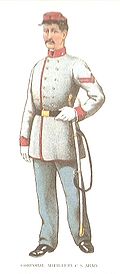 Corporal of the Artillery division of the Confederate Army
 -
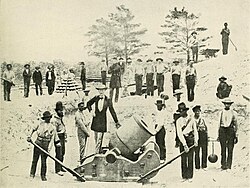 Confederate mortar crew at Warrington, Florida in 1861, across from Fort Pickens
 -
 Confederate artillery at Charleston Harbor, 1863
 -
 Lt Col. E. V. Nash, 4th Georgia Infantry Doles-Cook Brigade, who was killed in 1864


.jpg)
Ranks and insignia
[edit]| Officer rank structure of the Confederate Army | ||||||||||
|---|---|---|---|---|---|---|---|---|---|---|
| General | Colonel | Lieutenant colonel | Major | Captain | First lieutenant | Second lieutenant | ||||

|

|

|

|

|

|

| ||||
-
 General (CSA)
 -
 Colonel (Infantry shown)
 -
 Lieutenant-colonel (Headquarters shown)
 -
 Major (Medical Corps shown)
 -
 Captain (Marine Corps shown)
 -
 1st Lieutenant (Artillery shown)
 -
 2nd Lieutenant (Cavalry shown)


There were four grades of general officer (general, lieutenant general, major general, and brigadier general), but all wore the same insignia regardless of grade. This was a decision made early in the conflict. The Confederate Congress initially made the rank of brigadier general the highest rank. As the war progressed, the other general-officer ranks were quickly added, but no insignia for them was created. (Robert E. Lee was a notable exception to this. He chose to wear the rank insignia of a colonel.) Only seven men achieved the rank of (full) general;[78] the highest-ranking (earliest date of rank) was Samuel Cooper, Adjutant General and Inspector General of the Confederate States Army.
Officers' uniforms bore a braided design on the sleeves and kepi, the number of adjacent strips (and therefore the width of the lines of the design) denoting rank. The color of the piping and kepi denoted the military branch. The braid was sometimes left off by officers since it made them conspicuous targets. The kepi was rarely used, the common slouch hat being preferred for its practicality in the Southern climate.
| Enlisted rank structure | ||||||||||
|---|---|---|---|---|---|---|---|---|---|---|
| Sergeant Major | Quartermaster Sergeant | Ordnance Sergeant | First Sergeant | |||||||

|

|

|

| |||||||
| Sergeant | Corporal | Musician | Private | |||||||

|

|
no insignia | no insignia | |||||||
Branch colors were used for the color of chevrons—blue for infantry, yellow for cavalry, and red for artillery. This could differ with some units, however, depending on available resources or the unit commander's desire. Cavalry regiments from Texas, for example, often used red insignia and at least one Texas infantry regiment used black.
The CSA differed from many contemporaneous armies in that all officers under the rank of brigadier general were elected by the soldiers under their command. The Confederate Congress authorized the awarding of medals for courage and good conduct on October 13, 1862, but wartime difficulties prevented the procurement of the needed medals. To avoid postponing recognition for their valor, those nominated for the awards had their names placed on a Roll of Honor, which would be read at the first dress parade after its receipt and be published in at least one newspaper in each state.
Armies and prominent leaders
[edit]The C.S. Army was composed of independent armies and military departments that were constituted, renamed, and disbanded as needs arose, particularly in reaction to offensives launched by the United States. These major units were generally named after states or geographic regions (in comparison to the U.S. Army's custom of naming armies after rivers). Armies were usually commanded by full generals (there were seven in the C.S. Army) or lieutenant generals. Some of the more important armies and their commanders were:

- Army of Central Kentucky – Simon B. Buckner, Albert Sidney Johnston
- Army of East Tennessee – Edmund Kirby Smith (later renamed Army of Kentucky)
- Army of Eastern Kentucky – Humphrey Marshall
- Army of the Kanawha – Henry A. Wise, John B. Floyd, Robert E. Lee
- Army of Kentucky – Edmund Kirby Smith (eventually commander of all forces West of the Mississippi)
- Army of Louisiana – Braxton Bragg. Paul O. Hébert
- Army of Mississippi
- March 1862 – November 1862: P. G. T. Beauregard, Albert Sidney Johnston, Braxton Bragg, William J. Hardee, Leonidas Polk, (also known as the Army of the Mississippi; redesignated Army of Tennessee on November 20, 1862)
- December 1862 – July 1863: John C. Pemberton, Earl Van Dorn, (1863) William W. Loring (also known as Army of Vicksburg)
- July 1863 – June 1864: William J. Hardee, Leonidas Polk, William W. Loring (also known as the Army of the Mississippi; redesignated III Corps, Army of Tennessee in May 1864, but continued to use its old name)
- Army of Middle Tennessee – John C. Breckinridge
- Army of Missouri – Sterling Price
- Army of Mobile – Jones M. Withers, Braxton Bragg, John B. Villepigue, Samuel Jones, William L. Powell, John H. Forney
- Army of New Mexico – Henry H. Sibley
- Army of Northern Virginia – Joseph E. Johnston, Gustavus W. Smith, Robert E. Lee
- Army of the New River – Henry Heth
- Army of the Northwest – Robert S. Garnett, Henry R. Jackson, William W. Loring, Edward Johnson
- Army of the Peninsula – John B. Magruder, Daniel H. Hill
- Army of Pensacola – Adley H. Gladden, Braxton Bragg, Samuel Jones
- Army of the Potomac – P. G. T. Beauregard, Joseph E. Johnston
- Army of the Shenandoah – Joseph E. Johnston
- Army of Tennessee – Braxton Bragg, Samuel Gibbs French, William J. Hardee, Daniel H. Hill, John Bell Hood, Joseph E. Johnston, Richard Taylor
- Army of the Trans-Mississippi – Thomas C. Hindman, Theophilus Holmes, Edmund Kirby Smith (also known as the Army of the Southwest)
- Army of the Valley (also known as Second Corps, Army of Northern Virginia) – Jubal Early
- Army of the West – Earl van Dorn, John P. McCown, Dabney H. Maury, Sterling Price
- Army of West Tennessee – Earl Van Dorn
- Army of Western Louisiana – Richard Taylor, John G. Walker
Some other prominent Confederate generals who led significant units operating sometimes independently in the CSA included Thomas J. "Stonewall" Jackson, James Longstreet, J. E. B. Stuart, Gideon Pillow, A. P. Hill, John B. Gordon.
Military departments
[edit]In addition to the Confederate field armies, the Confederate States itself was divided into several military territorial organizations, known as departments. These departments were mainly administrative in nature, organizing recruiting, supply distribution, and coordinating with the field armies in the event of Union invasions. The military departments were also the ultimate authority for all Confederate forts within their region, as well as commanding all garrison forces and units of the Confederate Home Guard[79]
Unlike the Union, which had fairly stable military departments through most of the Civil War, Confederate departments were constantly being formed, reformed, and renamed as the war progressed. The original two departments, formed at the beginning of the Civil War, were "Department No 1" (later incorporated into the Department of Louisiana) and "Department No 2" (later becoming the Western Department).
In Virginia, where hostilities broke out almost immediately after the start of the war, the "Alexandria line" was established as the first Confederate administrative body in this area. This was later expanded to formal military departments in the following order:
- Department of Alexandria
- Department of the Potomac
- Department of Northern Virginia
Virginia also maintained the following smaller departments which fluctuated as the war progressed:
- Department of Norfolk
- Department of Fredericksburg
- Department of Richmond (operated in tandem with the Department of Henrico)
- Department of Southwestern Virginia
- Department of the Peninsula
In the Shenandoah Valley, the first Confederate administrative command was set up at Harper's Ferry, later becoming the Valley District, directly subordinate to the Army of the Shenandoah. The Shenandoah Valley was without a department for most of the war, militarily controlled by Army of the Northwest and the Army of the Valley, before finally being declared the Trans-Allegheny Department. Elsewhere in the Confederacy, the following major departments were formed which operated throughout most of the war:[80]
- Department of Louisiana
- Department of Tennessee
- Department of North Carolina
- Department of South Carolina
- Department of Georgia
The Union attack on Vicksburg, Mississippi also brought about a succession of departments known as:
- Department of Mississippi and East Louisiana
- Department of Alabama and East Mississippi
- Department of Alabama, Mississippi, and Eastern Louisiana
The entire Mississippi region was eventually merged into the Trans-Mississippi Department, one of the largest departments of the war. At the same time, departments were being formed further west as the:
- Western Department
- Department of Texas
- Department of the Indian Territory
Battles in Tennessee, and shifting fronts in that region, also brought about the need for new departments in that region, most of which reported directly to the Army of Tennessee under John Bell Hood. Hood would directly command the following three departments at the same time as his service as an Army commander:[81]
- Department of East Tennessee
- Department of East Tennessee and West Virginia
- Department of Tennessee and Georgia
In 1864, Robert E. Lee held the idea for "super theaters" encompassing vast areas of the south, as follows:
- Department of North Carolina and Southern Virginia (expansion of the Department of Southern Virginia)
- Department of South Carolina, Georgia, and East Florida
- Department of South Carolina and Georgia (later expanded to the Department of South Carolina, Georgia, and Florida
Lesser departments, without much combat activity, were:
- Department of West Florida
- Department of Alabama and West Florida (expansion of the District of Alabama)
- Department of Middle and Eastern Florida
- Department of Western Kentucky
Supply and logistics
[edit]
The supply situation for most Confederate armies was dismal, even when they were victorious on the battlefield. The central Confederate government was short of money so each state government had to supply its regiments. The lack of central authority and the ineffective railroads, combined with the frequent unwillingness or inability of Southern state governments to provide adequate funding, were key factors in the Confederate army's demise. The Confederacy early on lost control of most of its major river and ocean ports to capture or blockade. The road system was poor, and it relied more and more on a heavily overburdened railroad system. U.S. forces destroyed track, engines, cars, bridges and telegraph lines as often as possible, knowing that new equipment was unavailable to the Confederacy.[83] Occasional raids into the North were designed to bring back money and supplies. In 1864, the Confederates burned down Chambersburg, a Pennsylvania city they had raided twice in the years before, due to its failure to pay an extortion demand.[84]
As a result of severe supply problems, as well as the lack of textile factories in the Confederacy and the successful U.S. naval blockade of Southern ports, the typical Confederate soldier was rarely able to wear the standard regulation uniform, particularly as the war progressed. While on the march or in parade formation, Confederate armies often displayed a wide array of dress, ranging from faded, patched-together regulation uniforms; rough, homespun uniforms colored with homemade dyes such as butternut (a yellow-brown color), and even soldiers in a hodgepodge of civilian clothing. After a successful battle, it was not unusual for victorious Confederate troops to procure U.S. Army uniform parts from captured supplies and dead U.S. soldiers; this would occasionally cause confusion in later battles and skirmishes.[85]
Individual states were expected to supply their soldiers, which led to a lack of uniformity. Some states (such as North Carolina) were able to better supply their soldiers, while other states (such as Texas) were unable for various reasons to adequately supply their troops as the war continued.
Furthermore, each state often had its uniform regulations and insignia, which meant that the "standard" Confederate uniform often featured a variety of differences based on the state the soldier came from. For example, uniforms for North Carolina regiments often featured a colored strip of cloth on their shoulders to designate what part of the service the soldier was in. Confederate soldiers also frequently suffered from inadequate supplies of shoes, tents, and other gear, and would be forced to innovate and make do with whatever they could scrounge from the local countryside. While Confederate officers were generally better-supplied and were normally able to wear a regulation officer's uniform, they often chose to share other hardships – such as the lack of adequate food – with their troops.

Confederate soldiers were also faced with inadequate food rations, especially as the war progressed. There was plenty of meat in the Confederacy. The unsolvable problem was shipping it to the armies, especially when Lee's army in Virginia was at the end of a long, tenuous supply line. The United States victory at Vicksburg in 1863 shut off supplies from Texas and the west.[86]
By 1863, Confederate generals such as Robert E. Lee often spent as much time and effort searching for food for their men, as they did in planning strategy and tactics. Individual commanders often had to "beg, borrow or steal" food and ammunition from whatever sources were available, including captured U.S. depots and encampments, and private citizens regardless of their loyalties. Lee's campaign against Gettysburg and southern Pennsylvania (a rich agricultural region) was driven in part by his desperate need of supplies, especially food.[87]
General Sherman's total warfare reduced the ability of the South to produce food and ship it to the armies or its cities. Coupled with the U.S. blockade of all ports the devastation of plantations, farms and railroads meant the Confederacy increasingly lost the capacity to feed its soldiers and civilians.
Arms importation
[edit]The Confederate government had some success in importing weapons from Britain. When the War began, the Confederacy lacked the financial and manufacturing capacity to wage war against the industrialized North. To increase its arsenal, the Confederacy looked to Britain as a major source of arms. British merchants and bankers funded the purchase of arms and construction of ships being outfitted as blockade runners which later carried war supplies bound for Southern ports. A British publication in 1862 summed up the country's involvement in blockade running:
Score after score of the finest, swiftest British steamers and ships, loaded with British material of war of every description, cannon, rifles by the hundreds of thousand, powder by the thousand of tons, shot, shell, cartridges, swords, etc, with cargo after cargo of clothes, boots, shoes, blankets, medicines and supplies of every kind, all paid for by British money, at the sole risk of British adventurers, well insured by Lloyds and under the protection of the British flag, have been sent across the ocean to the insurgents by British agency.[88]
It was estimated the Confederate Army received thousands of tons of gunpowder, half a million rifles, and several hundred cannons from British blockade runners.[89]
Ulysses S. Grant III, President of the American Civil War Centennial in 1961, remarked for example:
[B]etween October 26, 1864 and January 1865, it was still possible for 8,632,000 lbs of meat, 1,507,000 lbs of lead, 1,933,000 lbs of saltpeter, 546,000 pairs of shoes, 316,000 blankets, half a million pounds of coffee, 69,000 rifles, and 43 cannon to run the blockade into the port of Wilmington alone, while cotton sufficient to pay for these purchases was exported[. I]t is evident that the blockade runners made an important contribution to the Confederate effort to carry on.[90]
Italian Americans and the Confederate Army
[edit]
Many Italian American soldiers of the Confederate States Army were veterans from the Army of the Two Sicilies who had fought against Giuseppe Garibaldi in, and were captured during, the Expedition of the Thousand as part of the unification of Italy. They were released after a treaty between Garibaldi and Chatham Roberdeau Wheat. In December 1860 and few months of 1861, these volunteers were transported to New Orleans with the ships Elisabetta, Olyphant, Utile, Charles & Jane, Washington and Franklin.[91] Most Confederate Italian Americans had settled in Louisiana. The militia of Louisiana had an Italian Guards Battalion that became part of its 6th Regiment.[92]
Native Americans and the Confederate Army
[edit]Native Americans served in both the United States and Confederate military during the American Civil War.[93][94] They fought knowing they might jeopardize their freedom, unique cultures, and ancestral lands if they ended up on the losing side of the Civil War.[93][95] During the Civil War, 28,693 Native Americans served in the U.S. and Confederate armies, participating in battles such as Pea Ridge, Second Manassas, Antietam, Spotsylvania, Cold Harbor, and in Federal assaults on Petersburg.[93][94] Many Native American tribes, such as the Creek, the Cherokee, and the Choctaw, were slaveholders themselves, and thus, found a political and economic commonality with the Confederacy.[96]
At the beginning of the war, Albert Pike was appointed as Confederate envoy to Native Americans. In this capacity he negotiated several treaties, one such treaty was the Treaty with Choctaws and Chickasaws conducted in July 1861. The treaty covered sixty-four terms covering many subjects like Choctaw and Chickasaw nation sovereignty, Confederate States of America citizenship possibilities, and an entitled delegate in the House of Representatives of the Confederate States of America. The Cherokee, Choctaw, Seminole, Catawba, and Creek tribes were the only tribes to fight on the Confederate side. The Confederacy wanted to recruit Indians east of the Mississippi River in 1862, so they opened up a recruiting camp in Mobile, Alabama "at the foot of Stone Street".[97] The Mobile Advertiser and Register would advertise for a chance at military service.
A Chance for Active Service. The Secretary of War has authorized me to enlist all the Indians east of the Mississippi River into the service of the Confederate States, as Scouts. In addition to the Indians, I will receive all white male citizens, who are good marksmen. To each member, Fifty Dollars Bounty, clothes, arms, camp equipage &c: furnished. The weapons shall be Enfield Rifles. For further information address me at Mobile, Ala. (Signed) S. G. Spann, Comm'ing Choctaw Forces.
— Jacqueline Anderson Matte, They Say the Wind Is Red[97]
Cherokee
[edit]
Stand Watie, along with a few Cherokee, sided with the Confederate army, in which he was made colonel and commanded a battalion of Cherokee.[93] Reluctantly, on October 7, 1861, Chief Ross signed a treaty transferring all obligations due to the Cherokee from the United States to the Confederate States.[93] The Cherokee were guaranteed protection, rations of food, livestock, tools, and other goods, as well as a delegate to the Confederate Congress at Richmond.[93]
In exchange, the Cherokee would furnish ten companies of mounted men, and allow the construction of military posts and roads within the Cherokee Nation. However, no Indian regiment was to be called on to fight outside Indian Territory.[93] As a result of the Treaty, the 2nd Cherokee Mounted Rifles, led by Col. John Drew, was formed. Following the Battle of Pea Ridge, Arkansas, March 7–8, 1862, Drew's Mounted Rifles defected to the United States forces in Kansas, where they joined the Indian Home Guard. In the summer of 1862, U.S. troops captured Chief Ross, who was paroled and spent the remainder of the war in Washington and Philadelphia proclaiming Cherokee loyalty to the United States Army.[93]
William Holland Thomas, the adopted white son of the chief of the Eastern Band of Cherokee Indians, recruited hundreds of Cherokees for the Confederate army, particularly for Thomas' Legion. The Legion, raised in September 1862, fought until the end of the War.
Choctaw
[edit]
Choctaw Confederate battalions were formed in Indian Territory and later in Mississippi in support of the southern cause. The Choctaws, who were expecting support from the Confederates, got little. Webb Garrison, a Civil War historian, describes their response: when Confederate Brigadier General Albert Pike authorized the raising of regiments during the fall of 1860, Seminoles, Creeks, Chickasaws, Choctaws, and Cherokees responded with considerable enthusiasm. Their zeal for the Confederate cause, however, began to evaporate when they found that neither arms nor pay had been arranged for them. A disgusted officer later acknowledged that "with the exception of a partial supply for the Choctaw regiment, no tents, clothing, or camp, and garrison equipage was furnished to any of them."[98]
African Americans and the Confederate Army
[edit],_by_Harper%27s_Weekly.jpg)
,_by_Harper%27s_Weekly.png)
,_by_Frank_Bellew.jpg)

With so many white males conscripted into the army and roughly 40% of its population unfree, the work required to maintain a functioning society in the Confederacy ended up largely on the backs of slaves.[105] Even Georgian governor Joseph E. Brown noted that "the country and the army are mainly dependent upon slave labor for support."[106] African American slave labor was used in a wide variety of logistical support roles for the Confederacy, from infrastructure and mining, to teamster and medical roles such as hospital attendants and nurses.[107][108]
Using enslaved soldiers
[edit]The Confederacy did not allow African Americans to join the army, neither free people nor slaves. The idea of arming the Confederacy's slaves for use as soldiers was speculated on from the onset of the war, but such proposals were not seriously considered by Jefferson Davis or others in the Confederate administration until late in the war when severe manpower shortages were faced.[109] Gary Gallagher says, "When Lee publicly advocated arming slaves in early 1865, he did so as a desperate expedient that might prolong Southern military resistance."[110] After acrimonious debate the Confederate Congress agreed in March 1865. The war was nearly over by then, and only about two hundred enslaved soldiers ended up being enlisted before the Confederate armies all surrendered.[22]
Opposition from Confederates
[edit]As early as November 1864, some Confederates knew that the chance of securing victory against the U.S. was slim.[111] Despite lacking foreign assistance and recognition and facing slim chances of victory against superior U.S. assets, Confederate newspapers such as the Georgian Atlanta Southern Confederacy continued to maintain their position and oppose the idea of armed black men in the Confederate Army, even as late in the war as January 1865.[112] They stated that it was incongruous with the Confederacy's goals and views regarding African Americans and slavery. The Georgian newspaper opined that using black men as soldiers would be an embarrassment to Confederates and their children, saying that although African Americans should be used for slave labor, they should not be used as armed soldiers, opining that:
Such an act on our part would be a stigma on the imperishable pages of history, of which all future generations of Southrons would be ashamed. These are some of the additional considerations which have suggested themselves to us. Let us put the negro to work, but not to fight.
— Atlanta Southern Confederacy (January 20, 1865), Macon, Georgia.[112]
Prominent Confederates such as R. M. T. Hunter and Georgian Democrat Howell Cobb opposed arming slaves, saying that it was "suicidal" and would run contrary to the Confederacy's ideology. Opposing such a move, Cobb stated that African Americans were untrustworthy and innately lacked the qualities to make good soldiers, and that using them would cause many Confederates to quit the army. Cobb said using blacks as soldiers would be the end of the revolution, because "if slaves make good soldiers, our whole theory of slavery is wrong."[113][114][115]
The overwhelming support most Confederates had for maintaining black slavery was the primary cause of their strong opposition to using African Americans as armed soldiers. Former Confederate secretary of state Robert Toombs said "In my opinion, the worst calamity that could befall us would be to gain our independence by the valor of our slaves... instead of our own... " and complained using black troops would be "a surrender of the entire slavery question."[116] Maintaining the institution of slavery was the primary goal of the Confederacy's existence, and thus, using their slaves as soldiers was incongruous with that goal. According to historian Paul D. Escott:
[F]or a great many of the most powerful southerners the idea of arming and freeing the slaves was repugnant because the protection of slavery had been and still remained the central core of Confederate purpose ... Slavery was the basis of the planter class's wealth, power, and position in society. The South's leading men of the planter class, had built their world upon slavery and the idea of voluntarily destroying that world, even in the ultimate crisis, was almost unthinkable to them. Such feelings moved Senator R. M. T. Hunter to deliver a long speech against the bill to arm the slaves.[117]
Though most Confederates were opposed to the idea of using black soldiers, a small number suggested the idea. An acrimonious and controversial debate was raised by a letter from Patrick Cleburne[118] urging the Confederacy to raise black soldiers by offering emancipation; Jefferson Davis refused to consider the proposal and issued instructions forbidding the matter from being discussed.[119] It would not be until Robert E. Lee wrote the Confederate Congress urging them that the idea would take serious traction.[120]
On March 13, 1865,[22] the Confederate Congress passed General Order 14[121][122] by a single vote in the Confederate senate,[22][123] and Jefferson Davis signed the order into law. The order was issued March 23, but as it was late in the war, only a few African American companies were raised in the Richmond area before the town was captured by the U.S. Army and placed back under U.S. control.[124] According to historian James M. McPherson in 1994, "no black soldiers fought in the Confederate army, unless they were passing as white.[125] He noted that some Confederates brought along "their body servants, who in many cases had grown up with them" and that "on occasion some of those body servants were known to have picked up a rifle and fought. But there was no official recruitment of black soldiers in the Confederate army until the very end of the war..." He continued, "But Appomattox came only a few weeks later, and none of these men were ever put in uniform to fight."[22]
Treatment of black civilians
[edit]In some cases, the Confederates forced their African American slaves to fire upon U.S. soldiers at gunpoint,[103][104] such as at the First Battle of Bull Run. According to John Parker, a slave who was forced by the Confederates to fight Union soldiers, "Our masters tried all they could to make us fight ... They promised to give us our freedom and money besides, but none of us believed them; we only fought because we had to." Parker stated that had he been given an opportunity, he would have turned against his Confederate captors, and "could do it with pleasure".[103][104] According to abolitionist Henry Highland Garnet in 1862, he had met a slave who "had unwillingly fought on the side of Rebellion", but the slave had since defected to "the side of Union and universal liberty".[104]
During the siege of Yorktown, The United States Army's elite sniper unit, the 1st United States Sharpshooters, was devastatingly effective at shooting Confederate artillerymen defending the city. In response, some Confederate artillery crews started forcing slaves to load the cannons. "They forced their negroes to load their cannon," reported a U.S. officer. "They shot them if they would not load the cannon, and we shot them if they did."[126]
In other cases, under explicit orders from their commanders, Confederate armies would often forcibly kidnap free African American civilians during their incursions into Union territory, sending them south into Confederate territory and thus enslaving them, as was the case with the Army of Northern Virginia when it invaded Pennsylvania in 1863.[127][128]
Treatment of black prisoners of war
[edit]The usage of black men as soldiers by the Union, combined with Abraham Lincoln's issuing of the Emancipation Proclamation, profoundly angered the Confederacy,[129] with the Confederates calling it uncivilized.[130] As a response, in May 1863, the Confederacy passed a law demanding "full and ample retaliation" against the United States, stating that any black person captured in "arms against the Confederate States" or giving aid and comfort to their enemies would be turned over to state authorities, where they could be tried as slave insurrectionists; a capital offense punishable with a sentence of death.[131][132] However, Confederate authorities feared retaliation, and consequently no black prisoner was ever put on trial and executed.[133]
James McPherson states that "Confederate troops sometimes murdered black soldiers and their officers as they tried to surrender. In most cases, though, Confederate officers returned captured black soldiers to slavery or put them to hard labor on southern fortifications."[134][135] African American soldiers who served in the United States Colored Troops were often singled out by the Confederates and suffered extra violence when captured by them.[99] They were often the victims of battlefield massacres and atrocities at the hands of the Confederates,[99] most notably at Fort Pillow in Tennessee and at the Battle of the Crater in Virginia.[136][137]
Prisoner exchanges with the United States
[edit]The Confederate law declaring black U.S. soldiers to be insurrectionist slaves, combined with the Confederacy's discriminatory mistreatment of captured black U.S. soldiers, became a stumbling block for prisoner exchanges between the United States and the Confederacy, as the U.S. government in the Lieber Code officially objected to the Confederacy's discriminatory mistreatment of prisoners of war on basis of color.[138][139] The Republican Party's platform of the 1864 presidential election reflected this view, as it too condemned the Confederacy's discriminatory mistreatment of captured black U.S. soldiers.[140] According to the authors of Liberty, Equality, Power, "Expressing outrage at this treatment, in 1863 the Lincoln administration suspended the exchange of prisoners until the Confederacy agree to treat white and black prisoners alike. The Confederacy refused."[138]
Statistics and size
[edit]
Incomplete and destroyed records make an accurate count of the number of soldiers who served in the Confederate army impossible. Historians provide estimates of the actual number of individual Confederate soldiers between 750,000 and 1,000,000 troops.[141]
The exact number is unknown. Since these figures include estimates of the total number of individual soldiers who served in each army at any time during the war, they do not represent the size of the armies at any given date. Confederate casualty figures are as incomplete and unreliable as the figures on the number of Confederate soldiers. The best estimates of the number of deaths of Confederate soldiers appear to be about 94,000 killed or mortally wounded in battle, 164,000 deaths from disease and between 26,000 and 31,000 deaths in Union prison camps. In contrast, about 25,000 Union soldiers died as a result of accidents, drowning, murder, killed after capture, suicide, execution for various crimes, execution by the Confederates (64), sunstroke, other and not stated. Confederate casualties for all these reasons are unavailable. Since some Confederate soldiers would have died for these reasons, more total deaths and total casualties for the Confederacy must have occurred. One estimate of the Confederate wounded, which is considered incomplete, is 194,026; another is 226,000. At the end of the war 174,223 men of the Confederate forces surrendered to the Union Army.[142][143]
Compared to the Union Army at the time, the Confederate Army was not very ethnically diverse. Ninety-one percent of Confederate soldiers were native-born white men and only nine percent were foreign-born white men, Irishmen being the largest group with others including Germans, French, Mexicans, and British. A small number of Asian men were forcibly inducted into the Confederate Army against their will, when they arrived in Louisiana from overseas.[144]
See also
[edit]
- Confederate States Navy
- Blockade runners of the American Civil War
- General in Chief of the Armies of the Confederate States
- Confederate Government Civil War units
- Confederate States Marine Corps
- Medicine in the American Civil War
- Military of the Confederate States of America
- Social history of soldiers and veterans in the United States
- Uniforms of the Confederate States Armed Forces
- Uniforms of the Confederate military
- Bibliography of the American Civil War
- Postage stamps and postal history of the Confederate States
- Removal of Confederate monuments and memorials
References
[edit]- ^ "Civil War Facts". American Battlefield Trust. August 16, 2011.
- ^ C.S. War Dept., p. 402.
- ^ On February 8, 1861, delegates from the first seven Deep South slave states which had already declared their secession from the Union of the United States of America met at Montgomery, the state capital of Alabama, adopted the Provisional Constitution of the Confederate States.
- ^ Records of the number of individuals who served in the United States Army are more extensive and reliable, but are not entirely accurate. Estimates of the number of individual Union soldiers range between 1,550,000 and 2,400,000, with a number between 2,000,000 and 2,200,000 most likely. Union Army records show slightly more than 2,677,000 enlistments, but this number apparently includes many re-enlistments. These numbers do not include sailors who served in United States Navy or United States Marine Corps. These figures represent the total number of soldiers who served at any time during the war, not the size of the army at any given date.
- ^ Albert Burton Moore, Conscription and Conflict in the Confederacy (1924).
- ^ NPS Staff. "Facts – The Civil War (U.S. National Park Service)". NPS.gov. Archived from the original on December 3, 2024.
- ^ Confederate forces at Mobile, Alabama, and Columbus, Georgia, also had already surrendered on April 14, 1865, and April 16, 1865, respectively. U.S. and Confederate units fought a battle at Columbus, Georgia, before the surrender on April 16, 1865, and a small final battle at Palmito Ranch, Texas, on May 12, 1865. In areas more distant from the main theaters of operations, Confederate forces in Alabama and Mississippi under Lieutenant General Richard Taylor, in Arkansas under Brigadier General M. Jeff Thompson, in Louisiana and Texas under General E. Kirby Smith and in Indian Territory under Brigadier General Stand Watie surrendered on May 4, 1865, May 12, 1865, May 26, 1865 (officially June 2, 1865), and June 28, 1865, respectively.
- ^ Eric Foner (1988). Reconstruction: America's Unfinished Revolution, 1863–1877. Harper Collins. p. 15. ISBN 9780062035868.
- ^ Hamner, Christopher. "Deserters in the Civil War | Teachinghistory.org". teachinghistory.org. Retrieved August 3, 2018.
- ^ James M. McPherson (June 2004). The Most Fearful Ordeal: Original Coverage of the Civil War by Writers and Reporters of The New York Times. St. Martin's Press. p. 55. ISBN 978-0-312-33123-8.
- ^ Spencer C. Tucker (September 30, 2013). American Civil War: The Definitive Encyclopedia and Document Collection [6 volumes]: The Definitive Encyclopedia and Document Collection. ABC-CLIO. p. 74. ISBN 978-1-85109-682-4.
- ^ Russell Frank Weigley (2000). A Great Civil War: A Military and Political History, 1861–1865. Indiana University Press. pp. 21–23. ISBN 0-253-33738-0.
- ^ T. Harry Williams (November 6, 2015). P. G. T. Beauregard: Napoleon In Gray. Golden Springs Publishing. pp. 62–64. ISBN 978-1-78289-373-8.
- ^ Weigley 2000, p. 24
- ^ Peter Karsten (2006). Encyclopedia of War and American Society. SAGE. p. 187. ISBN 978-0-7619-3097-6.
- ^ Mark Grimsley; Steven E. Woodworth (2006). Shiloh: A Battlefield Guide. U of Nebraska Press. pp. 3–. ISBN 0-8032-7100-X.
- ^ McPherson 1997, pp. 104–105.
- ^ Bruce S. Allardice (2008). Confederate Colonels: A Biographical Register. University of Missouri Press. pp. 8–9. ISBN 978-0-8262-6648-4.
- ^ a b Eicher, pp. 70, 66.
- ^ United States. War Dept (1900). Official Records of the Union and Confederate Armies. p. 134.
- ^ John George Nicolay; John Hay (1890). Abraham Lincoln: A History. The Century Co. p. 264.
- ^ a b c d e McPherson, James M.; Lamb, Brian (May 22, 1994). "James McPherson: What They Fought For, 1861–1865". Booknotes. National Cable Satellite Corporation. Archived from the original on March 9, 2016. Retrieved March 9, 2016.
- ^ Foner, Eric (1988). Reconstruction: America's Unfinished Revolution, 1863–1877. United States of America: Harper & Row. p. 15. ISBN 0-06-093716-5. Retrieved March 2, 2016.
[T]he Confederacy enacted the first conscription laws in American history ...
- ^ Civil War Conscription Laws: November 15, 2012 by Margaret Wood.
- ^ Faust, Patricia L. ed Historical Times Encyclopedia of the Civil War: New York, 1986
- ^ Loewen, James W. (2007). Lies My Teacher Told Me: Everything Your American History Textbook Got Wrong. New York: The New Press. pp. 224–226. ISBN 978-1-56584-100-0. OCLC 29877812. Retrieved January 19, 2016.
- ^ Bell Irvin Wiley (January 1, 2008). The Life of Johnny Reb: The Common Soldier of the Confederacy. LSU Press. p. 505. ISBN 978-0-8071-5604-9.
- ^ "War Conscription Laws": November 15, 2012 by Margaret Wood."".[permanent dead link]
- ^ Mississippi Law Journal (2000). "'Necessity Knows No Law': Vested Rights and Styles of Reasoning in the Confederate Conscription Cases" (PDF). Mississippi Law Journal. Mississippi: University of Mississippi School of Law..
- ^ Perman, Michael; Taylor, Amy Murrell (2010). Major Problems in the Civil War and Reconstruction. Cengage. p. 178. ISBN 978-0618875207. Retrieved March 9, 2016.
- ^ James McPherson, For Cause and Comrades: Why Men Fought in the Civil War (1998) pp 104–5.
- ^ Edward L. Ayers; Gary W. Gallagher; Andrew J. Torget (2006). Edward L. Ayers (ed.). Crucible of the Civil War: Virginia from Secession to Commemoration. University of Virginia Press. pp. 80–81. ISBN 978-0-8139-2552-3.
- ^ W. Harrison Daniel, "Southern Protestantism and Army Missions in the Confederacy." Mississippi Quarterly 17.4 (1964): 179+.
- ^ Dollar, Kent T. (2005). Soldiers of the Cross: Soldier-Christians and the Impact of the War on their Faith. Mercer University Press.
- ^ Woodworth, Steven E. (2001). While God is Marching On.
- ^ Wilson, Charles Reagan (1980). Baptized in Blood.
- ^ Kurt O. Berends (November 5, 1998). ""Wholesome Reading Purifies and Elevates the Man": The Religious Military Press in the Confederacy". In Randall M. Miller; Harry S. Stout; Charles Reagan Wilson (eds.). Religion and the American Civil War. Oxford University Press. pp. 141–142. ISBN 978-0-19-802834-5.
- ^ Samuel J. Watson, "Religion and combat motivation in the Confederate armies." Journal of Military History 58#1 (1994): 29+.
- ^ Sheehan-Dean, Aaron (2009). Why Confederates Fought: Family and Nation in Civil War Virginia.
- ^ a b McPherson, James M. (1997). For Cause and Comrades: Why Men Fought in the Civil War. New York: Oxford University Press. p. 106. ISBN 0-19-509-023-3. OCLC 34912692.
Confederate soldiers from slaveholding families expressed no feelings of embarrassment or inconsistency in fighting for their liberty while holding other people in slavery. Indeed, white supremacy and the right of property in slaves were at the core of the ideology for which Confederate soldiers fought.
- ^ a b McPherson, James M. (1997). For Cause and Comrades: Why Men Fought in the Civil War. New York City: Oxford University Press, Inc. pp. 109–110. ISBN 0-19-509-023-3. Retrieved April 1, 2016.
It would be wrong, however, to assume that Confederate soldiers were constantly preoccupied with this matter. Only 20 percent of the sample of 429 Southern soldiers explicitly voiced proslavery convictions in their letters or diaries. As one might expect, a much higher percentage of soldiers from slaveholding families than from non-slaveholding families expressed such a purpose: 33 percent, compared with 12 percent. Ironically, the proportion of Union soldiers who wrote about the slavery question was greater, as the next chapter will show. There is a ready explanation for this apparent paradox. Emancipation was a salient issue for Union soldiers because it was controversial. Slavery was less salient for most Confederate soldiers because it was not controversial. They took slavery for granted as one of the Southern 'rights' and institutions for which they fought, and did not feel compelled to discuss it. Although only 20 percent of the soldiers avowed explicit proslavery purposes in their letters and diaries, none at all dissented from that view.
- ^ James M. McPherson, For Cause and Comrades: Why Men Fought in the Civil War (1997), p. ix. "In both the Union and Confederate samples, foreign-born soldiers are substantially underrepresented. In the Union sample, only 9 percent of soldiers were born abroad in the Confederate Army, compared with 24 percent of all Union Army soldiers. Unskilled and even skilled laborers are underrepresented in both samples. Nonslaveholding farmers are underrepresented in the Confederate sample. Indeed, while about one-third of all Confederate soldiers belonged to slaveholding families, slightly more than two-thirds of the sample whose slaveholding status is known did so ... Officers are overrepresented in both samples. While some 10 percent of Civil War soldiers served as officers for at least half of their time in the army, 47 percent of the Confederate sample and 35 percent of the Union sample did so. Both samples are also skewed toward those who volunteered in 1861–62 and therefore contain disproportionately few draftees ..."
- ^ a b McPherson, James M. (1997). For Cause and Comrades: Why Men Fought in the Civil War. New York City: Oxford University Press. p. 107. ISBN 0-19-509-023-3. OCLC 34912692. Retrieved April 1, 2016.
The Proclamation is worth three hundred thousand soldiers to our Government at least ... It shows exactly what this war was brought about for and the intention of its damnable authors.
- ^ a b McPherson, James M. (1997). For Cause and Comrades: Why Men Fought in the Civil War. New York City: Oxford University Press, Inc. p. 117. ISBN 0-19-509-023-3. OCLC 34912692. Retrieved April 1, 2016.
- ^ a b McPherson, James M. (1997). For Cause and Comrades: Why Men Fought in the Civil War. New York City: Oxford University Press, Inc. p. 109. ISBN 0-19-509-023-3. Retrieved April 1, 2016.
- ^ Coski, John M. (2005). The Confederate Battle Flag: America's Most Embattled Emblem. United States of America: First Harvard University Press. p. 26. ISBN 0-674-01722-6. Retrieved July 1, 2015.
- ^ Lozada, Carlos (June 19, 2015). "How people convince themselves that the Confederate flag represents freedom, not slavery: Historian John M. Coski examines the fights over the symbol's meaning in 'The Confederate Battle Flag: America's Most Embattled Emblem.'". The Washington Post. Washington, D.C.: Graham Holdings Company. Retrieved July 1, 2015.
- ^ Hall, Andrew; Huff, Connor; Kuriwaki, Shiro (August 2019). "Wealth, Slaveownership, and Fighting for the Confederacy: An Empirical Study of the American Civil War". American Political Science Review. 113 (3): 658–673. doi:10.1017/S0003055419000170. S2CID 21749302.
- ^ David Williams (2011). Rich Man's War: Class, Caste, and Confederate Defeat in the Lower Chattahoochee Valley. University of Georgia Press. p. 4. ISBN 9780820340791.
- ^ Mark A. Weitz, A higher duty: desertion among Georgia troops during the Civil War (U of Nebraska Press, 2005).
- ^ K. M. L. "Stonewall's Rush to Judgment", Civil War Times (2010) 49#2 pp 51+.
- ^ Ella Lonn, Desertion during the Civil War (1928).
- ^ Weitz, Mark. "Desertion, Cowardice and Punishment". Essential Civil War Curriculum. Retrieved August 23, 2025.
- ^ Cutrer, Thomas. "Military Executions during the Civil War". Encyclopedia Virginia. Retrieved August 23, 2025.
- ^ Severance, Ben (Spring–Summer 2006). "More Damning Than Slaughter: Desertion in the Confederate Army". Civil War Book Review. Retrieved August 25, 2025.
- ^ Bearman, Peter S. (1991). "Desertion as Localism: Army Unit Solidarity and Group Norms in the U.S. Civil War". Social Forces. 70 (2): 321–342. doi:10.2307/2580242. JSTOR 2580242.
- ^ Foner, Eric (March 1989). "The South's Inner Civil War: The more fiercely the Confederacy fought for its independence, the more bitterly divided it became. To fully understand the vast changes the war unleashed on the country, you must first understand the plight of the Southerners who didn't want secession". American Heritage. Vol. 40, no. 2. p. 3. Archived from the original on December 18, 2013.
- ^ Doyle, Patrick J. (2013). "Understanding the Desertion of South Carolinian Soldiers during the Final Years of the Confederacy". Historical Journal. 56 (3): 657–679. doi:10.1017/s0018246x13000046. S2CID 159773914.
- ^ Dotson, Rand (2000). ""The Grave and Scandalous Evil Infected to Your People": The Erosion of Confederate Loyalty in Floyd County, Virginia". The Virginia Magazine of History and Biography. 108 (4): 393–434. JSTOR 4249872.
- ^ Otten, James T. (1974). "Disloyalty in the Upper Districts of South Carolina During the Civil War". South Carolina Historical Magazine. 75 (2): 95–110. JSTOR 27567243.
- ^ Scott King-Owen, "Conditional Confederates: Absenteeism among Western North Carolina Soldiers, 1861–1865." Civil War History 2011; 57(4): 349–379. online
- ^ Giuffre, Katherine A. (1997). "First in Flight: Desertion as Politics in the North Carolina Confederate Army". Social Science History. 21 (2): 245–263. doi:10.2307/1171275. JSTOR 1171275.
- ^ Schmitz, Neil (2007). "Mark Twain, Traitor". Arizona Quarterly. 63 (4): 25–37. doi:10.1353/arq.2007.0025. S2CID 161125965.
- ^ Eicher, p. 71.
- ^ Eicher, p. 25.
- ^ Eicher, p. 26.
- ^ Eicher, p. 29.
- ^ Official Records, Series IV, Vol. III, pp. 1161–62.
- ^ Lynda Lasswell Crist (May 25, 2017). Ted Ownby; Charles Reagan Wilson; Ann J. Abadie; Odie Lindsey; James G. Thomas, Jr. (eds.). The Mississippi Encyclopedia. University Press of Mississippi. p. 317. ISBN 978-1-4968-1159-2.
- ^ James D. McCabe (1870). Life and Campaigns of General Robert E. Lee. p. 49.
- ^ Samuel J. Martin (January 10, 2014). General Braxton Bragg, C.S.A. McFarland. p. 382. ISBN 978-0-7864-6194-3.
- ^ Emory M. Thomas (June 17, 1997). Robert E. Lee: A Biography. W. W. Norton. p. 347. ISBN 978-0-393-31631-5.
- ^ James M. McPherson (December 11, 2003). The Illustrated Battle Cry of Freedom: The Civil War Era. Oxford University Press. p. 433. ISBN 978-0-19-974390-2.
- ^ Jim Jordan (2018). The Slave-trader's Letter-book: Charles Lamar, the Wanderer, and Other Tales of the African Slave Trade. University of Georgia Press. p. 242. ISBN 978-0-8203-5196-4.
- ^ Faust, Patricia L.; Delaney, Norman C., eds. (1986). Historical times illustrated encyclopedia of the Civil War (1st ed.). New York: Harper & Row. ISBN 0061812617. OCLC 13796662.
- ^ The Civil War Book of Lists, p. 56
- ^ Boatner, Mark Mayo; Northrop, Allen C.; Miller, Lowell I. (1980) [1959]. The Civil War dictionary. New York: D. McKay Co. ISBN 0679500138. OCLC 445154.
- ^ Eicher, p. 807. There were seven full generals in the CSA; John Bell Hood held "temporary full general" rank, which was withdrawn by the Confederate Congress.
- ^ Fullerton, D. (2017). "Armies in Gray: The Organizational History of the Confederate States Army in the Civil War", LSU Press.
- ^ Vandiver, F. (1977) "Rebel Brass: The Confederate Command System", Greenwood Publishing.
- ^ Woods, M. (2019). "Tennessee In The War, 1861–1865: Lists Of Military Organizations And Officers From Tennessee In Both The Confederate And Union Armies", Wentworth Press.
- ^ "The Civil War News & Views Open Discussion Forum". Archived from the original on January 13, 2009.
- ^ George Edgar Turner, Victory rode the rails: the strategic place of the railroads in the Civil War (1972)
- ^ Smith, Everard H. (1991). "Chambersburg: Anatomy of a Confederate Reprisal". The American Historical Review. 96 (2): 432–455. doi:10.2307/2163218. JSTOR 2163218.
- ^ Steven G. Collins, "System in the South: John W. Mallet, Josiah Gorgas, and uniform production at the confederate ordnance department." Technology and culture (1999) 40#3 pp: 517–544 in Project MUSE.
- ^ Vandiver, Frank E. (1944). "Texas and the Confederate Army's Meat Problem". Southwestern Historical Quarterly. 47 (3): 225–233. JSTOR 30236034.
- ^ Larry J. Daniel, Soldiering in the Army of Tennessee: A Portrait of Life in a Confederate Army (2003) ch 4 on inadequate rations
- ^ Peter Andreas (January 16, 2013). Smuggler Nation: How Illicit Trade Made America. Oxford University Press. p. 159. ISBN 9-7801-9930-1607.
- ^ Gallien, Max; Weigand, Florian (December 21, 2021). The Routledge Handbook of Smuggling. Taylor & Francis. p. 321. ISBN 9-7810-0050-8772.
- ^ "Wilmington to Canada: Blockade Runners & Secret Agents". Cape Fear Historical Institute.
- ^ Italiani nella guerra civile americana
- ^ Lonn, Ella (2002). Foreigners in the Confederacy. University of North Carolina Press. pp. 113–115. Retrieved December 21, 2022.
- ^ a b c d e f g h W. David Baird; et al. (January 5, 2009). ""We are all Americans", Native Americans in the Civil War". Native Americans.com. Retrieved January 5, 2009.
- ^ a b Rodman, Leslie. The Five Civilized Tribes and the American Civil War (PDF). p. 2. Archived from the original (PDF) on July 23, 2011.
- ^ "Native Americans in the Civil War". Ethic Composition of Civil War Forces (C.S & U.S.A.). January 5, 2009. Retrieved January 5, 2009.
- ^ Rodman, Leslie. The Five Civilized Tribes and the American Civil War (PDF). p. 5. Archived from the original (PDF) on July 23, 2011.
- ^ a b Matte, Jacqueline (2002). "Refugees- Six Towns Choctaw, 1830–1890". They Say the Wind is Red. New South Books. p. 65. ISBN 978-1-58838-079-1.
- ^ Garrison, Webb (1995). "Padday Some Day". More Civil War Curiosities. Rutledge Hill Press. ISBN 978-1-55853-366-0.
- ^ a b c Loewen, James W. (2007). Lies My Teacher Told Me: Everything Your American History Textbook Got Wrong. New York: The New Press. p. 193. ISBN 978-1-56584-100-0.
White Southerners founded the Confederacy on the ideology of white supremacy. Confederate soldiers on their way to Antietam and Gettysburg, their two main forays into U.S. states, put this ideology into practice: they seized scores of free black people in Maryland and Pennsylvania and sold them south into slavery. Confederates maltreated black U.S. troops when they captured them.
- ^ Symonds, Craig L. (2001). American Heritage History of the Battle of Gettysburg. New York: HarperCollins. pp. 49–54. ISBN 0-06-019474-X.
- ^ Loewen, James W. (1999). Lies Across America: What American Historic Sites Get Wrong. New York City: Touchstone, Simon & Schuster, Inc. p. 350. ISBN 0-684-87067-3. Retrieved March 5, 2016.
Lee's troops seized scores of free black people in Maryland and Pennsylvania and sent them south into slavery. This was in keeping with Confederate national policy, which virtually re-enslaved free people of color into work gangs on earthworks throughout the south.
- ^ Simpson, Brooks D. (July 5, 2015). "The Soldiers' Flag?". Crossroads. WordPress.
[T]he Army of Northern Virginia was under orders to capture and send south supposed escaped slaves during that army's invasion of Pennsylvania in 1863.
- ^ a b c Masur, Kate (July 27, 2011). "Slavery and Freedom at Bull Run". The New York Times. New York. Retrieved March 5, 2016.
- ^ a b c d Hall, Andy (February 20, 2015). "Memory: Frederick Douglass' Black Confederate". Dead Confederates: A Civil War Blog. WordPress. Archived from the original on March 9, 2016. Retrieved March 9, 2016.
- ^ Bruce Levine (November 1, 2005). Confederate Emancipation: Southern Plans to Free and Arm Slaves during the Civil War. Oxford University Press. p. 17. ISBN 978-0-19-803367-7.
- ^ Journal of the Senate at an Extra Session of the General Assembly of the State of Georgia, Convened under the Proclamation of the Governor, March 25, 1863, p. 6.
- ^ Levine 2005, pp. 62–63,
- ^ Jaime Amanda Martinez, Confederate Slave Impressment in the Upper South (U. North Carolina Press, 2013)
- ^ Levine 2005, pp. 17–18
- ^ Gary W. Gallagher (2002). Lee and His Army in Confederate History. Univ of North Carolina Press. p. 169. ISBN 9780807875629.
- ^ Davis, William C. (2002). Look Away!: A History of the Confederate States of America. New York: The Free Press. p. 402. ISBN 0-7432-2771-9. Retrieved March 9, 2016.
- ^ a b Durden, Robert F. (1875). The Gray and the Black: The Confederate Debate on Emancipation. Louisiana State University. pp. 156–58.
- ^ Cobb, Howell (January 8, 1865). "Letter to James A. Seddon". Archived from the original on March 8, 2016. Retrieved March 8, 2016.
- ^ Hall, Andy (January 8, 2015). "Real Confederates Didn't Know About Black Confederates". Dead Confederates: A Civil War Blog. WordPress. Archived from the original on March 8, 2016. Retrieved March 8, 2016.
[E]arnest and vituperative opposition to the enlistment of slaves in Confederate service was widespread, even as the concussion of U.S. artillery rattled the panes in the windows of the capitol in Richmond.
- ^ Levin, Kevin M. (January 7, 2015). "The Most Pernicious Idea: 150 Years Later". Civil War Memory. Archived from the original on January 9, 2015. Retrieved January 9, 2015.
- ^ Allan Nevins (1959). The War for the Union: The Organized War, 1863–1864. Scribner. p. 279. ISBN 978-0-684-10429-4.
{{cite book}}: ISBN / Date incompatibility (help) - ^ Paul D. Escott, After Secession: Jefferson Davis and the Failure of Confederate Nationalism (1992), p. 254.
- ^ Official Records, Series I, Vol. LII, Part 2, pp. 586–92.
- ^ McPherson, James M. (1991). "Chapter 17: The Decision to Raise a Negro Army, 1864–1865". The Negro's Civil War: How American Blacks Felt and Acted During the War for the Union. New York: Ballantine Books. ISBN 978-0-307-48860-2. Retrieved March 11, 2016.
- ^ Durden, Robert F. (2000). The Gray and the Black: The Confederate Debate on Emancipation. Louisiana: LSU Press.
- ^ "General Orders No. 14". Civil War on the Western Border: The Missouri-Kansas Conflict, 1855–1865. Kansas City: The Kansas City Public Library. Archived from the original on November 5, 2014. Retrieved November 5, 2014.
[I]t does not extend freedom to the slaves who serve, giving them little personal motivation to support the Southern cause. Ultimately, very few blacks serve in the Confederate armed forces, as compared to hundreds of thousands who serve for the Union.
- ^ Arnold, James R.; Wiener, Roberta; Weitz, Seth A. (2011). "Congress, Confederate". American Civil War: The Essential Reference Guide. Santa Barbara, California: ABC-CLIO, LLC. p. 56. ISBN 978-1-59884-905-9. Retrieved March 11, 2016.
- ^ "Confederate Law authorizing the enlistment of black soldiers, March 13, 1865, as promulgated in a military order". Archived from the original on March 12, 2012. Retrieved August 28, 2015.
- ^ E. Merton Coulter (1950). The Confederate States of America, 1861–1865. LSU Press. pp. 267–68. ISBN 9780807100073.
{{cite book}}: ISBN / Date incompatibility (help) - ^ James M. McPherson (August 4, 2008). "Slavery, the Union, and War". In Roy Basler; Carl Sandburg (eds.). Abraham Lincoln: His Speeches And Writings. Hachette Books. p. 86. ISBN 978-0-7867-2372-0.
- ^ "Killers in Green Coats". HistoryNet. July 20, 2016.
- ^ David G. Smith, "Race and Retaliation: The Capture of African Americans During the Gettysburg Campaign." in Peter Wallenstein and Bertram Wyatt-Brown, ed., Virginia's Civil War (2004) pp: 122–37. online
- ^ Ted Alexander, "'A Regular Slave Hunt': The Army of Northern Virginia and Black Civilians in the Gettysburg Campaign", North & South 4 (September 2001): 82–89
- ^ Grant, Ulysses (August 23, 1863). "Letter to Abraham Lincoln". Cairo, Illinois. Archived from the original on May 3, 2014. Retrieved May 3, 2014 – via Civil War Tribute.
I have given the subject of arming the negro my hearty support. This, with the emancipation of the negro, is the heavyest blow yet given the Confederacy. The South rave a greatdeel about it and profess to be very angry.
- ^ Hall, Andy (April 15, 2014). "Understanding Fort Pillow: 'Full and Ample Retaliation'". Dead Confederates. WordPress. Archived from the original on March 7, 2016. Retrieved March 6, 2016.
- ^ Williams, George W., History of the Negro Race in America from 1619 to 1880: Negros as Slaves, as Soldiers, and as Citizens, vol. II, New York: G.P. Putnam Son's, 1883, pp. 351–352.
- ^ Congress of the Confederate States of America (May 1, 1863). "No. 5". Joint Resolution on the Subject of Retaliation. Virginia. Retrieved March 6, 2016.[dead link]
- ^ Karcher, Carolyn L. (April 19, 1994). The First Woman in the Republic: A Cultural Biography of Lydia Maria Child. Duke University Press. ISBN 0822321637 – via Google Books.
- ^ Murrin, John; McPherson, James M.; Johnson, Paul; Fahs, Alice; Gerstle, Gary (2009). Liberty, Liberty, Equality, Power. Cengage Learning. p. 433. ISBN 978-0495565987.
- ^ Cornish, Dudley Taylor (1965). The Sable Arm: Negro Troops in the Union Army, 1861–1865. New York: W.W. Norton. pp. 173–180.
- ^ Robertson, James I. Jr.; Pegram, William. "The Boy Artillerist": Letters of Colonel William Pegram, C.S.A.
- ^ The Virginia Magazine of History and Biography 98, no. 2 (The Trumpet Unblown: The Old Dominion in the Civil War), (1990), pp. 242–43.
- ^ a b Murrin, John; McPherson, James M.; Johnson, Paul; Fahs, Alice; Gerstle, Gary (2009). Liberty, Equality, Power: Enhanced Concise Fourth Edition. Belmont, California: Cengage Learning. p. 433. ISBN 978-0495565987.
Confederate troops sometimes murdered black soldiers and their officers as they tried to surrender. In most cases, though, Confederate officers returned captured black soldiers to slavery or put them to hard labor on southern fortifications ... Expressing outrage at this treatment, in 1863 the Lincoln administration suspended the exchange of prisoners until the Confederacy agree to treat white and black prisoners alike. The Confederacy refused.
- ^ Townsend, E.D. (April 24, 1863). "Section III.–Deserters—Prisoners of war–Hostages–Booty on the battle-field". Instructions for the Government of Armies of the United States in the Field. Washington. Archived from the original on April 7, 2001. Retrieved April 7, 2001 – via The American Civil War Home Page.
58. The law of nations knows of no distinction of color, and if an enemy of the United States should enslave and sell any captured persons of their army, it would be a case for the severest retaliation, if not redressed upon complaint.
- ^ Republican Party of the United States (June 7, 1864). "Republican Party Platform of 1864". The American Presidency Project. Archived from the original on April 21, 2015.
[T]he Government owes to all men employed in its armies, without regard to distinction of color, the full protection of the laws of war—and that any violation of these laws, or of the usages of civilized nations in time of war, by the Rebels now in arms, should be made the subject of prompt and full redress.
- ^ Long, E. B. The Civil War Day by Day: An Almanac, 1861–1865. Garden City, NY: Doubleday, 1971. OCLC 68283123. p. 705
- ^ "Fact Sheet: America's Wars". United States Department of Veterans Affairs. November 2008. Archived from the original on July 30, 2009.
- ^ Long, 1971, p. 711
- ^ Davis, Burke (1960). Civil War: Strange and Fascinating Facts. Random House.
Further reading
[edit]- Adams, George Worthington (1940). "Confederate Medicine". Journal of Southern History. 6#2 (2): 151–166. doi:10.2307/2191203. JSTOR 2191203.
- Bardolph, Richard. "Inconstant rebels: desertion of North Carolina troops in the Civil War." North Carolina Historical Review 41.2 (1964): 163–189. online
- Allardice, Bruce (1997). "West Points of the Confederacy: Southern Military Schools and the Confederate Army". Civil War History. 43#4.
- Bledsoe, Andrew S. Citizen-Officers: The Union and Confederate Volunteer Junior Officer Corps in the American Civil War. Baton Rouge, Louisiana: Louisiana State University Press, 2015. ISBN 978-0-8071-6070-1.
- Crawford, Martin (1991). "Confederate Volunteering and Enlistment in Ashe County, North Carolina, 1861–1862". Civil War History. 37 (1): 29–50. doi:10.1353/cwh.1991.0031. S2CID 144583591.
- Crute, Joseph H. Jr. (1987). Units of the Confederate States Army (2nd ed.). Gaithersburg: Olde Soldier Books. ISBN 0-942211-53-7.
- Daniel, Larry J. (2003). Soldiering in the Army of Tennessee: A Portrait of Life in a Confederate Army. online
- Donald, David. "The Confederate as a Fighting Man." Journal of Southern History 25.2 (1959): 178–193. online
- Eicher, John H.; Eicher, David J. (2001). Civil War High Commands. Stanford University Press. ISBN 978-0-8047-3641-1.
- Faust, Drew Gilpin (1987). Christian Soldiers: The Meaning of Revivalism in the Confederate Army. In The Journal of Southern History, Vol. 53, No. 1 (Feb., 1987), pp. 63–90.
- Freemon, Frank R. (1987). "Administration of the Medical Department of the Confederate States Army, 1861 to 1865". Southern Medical Journal. 80 (5): 630–637. doi:10.1097/00007611-198705000-00019. PMID 3554537.
- Haughton, Andrew (2000). Training, Tactics and Leadership in the Confederate Army of Tennessee: Seeds of Failure.
- Jones, Adam Matthew. "'The land of my birth and the home of my heart': Enlistment Motivations for Confederate Soldiers in Montgomery County, Virginia, 1861–1862.'" (MA thesis Virginia Tech, 2014). online bibliography, pp 123–30.
- Levine, Bruce (2005). Confederate Emancipation: Southern Plans to Free and Arm Slaves during the Civil War.
- Levin, Kevin M. Searching for Black Confederates: The civil War’s most persistent Myth (UNC Press Books, 2019). Debunks a false myth. online
- Logue, Larry M. (1993). "Who Joined the Confederate Army? Soldiers, Civilians, and Communities in Mississippi". Journal of Social History. 26#3 (3): 611–623. doi:10.1353/jsh/26.3.611. JSTOR 3788629.
- Marrs, Aaron W. "Desertion and loyalty in the South Carolina infantry, 1861-1865." Civil War History 50.1 (2004): 47–65. excerpt
- Power, J. Tracy. Lee's Miserables: Life in the Army of Northern Virginia from the Wilderness to Appomattox (UNC Press Books, 2002). online
- Sheehan-Dean, Aaron. "Justice Has Something to Do with It: Class Relations and the Confederate Army." Virginia Magazine of History and Biography 113 (2005):340–377.
- Sheehan-Dean, Aaron. Why Confederates Fought: Family and Nation in Civil War Virginia (2007). online
- Warner, Ezra J. Generals in Gray: Lives of the Confederate Commanders (LSU Press, 1959). online
- Watson, Samuel J (1994). "Religion and combat motivation in the Confederate armies". Journal of Military History. 58 (1): 29–55. doi:10.2307/2944178. JSTOR 2944178.
- Weinert, Richard P. Jr. (1991). The Confederate Regular Army. White Mane Publishing. ISBN 978-0-942597-27-1.
- Weitz, Mark A. (2005). More Damning than Slaughter: Desertion in the Confederate Army. U of Nebraska Press.
- Wiley, Bell Irvin. The Life of Johnny Reb: The Common Soldier of the Confederacy (1943). onlin e
- Wright, Marcus J. (1983). General Officers of the Confederate Army. J. M. Carroll & Co. ISBN 978-0-8488-0009-3.
Historiography
[edit]- Sheehan-Dean, Aaron. "The Blue and Gray in Black and White: Assessing the Scholarship on Civil War Soldiers," in Aaron Sheehan-Dean, ed., The View from the Ground: Experiences of Civil War Soldiers (University Press of Kentucky, 2007) pp 9–30. online
Primary sources
[edit]- Confederate States. War Dept. Regulations for the Army of the Confederate States. Richmond: J.W. Randolph. 1863.
- Robson, John S. (2007). How A One-Legged Rebel Lives: Reminiscences of the Civil War; The Story of the Campaigns of Stonewall Jackson. Kessinger Publishing. ISBN 978-1-84685-665-5.
- U.S. War Department (1880–1901), "The War of the Rebellion: a Compilation of the Official Records of the Union and Confederate Armies", ehistory.osu.edu, U.S. Government Printing Office, archived from the original on September 13, 2009, retrieved February 3, 2009
External links
[edit]

- Confederate soldiers
- A Manual of Military Surgery (1863). The manual used by doctors in the CSA.
- U.S. Civil War Era Uniforms and Accouterments
- collections/strong/Duke University Libraries Digital Collections – William Emerson Strong Photograph Album 200 cartes-de-visite depicting officers in the Confederate army and navy, officials in the Confederate government, famous Confederate wives, and other notable figures of the Confederacy. Also included are 64 photographs attributed to Mathew Brady.
- Confederate and State Regulations at confederateuniforms.org
- 1st Confederate Battalion, Forney's Regiment (Living History Organization)
- Black soldiers in the U.S. Civil War
- Confederate Enlistment Oaths and Discharges of the Army of the State of Georgia
- Atkinson, Charles Francis (1911). . Encyclopædia Britannica. Vol. 1 (11th ed.). pp. 818–828.
- Schwab, John Christopher (1911). . Encyclopædia Britannica. Vol. 6 (11th ed.). pp. 899–901.


| International | |
|---|---|
| National | |
| Other | |

Confederate States Army
View on GrokipediaThe Confederate States Army (CSA) served as the principal land-based military organization of the Confederate States of America, established through legislative acts of the Confederate Congress in early 1861 to conduct defensive and offensive operations against the United States during the American Civil War.[1] Authorized initially as a provisional force in February 1861 and formalized as a regular army by March 6, it drew primarily from white male volunteers and later conscripts across the eleven seceded states, peaking in active strength around mid-1862 before declining due to casualties, desertions, and resource constraints.[2] Between 750,000 and 1,227,890 men enlisted over the war's duration, representing a force roughly half the size of its Union counterpart yet capable of inflicting disproportionate losses through maneuver warfare and fortifications.[3] Structured along lines similar to the pre-war U.S. Army, the CSA comprised infantry, cavalry, and artillery units aggregated into companies of about 100 men, regiments of ten companies, brigades of four to six regiments, divisions, corps (authorized in 1862), and major field armies such as the Army of Northern Virginia.[4][5] Commanded ultimately by President Jefferson Davis as commander-in-chief, it operated with significant autonomy for field generals, enabling tactical successes like the victories at First Bull Run, Fredericksburg, and Chickamauga, where outnumbered Confederate forces leveraged interior lines, defensive positions, and aggressive leadership to achieve local superiority.[6] However, systemic challenges—including inadequate industrialization, naval blockade-induced supply deficits, high desertion rates exceeding 10% annually, and conscription resistance rooted in states' rights doctrines—undermined sustained operations, culminating in surrenders from 1865 onward after defeats at Gettysburg, Vicksburg, and Atlanta eroded manpower and morale.[3][2] The army's defining characteristics included reliance on irregular warfare elements, impressment of civilian resources, and late-war experiments with arming enslaved Black troops, reflecting desperate adaptations to existential threats rather than ideological commitments to emancipation.[7]