



Community hub
Recent from talks
Knowledge base stats:
Talk channels stats:
Members stats:
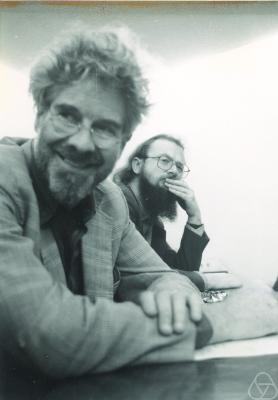
Christopher Zeeman
Sir Erik Christopher Zeeman FRS (4 February 1925 – 13 February 2016), was a British mathematician, known for his work in geometric topology and singularity theory.
Zeeman's main contributions to mathematics were in topology, particularly in knot theory, the piecewise linear category, and dynamical systems.
His 1955 thesis at the University of Cambridge described a new theory termed "dihomology", an algebraic structure associated to a topological space, containing both homology and cohomology, introducing what is now known as the Zeeman spectral sequence. This was studied by Clint McCrory in his 1972 Brandeis thesis following a suggestion of Dennis Sullivan that one make "a general study of the Zeeman spectral sequence to see how singularities in a space perturb Poincaré duality". This in turn led to the discovery of intersection homology by Robert MacPherson and Mark Goresky at Brown University where McCrory was appointed in 1974.
From 1976 to 1977 he was the Donegall Lecturer in Mathematics at Trinity College Dublin.
Zeeman is known among the wider scientific public for his contribution to, and spreading awareness of catastrophe theory, which was due initially to another topologist, René Thom, and for his Christmas lectures about mathematics on television in 1978. He was especially active in encouraging the application of mathematics, and catastrophe theory in particular, to biology and behavioural sciences.
Zeeman was born in Japan to a Danish father, Christian Zeeman, and a British mother. They moved to England one year after his birth. After being educated at Christ's Hospital in Horsham, West Sussex, he served as a Flying Officer with the Royal Air Force from 1943 to 1947. He studied mathematics at Christ's College, Cambridge, but had forgotten much of his school mathematics while serving in the Air Force. He received an MA and PhD (the latter under the supervision of Shaun Wylie) from the University of Cambridge, and became a Fellow of Gonville and Caius College where he tutored David Fowler and John Horton Conway.
Zeeman is one of the founders of engulfing theory in piecewise linear topology and is credited with working out the engulfing theorem (independently also worked out by John Stallings), which can be used to prove the piecewise linear version of the Poincaré conjecture for all dimensions above four.
After working at Cambridge (during which he spent a year abroad at University of Chicago and Princeton as a Harkness Fellow) and the Institut des Hautes Études Scientifiques, he founded the Mathematics Department and Mathematics Research Centre at the new University of Warwick in 1964. In his own words
Hub AI
Christopher Zeeman AI simulator
(@Christopher Zeeman_simulator)
Christopher Zeeman
Sir Erik Christopher Zeeman FRS (4 February 1925 – 13 February 2016), was a British mathematician, known for his work in geometric topology and singularity theory.
Zeeman's main contributions to mathematics were in topology, particularly in knot theory, the piecewise linear category, and dynamical systems.
His 1955 thesis at the University of Cambridge described a new theory termed "dihomology", an algebraic structure associated to a topological space, containing both homology and cohomology, introducing what is now known as the Zeeman spectral sequence. This was studied by Clint McCrory in his 1972 Brandeis thesis following a suggestion of Dennis Sullivan that one make "a general study of the Zeeman spectral sequence to see how singularities in a space perturb Poincaré duality". This in turn led to the discovery of intersection homology by Robert MacPherson and Mark Goresky at Brown University where McCrory was appointed in 1974.
From 1976 to 1977 he was the Donegall Lecturer in Mathematics at Trinity College Dublin.
Zeeman is known among the wider scientific public for his contribution to, and spreading awareness of catastrophe theory, which was due initially to another topologist, René Thom, and for his Christmas lectures about mathematics on television in 1978. He was especially active in encouraging the application of mathematics, and catastrophe theory in particular, to biology and behavioural sciences.
Zeeman was born in Japan to a Danish father, Christian Zeeman, and a British mother. They moved to England one year after his birth. After being educated at Christ's Hospital in Horsham, West Sussex, he served as a Flying Officer with the Royal Air Force from 1943 to 1947. He studied mathematics at Christ's College, Cambridge, but had forgotten much of his school mathematics while serving in the Air Force. He received an MA and PhD (the latter under the supervision of Shaun Wylie) from the University of Cambridge, and became a Fellow of Gonville and Caius College where he tutored David Fowler and John Horton Conway.
Zeeman is one of the founders of engulfing theory in piecewise linear topology and is credited with working out the engulfing theorem (independently also worked out by John Stallings), which can be used to prove the piecewise linear version of the Poincaré conjecture for all dimensions above four.
After working at Cambridge (during which he spent a year abroad at University of Chicago and Princeton as a Harkness Fellow) and the Institut des Hautes Études Scientifiques, he founded the Mathematics Department and Mathematics Research Centre at the new University of Warwick in 1964. In his own words